Showing posts with label Savanna Hawk. Show all posts

Sunday, October 5, 2014

Bobolinks!

Last week, I checked my e-mail and noticed immediately an e-Bird alert message including an unusual report of Bobolinks from near the Caribbean coast in the Canal Area of Panama, specifically at the Gatún Dam.  With that in mind, I convinced my family and my mother-in-law to wake up early today in order to visit the dam and other interesting sites in the surroundings.  A visit to the Panama Canal Expansion Observation Center is a most, as we did later in the day (and where I took these photos of the works with my phone).
We took the "Don Alberto Motta" highway to Colon City (just a 40 minutes drive coast to coast!) and turned left at the "4 Altos", heading to the impressive Gatún locks.  Once we crossed the one-lane bridge across the locks, we drove along the grassy slopes of the Gatún dam, watching hundreds of resident and migratory swallows.  After crossing the bridge over the spillway, I parked along the road and started to spot some interesting suspects; however, the first birds I saw were Ruddy-breasted Seedeaters feeding close to the car.
Ruddy-breasted Seedeater, male
It was raining a little bit, and the tall grass was quite wet... wet enough to soak my shoes; however, Gabrielle was well prepared (I have to say that my wife is almost clairvoyant anticipating and preparing for any situation that might find our daughter).
Rubber boots and umbrella... someone was prepared!
Eventually, I saw a flock of little brown birds flying low over the grass.  They perched low, but some were barely visible at first... listed crowns and backs, pale conical bills... pointed tail feathers... Bobolinks!
Bobolinks
There were also Red-breasted Blackbirds in the vicinity... the females can be quite similar to this species; however, note the unstreaked nape and the uniformly yellowish breasts (with no rosy wash).  Also, these birds were slimmer and smaller than the blackbirds.
Bobolink
Bobolink
Both Gloriela and me had excellent views... the photos are just record shots.  Bobolinks are uncommon transients in Panama... and this was the first time I see them in this country!  Yeah, a Panama lifer (and only the second time ever I see this bird).  We left the dam just after spying this immature Savanna Hawk (also uncommon in this part of Panama).
Savanna Hawk, immature
We visited the Castillo de San Lorenzo (at the mouth of the mighty Chagres river) where Gabrielle was amazed with the history of pirates and cannons defending the site.  We ended at the Panama Canal Expansion Observation Center as mentioned earlier... the views of the Gatún lake and the works are unmatched.  After all, we really enjoyed our day at the Caribbean coast... amazing views and national lifers for all!
At the Castillo de San Lorenzo

Wednesday, June 4, 2014

Portraits in the savanna

In spite of not finding the Maguari Stork reported for Juan Hombron (Cocle province, central Panama) after several visits, the good thing is that I had the opportunity to take some close-ups of common inhabitants of these typical arid savannas.  Advantages like clear light and unobstructed views are the ingredients to great portraits... even for an amateur photographer like me.
Variable Seedeater
For example, the male Variable Seedeater pictured above was quite curious and came to inspect me for a while.  Several males were engaged in courtship displays and singing the heart out.  They were very common in those fields.  Another common species was the Straight-billed Woodcreeper.
Straight-billed Woodcreeper
Not only common, but beautiful as well too.  For a woodcreeper, it is quite distinctive, with that straight, pink bill and bold head marks.  It is restricted to mangroves and adjacent shrubs and secondary growths.  In the other hand, the Groove-billed Ani is simply an all-black bird.  In fact, it is easier to ID it by voice than by sight (due to confusion issues with the Smooth-billed Ani present in smaller number in this same area).
Groove-billed Ani
However, with looks like this you can actually see the grooves in the bill of this individual!  It easy to ID the birds if you actually see the field mark by which they were named; for example, can you name the next species?
Lesser Yellow-headed Vulture
Jejejeje, just kidding.  However, they would be more difficult to identify if flying away.  The Lesser Yellow-headed Vultures are commoner than Turkey Vultures in this habitat, specially this time of the year.   Also common, and a nice representative of this savanna, is the Savanna Hawk.
Savanna Hawk
This long-legged hawk is huge and colorful, making it recognizable from long distances.  Due to the lack of tall trees in the savanna, this raptor (like many other as well) take advantage of any high site (like this telephone pole) to observe its domains.  Well, that is all for now... but certainly is not my last time in Juan Hombron looking for my Maguari!

Monday, July 22, 2013

In search of THE heron. Part I

There were some clues in the air... something really important was happening to the east of Panamá City.  But in spite of all my suppositions, I never thought that it would be a NEW species for the country and North America!  The news were published in various social media and in Xenornis a week ago.  A Whistling Heron was photographed and videotaped in the outskirts of the town of Chepo, 30 minutes east of Panamá City by Kevin Easley and others.  This is an extraordinaire record, since there are no known populations of this beautiful heron close to the Panamá border in Colombia.  Two distinct populations exists, one in the llanos of Venezuela and eastern Colombia (where I took the next photo, that I published elsewhere); the other, in the open lands of Bolivia to northeastern Brazil and Argentina.
So far, some resident birders visited the place after the first report, but the heron could not have been relocated.  So, accompanied by Rafael Luck, Venicio "Beny" Wilson and Itzel Wong, I went last saturday in search of it.   After checking maps of the area, Beny chose the route, following the old road to Chepo from the town of Palo Blanco, crossing pastures and degraded habitat, but also many gallery forests along creeks and rivers supporting species typical of wetter habitats.  That is so, that in our first stop we found a Rufous-breasted Hermit... essentially unexpected for us.
Others unexpected finds were Brown-hooded Parrots, Gray-headed Kite and this Gray-lined Hawk, nicely perched atop a dead tree.
However, the most common birds were those typical of open lands and marshy areas.  In fact, we checked many marshes in the middle of huge pasture lands, and we were glad to see again some species restricted to this type of habitat.  For example, this Pale-breasted Spinetail was very cooperative, calling from exposed perches and even showing the reason of its name.
And who can't be glad of finding Pied Water-Tyrants?  This elegant bird is restricted to the eastern part of the country, and always is a great bird to see.
And what about the heron?  Well, eventually we found the very same perch where the Whistling Heron was photographed.  The tree was a preferred perch for many species in the surroundings, including  Black-bellied Whistling-Ducks, Little Blue Heron and Great Egrets.  We waited and searched all around, but the heron was not there.
To be honest, we were quite optimistic, considering that the area is huge, full of adequate habitat... it was like looking for a needle in a haystack.  However, we kept searching... only stopping for a quick meal in town.  That habitat was also excellent for birds of prey.  Besides those already mentioned, we saw other seven hawks and kites species, including this majestic Savanna Hawk.
We also saw (or heard) four falconids, including three pairs of American Kestrels.  Formerly only a winter visitor from northern latitudes; now, South American subspecies have been established in our fields.
Notice the completely lack of spots in the underparts of this beautiful male, characteristic of southern subspecies.  Well, we didn't find the heron... but have a lot of fun looking for it!

Tuesday, February 7, 2012

South of town

I just want to share with you some pics from the savanna south of Penonome (Cocle province, central Panama). It is a special habitat, and it is always amusing to crossed it. I started at the airstrip and took a dirt road running all the way along the fence, each post of it was tipped with a Red-breasted Blackbird, an Eastern Meadowlark or a Fork-tailed Flycatcher!
The dry landscape soon became more wet when I reached the shores of a huge artificial lake in the middle of the savanna. I know the lake was part of a huge development that did not progress.
The open areas with short grass had Cattle and Great Egrets, hundreds of Barn Swallows (both flying and perched), Southern Lapwings and at least two Killdeers.
A marshy area was the home of a group of Purple Gallinules, both shiny adults and duller immatures; however, only the immature stayed enough for photos. In the open waters I only saw a Least Grebe... no ducks in the lake, which is weird considering the big group present in a nearby, much smaller lake which I saw some weeks ago (here the entry).
Only a short trip to a wonderful area, but the trip can not be completed without seeing the icon of this habitat: a magnificent Savanna Hawk posing for photos (this time an immature).

Saturday, September 18, 2010

More than shorebirds in Costa del Este

When I mention Costa del Este (Panama City), I'm pretty sure that, at this point, most of you think on shorebirds. Yes, Costa del Este is an excellent site for shorebirds, but you can find other interesting species as well. Yesterday, I found two hard-to-find species within the city limits, considering that both are pretty common just to the east and to the west. The first one was a young (but beautiful) Savanna Hawk in the middle of a grassland. It stayed for a while and then flew to a streetlight post, where an American Kestrel started to attack him (I included it in my "raptors on streetlights" collection).The other species was a Lesser Yellow-headed Vulture. It was eating something in the ground, but I did not figure out what it was.Later, I moved to the Matías Hernández river, which was full of Neotropic Cormorants. I found several Yellow-crowned Night-Herons (I included a photo at my "waders and more waders" post), but also Mangrove (Yellow) Warblers, Eastern Wood-Pewees, an Amazon Kingfisher and a subadult Black-crowned Night-Heron perched in a mangrove tree.It is always nice to find all these birds in the city!
Tuesday, May 25, 2010

Las Macanas marsh

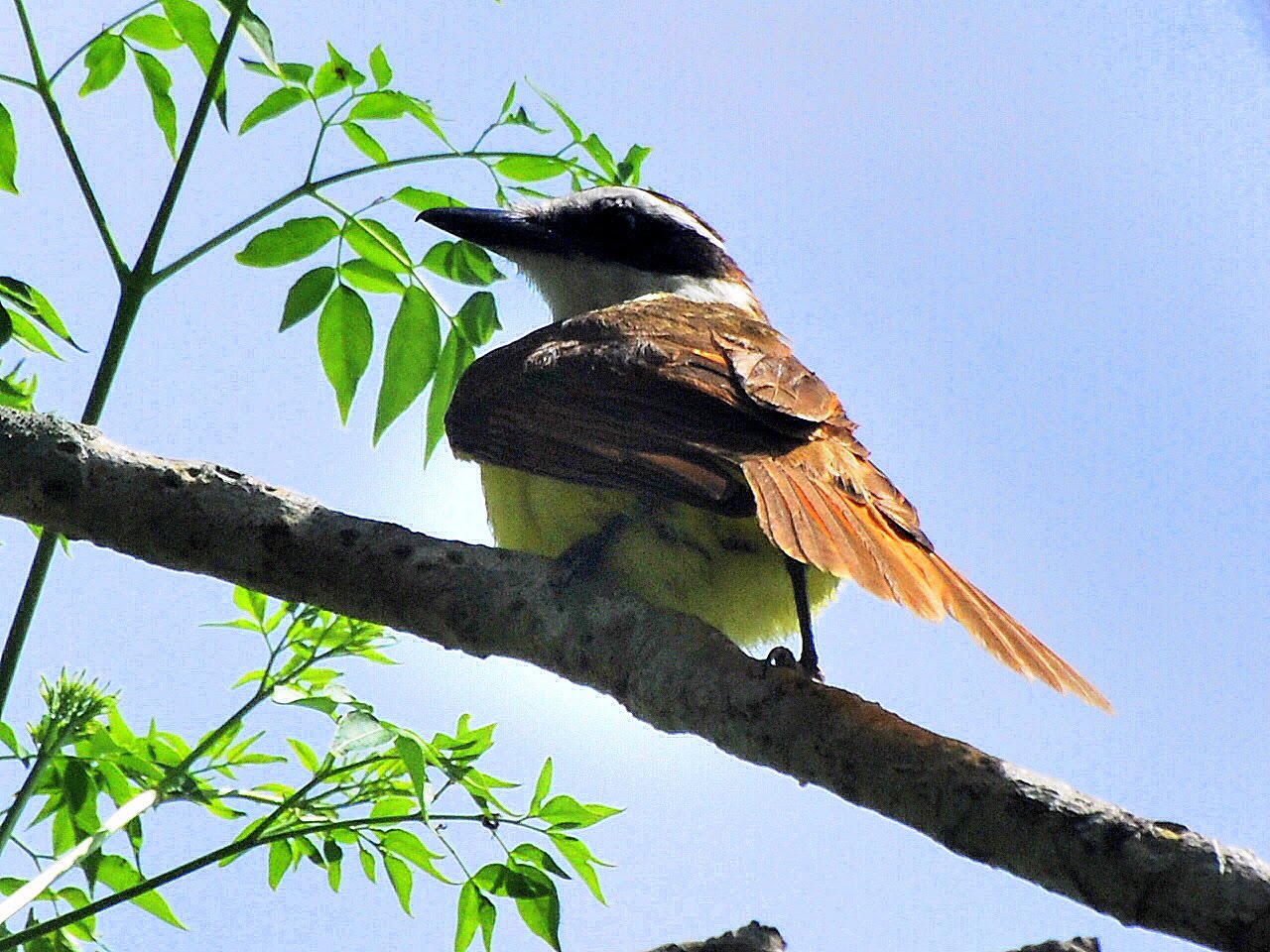
After checking the ponds and mudflats in El Agallito beach, I decided to pay a visit to Las Macanas marsh in my way back to Penonomé last saturday. Las Macanas marsh, located in the Herrera province of the Azuero Peninsula, is a protected area with an observation tower overlooking a shallow lake very good for aquatic species. It holds also some typical species of very dry habitats, as you will see here. It was very hot by the time I arrived the marsh, but anyways I managed to hear and locate some species. Both the Great Kiskadees and the Rufous-browed Peppershrikes were very vocal, with one or two almost always within "hearing" distance. There was a group of locals maintaining the trails and a public area, preparing it for an Ecological Fair next month. It is always good to see the local people taking care of their reserves and protected areas, understanding the importance of the conservation of our nature marvels for the next generations. Above the lake, there were tons of Black-bellied Whistling-Ducks flying from one side to another, but I did not saw any Fulvous Whistling-Ducks that also nest in the area. From the tower, while inspecting the surroundings with my binoculars, I found a distant Roseate Spoonbill, two or three Limpkins, many Southern Lapwings and some Glossy Ibises. Once in the base of the tower, I heard the characteristic guffaw-like call of a Mouse-colored Tyrannulet and soon was watching it. The call and the ochraceous wing bars (plus habitat) are diagnostic. I planned to spent only one hour or so in the place, so I decided to return when suddenly a flushed bird took off almost from my feet. It was a female Common Pauraque that landed a few meters ahead in the trail. It is a rare sight to find a caprimulgid during daylight, so I took advantage of the opportunity to take photos. In my way out, a found MANY raptors, including a White-tailed and Snail Kites, Roadside and Common Black Hawks (formerly Mangrove Hawk), both Crested and Yellow-headed Caracaras, both Bat and Aplomado Falcons and a very cooperative and huge Savanna Hawk, peched on a fence.
Great birds for only a one-hour visit!

Friday, February 19, 2010

Birding the savanna

The day after my visit to the Aguadulce Salinas, I woke early in order to visit the open fields and the savanna that surrounds Penonome (central Panama). This habitat was altered mostly by human activities, but it still holds many of the species typical of it, except for some that are harder to find now (Grassland Yellow-Finch, Yellowish Pipit), including one probably extirpated (Grasshopper Sparrow). I headed to the south, in the way to El Coco, and then I took the turn to El Gago, which passes through some cattle and agricultural land, with rice fields and some scattered bushes. Soon I was watching my first specialty of the area: a flock of Plain-breasted Ground-Doves (mostly females) that looked like a covey of tiny quails. Only the male stayed enough time to get a picture.. the females ran (yes, ran) away. Not to much after that, I got my second columbiforme of the day: a pair of Mourning Doves. We have two populations of this dove in Panama, one in the western highlands and other in the lowlands of the dry pacific slope. In the lowlands, this dove is locally common... but it seems that nobody has heard them singing here. Both of them (the dove and the ground-dove) were new year-birds for me. Other doves species for the day were the Ruddy Ground-Dove (widespread), the White-tipped Dove (quite shy here) and four Pale-vented Pigeons at a fruiting tree. Of course, by that moment I already had recorded more widespread species like Blue-black Grassquit, Great-tailed Grackle, Red-crowned Woodpecker, and so on... At a dump next to the road I got three species of Vultures (Black, Turkey and Lesser Yellow-headed) plus many Yellow-headed Caracaras in all sort of ages and two adult Crested Caracaras. I realized that I was getting luckier with the raptors when I saw an Aplomado Falcon followed few minutes later by an American Kestrel and a White-tailed Kite, while, perched in the ground, a Savanna Hawk was inspecting its territory. In my cropped picture is very hard to see the rich cinnamon color that makes this bird so beautiful, specially when flying. Eventually I reached a flooded rice field that was full with egrets and, curiously, Greater Yellowlegs. The yellowlegs were chasing each other, vocalizing. They should have been around 12 or more. I wonder if they were congregating in order to begin its northward migration. Well, it was getting very hot, so I started to return, finding both Eastern Meadowlarks and Red-breasted Blackbirds in the same field, and a flock of Brown-throated Parakeets that perched very close as saying good-bye. Many new year-birds in this short trip!