Showing posts with label Castillo de San Lorenzo. Show all posts

Sunday, October 5, 2014

Bobolinks!

Last week, I checked my e-mail and noticed immediately an e-Bird alert message including an unusual report of Bobolinks from near the Caribbean coast in the Canal Area of Panama, specifically at the Gatún Dam.  With that in mind, I convinced my family and my mother-in-law to wake up early today in order to visit the dam and other interesting sites in the surroundings.  A visit to the Panama Canal Expansion Observation Center is a most, as we did later in the day (and where I took these photos of the works with my phone).
We took the "Don Alberto Motta" highway to Colon City (just a 40 minutes drive coast to coast!) and turned left at the "4 Altos", heading to the impressive Gatún locks.  Once we crossed the one-lane bridge across the locks, we drove along the grassy slopes of the Gatún dam, watching hundreds of resident and migratory swallows.  After crossing the bridge over the spillway, I parked along the road and started to spot some interesting suspects; however, the first birds I saw were Ruddy-breasted Seedeaters feeding close to the car.
Ruddy-breasted Seedeater, male
It was raining a little bit, and the tall grass was quite wet... wet enough to soak my shoes; however, Gabrielle was well prepared (I have to say that my wife is almost clairvoyant anticipating and preparing for any situation that might find our daughter).
Rubber boots and umbrella... someone was prepared!
Eventually, I saw a flock of little brown birds flying low over the grass.  They perched low, but some were barely visible at first... listed crowns and backs, pale conical bills... pointed tail feathers... Bobolinks!
Bobolinks
There were also Red-breasted Blackbirds in the vicinity... the females can be quite similar to this species; however, note the unstreaked nape and the uniformly yellowish breasts (with no rosy wash).  Also, these birds were slimmer and smaller than the blackbirds.
Bobolink
Bobolink
Both Gloriela and me had excellent views... the photos are just record shots.  Bobolinks are uncommon transients in Panama... and this was the first time I see them in this country!  Yeah, a Panama lifer (and only the second time ever I see this bird).  We left the dam just after spying this immature Savanna Hawk (also uncommon in this part of Panama).
Savanna Hawk, immature
We visited the Castillo de San Lorenzo (at the mouth of the mighty Chagres river) where Gabrielle was amazed with the history of pirates and cannons defending the site.  We ended at the Panama Canal Expansion Observation Center as mentioned earlier... the views of the Gatún lake and the works are unmatched.  After all, we really enjoyed our day at the Caribbean coast... amazing views and national lifers for all!
At the Castillo de San Lorenzo

Sunday, October 30, 2011

At the castle

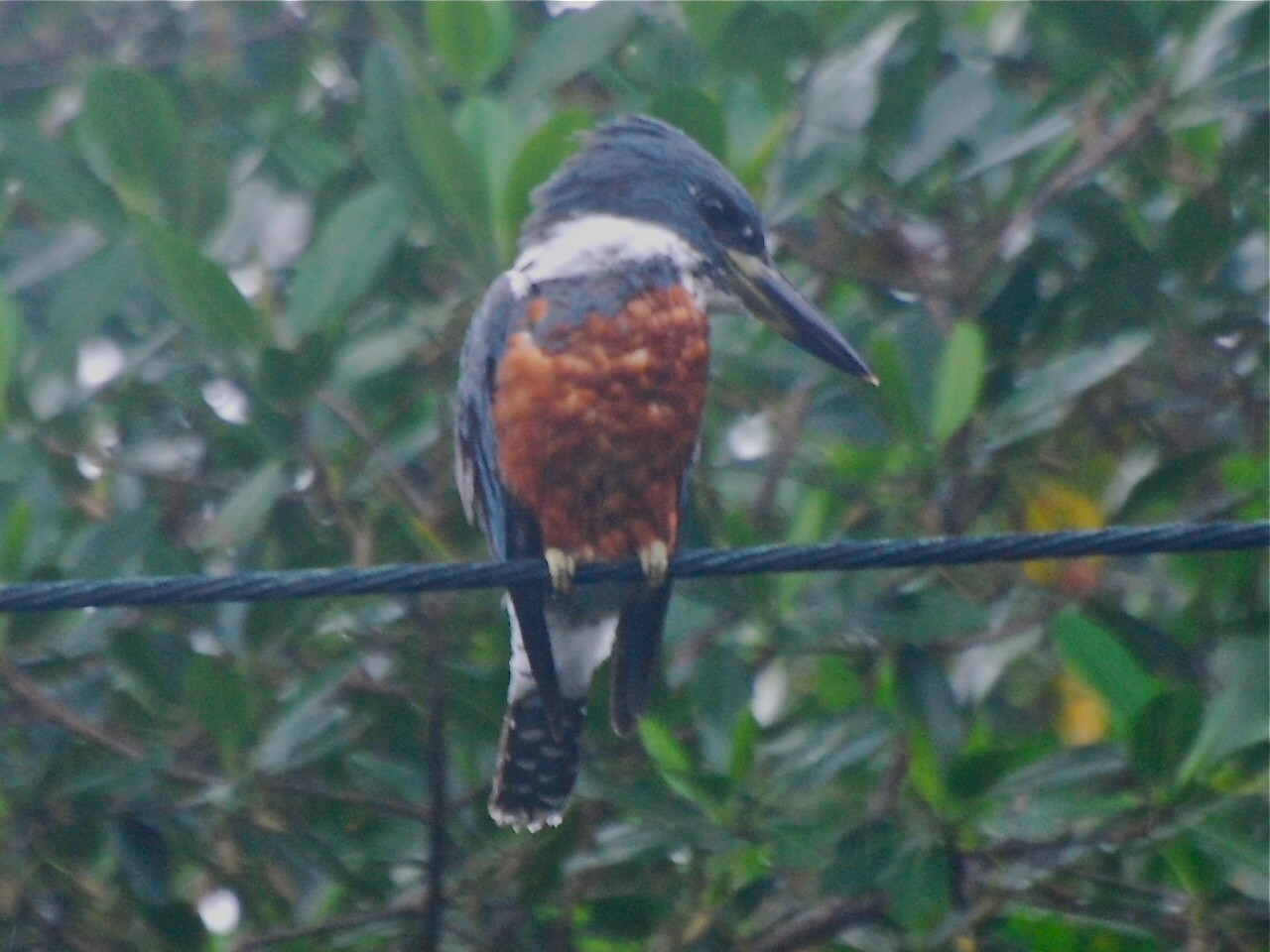
To end well the weekend, I went with Gloriela (and Gabrielle of course) to the Caribbean coast of central Panama, to the Colon province. Specifically, we tried the San Lorenzo National Park and the former Fort Sherman. In the way, we drove through heavy rain and dense mist along the Transisthmic highway, but as soon as we reached Colon, the weather improved, and a radiant sun illuminated us. The road to Sherman is very picturesque, as I have said before, passing through grasslands, primary forests, lagoons and mangroves. The phone lines along this road are the most birdy in Panama... we saw at least one Broad-winged Hawk, several Common Black-Hawks, a male White-tailed Trogon and four Black-breasted Puffbirds perched on the lines. Notice the drops of water in the puffbird body... it was raining a little bit. Not only that, in the stretch of mangroves, the guests on the wires were the Ringed Kingfishers... three of them were noticed along the route... and all this before reaching the gate at the entrance of Fort Sherman! The grasslands in Sherman were alive with birds, including many migrants. For some reason, the most common migrants this time were the Indigo Buntings and the Blue Grosbeaks. Most of them exhibited the dull winter plumage (essentially all warm brown), some had patches of blue in the wings and ventral parts. In these photos you can notice the difference in bill's size and shape (smaller and thinner in the bunting)... the size difference is not evident (the grosbeak is considerably larger than the bunting). Eventually, we reached the old Castillo de San Lorenzo... as usual, we were almost the only beings in the place, except for a family that was also visiting the ruins. The serenity, the silence and the spectacular sights makes this place special... I'm pretty sure that this Brown-throated Three-toed Sloth was also enjoying these aspects of the castle. Do you remember why he looks so green (if not, you may want to read the comments of this post)? In the castle's plaza, two little birds caught my attention. They were feeding actively in the ground, constantly wagging the tails and with conspicuous yellow undertail coverts: a pair of Palm Warblers! It is always great to find this species in Panama because they are rare here... but not only that... supposedly, they arrive to Panama by mid-November, with november 7th as the earliest date recorded (in El Real, Darien... check the report here). Probably they happen unnoticed or simply unrecorded. We crossed all the corridors of the castle and took many pictures of it... of course I couldn't refuse to take a photo of Gloriela and Gabrielle having the mighty Chagres river as background... a small souvenir of her first visit to the castle!

Wednesday, January 12, 2011

Show me the migrants!

Recently, I went with Gloriela to the Caribbean side of central Panama, specifically to the San Lorenzo National Park and the former Fort Sherman, in search of the migrant warblers that my former Central CBC's team reported during the Atlantic CBC (I did not participate in that one). I tried to find the migrant warblers some months ago, without success due to the sunny and hot day, but this time the day was completely different. We started earlier this time, but a heavy rain stopped us from birding during the first hours of the morning. We waited at the Castillo de San Lorenzo for the rain to stop, and when it happened (more or less) we started to walk along the ruins. At one of the corners of the old fortress, by the ditch, we found a cooperative Yellow-rumped Warbler showing nicely its rump. It was feeding mostly on the ground, in the short, wet grass in a very active manner. Almost immediately, Gloriela noticed a second warbler very close to the first one, but this one was more uniformely brown. I quickly checked it with my binoculars, confirming its identity, a rare (for Panama) Palm Warbler. We stayed for a while, admiring these two rare species (both were lifers for Gloriela) until the rain started again. Then, we drove to Fort Sherman, to the former church where the CBC team found many migrants (don't ask at the restaurant about the church... they have no idea). The place was simply magic. Soon, we both were surrounded by lots of migrants probably because of my intense "pishing". The first one we saw was a female Blue Grosbeak that flew from the understore to a tree, to inspect us. Then, a mixed flock with both resident and migrant species showed up. It was amazing to see, in the same flock, Yellow, Chestnut-sided, Bay-breasted, Prothonotary, Black-and-white and Tennessee Warblers, Northern Waterthrush and American Redstart (a female), plus the residents Yellow-olive Flycatcher, Southern Beardless-Tyrannulet, Common Tody-Flycatcher and Lesser Greenlets. Then, I saw a little warbler high over the main flock with bright yelllow throat and breast (with a dark chestnut spot), white underparts, bluish upperparts and contrasting but incomplete white eye-ring: a male Northern Parula, just like reported for that very same place! This is just my third sight (the second for Gloriela), with my last one during an Atlantic CBC with Rafael Luck two years ago (report in XENORNIS). But a bigger bird was accompanying the flock too. It was first very hard to see because it moved in the understore, but then, when the flock visited a bare tree, it did the same showing it slim profile and chestnut vent, a migrant Gray Catbird. Despite it was not a lifer for any of us, we enjoyed it because this bird is seldom seen in Panama (specially in the open, my second photo shows better the actual field conditions where you usually find this skulker). About the reported warblers, we only missed the Yellow-throated found by the CBC team in Fort Sherman. In our way out we stopped to enjoy the several Killdeers working the grasslands of the airstrip. The Killdeer is not rare, but is always nice to see them. We found at least three nervous individuals, making its kil-deer call for us. Great day after all... I already want to go back!

Tuesday, September 28, 2010

Migrants, castles and more!

I had a crazy idea this morning... to drive all the way to the Caribbean coast after leaving Gloriela at the hospital in order to see if I can find some rare migrants or something. So, I left behind the rainy and dark Panama City, took the highway and after one hour (more or less) I was in Gatun waiting my turn to pass the one-lane bridge through the locks. Contrasting with Panama City, the Caribbean side of the Panama Canal was unexpectedly sunny, hot and bright... probably too much. I did find some migrants, but not the rare ones I was expecting. Anyway, the numbers were impressive. Hundreds (perhaps thousands) of Bank, Cliff and Barn Swallows were flying low over the grassy fields of the Gatun dam, maneuvering acrobatically and sometimes passing just in front of the car. There was also a huge flock of Eastern Kingbirds at the fence of the facilities, sometimes feeding in the ground. They were accompanied by many Fork-tailed Flycatchers, which could have been migrants too. The only other birds that I saw at the dam were the Gray-breasted Martins, the regular American Kestrel and a Southern Lapwing. The spillway had no many birds, only some Little Blue Herons were present. I decided to go to one of the most important touristic attractions of the area: the Castillo de San Lorenzo (San Lorenzo Castle) at the mouth of the mighty Chagres river, within the San Lorenzo National Park. It is about 35 minutes from the locks to the castle through a paved road which crosses several habitats: grasslands, mangroves, residential areas and forests. It also passes through the former Sherman Base (where you are asked for your ID) and the Park rangers station (where you have to pay the fee for entering the park). I did few stops on the way, usually to appreciate the Northern Waterthrushes that were all around. Just a little after the station, I found a snake crossing the road. I was able to see this 5 feet-long beauty before it vanished in the understore of the forest. I think it is a Salmon-bellied Racer, but I could be wrong. Once in the castle, the place was desolated, contributing to the sensation of immensity that was surrounding me.Despite there are no guides, the site has many interpretative signs that tell you the story of this fortress. That was how I knew that it was constructed by the Spaniards back in 1597 to protect the entrance of the Chagres river, and after that, it was destroyed and re-constructed several times, the last one in 1750.
The view is VERY impressive due to its location atop of a hill, dominating the mouth of the Chagres river, which was so important in those days, as it is today! You also have an unobstructed view of the Caribbean sea and some lovely beaches at the base of the hill.
It was a great experience. My last time there was maaaany years ago. Then, as a little child, I imagined myself as a "Caribbean pirate", running and yelling through the corridors of the castle... the idea crossed my mind several times during this visit!