Showing posts with label White-nosed Coati. Show all posts

Sunday, April 20, 2014

Random day at the Metro Park

In spite of the long free weekend, I have not had time to go out to birdwatch... that's why I'm posting some old photos of residents birds at the Metropolitan Natural Park, right in the middle of Panama City.  By this time of year, the park is filled with migrants going back home, so I hope I can show pictures of them soon... for now, what about this common voice inside these forests?
Slaty-tailed Trogon
Yes, it is a male Slaty-tailed Trogon.  Its call sounds like a dog barking, seriously!  Sometimes it is hard to believe that such beauties live so close to the skycrapers... the same can be said about this Slate-colored Grosbeak.
Slate-colored Grosbeak
Actually not a grosbeak, but a saltator, a fact that sounds logical if you compare it with some other forest-dwelling saltators in South America.  Did you notice that both birds bear names that have nothing to do with their amazing coloration!  Just look the deep coral-red bill!  In the other hand, the next resident bird is named after its bill:
The Double-toothed Kite is a forest raptor quite common in the city.  Although not really "toothed", the name refers to the pair of identations at the cutting edge of the upper mandible.  This mark is not very conspicuous in the field, nor in my photo.  I found this immature bird a little bit after finding a pack of White-nosed Coatis.
White-nosed Coatis
I mention this because the Double-toothed Kite is known to follow troops of monkeys and other mammals, taking advantage of the insects flushed by these animals.  Perhaps this bird was doing just that!  Well, that's all for now... but soon I'll be back with those migrants photos!

Wednesday, August 11, 2010

Mammals of Metro Park

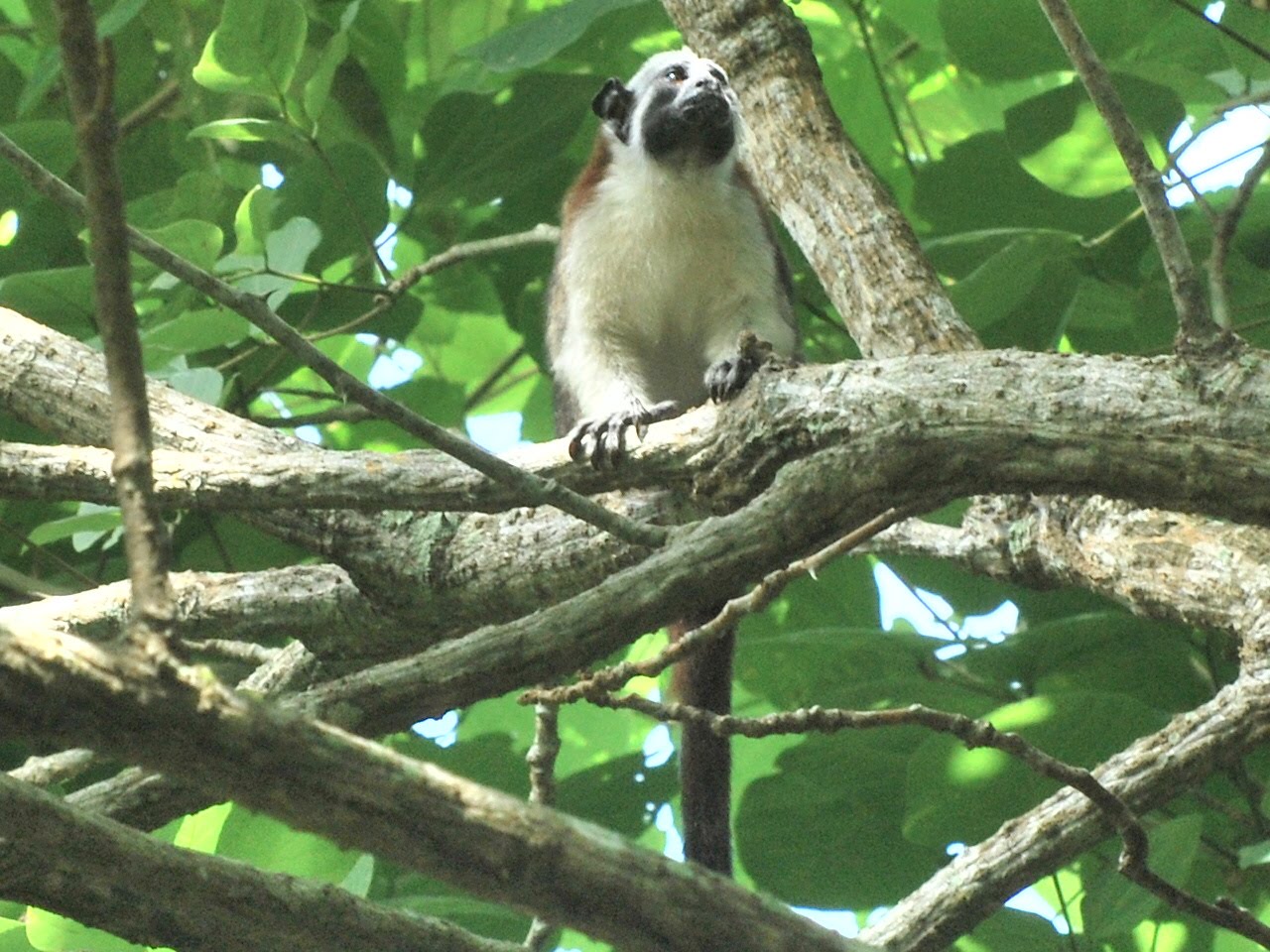
I always have been lucky finding mammals in the Metropolitan Natural Park, and yesterday was not the exception. After all, I think that Panama in general is a good country to find mammals... and it seems that I'm not the only one that think this. I have been reading some comments in the web of how easy it was to some guys to find wildlife in Panama (including mammals) and now I even found offerings of mammals trips to Panama. Well, back to Metro Park, most of the mammals species that I found yesterday were at the lookout (that was full of birds too). Surely, the abundance of fruits had something to do with that. The first species that I saw was a Central American Agouti (Dasyprocta punctata) that quickly ran to cover. They are pretty common in the park, and you can find many individuals along the different trails, sometimes in loose herds. Little after that, I heard a noise close to me. I turned back, finding a Variegated Squirrel (Sciurus variegatoides) that was scolding me while eating a seed. These squirrels are very common in all sort of habitats, including urban areas and open forests. This is the common and familiar squirrel of Panama City and many other cities in the country, exhibiting a great variation in patterns and colours among the subspecies. They share the park with the Red-tailed Squirrels (Sciurus granatensis) that I have found several times there (but not yesterday), usually in wetter and/or darker sites, like along La Cieneguita trail. It is always entertained to see these acrobatic creatures to move effortless through the branches. I also found a family group of White-nosed Coaties (Nasua narica), with an adult (surely a female) and three cubs. The males usually wander alone, the reason of their spanish name "Gato Solo" (lonely cat). These racoons-relatives are as happy in the ground as climbing the trees, as you can see in the photo (one of the cubs, the ear and the tail of the other two cubs also appear in the photo). But the stars of the show were the Geoffrey's Tamarins (Saguinus geoffroyi). A troop of nine tamarins got very close to me while making their bird-like calls. These squirrel-like monkeys are fortunately still pretty common in the right habitat, including this park. I even saw a tamarin with a baby on her back. They did not care about the Double-toothed Kite that was following them. In contrast, they overturned all the attention to another mammal that I had left unnoticed: a Brown-throated Three-toed Sloth (Bradypus variegatus) in a Cecropia tree. What can I say about them? These animals are real survivors, a big success of nature. You can see in the photo the three claws of the forearm, and the masked look that distinguishes this species of the Hoffmann's Two-toed Sloth (Choloepus hoffmanni), also found in the park (but again, not yesterday). It was a great day, both for birds and mammals. In my way out I heard the characteristic howl of a troop of Mantled Howlers Monkeys (Alouata palliata) and found this footprint that I'm trying to figure out to whom it belongs. Any idea? (that's my 67mm lens cap for comparison)

Wednesday, May 12, 2010

New year-birds in Metro Park

A very short visit to the Metropolitan Natural Park, in Panama City, recently produced some new year-birds for me. As usual, I started in the Mono Tití trail up to El Mirador (where I got the view pictured above... it is incredible how a park so close to a cosmopolitan city still holds such species like tinamues, forest-falcons, antbirds, manakins, monkeys, and so on...), and then completing the circuit through La Cieneguita trail. Most of the migrants are gone by now, so the activity was slow. In the other hand, the first rains of the season probably explain the hungry mosquitoes that I found during my walk... specially in La Cieneguita trail. I found a big mixed flock by the entrance of the trail, close to "The Castle", attended mostly by Red-throated Ant-Tanagers and lots of flycatchers, including Yellow-olive and Panama Flycatchers, Yellow-bellied and Greenish Elaenias, Southern Bentbill and Beardless-Tyrannulets and a pair of Common Tody-Flycatchers. Also, a lonely Rufous-breasted Wren accompanied the flock while singing, followed by a Yellow-green Tyrannulet. This active, smart and gnatcatcher-like tyrannulet is a national endemic for Panama, and Metro Park is a reliable site to find it, specially if you know its call. Close to the flock, but not exactly with it, was a pair of Blue-crowned (Whooping) Motmots flycatching. After the flock passed, the things turned quiet... only finding a handsome Orange-billed Sparrow skulking in some bushes. My photo shows the bird just like you usually find it in the field... with tons of tangles and branches in front of it! With patience it is possibly to attract them by "pishing", as I did. In my experience, the only birds that are usually attracted by my "pishing", apart of some warblers, are the Ant-Tanagers. They rapidly approach scolding me and that day was not the exception. The common one in most of Panama is the Red-throated Ant-Tanager, but in Metro Park you have great chances to find the Red-crowned Ant-Tanager as well... just like I did! I found a pair close to a flock of Red-throateds that responded to my "pishing" (I usually don't "pish", nor use play-luring techniques... I only tried this time to get a picture of the sparrow... instinctively it came out from my mouth while holding the camera!). The males differ in its more uniform brick-red coloration, while the female are safely told apart by its yellow crown (both species have red or yellow throats, both males have red crowns). In the way back I found some interesting mammals, including a Central American Agouti, a White-nosed Coati and a group of Geoffroy's Tamarins (the monos titíes), detected by its bird-like calls. A short walk after all, I only stayed for a couple of hours, but found great birds and wildlife!