Showing posts with label Purple-crowned Fairy. Show all posts

Sunday, February 7, 2016

Cute and colorful migrant!

At this point, most of you are aware of the vagrant Painted Bunting that showed up in Brooklyn, NY and all the media frenzy it has generated... but you know that the same is happening down here in central Panama?  The report of several Painted Buntings, including a stunning male, at the Summit Ponds passed unnoticed for some days... after all, it is not the first time the species is reported for the place and usually are seen only once.  But then, the colorful male was reported repeatedly from the same spot several days in a row... and some awesome pictures by my friend Rafael Lau simply attracted attention to the rare migrant (see this eBird checklist and you'll see what I'm talking about).
"Just for tourists"
So, I went to the Summit Ponds in order to find the little bird.  The "Just for tourists" sign didn't intimidate me and I jumped the fence to reach the exact place where it has been hanging around (just joking... the sign is at the entrance of the Summit Ponds trail, but it refers to a portable bathroom that is long gone and the place is open to the general public).  The Summit Ponds are a favorite birding hotspot, so I started to find some nice species... including the local Jet Antbird, a specialty for this place.
This is how you usually see Jet Antbirds
My friends Osvaldo (Code Name: Green Kingfisher), Rafael Luck (CN: Crested Caracara) and Itzel (CN: Green Heron) where already waiting for the bird (just in case you're wondering, my code name is Cinnamon Woodpecker).  It was close to 3:00 pm and I decided to walk a little more into the trail, since the bird had been religiously seen around 4:00 pm.  I found several common residents and it was quite entertaining... a male Purple-crowned Fairy and three different species of euphonias were the highlights... but it soon was time to check for the bunting.
Purple-crowned Fairy
A little bit before 4:00 pm, I noticed a little bird flying low behind my pals.  A quick glimpse with my binoculars confirmed my suspicion: the expected male Painted Bunting!  I hurried to call my friends who were able to watch the shy bird... it was a life bird for all of them.
Painted Bunting 
Painted Bunting
My pictures are just for record purposes, of course... the bird was a little far for my lenses and didn't allow us to approach (it was very shy as I mentioned before), so we decided to left him alone.  What a magnificent little bird... so deliberately colored!  We didn't see the females reported before, but I'm sure there were at least two adult males because the next day I was able to see them just seconds apart.
Painted Bunting
It was not a lifer for me... but trust me that this is a species don't you want to miss in Panama if you got the chance!

Sunday, November 24, 2013

Great day at the feeders!

Yesterday, I joined Osvaldo Quintero, Rafael Luck and Itzel Fong in a day-trip to Cerro Azul, the gated community in the foothills to the east of Panama City.  Our destination was Birder's View, known by its well-kept hummingbird feeders and lush garden attracting many species of birds.  At our arrival, we were attracted to the feeders... just like the tons of hummingbirds swarming around!
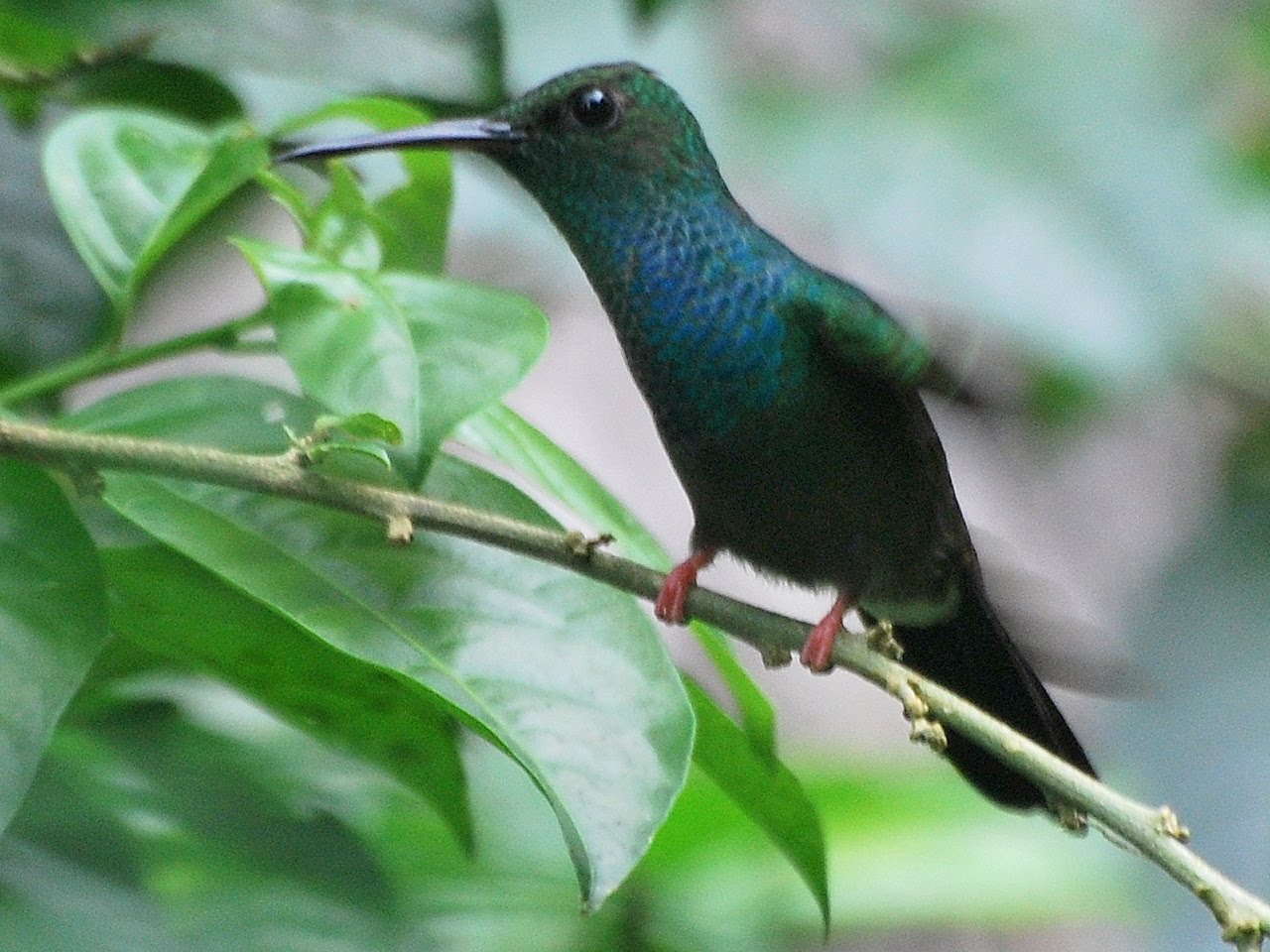
What a great spectacle!  Both White-necked Jacobin and Bronze-tailed Plumeleteer (like the one above) were the most common species.  Those red feet are so distinctive among the Panamanian hummingbirds.  Other common species was the Snowy-bellied Hummingbird.  Notice the sharp contrast between the iridescent green breast and the snowy white belly.  They have an easily recognizable call, quite metallic in quality.
As I said before, Cerro Azul is the most reliable site (in the world) to find the near-endemic for Panama Violet-capped Hummingbird.  This bird is very special... and beautiful... the only member of the genus Goldmania.  With the right angle, these birds literally glow!
The same for this Crowned (Violet-crowned) Woodnymph.  Usually, it looks pretty dark... almost black, but then... PAM!  Shock of color!
Other common species at the feeders were the Rufous-tailed Hummingbird and Green Hermits.  In fact, one of these hermits was trapped inside the house.  Luckily, Carlos (the house keeper) rescued him and released it smoothly.
Some other regular species were present in lower numbers, like the Violet-headed Hummingbird (one of my favorites) and the stunning Purple-crowned Fairy.  This one looked like a stuffed bird!
The Long-billed Starthroat and the Green-crowned Brilliant made a single appearance, not enough for photos.  However, we did not lack subjects to photograph.  Not only hummingbirds were attending the feeders: Bananaquits, Green, Red-legged and Shining Honeycreepers were trying to slurp a bit of sugar water.  We even saw a male Yellow-faced Grassquit drinking at the feeder.
What a great day in the foothills!

Saturday, March 12, 2011

Post-carnival trip to the highlands. Part I

At last, the end of the first day of our swift trip to the Chiriqui highlands. I left Penonome (central Panama) with Gloriela around 3:00 AM today, in order for be birding early in the morning in several spots along the Concepcion-Volcan-Santa Clara road (Chiriqui province, western Panama's Pacific slope). Our first stop was at the entrance road to the town of San Vicente, where a small patch of forest survives along the junction of two creeks. A flock of Golden-hooded Tanagers was inspecting the bushes while a female Purple-crowned Fairy showed up for our delight. Despite it is not a rarity there, it is always nice to see this elegant hummingbird. But more interesting, an adult male Spot-crowned Euphonia perched in a bare branch for five seconds, enough to check its limited yellow crown. This species is scarce due to habitat loss in its former panamanian distribution. You will have to trust me on this one, since my photo only shows the complete yellow undertail coverts and the black throat, field marks that this species shares with the more common Yellow-crowned Euphonia, which have a more extensive yellow crown as its name suggests. Our next stop was the Macho de Monte river, entering through the town of Cuesta de Piedra. By the time we reached the place, it was quite hot, and the activity was low. However, we got a great collection of cool birds common of this habitat, including a male Golden-olive Woodpecker (photo), an Eye-ringed Flatbill (lifer for Gloriela), Buff-rumped, Chestnut-sided, Tennessee and Blackburnian Warblers and a Torrent Tyrannulet. The only hummer attending the flowered Inga tree turned out to be a Blue-throated Goldentail, a bird not seldom seen by any of us. We then passed the town of Volcan in our way to the town of Santa Clara. This part of the road crosses several patches of foothills forest and coffee plantations that sometimes are alive with birds. We stopped at a now-usual site with lots of Cecropia trees with fruits... and birds. One of the first to appear was a smart Tropical Parula. This delicate and beautiful creature checked actively every single fruit, surely looking for tiny insects to eat. There were also tons of Clay-colored Thrushes and at least one White-throated Thrush... but the main characters of that scene were the tanagers: Cherrie's, White-lined, Blue-gray, Palm, Golden-hooded and Silver-throated Tanagers were all feeding on the fruits in a kind of frenesi (my photo of the Silver-throated Tanager is of an individual on a banana feeder that we saw later in the day above Cerro Punta). It was around noon when we decided to return to Volcan, were we rest for a while (well-deserved) before heading to our next stop in the highlands: La Amistad International Park above the town of Las Nubes.

Sunday, November 21, 2010

Cerro Azul hummers revisited

I'll be sincere. This post is just an excuse to publish some photos of hummingbirds found at Cerro Azul my last time there. Some are OK, others are bad, but still showing some interesting species, most of them for the first time in this blog.
I already posted photos of my year-birds # 600 and 601 (Violet-headed and Violet-capped Hummingbirds), but with my year-bird # 603 I was not as lucky in order to get good photos. Despite that, we got terrific views of several White-tipped Sicklebills at a known spot in Birders' View thanks to their habit of inspecting you while hovering in the air right in your face! These amazing birds have specialized 90º curved bills to extract the nectar from specific Heliconias flowers. In this (bad) picture, the bill is not evident, but the bird is hanging from its favorite Heliconia. You can readily recognize the bird by its streaked underparts, unique among the hummingbirds of that locale. The second (bad) picture is from near El Valle de Anton (Cocle province), just to show the bill and also that it is usually not easy to photograph them because they prefer shaded places inside the forest.
Like the sicklebills, the hermits also have the habit of confronting you. The common species in Cerro Azul is the Green Hermit. These are big hummers with long tails and decurved bills. They exhibit some sexual dimorphism, with the males being greener than females, which exhibit different degrees of gray and tawny on their plumages. These are common feeders visitors, like other big hummers, but they are not dominant on them. They can be very difficult to detect when perched, specially the lekking males low inside the forest. As you can see, both pictures here are of females. Other hermits species are less common at the gardens we visited, including both the Long-billed and Stripe-throated Hermits (both are commoner in the lowlands).
At the Ahrens' place, a very nice Purple-crowned Fairy visits regularly the hummingbird feeders. These hummers are so elegant and delicately patterned in clean white and green that it is hard to believe. The lack of green moustache makes this individual a female, which have longer tails than males. This is not the first time I post a photo of this species, but who can get tired of it? Other big hummer regularly visiting feeders at Cerro Azul is the Long-billed Starthroat. I saw it once in Birders' View, but it seems more regular at the Ahrens' place and at the Lieurance's place (The Petrels in Panama living in Cerro Azul, check their video).
Of course, we also saw more common species like Snowy-bellied, Rufous-tailed and Blue-chested Hummingbirds and White-necked Jacobins, but I have posted photos of them before elsewhere. Somehow, I haven't posted photos of the next species despite its commoness in Cerro Azul: the Bronze-tailed Plumeleteer. This is also a medium to large-sized hummingbird inhabitant of forests and borders that is readily attracted to feeders. It is SO easy to identify due to its conspicuous red-pinkish feet, a mark not shared with ANY other hummingbird in Panama.
Well, the list of hummingbirds recorded at Cerro Azul is impressive, including some species that I still have to find in that place (Green-crowned Brilliant comes to my mind) and others that are present only seasonally, like the Rufous-crested Coquette and the Green Thorntail. I still need many more visits to that charming piece of Panama!

Sunday, November 22, 2009

Thorntails at Cerro Azul

I received an e-mail from my friend and former PAS president Rosabel Miró. While leaving her house in Cerro Azul yesterday's evening, she saw a male and two females Thorntails at a flowering tree in her parking lot. What surprised her was that they were not leaving the place, defending themselves from the others hummingbirds attending the banquet. The Green Thorntail is a beautiful hummingbird, but kind of erratic and unpredictable in Panama. It has been a target bird for me since many years ago, actively searching for it in such places like El Valle (Cocle province), El Montuoso (Herrera province), the western highlands, and so on. In one occasion, I was seeing an American Dipper in Fortuna (central Chiriqui province) while the guy just behind me was seeing a male Thorntail... I didn't saw it of course. I was pretty sure that my luck was about to change when I read the e-mail this morning. I picked up Gloriela in the airport (she was arriving from Nicaragua after a week attending a congress), have lunch and then we headed to the foothills of Cerro Azul. After an one-hour drive, we reached Rosabel's house at 4:15 pm, finding almost immediately the tree, when suddenly I saw a longish tail appearing among the flowers. It was raining, so we took our umbrellas and start searching. We didn't wait too much before finding a male Green Thorntail graciously flying around with its long tail elegantly cocked up!!!, a lifer for both of us. It was not alone, the tree was attracting many little and medium-sized hummingbirds, all of them fighting for the right to be there...but as Rosabel noted, the Thorntail was not getting scared easily, always coming back to the flowers, or to a distant perch (that's why my rather poor pics) despite the almost constant assaults of the Snowy-bellied, Violet-headed and Violet-capped Hummingbirds (specially the aggresives Snowy-bellieds). What a show, but it was not over. Then, a second and third bird appeared, this time an adult female and a female-plumaged individual with longish tail. They were not so aggresive as the male, visiting the flowers for few seconds and then perching on a very distant skinny stick against the sky, in backlight (again, sorry for the rather poor pic, but an awesome bird anyway... only for the record). Occasionally they made a kind of ritual display, facing eye-to-eye while elevating on the air, sometimes joined by the male. By this time the rain stopped, and we started to hear and see many others birds. Just behind us, a bush was covered in tanagers!, with Golden-hooded, Bay-headed and Blue-and-grays, but it was a Green Honeycreeper that stole the show. Its ultramarine green body contrasting with the black mask, and its photo-friendly behaviour was all what we needed to admire it for many minutes, while a pair of Fulvous-vented Euphonias tried to pass unnoticed... they were feeding low and in silence, but very close. We decided to visit the hummingbird feeders at the backyard, welcomed by an agressive Bronze-tailed Plumeleteer. The action was intense, with lots of hummingbirds trying to suck the last sip of nectar for the night. Besides the Plumeleteer, there were also White-necked Jacobins, Snowy-bellied and Rufous-tailed Hummingbirds, Green Hermit and, occasionally, a female Violet-capped Hummingbird. In the way to the parking lot, I pointed a female Purple-crowned Fairy to Gloriela... realizing that it was a lifer for her according to the big WOW that she expressed. The bird is worth admiring, with its immaculate white underparts and the long tail (longer in females). It was our 10th species of hummingbird for the evening. Back in the parking lot, we were still amazed with the Thorntails, we watched them until it was too dark to see anything. Well, nice collection of birds, plus several lifers for both of us, in only 1.5 hours of backyard birding in Cerro Azul (I need a backyard like that one). Thanks Rosabel!

Sunday, September 13, 2009

Free weekend, short trips

This weekend was a really busy one for me. Anyhow, I managed to visit few places close to the city with my camera. Starting yesterday, taking advantage of the not too very high tide in the morning, I stopped at the mouth of the Matías Hernández river in Costa del Este. This site is known by the flocks of gulls and sandpipers that gather there, sometimes with really nice goodies (even a new species for Panama!). Unfortunately, the flock was not close, and it seemed to be composed mainly by Laughing Gulls, plus a lonely Black Skimmer. Resting with the gulls was a group of Marbled Godwits and Black-bellied Plovers too far away for my camera. A group of Semipalmated Plovers with Spotted Sandpipers and Whimbrels was closer, allowing me some shots. Then, I drove to Panama Viejo, checking the mudflats between the tower and the Visitor Center. A Ring-billed Gull was among the Laughings plus tons of Brown Pelicans and Neotropic Cormorants. There were Semipalmated and Western Sandpipers too, and many other common birds (Willets, Yellowlegs, and so on...), but I didn't stayed long because is simply a bad idea if you are alone (specially with binoculars and camera equipments clearly visible). So, I stopped at the Visitor Center where some Gull-billed Terns were delicately picking food of the surface, watching a Ruddy Turnstone (not so ruddy) flying by and Yellow-crowned Night-Herons right in the open in the middle of the day. The little patch of mangroves was full of pelicans, cormorants, egrets and herons, but no storks like other times. The garden and the grass at the Center hold a family group of Saffron Finches, now a common bird in Panama City. It never fails to impress with its bright yellow body. With that in mind, I finished my duties for the day and went to the dance presentation of my 5-years old nephew at his school in the afternoon. Today, I went to Gamboa, with Osvaldo Quintero. As usual, the first stop was in the Ammo Dump, where the resident Tiger-Herons were waiting for us. A female Olivaceous Piculet quickly appeared just for a couple of minutes, while a pair of babies Capybaras were having breakfast very close to us. After a few pictures, we headed to the Rainforest Discovery Center, enjoying a group of Purple-throated Fruticrows right in the installations, building a nest. Males and females were bringing nesting material, announcing its arrival noisily. We walked some trails with no luck, just to find a huge mixed flock right in the parking lot. The birds cooperated, allowing us nice views. Cinnamon and White-winged Becards, White-shouldered, Plain-colored and Golden-hooded Tanagers, Shining and Green Honeycreepers, Forest Elaenias, Brown-capped Tyrannulet, Yellow Warbler, Long-billed Gnatwren, just to mention a few. A beautiful male Purple-crowned Fairy was visiting the nearby Heliconias, just stopping for a second or so. My blurry picture does not do justice to it, but at least you can have a glance of the explosion of colours it gave to us when facing the sun. Every five minutes or so we added a new species to the flock... there is a Golden-collared Manakin and a Fasciated Antshrike... oh my lord look at that male Blue-crowned Manakin... is that an Empidonax over there? Wow, the action was intense, so we stayed an hour more or less. Back in the Center, we saw a single Squirrel Cuckoo hunt and eat at least ten big and fat worms in less than 15 minutes... that was a really hungry cuckoo! It was getting hot and late, so we started to return to Panama City, seeing a Ruddy-breasted Seedeater having lunch (a tasty spike) next to our window. Nice mix of birds for a short trip!