Showing posts with label Cerro Hoya. Show all posts

Sunday, July 21, 2019

All about timing!

At this point, most of you know that I'm doing a Big Year in Panama.  As in any other place, making a big year implies a lot of time and, why not, money (to travel, essentially)!  However, if you have a profound knowledge of your area birds and their natural history (or get advised by the people who has that knowledge), you may save both time and money... specially if you have a regular job that doesn't implies birding or if you are NOT taking a sabbatic year to birdwatch!
My family in front of Eugene Eisenmann's mural in Coronado, Panama (some years ago of course!)
It is all about timing... knowing when some species are most likely to be more conspicuous than usual, when is their peak migration, or when they visit more accesible sites so you don't have to organize a whole expedition to look after them.  A have many examples of how good timing helped me to find rare or unusual species... but I'll write about two recent experiences in this post.  It took me only two days to trackle down two VERY localized species for Panama, both of them represented by endemic forms that, coincidentally, are named eisenmanni, honoring Eugene Eisenmann (1906-1981), a Panamanian ornithologist well-known in the neotropics by his nomenclature arrangements.  The first one was Grassland Yellow-Finch (Sicalis luteola eisenmanni).  As many other grasslands species, this one is declining in our country due to habitat loss.  Even knowing its usual haunts, it is not easy to find this species in Panama... except during its breeding season when adult males are conspicuously singing atop low bushes in the middle of pasture land.
Adult male Grassland Yellow-Finch
Not only that... this species is absent from apparently suitable habitat, even at the SAME location where we use to spot it... El Chirú, Coclé province in central Panama.  These males are not easy to find either.  The very high-pitched song is hard to follow to the source, there are only few territories (and individuals), you need to crawl under barbed wire fences and dodge curious cattle and being expose to ticks and chiggers while trying to approach them (because if you don't lie down they will spot you right away in their preferred open habitat).  All of these is worth the effort... after just 1.5 hours of driving from Panama City to El Chirú, I was able to find this adult male right away.  Try to do the same any other month... you'll spend weeks around without finding even one!
Singing adult male Grassland Yellow-Finch
I enjoyed this male for some minutes until it flew after another adult male.  Then, I left the place and headed southwest, to western Azuero Peninsula in central Panamá. The several stops along the way (to birdwatch, of course) made a 2.5-hours drive from El Chirú to the town of Malena into a 6+ hours trip.  At Malena, I joined my friend Kees and his wife Loes, who run the lovely Heliconia B&B, my home for that night.  During dinner, we planned the next day: an early breakfast before the 1.5-hours drive to the town of Flores, in extreme southern western Azuero peninsula.  Why?  Well, nances and figs.  Yes, fruits!  Our target there inhabits the middle elevations forests of the Cerro Hoya massif,  essentially inaccessible without mounting an expedition or without an strenuous hike (probably more accesible through Río Pavo).
Kees at Río Pavo
However, during the few weeks when the nances and figs are ripe, our target descend from the mountain to feed on them at the border of the forest with cattle pastures.  And we knew a place where that happens regularly: Finca Velásquez.  Since many years now, Juan Velásquez and his lovely family have been watching and reporting the returning of the Azuero Parakeets (Pyrrhura picta eisenmanni) to their property bordering Cerro Hoya National Park.  Over the years, the ripening of the fruit has been more difficult to predict and the flocks that descend are smaller, shyer and stay for shorter time... so the Velásquez family's input is VERY important to travel there and see the parakeets!
Great Green Macaws
Juan waited for us at the entrance of the finca at 7:00 am and guided us through dirt roads to his property. As soon as we got there it was evident that the fruiting trees were attracting birds, including some parakeets and parrots species, but not the Azueros... yet.  Juan invited us to wander around since he usually sees the parakeets around 9:00 to 10:00 am and pointed us the preferred nance trees. Even before we were able to do so, a flock of resident Great Green Macaws revealed its presence with raucous calls while they flew above us to sit on a fig tree by Juan's house.  It is amazing how such huge birds "dissapeared" as soon as they perched on the fig tree!  We then took the trail to Río Pavo, finding nice activity of mixed flocks, including some western Pacific lowlands specialties like Orange-collared Manakin and Black-hooded Antshrike.  The raptors were represented by some nice species, including rare Black-and-White Hawk-Eagles and obliging White Hawk that posed for photos.
White Hawk
At 9:00 am, we were waiting in front of the nance trees pointed before by Juan.  On time, a flock of 12 Azuero Parakeets flew in and perched quietly in one of the trees!  We had excellent views while the birds were eating, but they did not allow photos.  They stayed less than ten minutes and flew away.  One hour later, the same flock arrived again and did the same.  This time I managed to obtain poor photos of an individual feeding on nance.  The Azuero Parakeet is considered part of the Painted Parakeet complex of South America; however, its extraordinaire isolation and differences in plumages respect to other forms merits it specific status according to some authorities, including the Panama Audubon Society.
Poor shot of an Azuero Parakeet feeding on nance
Without the opportune help of the Velásquez family, it would be impossible to see this species and to be back in Panama City by dinner time!  So, there were no need of expeditions nor days off at work (I already runned out of permits for this year)!  There is no doubt that good timing is everything when birding!

Saturday, April 30, 2016

The Cerro Hoya Expedition

The Azuero Peninsula, in south-central Panama, is known by its infamous history of deforestation that began with the Spanish colonization.  However, there are still patches of wooded areas, mainly in the highlands of the southern extreme of the peninsula, specially in the Cerro Hoya massif.  This is not coincidence... the roughness of the area, and its inaccessibility prevented the destruction of this natural treasure... but also prevented its exploration, thus becoming one of the most unknown areas in Panama, ornithologically talking at least.  Home to some range-restricted and globally threatened species, the Cerro Hoya massif also host a number of montane species represented by distinct forms, isolated from similar populations by at least 150 kms.
That's why my friend Euclides "Kilo" Campos and I were so interested in climbing that mountain.  Accompanied by a visitor birder, Macklin, and organized by Kees Groenendijk (of Hotel Heliconia, he also accompanied us), the four of us set camp at 1160 meters above sea level last week... after six hours of climbing along a winding and steep trail.
Campsite 
Of course we birded along the trail, finding some very nice species.  We started to hear, and see, Brown-backed Doves above the 400 meters mark and to hear Azuero Parakeets above the 1000 meters mark.  Both are endemic forms, still considered subspecies of wider-ranged species, in this case, Gray-headed Dove and Painted Parakeet, respectively.  The Panama Audubon Society considers both full species, endemics to the country... quite restricted endemics by the way!
Brown-backed Dove
Also above the 400 meters mark the characteristic calls of the Three-wattled Bellbirds started to be more and more common, as well as sightings of White-ruffed Manakins.  These populations seem to reside in the area year-round.  About the bellbirds, some experts think that these birds differ vocally to the populations of the western highlands.  The far-carrying calls are impressive.  However, in spite of the loud calls, these beautifully patterned birds are quite difficult to see.  We were lucky enough to spy some males, and I managed some photos as well.
male White-ruffed Manakin
male Three-wattled Bellbird
We stayed two nights in the forest, spending one day almost entirely above the 1200 meters mark looking for montane subspecies, finding both expected and new ones for this region.  The montane forest made us wonder if we were still in the Azuero Peninsula!  There are some curiosities up there... for example, some lowlands species are found all the way up to the montane forests, like Scaly-throated Leaftosser and Cocoa Woodcreeper, certainly due to the lack of their montane counterparts in this region (in these cases, Tawny-throated Leaftosser and Spotted Woodcreeper respectively).
Scaly-throated Leaftosser
Other montane species are shared with other remaining (although lower) montane areas in the Azuero Peninsula, like El Montuoso Forest Reserve.  Some of these species are widely distributed, like the Golden-crowned Warbler, while other are more local, sometimes hard to find... like the beautiful White-winged Tanager.  Cerro Hoya is probably the most reliable site to find this beauty!
Golden-crowned Warbler
male White-winged Tanager
But we were after the forms only found in the Cerro Hoya massif... and we found three of them (only missing the Selasphorus sp., probably due to lack of appropriate habitat up there).  All of them were above 1200 meters above the sea level.  The most common was the Purple-throated Mountain-Gem.  This form is certainly a new subspecies... and probably a new full species!
male Purple-throated Mountain-Gem ssp. nov.
Check this post with the rationale of why this could be a good species... you can see the differences with other forms in my photos.  The other endemic form was the White-naped Brush-Finch, ssp. azuerensis.  This form was darker in the underparts and browner in the upperparts than other forms found in Panama... it was also more arboreal and quite shy.
White-naped Brush-Finch ssp. azuerensis
The last form was the most difficult to find... in fact, we only saw two pairs, both above the 1300 meters mark: Black-cheeked Warbler.  Phenotypically, the only difference we noticed was its olive(ish) upperparts, instead of grayish.  These birds responded to recorded calls of Black-cheeked Warblers from the western highlands.
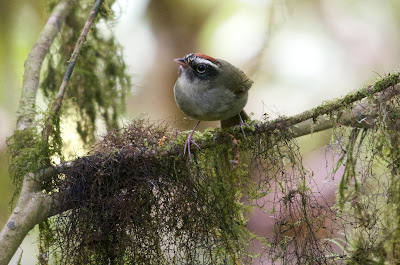
Black-cheeked Warbler ssp. nov?
As you can see, it was a quite productive trip.  We recorded 123 species for the area, including some new ones to Azuero and even one lifer!  While walking around 1300 meters above sea level, we found two chicken-sized birds walking in a small ravine... they were Rufous-necked Wood-Rails!  That evening, we heard at least two pairs at the campsite... Kilo barely managed to record part of the call with his cell phone (headphones needed).
There are only few reports of Rufous-necked Wood-Rails in Panama, where it is considered a real rarity and this is the first time the species have been recorded away from mangroves in Panama (although it has been recorded in similar habitats in other countries).  As you can see, there is still much to learn about this place, and I'm pretty sure this is not the last thing we will heard about discoveries in Cerro Hoya!

Thursday, May 10, 2012

More species than supposed !

I have just attended a VERY interesting lecture by Matthew Miller (of the Bermingham lab at the Smithsonian Tropical Research Institute's -STRI- Naos Laboratory) during the Panama Audubon Society's monthly meeting in Panama City.  His first words stated that we are probably underestimating 30% of the avian diversity of our country !!!  
Many different forms of lowland birds (and surely highlands too) in Panama may represent new, sometimes cryptic, species under the biological species concept.  Birds like White-whiskered Puffbird, Ochre-bellied Flycatcher and White-breasted Wood-Wren are probably represented by more than one species within Panama... amazing!  Just check Matthew's chart on White-breasted Wood-Wren populations that exhibit almost no introgression among them (suggesting THREE different species!).
There are different ways for divergence among the new species... with some groups forming distinct, new separable species in a relatively short time by exhibiting habits and behaviors that reinforce the breeding barriers among them, as in the case of the Selasphorus Scintillant and Volcano Hummingbirds.
Volcano Hummingbird, genetically very similar to the Scintillant Hummingbird
But others  than the Selasphorus hummingbirds were the main attraction of the lecture.  First of all, he showed to us the distinctiveness, both physical and genotypically, of the Escudo Hummingbird, Amazilia handleyi.  Actually recognized as part of the widespread Rufous-tailed Hummingbird, A. tzacatl, the recognition of handleyi as a distinct, VERY range-restricted, full species would raise the conservation of tiny Escudo de Veraguas island as of high priority (the island is unprotected right now, and could hold more species new to science).
Two Amazilia handleyi at the extreme right.  Notice the larger size and general darker coloration in comparison with Amazilia tzacatl to the left
And what everybody was waiting for.... Matthew confirmed the discovery of a completely new hummingbird species for science.  In july 2011, STRI personnel collected a Lampornis hummingbird from southern Azuero Peninsula (Cerro Hoya), superficially similar to the Purple-throated Mountain-Gem (Lampornis calolaemus) of Nicaragua to central Panama.  It differs in both crown and vent coloration, you can see the difference in vent color in the next two photos of prepared skins (Venicio "Beny" Wilson's photo shows the difference in crown color here).
Lampornis sp. nov. at extreme left (two skins)

From left to righ: Lampornis sp. nov., Lampornis calolaemus and Lampornis castaneoventris
The Purple-throated Mountain-Gem distribution is interrupted by that of the White-throated Mountain-Gem (Lampornis castaneoventris) in Costa Rica and western Panama, with two separable form: cinereicauda (so far restricted to Costa Rica) and nominal castaneoventris (extreme eastern Costa Rica and western Panama)... but in the next photo of one of Matthew's slides, you can also see how genetically different are the Cerro Hoya birds from all the others members of the complex (notice that the pectoralis population of Nicaragua and northwestern Costa Rica is also very distinct from the homogenes - and calolaemus - birds from southwestern Costa Rica/Panama and northern/central Costa Rica respectively, but physically very similar).
Notice how distinct the Cerro Hoya birds are (enlarge the picture and follow the lines)
Congratulations Matthew, and we are eager to see the formal description of the new species (as in plural) published soon!

Friday, May 4, 2012

Good Friday in Flores

I spend the last Good Friday (april 6th) birding with my buddies Rafael Luck and Venicio "Beny" Wilson in extreme southwestern Azuero Peninsula of central Panamá,  at the slopes of Cerro Hoya near the town of Flores.  This was my second time in Flores, and I already blogged about it, because this spot is certainly the most accessible and easy site for seeing the endemic Azuero Parakeet!
Again, the Velasquez family received us, and Juan guided us through part of his property.  This is not exactly parakeets' season, they spent this part of the year in the higher slopes, coming down by may and june, but we want to have a shot and, who knows, maybe see some others goodies for the area.  The road going down Flores from the town of Mariato is simply spectacular, hilly, with great views of the rushing sea.
It is from close to Flores where you can see the forested slopes of Cerro Hoya... it is like a lost world in the middle of pasture lands... notice the fog and the rain covering the valley.  The humid forest of Cerro Hoya holds some interesting species, some of them only present in this particular mountain range in the world!
Juan took us through a narrow trail that steeply started to raise over the flat terrain surrounding, entering humid forest after crossing a nice creek.  The hike was a little bit exhausting for us, who were carrying photographic equipment.  Eventually we reached a flat spot where Juan had seen before the endemic (for Panama) Brown-backed Dove eating of the fallen fruits of a palm tree... but again, this was not the right time of the year for seeing them.  
However, the place was alive with the sounds of Orange-collared Manakins (only a record shot... shaking hands by the time we saw the manakins), we DID hear a pair of Azuero Parakeets flying-by upslope and heard (and saw) the characteristic double hoop of the local subspecies of Blue-crowned Motmot... which appeared to correspond vocally with lessoni, the Blue-diademed Motmot.
We walked more deeply inside the forest... the feeling of being in the middle of a tall, humid forest in Azuero is simply abstract!  We even saw birds so typical of forest interiors that we barely believed it... as for example, a pair of White-whiskered Puffbirds (photo) and a Royal Flycatcher.
In the way down, we stopped for lunch at the watering place for the cattle, accompanied by a Slaty-tailed Trogon and a young Spectacled Caiman carefully watching at us.  Circling above us were a pair of Short-tailed Hawks and, above them, a Black-and-white Hawk-Eagle that we found later never has been reported for the Azuero Peninsula (I hope Rafael's photos are conclusive).
After the lunch, Juan guided us through the forest border at the lower slope of the hill.  At one stop, we delighted ourselves with a mixed flock including Rufous-browed Peppershrike, two Tropical Gnatcatchers, a Yellow Warbler and a White-winged Becard.  At the same time, a pair of impressive White Hawks were monitoring us, eventually getting tired of us and flying away majestically.
Then, Beny pointed towards some trees, evidently excited: a group of Critically Endangered "Azuero" Spider Monkey was passing by... I don't know how many, probably around 30 individuals, with many young ones, agile and gracefully were moving among the branches, sometimes stopping to have a look at us!  What a great experience... this subspecies of the Central American Spider Monkey complex is severely affected by habitat destruction... and probably only two or three populations persists only in those forests!
In spite of the torrential downpour that struck us ultimately, we spend a VERY good time with Juan... and we hope to return back soon to Flores and Cerro Hoya!