Showing posts with label Cocoi Heron. Show all posts

Thursday, July 31, 2014

A promising pond

If you are planning a trip to eastern Panama province searching for the Whistling Heron (last time seen this monday, july 28th), remember to visit the pond that is to the left of the Panamerican highway just after the turn-off to the heron site.  As many others have noticed, this pond is full of life and, certainly, will produce some goodies in the future.  After seeing the nesting Pearly-breasted Cuckoo in Bayano, we stopped for a while to check this pond.
Wood Storks
Of course, the first thing we noticed was the immense number of Wood Storks.  More than 200 birds gathered there... they seemed to be just resting and relaxing.  This species is rather odd, with its bare head... but in the air its elegance has no parallel.  Here is another shot of part of the flock.
Wood Storks
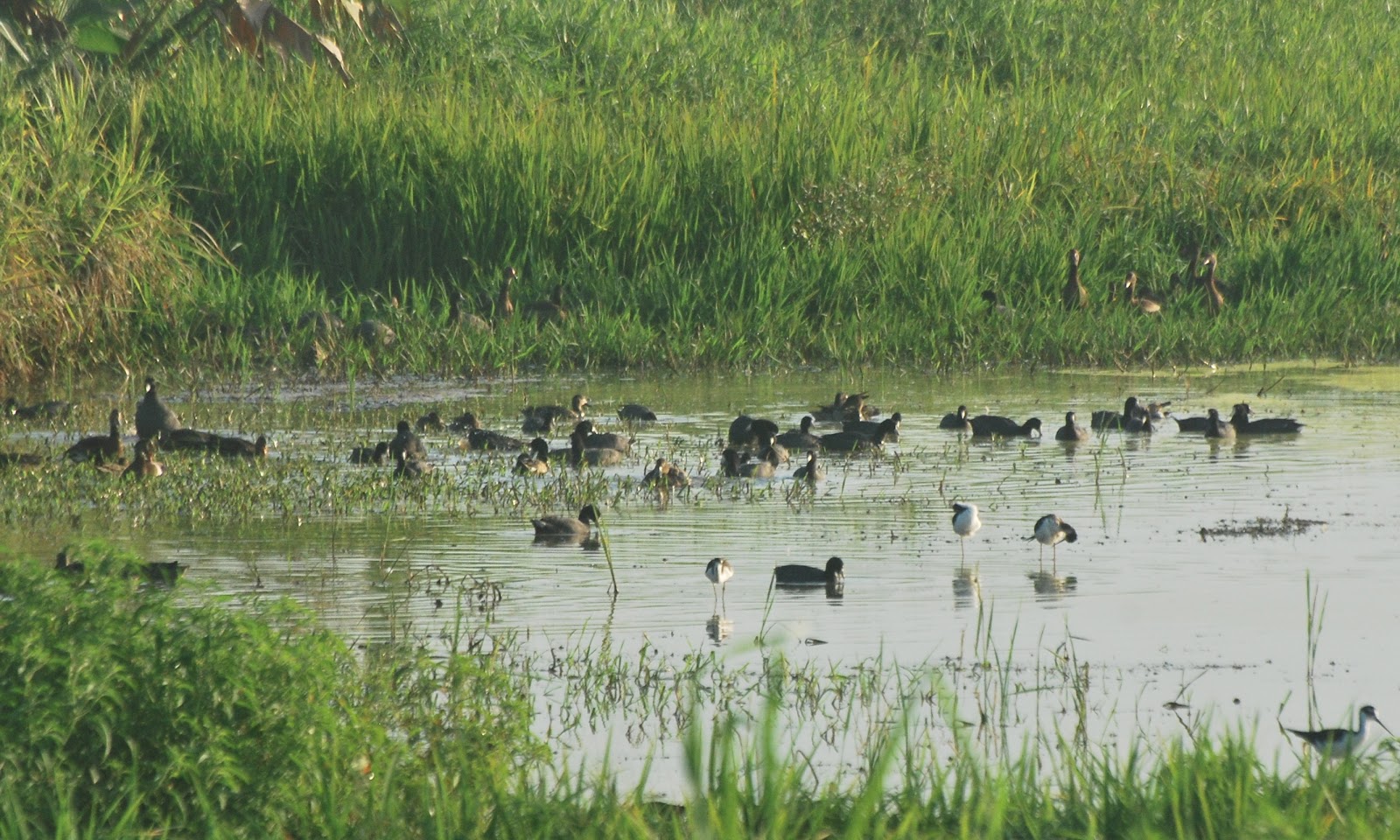
Second after the storks were the Black-bellied Whistling-Ducks.  They were farther away, so my shot is not very good.  Along with the whistling-ducks, we also saw Neotropic Cormorant, Least Grebes and a Common Gallinule.  The pond is perfect for migrant ducks, and in the past both American Wigeon and Northern Shoveler have been present.
Black-bellied Whistling-Ducks
There were some migrants too: Least, Solitary and Spotted Sandpipers, Greater Yellowlegs and Black-necked Stilts (although the last one could be a resident population).  Along with these migrants were Wattled Jacanas and Purple Gallinule.  The rice fields nearby had produced Paint-billed Crakes (!) and Long-billed Dowitchers (!!) too.  We also got many herons (seven species), including no less than four Cocoi Herons.
Cocoi Heron
Most of the small birds and the whistling-ducks flew off when an Aplomado Falcon showed up... yes, an Aplomado Falcon!  It was too fast for photos... but, as you can see, this pond promises good birds in the future, so keep an eye on it!

Tuesday, July 30, 2013

Still looking for THE heron

It seems that the only thing we did last month was to look for the vagrant Whistling Heron reported elsewhere by Kevin Easley et al.  And last weekend was not the exception!  However, this time accompanied by Rafael Luck, Osvaldo Quintero and his son-in-law Joaquín, we stopped first at some marshes just east of Panamá City, the former Tocumen marshes.  Like other days, we found the typical avifauna of these habitats, but dip on the heron again.  Well, nothing to sorry about because we knew it was very unlikely to find the bird so far away of the original spot, but we did have a nice day photographing all sort of birds species, including HUGE numbers of Wood Storks, Neotropic Cormorants all over the place (see the photo above), and many Cocoi Herons, like the one pictured below.
These marshes are also very good for raptors, and we saw or heard Roadside, Common Black and Gay-lined Hawks, plus Pearl and White-tailed Kites too.  This one was perched close to the road allowing some photos.
The site is the only reliable one for Yellow-headed Vulture close to the city, and we found at least three individuals resting close to the road.
We found no less than six Ringed Kingfishers in one stretch of a creek... soon we realized that they were nesting in the sandy banks.  This image remind me the photos of bee-eaters at their colonies... after all they are related.
We went to the spot near Chepo, but the day was hot and we only found more birders trying, unsuccessfully, to relocate the heron... so we called it a day.  The next day, I joined Karl and Rosabel Kaufmann and, very early, went to the spot near Chepo.  Though we had a good day, we were not able to relocate the Whistling Heron.  We checked miles of dirty roads, finding more Wood Storks and a beautiful Capped Heron sharing the pond with one of the storks.
Again, we saw many raptors, like Roadside and Great Black Hawk, White-tailed Kites, and several pairs of American Kestrels.  Again, notice the absence of spots in the underparts... probably the same individual we photographed some weeks ago in the same spot.
New for our list of the site was this Bat Falcon perched in some wires.  It allowed us to approach closely, a very cooperative bird.
Well, I don't know if the Whistling Heron will be found again... but that area surely will reveal many surprises in the future!

Tuesday, January 22, 2013

Birding the marshes. Part I

Last saturday, I joined Osvado Quintero early in the morning to explore some marshes to the east of Panama City where someone told us that he was seeing "clouds" of duck every morning since a while. Intrigued, we followed the directions and eventually found the site, surprisingly next to a huge urban development and a neighborhood.  Our first sight: CLOUDS of Black-bellied Whistling-Ducks darkening the sky... amazing!
If you have the time (and patience) to count the dots, no less than 1500 birds are present in that photo... and this was only part of one of the flocks!  Eventually, we saw and photographed eight (8) ducks species that morning, definitively a record for Panama (but more about that in another post).  Quantity and quality, everything was exaggerated.  For example, we saw tons of American Coots, just the next photo shows more than 20!
Or the absurd numbers of Cocoi Herons and Wood Storks all over the place, but specially in a big pond where I took the next photo (just half of the pond in this photo).
We also recorded Great Blue Herons, Great Egrets and Striated Herons, among many others as you can see in the next photo (although I accept comments about the Striated Heron).
Of course, the Pied Water-Tyrant could not be absent.  We were so impressed by the immense flocks of other species that we saw only two of this smart flycatcher.
However, one of the highlights were two (YES, TWO!) Long-winged Harriers.  We saw first a dark bird with the characteristic profile and facial pattern, pale panels in the primaries, white rump band and many white tail bands.  We even managed to take some photos of this individual.  Then, we saw another individual, a brown one with creamy underparts and dark chest, surely a female.
With just a handful of reports, this was exceptionally good... rethinking it, I have been quite lucky with this species, and that day in general will be hard to forget!

Monday, December 26, 2011

Brushing the mudflats

I visited the coast of Panama City, specifically around Panama Viejo, some days ago following some interesting reports including very rare shorebirds and gulls in the area. Essentially, I birded around the Visitors Center because you get there a piece of every type of habitat present in the place, like both rocky and sandy shores, grassland, mudflats, an estuary and mangroves... all within a short walk and under the security
of the Center facilities. The extensive mudflats were covered in shorebirds, specially Western and Semipalmated Sandpipers, Willets and tons of Black-bellied Plovers. However, it was a group of waders that caught my attention: no less than ten Wood Storks were standing in the mud, resting and preening. They reminded me my last experience with storks during the Pacific CBC and, considering the fact that these birds are good fliers, one should consider that they could be
the same beach-loving individuals we saw during the count! Closer to the mangroves, six herons species were wading, looking something to eat, except an elegant Cocoi Heron which was simply
preening in the sand, very close to several Great Blue Herons, a very similar species. Walking to the rocky part of the shore, looking for the Wandering Tattler reported elsewhere, I crossed the grassy section next to the parking lot of the Visitors Center, finding a young Green
Iguana having a sun bath. A close relative, a Spiny Iguana (Ctenosauria sp.) was inspecting me from the rocks. At the rocks, the closest bird to a Tattler that I found was a Spotted Sandpiper dressing its winter suit, which is not spotted at all!
By far, it is the most widely distributed sandpiper in Panama, easily identified by its stiff wing beats and the constant movement of its rear part... it should be named Bobbing Sandpiper! Among the hundreds of Laughing Gulls and dozens of Franklin's Gulls, I
found the Lesser Black-backed Gull that have been reported in Xenornis; however, when I was about to photograph it, the all flock left the place desperately. I turned my head and realized that the reason of the mess was a young Peregrine Falcon hunting low and actually grapping a Laughing Gull in front of my eyes! It was a kind of weird because I'm used to see the Peregrine Falcons hunting small peeps instead of gulls of almost its same size!

But it was not over... just seconds after the initial attack, a second Peregrine Falcon (an adult this time) appeared, and started to attack the first individual, which never gave up its prey. The attacks were marked with lot of noise by both birds, and it reminded me an attack that I witnessed almost exactly one year ago!


After a while, the adult Peregrine left the young one with its prey. The young Peregrine began to eat but after a while it left the place too. May be I didn't get my life tattler, but that was a show often seen in the wild, so I'm happy anyway!

Monday, December 20, 2010

2010's Pacific Christmas Bird Count

Yesterday, the Panama Audubon Society carried out the first (of three) Christmas Bird Counts in central Panama, with a great assistence and some good birds showing up. Like last year, I counted in the Farfan/Veracruz area (Panama Canal's west bank) in the morning... but this time alone because Gloriela stayed in home with a cold. I started very early, as usual, finding many of the specialties for the area (shorebirds, waders and open land birds). First, I checked Veracruz beach walking along the tide line in rubber boots finding tons of Willets and Whimbrels in the same flock along with a White Ibis, a Ruddy Turnstone, and some Collared, Wilson's and Black-bellied Plovers. I also found two Lesser Yellow-headed Vultures (so far the only two of the count) and heard a Striped Cuckoo in an adjacent grassland. Then, I checked Farfan beach, finding maaany herons and egrets, including my new-for-the-year Boat-billed Heron inside a mangrove and several Great Blue Herons. The highlights were two American Oystercatchers spotted far away in the rocky shores, also the only two for the count. Other birds related to the aquatic environment were the Amazon and Ringed Kingfishers at the river, several Northern Waterthrushes, a single Prothonotary Warbler and a flock of Greater Anis making a guttural call. These are shiny and good-looking birds compared to the Smooth-billed Anis found before. I like its expressive yellow eyes... not to be confused with the abundant Great-tailed Grackle). I moved to Amador where I entered Punta Culebra, the most reliable site inside the count circle to find the Northern Scrub-Flycatcher... and one of these little friends was perched on the entrance sign! Notice its pattern, quite similar to the Myiarchus flycatchers. You can identify it by its smaller size, short bill and different voice. The site is also very good for Sapphire-throated Hummingbird (only one male seen), Garden Emerald (up to four different birds of both sexes present) and "Mangrove" Warblers (with several seen). I also saw both Brown and Blue-footed Boobies (following a ship entering the Canal!) INSIDE the count circle. By midday, all the groups met at the Chiva Chiva ponds (beyond the Miraflores locks) to compilate the preliminar list and to organize the plans for the afternoon journey. After checking the missing birds, I went to different sites with Darien Montañez (PAS president, this CBC main compilator and XENORNIS editor) looking to add more birds to the day list, with moderate success. The very first stop was at the first of the two Chiva Chiva ponds, were we scoped several Common Gallinules (aka Moorhens), an American Coot and four (probably more) Pied-billed Grebes, the latter two were new year-birds for me! At the mangroves of Diablo Heights, Darien showed me a female American Redstart (new year-bird!) and we saw a quite grayish Cocoi Heron (white thighs and solid black crown, so its grayness was probably age-related). We failed to locate the Cattle Tyrant at its former usual haunts in Amador, but added Shiny Honeycreeper and Black-tailed Flycatcher at the Metropolitan Natural Park (with Venicio "Beny" Wilson and Olmedo Miró). The day ended doing some owling at Beny's place in Ancon... 15 hours of intense birding! Great count with great birds!

Wednesday, September 15, 2010

Waders and more waders

How many different herons species can you find in a morning. If you visit specific sites at the Upper Bay of Panama, then the answer is MAAANY! Yesterday, I went with Osvaldo Quintero to the Juan Díaz mangroves, Costa del Este and the Panama Viejo mudflats in a quick succession, twitching the recently reported American Avocet (which we did not find by the way). So, from east to west we got: Great and Snowy Egrets, Tricolored, Little Blue and Green Herons and Wood Stork (not a heron, but a wader too) in Juan Díaz.Cattle Egrets (same birds seen before) and Yellow-crowned Night-Heron in Costa del Este and Cocoi Heron, a Little Blue Heron molting into adult plumage and a Black-crowned Night-Heron (yes, the flying-away bird with the black back) at Panama Viejo (behind the new Visitors Center).Nine species in just two hours. Now, consider that three other species can be expected (Capped, Great Blue and Striated Herons) and you get herons' heaven.

Bonus Long-billed Curlew at the Panama Viejo's Visitors Center, a life bird for Osvaldo (which was a nice surprise for me!).

Wednesday, January 20, 2010

Skimmers at Costa del Este

After a heavy birding morning (visiting Veracruz, Farfan and the Metropolitan Natural Park) and a well deserved rest, I went with Gloriela and Michael (her nephew) to Costa del Este taking advantage of the evening's high tide last sunday, january 17. As usual, lots of birds were congregated at the mouth of the Matias Hernández river. Among them were at least four different Black Skimmers maybe of the South american race (there were only two in the morning, according to the e-mail that Rosabel Miró sent me). I suppose that it is now a regular bird in this site. The skimmers were not the only highlights. Among the gulls, the most numerous were the Franklins', they used to be quite uncommon in Panama, always outnumbered by the Laughing Gulls. Not only adults, but 1st winter birds too, allowing to check its field marks (notice, for example, the large hood and the white outer tail feathers in the flying individual that I picture here). Why we have so many Franklin's Gulls wintering in Panama this season? Maybe El Niño has made too warm their usual wintering grounds in South America (I remember THOUSANDS of Franklins' wintering in coastal Lima, Perú, some years ago) or who knows and perhaps we have been overlooking them so far (less likely). Also present were Black-bellied Plovers and Southern Lapwings (6th plover species for the day); Marbled Godwits, Greater Yellowlegs, Willets and Whimbrels representing the large shorebirds; and a compact group of Western and Spotted Sandpipers moving with the waves. Very much farther, the usual assortment of cormorants, pelicans and egrets were accompanied by a lone Cocoi Heron (first for my year list). It was a very short visit, but full of birds anyway!