I still don't know why I don't visit the Ancon Hill more often. It is in Panama City, VERY close to  my place, and holds a good amount of wildlife, not only birds, but also mammals and insects. But, more important, it is a nice migrant trap in the right season, specially october. Several times during the first two weeks of this month, I visited the volunteers of the migrant raptors count, who have reported rare migrants like Black-billed Cuckoo and almost a definitive Painted Bunting this season at the summit of the hill. Despite I saw none of these rarities in my visits, the number of
  species and individuals of migrants was really amazing. Gloriela (and Gabrielle) accompanied me the last time, and even helped the counters recollecting data on temperature and wind direction for the records. Surely, the most common species (only after the abundant Sawinson's Thrushes) was the Eastern Kingbird. Flock after flock passed by, taking advantage of some
  fruiting trees in the vicinity of the summit. Some of them also did some flycatching while we were there, sometimes side-by-side with our local Tropical Kingbirds who simply shared the perch without hesitation. The flycatchers were well represented. Not only the Eastern Kingbirds were present, we also saw
  Great Crested and Sulphur-bellied Flycatchers. The latter is an uncommon transient through the isthmus. We had the opportunity to have side-by-side views of this species with the very similar, resident and much more common and noisy Streaked Flycatcher. Many field marks have been described to separate these two flycatchers, but the most reliable is the black chin and more pronounced black malar stripe of the Sulphur-bellied
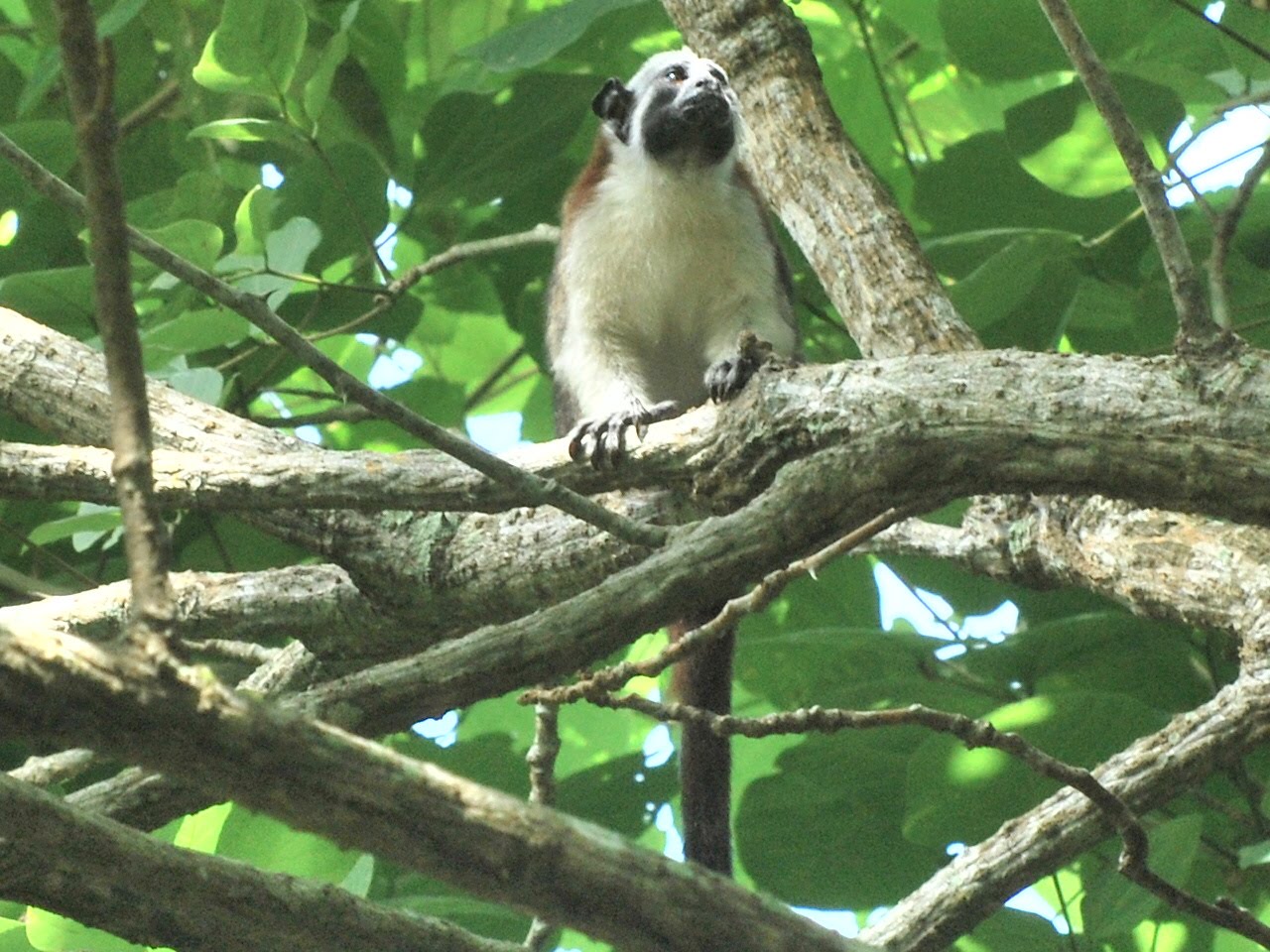
  Flycatchers. You can notice that the chin area of the Streaked Flycatcher is completely white. The amount of yellow in the underparts can be similar for both species, the same with the color of the bill (usually, the Sulphur-bellieds have only little pink in the base of the lower mandible). Perhaps the Streaked Flycatcher is very common, but it can't be more beautiful! In the meanwhile, a single Geoffrey's Tamarin was eating the
  berries of a tall tree abiove our heads. We noticed it first because one of the berries struck Gloriela in the head! We were able to heard the rest of the group in the trees nearby; they sound like a flock of little birds... or were they laughing at us? We quickly forgot the
  incident after seeing our first group of migrant Scarlet Tanagers. Even without the breeding plumage, the males are still attractive, with their contrasting jet black wings. They outnumbered the others tanagers, a phenomenon that happens only this time a year. The only other migrant tanager (or should I say "cardinal"?) was the Summer Tanager, with one or two shyly working around the trees bordering the access road.
  Another representative group was the wood-warblers. Hordes of Yellow, Canada, Blackburnian, Tennessee and Black-and-white Warblers invaded the hill, giving it some color. My photo of the female Black-and-white Warbler is simply to poor to reflect the beauty of this smart, creeper-like warbler. I still need a good photo of most of these warblers, but you know,
  they simply can not stop... always in the move, usually high in the canopy, in backlight... in summary: a real headache for the amateur photographer (like me)! Sometimes it was hard to focus in a single bird due to the great activity all over the place, but a slim silhouette definitively caught my attention during one of the first visits. The bird in the shade turned out to be the first (of many) Yellow-billed Cuckoo having a huge worm for lunch... I was expecting the Black-billed reported by the volunteers... but you can not win everytime and, after all, it is a good reason to return next year!
 my place, and holds a good amount of wildlife, not only birds, but also mammals and insects. But, more important, it is a nice migrant trap in the right season, specially october. Several times during the first two weeks of this month, I visited the volunteers of the migrant raptors count, who have reported rare migrants like Black-billed Cuckoo and almost a definitive Painted Bunting this season at the summit of the hill. Despite I saw none of these rarities in my visits, the number of
  species and individuals of migrants was really amazing. Gloriela (and Gabrielle) accompanied me the last time, and even helped the counters recollecting data on temperature and wind direction for the records. Surely, the most common species (only after the abundant Sawinson's Thrushes) was the Eastern Kingbird. Flock after flock passed by, taking advantage of some
  fruiting trees in the vicinity of the summit. Some of them also did some flycatching while we were there, sometimes side-by-side with our local Tropical Kingbirds who simply shared the perch without hesitation. The flycatchers were well represented. Not only the Eastern Kingbirds were present, we also saw
  Great Crested and Sulphur-bellied Flycatchers. The latter is an uncommon transient through the isthmus. We had the opportunity to have side-by-side views of this species with the very similar, resident and much more common and noisy Streaked Flycatcher. Many field marks have been described to separate these two flycatchers, but the most reliable is the black chin and more pronounced black malar stripe of the Sulphur-bellied
  Flycatchers. You can notice that the chin area of the Streaked Flycatcher is completely white. The amount of yellow in the underparts can be similar for both species, the same with the color of the bill (usually, the Sulphur-bellieds have only little pink in the base of the lower mandible). Perhaps the Streaked Flycatcher is very common, but it can't be more beautiful! In the meanwhile, a single Geoffrey's Tamarin was eating the
  berries of a tall tree abiove our heads. We noticed it first because one of the berries struck Gloriela in the head! We were able to heard the rest of the group in the trees nearby; they sound like a flock of little birds... or were they laughing at us? We quickly forgot the
  incident after seeing our first group of migrant Scarlet Tanagers. Even without the breeding plumage, the males are still attractive, with their contrasting jet black wings. They outnumbered the others tanagers, a phenomenon that happens only this time a year. The only other migrant tanager (or should I say "cardinal"?) was the Summer Tanager, with one or two shyly working around the trees bordering the access road.
  Another representative group was the wood-warblers. Hordes of Yellow, Canada, Blackburnian, Tennessee and Black-and-white Warblers invaded the hill, giving it some color. My photo of the female Black-and-white Warbler is simply to poor to reflect the beauty of this smart, creeper-like warbler. I still need a good photo of most of these warblers, but you know,
  they simply can not stop... always in the move, usually high in the canopy, in backlight... in summary: a real headache for the amateur photographer (like me)! Sometimes it was hard to focus in a single bird due to the great activity all over the place, but a slim silhouette definitively caught my attention during one of the first visits. The bird in the shade turned out to be the first (of many) Yellow-billed Cuckoo having a huge worm for lunch... I was expecting the Black-billed reported by the volunteers... but you can not win everytime and, after all, it is a good reason to return next year!




 Posts
Posts