Showing posts with label Purple-throated Mountain-Gem. Show all posts

Saturday, April 30, 2016

The Cerro Hoya Expedition

The Azuero Peninsula, in south-central Panama, is known by its infamous history of deforestation that began with the Spanish colonization.  However, there are still patches of wooded areas, mainly in the highlands of the southern extreme of the peninsula, specially in the Cerro Hoya massif.  This is not coincidence... the roughness of the area, and its inaccessibility prevented the destruction of this natural treasure... but also prevented its exploration, thus becoming one of the most unknown areas in Panama, ornithologically talking at least.  Home to some range-restricted and globally threatened species, the Cerro Hoya massif also host a number of montane species represented by distinct forms, isolated from similar populations by at least 150 kms.
That's why my friend Euclides "Kilo" Campos and I were so interested in climbing that mountain.  Accompanied by a visitor birder, Macklin, and organized by Kees Groenendijk (of Hotel Heliconia, he also accompanied us), the four of us set camp at 1160 meters above sea level last week... after six hours of climbing along a winding and steep trail.
Campsite 
Of course we birded along the trail, finding some very nice species.  We started to hear, and see, Brown-backed Doves above the 400 meters mark and to hear Azuero Parakeets above the 1000 meters mark.  Both are endemic forms, still considered subspecies of wider-ranged species, in this case, Gray-headed Dove and Painted Parakeet, respectively.  The Panama Audubon Society considers both full species, endemics to the country... quite restricted endemics by the way!
Brown-backed Dove
Also above the 400 meters mark the characteristic calls of the Three-wattled Bellbirds started to be more and more common, as well as sightings of White-ruffed Manakins.  These populations seem to reside in the area year-round.  About the bellbirds, some experts think that these birds differ vocally to the populations of the western highlands.  The far-carrying calls are impressive.  However, in spite of the loud calls, these beautifully patterned birds are quite difficult to see.  We were lucky enough to spy some males, and I managed some photos as well.
male White-ruffed Manakin
male Three-wattled Bellbird
We stayed two nights in the forest, spending one day almost entirely above the 1200 meters mark looking for montane subspecies, finding both expected and new ones for this region.  The montane forest made us wonder if we were still in the Azuero Peninsula!  There are some curiosities up there... for example, some lowlands species are found all the way up to the montane forests, like Scaly-throated Leaftosser and Cocoa Woodcreeper, certainly due to the lack of their montane counterparts in this region (in these cases, Tawny-throated Leaftosser and Spotted Woodcreeper respectively).
Scaly-throated Leaftosser
Other montane species are shared with other remaining (although lower) montane areas in the Azuero Peninsula, like El Montuoso Forest Reserve.  Some of these species are widely distributed, like the Golden-crowned Warbler, while other are more local, sometimes hard to find... like the beautiful White-winged Tanager.  Cerro Hoya is probably the most reliable site to find this beauty!
Golden-crowned Warbler
male White-winged Tanager
But we were after the forms only found in the Cerro Hoya massif... and we found three of them (only missing the Selasphorus sp., probably due to lack of appropriate habitat up there).  All of them were above 1200 meters above the sea level.  The most common was the Purple-throated Mountain-Gem.  This form is certainly a new subspecies... and probably a new full species!
male Purple-throated Mountain-Gem ssp. nov.
Check this post with the rationale of why this could be a good species... you can see the differences with other forms in my photos.  The other endemic form was the White-naped Brush-Finch, ssp. azuerensis.  This form was darker in the underparts and browner in the upperparts than other forms found in Panama... it was also more arboreal and quite shy.
White-naped Brush-Finch ssp. azuerensis
The last form was the most difficult to find... in fact, we only saw two pairs, both above the 1300 meters mark: Black-cheeked Warbler.  Phenotypically, the only difference we noticed was its olive(ish) upperparts, instead of grayish.  These birds responded to recorded calls of Black-cheeked Warblers from the western highlands.
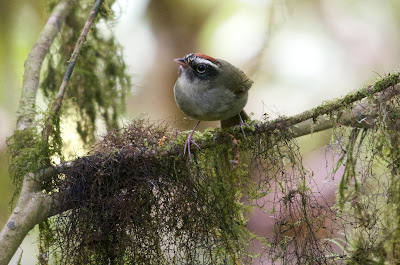
Black-cheeked Warbler ssp. nov?
As you can see, it was a quite productive trip.  We recorded 123 species for the area, including some new ones to Azuero and even one lifer!  While walking around 1300 meters above sea level, we found two chicken-sized birds walking in a small ravine... they were Rufous-necked Wood-Rails!  That evening, we heard at least two pairs at the campsite... Kilo barely managed to record part of the call with his cell phone (headphones needed).
There are only few reports of Rufous-necked Wood-Rails in Panama, where it is considered a real rarity and this is the first time the species have been recorded away from mangroves in Panama (although it has been recorded in similar habitats in other countries).  As you can see, there is still much to learn about this place, and I'm pretty sure this is not the last thing we will heard about discoveries in Cerro Hoya!

Thursday, August 29, 2013

Not only endemics in Cerro Santiago

Besides the endemic species and subspecies found in our last trip to the mountains of the Tabasará range, we also saw more widespread species of birds as you can imagine (read this entry for example).  The group of intrepid birders consisted of William Adsett, Dan Wade and Charles Davies... and for us, every species was special in its special way.  For example, check out this Spangle-cheeked Tanager... beautiful no matter how common it is!
We crossed several flocks, always three to six birds, most of the time mixed with other tanagers, finches and/or warblers.  One of those times, the mixed flock was accompanied by a female Black-and-Yellow Silky-Flycatcher.  This is an odd silky... it looks more like a colorful thrush, and some even think that this species doesn't belong to the family.
One important element in the Tabasará avifauna are the hummingbirds (as you may know by now).  Besides confusing female Selasphorus, we saw more common species.  In fact, the most common hummer all over the place was the Purple-throated Mountain-Gem.  The ground epiphytes along the road through the slopes of Cerro Santiago were frequently visited by these hummers, allowing nice shots (here, adult and immature males, adult female).
Others hummers for the area included Green Violetear, Violet Sabrewing, White-tailed Emerald, Stripe-tailed Hummingbird, Green-fronted Lancebill and Green-crowned Brilliant.  The male brilliant pictured here is quite blurry... but trust me that it was a real jewel glowing inside a beautiful cloud forest along the Continental Divide trail (above 1700 meters above sea level).
Not only the birds were putting a show, we saw some mammals, like this Pygmy-Squirrel in one of those productive forest patches along the road to the Ngöbe town of Ratón.  We still need some help to ID this little friend.
And the critters were awesome too... Dan was our expert in this field, and we learned a lot.  I will end this post with the photo of one of the coolest critter that I have seen.  Enjoy!

Thursday, May 10, 2012

More species than supposed !

I have just attended a VERY interesting lecture by Matthew Miller (of the Bermingham lab at the Smithsonian Tropical Research Institute's -STRI- Naos Laboratory) during the Panama Audubon Society's monthly meeting in Panama City.  His first words stated that we are probably underestimating 30% of the avian diversity of our country !!!  
Many different forms of lowland birds (and surely highlands too) in Panama may represent new, sometimes cryptic, species under the biological species concept.  Birds like White-whiskered Puffbird, Ochre-bellied Flycatcher and White-breasted Wood-Wren are probably represented by more than one species within Panama... amazing!  Just check Matthew's chart on White-breasted Wood-Wren populations that exhibit almost no introgression among them (suggesting THREE different species!).
There are different ways for divergence among the new species... with some groups forming distinct, new separable species in a relatively short time by exhibiting habits and behaviors that reinforce the breeding barriers among them, as in the case of the Selasphorus Scintillant and Volcano Hummingbirds.
Volcano Hummingbird, genetically very similar to the Scintillant Hummingbird
But others  than the Selasphorus hummingbirds were the main attraction of the lecture.  First of all, he showed to us the distinctiveness, both physical and genotypically, of the Escudo Hummingbird, Amazilia handleyi.  Actually recognized as part of the widespread Rufous-tailed Hummingbird, A. tzacatl, the recognition of handleyi as a distinct, VERY range-restricted, full species would raise the conservation of tiny Escudo de Veraguas island as of high priority (the island is unprotected right now, and could hold more species new to science).
Two Amazilia handleyi at the extreme right.  Notice the larger size and general darker coloration in comparison with Amazilia tzacatl to the left
And what everybody was waiting for.... Matthew confirmed the discovery of a completely new hummingbird species for science.  In july 2011, STRI personnel collected a Lampornis hummingbird from southern Azuero Peninsula (Cerro Hoya), superficially similar to the Purple-throated Mountain-Gem (Lampornis calolaemus) of Nicaragua to central Panama.  It differs in both crown and vent coloration, you can see the difference in vent color in the next two photos of prepared skins (Venicio "Beny" Wilson's photo shows the difference in crown color here).
Lampornis sp. nov. at extreme left (two skins)

From left to righ: Lampornis sp. nov., Lampornis calolaemus and Lampornis castaneoventris
The Purple-throated Mountain-Gem distribution is interrupted by that of the White-throated Mountain-Gem (Lampornis castaneoventris) in Costa Rica and western Panama, with two separable form: cinereicauda (so far restricted to Costa Rica) and nominal castaneoventris (extreme eastern Costa Rica and western Panama)... but in the next photo of one of Matthew's slides, you can also see how genetically different are the Cerro Hoya birds from all the others members of the complex (notice that the pectoralis population of Nicaragua and northwestern Costa Rica is also very distinct from the homogenes - and calolaemus - birds from southwestern Costa Rica/Panama and northern/central Costa Rica respectively, but physically very similar).
Notice how distinct the Cerro Hoya birds are (enlarge the picture and follow the lines)
Congratulations Matthew, and we are eager to see the formal description of the new species (as in plural) published soon!

Saturday, August 29, 2009

Visiting Altos del Maria

I just came from Altos del María, a gated community in the foothills of western Panama province that have proved to be a good birding spot. Along with Osvaldo Quintero and Alfred Raab, an Altos' resident who kindly guided us through the area, we explored some nice areas with good access roads and good birds. Alfred was constantly saying that we were lucky because we found a sunny day without fog in the upper part of the housing development (La Rioca), where we walked La Coruña street finding a nice mixed flock right in the entrance, with Silver-throated Tanager and Common (very common) Bush-Tanagers, along with Rufous-capped Warblers (feeding youngs), Tufted Flycatcher, Thick-billed and White-vented Euphonias, at least two Yellow-billed Caciques and an Ochraceous Wren that Alfred immediately recognized by its Winter Wren-like call. A little farther we took a trail that leads to an observation tower, attracted by the frog-like call of two Purplish-backed Quail-Doves that eluded us despite our efforts... but bonus birds were the male Purple-throated Mountain-Gem and a shy Black Guan plus a spectacular view of the Cerro Trinidad in the distance. At the tower, we had a terrific view of the pacific lowlands, and of the forest at the foothills. It is possible to see both oceans in a clear day. We decided to visit some other sites before the fog covered everything. Among other species recorded were White Hawk, Pale-vented Thrush, a bright female Shiny Honeycreeper, Paltry and Southern Beardless Tyrannulets, Yellow-margined Flycatcher, Golden-hooded and Bay-headed Tanagers.
We start to return, stopping at the Styria gate (the "pyramid") from where you can see all the lower valley of El Maria, where the main community is. We found a big group of American Swallow-tailed Kites plus a Short-tailed Hawk soaring in a thermal. You don't very often see these birds at eye level, nor from above, so we enjoyed the sight for a few minutes. Then, we descended to the valley, to Alfred's place. Alfred have done a good job in his property, hanging feeders and making trails that hold many birds. Only in few minutes around noon we saw or heard Rosy Thrush-Tanager, Black-striped Sparrow, Plain, Rufous-breasted and Rufous-and-white Wrens, a nesting Streaked Saltator and Lance-tailed Manakins... all of them typical of drier forest (like the Metropolitan Natural Park here in the city) than the humid mossy-covered forest that we found in La Rioca (which lies over the 1100 meters above sea level and on the Continental Divide). After a quick lunch, we headed to El Valle road (that connects Altos del Maria with El Valle de Anton), but as soon we got to the forest, the rain and the fog showed up. This part of the valley was full of flowering Inga trees that are very good for small hummingbirds (we only saw Rufous-tailed Hummingbirds) Despite our waiting, the rain didn't stop, so we decided to head back to Panama City after a great day in the foothills. Alfred: thank you for everything, I hope to see you soon!

Monday, July 13, 2009

Western Hummingbirds Gallery

The hummingbirds are among my favorite bird families (only second after the tanagers). These avian jewels are designed exquisitely to obtain the flowers' nectar that supports their busy lives and are readily attracted to feeders, making them popular among the birders (and non-birders too). I already posted a link to a video of a lowland hummingbird feeder close to Gamboa, in central Panama (see the bottom of the lateral bar), but now, I want to post some pics of these beautiful creatures that I got in my last trip to Panama's western highlands. Most of them were photographed while visiting my friends Glenn & Janet Lee in their lovely Cielito Sur B & B Inn (the best breakfast that I ever tasted) last saturday. Others were higher up, above Cerro Punta. Unfortunately, I don't have photos of neither the Selasphorus hummingbirds, nor of the spectacular Fiery-throated Hummingbird, endemics to Costa Rica and Western Panama. The following two species were photographed in the area of Fortuna Forest Reserve. The road that leads to the Continental Divide Trail has been asphalted all the way to the transmission tower, allowing me to park my car in front of a bunch of flowers (already in the Caribbean slope), where I simply waited.Finally, though they aren't restricted to the western highlands, the following two species are so common at the hummingbird feeders in Cielito Sur that deserve to be included in this gallery. Others species restricted to this area and sighted during my last trip, but not included, were the Stripe-tailed Hummingbird and the White-throated & White-bellied Mountain-Gems.
Happy Birding!