Showing posts with label Crimson-crested Woodpecker. Show all posts

Tuesday, February 18, 2014

An extraordinaire day

The definition of "extraordinaire day" is different for each person.  For some, a day is extraordinaire if everything goes as planned; for others, you need a special event to occur.  For me, ANY day with a GROUND-CUCKOO is an extraordinaire day!  And, after hearing that a family group of Rufous-vented Ground-Cuckoos were attending an antswarm in Pipeline Road (central Panama) allowing nice views for the visitors, I decided to accept the invitation of my friend Osvaldo to bird the area last saturday.
We started at the marina in the town of Gamboa.  We were expecting to find some migratory ducks, but it seems that this is not a good year for them.  The place was full of Common Gallinules as usual, and Wattled Jacanas (like the one pictured above).  After walking along the access road, we found many species of both resident and migrant birds.  My favorite was an adult Rufescent Tiger-Heron hunting quietly behind the access gate.
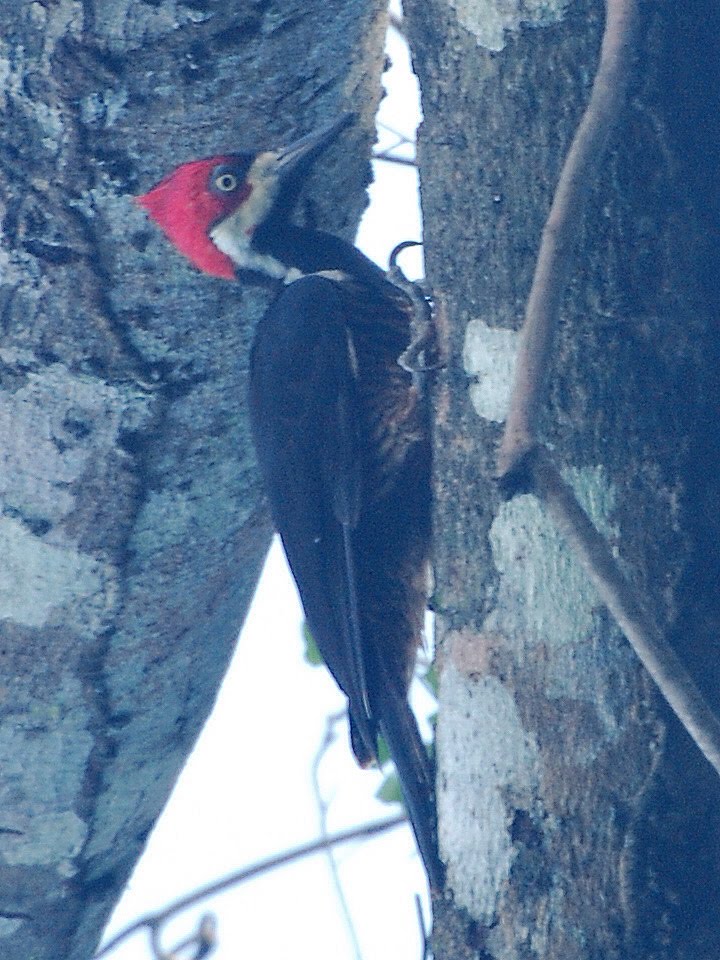
After a while, we decided to move to the famed Pipeline Road.  The furious activity at the marina deviated us from our main destination, the same happened in the other stops we made before reaching the entrance to Pipeline Road.  For example,  this Crimson-crested Woodpecker entertained us at the Ammo dump.
And a mixed group of warblers, antbirds and antwrens did the same right before entering Pipeline.  There, two species of antshrikes were inspecting a patch of forest close to the ground.  Considering that others birds were in the same area (like Black-bellied and Song Wrens, Dusky Antbirds and Black-faced Antthrush), I suspect that there were some ants or something in the ground.  Notice the heavy bill of this male Fasciated Antshrike.
And the black crown of this aptly named Black-crowned Antshrike.  This is a male, of course.  The female is patterned in brown and buff, with little black.  This species used to be called Western Slaty-Antshrike... but it is not closely related to other Slaty Antshrikes in South America.
A little before 11 am, we finally reached the Pipeline Road.  One kilometer after the entrance, we noticed a foreign birder standing aside the road.  We joined him and immediately heard the Bicolored Antbirds attending an antswarm.  The birder quickly showed us a photo in his bridge camera... a Rufous-vented Ground-Cuckoo appeared in the screen.  We waited for a while and then, the bird materialized above a log more or less 4 meters from us.  What a sight!  The long tail and powerful legs, plus the expressive crest is unmistakable.
File photo
Unfortunately, we could not take pictures.  I took the above photo five years ago almost exactly in the same site!  The Rufous-vented Ground-Cuckoo is a very rare ground-dwelling species that is found almost exclusively around antswarms.  Pipeline Road is, perhaps, the best place to see it, specially during our dry season.  So, now you see why that was an extraordinaire day?  

Sunday, October 16, 2011

One-day expedition to Darien

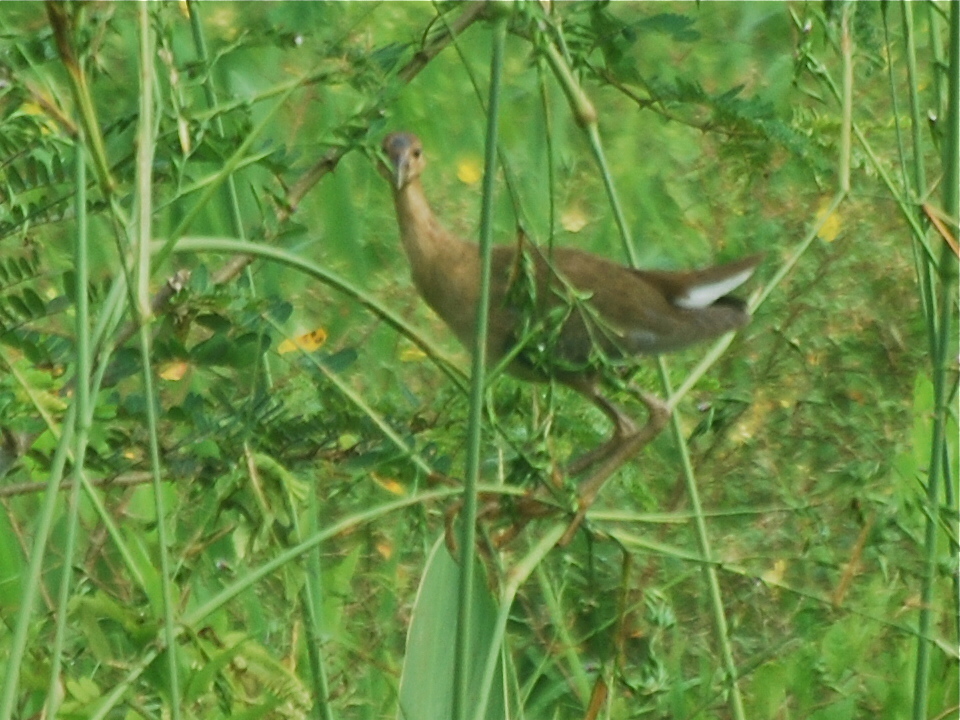
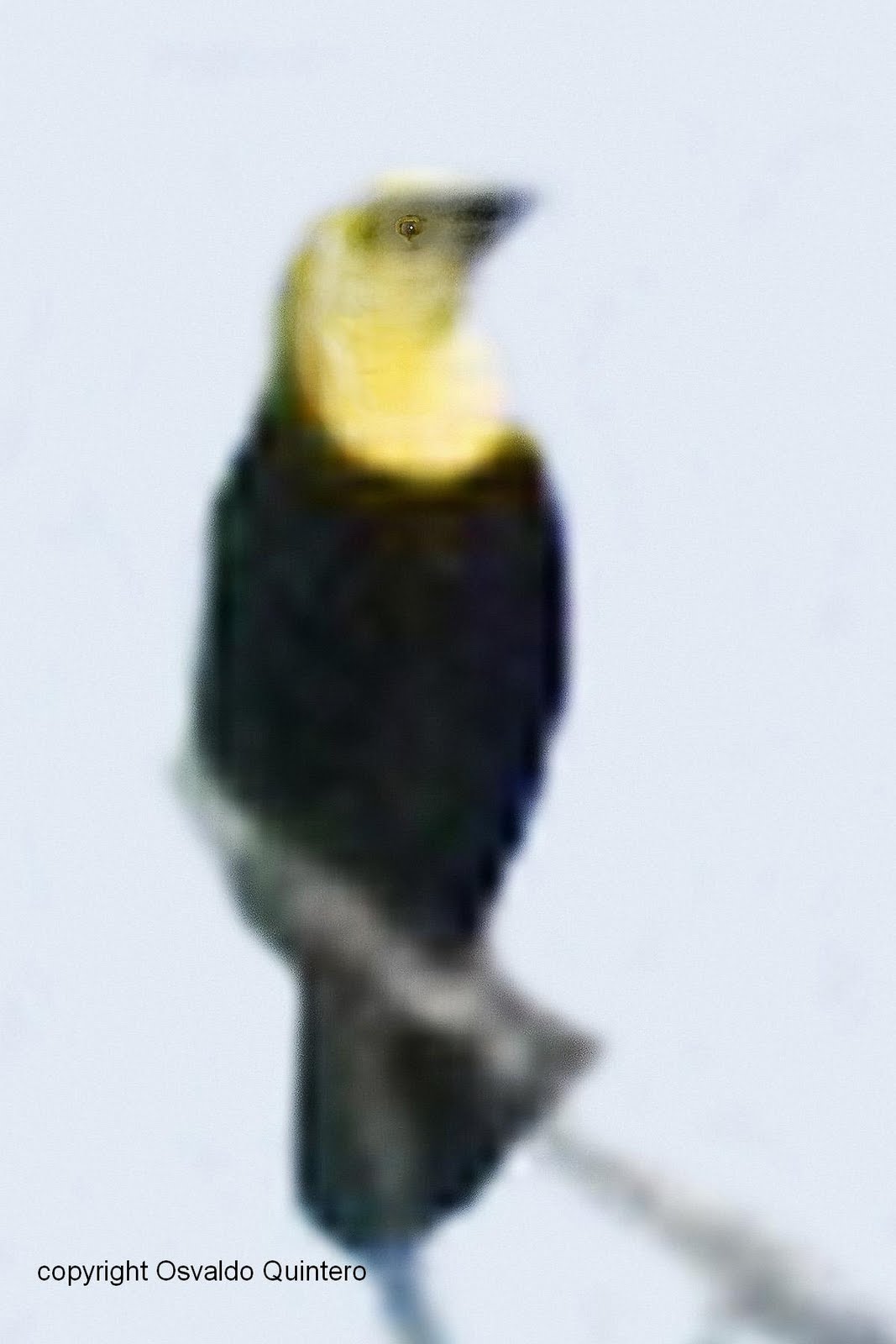
Darien is the easternmost, largest and less developed province of Panama, with a rich biodiversity, including hundreds of birds species. And now it is not indispensable to organize a huge expedition to remote areas to enjoy it... as you will read, it is enough with one day! The last weekend of september, I left Panama City the friday's afternoon with Rafael Luck and Osvaldo Quintero toward the town of Meteti, in central Darien. We only did few stops along the way, including some spots around the Bayano bridge, finding a female Cerulean Warbler with a mixed flock and a nice Crimson-crested Woodpecker drilling a hole in a dead trunk. In Meteti, we contacted our local guide, Daniel Santos by recommendation of Venicio "Beny" Wilson who told us about the several new birding spots along the Panamerican highway and the highlights he found recently (you can read it on his report to Xenornis). A very early breakfast the next day in town (with tons of House Sparrows waiting for the breadcrumbs) and we were ready for action. We picked up Daniel along the way and immediately he showed us the first birding spot: a marshy area beyond the town of Betzaida. The place was alive with birds, with both Smooth-billed and Greater Anis inspecting the bushes, Cattle Egrets following -you guessed it- the cattle, adult and juvenile Purple Gallinules inspecting the rushes and a pair of Black-bellied Whistling-Ducks flying over the marsh. We also heard the first, of many, Gray-breasted Crakes, but they were hidden in the thick vegetation. We drove a little farther to the east and took a side road with the entrance marked by a cow's skull. Immediately, in the dirt road we saw several Red-breasted Blackbirds very low, the males exhibiting the rather dull non-reproductive plumage, and a Cattle Tyrant walking in the open. There are few reports of Cattle Tyrants from Darien, including the very first one for Panama in Cana many years ago, so it was a delightful find. Each time we approached the bird, it flew to a low tree by the side of the road, where it looked like a kingbird. We visited exactly the same site at least four more times and we found the bird each time in the same place. The tyrant was not the only highlight of that road. We also saw several Pied Water-Tyrants, one (probably more) Spectacled Parrotlet and a White-tailed Kite eating a lizard, but the best was about to come. Close to the entrance, we heard the characteristic tinkling song of several Gray-breasted Crakes. Osvaldo started to play the call with his i-phone and then an adult Gray-breasted Crake came to the open for five seconds to inspect us!!! A HUGE lifer for me and for Rafael, who managed to took the photo I'm showing here. You can't imagine how many times I have been close to singing individuals without having a glimpse of the bird! Very happy with the encounter, we drove back to the first marsh, when suddenly, I spotted a bird atop some bare branches next to the road... a male Yellow-hooded Blackbird!!! Osvaldo took a quick blurry shot of the bird from inside the car, but the blackbird didn't wait for the rest of us, and flew very high in the distance. This species is a recent addition to Panama's list, but it was Beny who first reported it in that part of the province. It was not a lifer for me, since I saw a male a couple of years ago in El Real (farther east), but it was for Rafael and Osvaldo. It was around 10:00 A.M. and the sun was very high and hot already. We drove back towards Meteti, picking up along the way some interesting species like Spot-crowned Barbet, Orange-crowned Oriole, Yellow-breasted Flycatcher and a nice Striped Cuckoo singing its heart out. We stopped at a little marsh outside the town of Nuevo Bijao. It was tiny, VERY close to the highway and the place was so hot that we had little expectatives. But then Daniel saw a male Yellow-hooded Blackbird flying just over the marsh just to drop into it suddenly! Only Daniel saw it... but it was enough for us to spent a couple of more minutes inspecting it. Despite the heat, we started to see and hear nice birds eventually. Inspecting the distant trees at the edge of the marsh, we discovered a lonely Limpkin perched quietly quite low while an adult Pearl Kite was trying to escape of the trio of Tropical Kingbirds harassing him. We heard both Gray-breasted and White-throated Crakes side-by-side and saw a bunch of migrant Orchard Oriole and Yellow Warbler. But the real surprise came later. At the edge of the marsh, we got a pair of Black-capped Donacobius preening! Despite the distance, the amount of white, both in the tail and wings, was pretty obvious. After asking for permission to the owners of the adjacent ranch house, all of us climbed up (OK, some crawled) the barbed wire fence to have closer looks. With the aid of Osvaldo's i-phone, the birds approached enough to have excellent views (but not excellent photos as you can see). These birds are unique, and the show they perform while duetting is amazing! However, while enjoying the Donacobius, we did saw several males Yellow-hooded Blackbirds flying over the place... I even saw one perched among the tall grass for few seconds after it landed. We left Nuevo Bijao and visited the Fundación Vida Nueva at the entrance road to El Salto. The foundation keeps an extensive forest which harbors many Darien specialties... but it was almost noon when we reached the place, and the only birds we saw were Collared Aracaris, Black-chested Jays and a pair of Black-cheeked Woodpeckers (the "USE BOOTS" sign is justified, the trails were VERY muddy). We left Daniel at his home and left Darien after an excellent birding, with a huge list full of eastern Panama specialties and after spending only one morning!

Wednesday, August 11, 2010

Birds bonanza in Metro Park

Yesterday, I went to the Metropolitan Natural Park following the directions of Osvaldo Quintero who told me that the trees at the lookout were full with fruits and birds since the last week. I just wanted to see what it was all about up there so my plan was to walk without resting all the way to the lookout, which is at 135 meters above sea level in Cedro hill. I took the Mono Tití trail because is wider and fresher than La Cieneguita trail, which starts behind the rangers' station. Of course, my plan of walk directly to the lookout without stopping on route was quickly interrupted due to bird activity. Close to the first lookout (in the way up), a dead trunk attracted three different couples of birds: one of Crimson-crested Woodpeckers, other of Lineated Woodpeckers and a pair of Orange-chinned Parakeets excavating a nest in a termite nest... all in the same trunk. Both pairs of woodpeckers were working in different branches, ripping apart and throwing huge pieces of bark from the trunk while looking for worms and other insects, without agressions or shouts, everything in harmony. The parakeets stopped what they were doing to have a look at me, they are so curious! The understory that surrounded some fallen branches and roots of the dead trunk was also alive in birds. A pair of Fasciated Antshrikes were inspecting every corner while a Dusky Antbird sang from a cover. It is fascinating how a dead trunk have so many niches to occupy. Back on route, I started to hear the flocks of birds while approaching the lookout. And then I realized why... many of the trees bordering the lookout were full in fruits, just like Osvaldo told me. Many species were taking advantage of this, not only the frugivores, but also many insectivores as well. I also noticed lots of butterflies and other insects in the area, and many mammals too (more about them in my next post). I simply sat down and waited. The birds appeared in waves. First a flock (yes, a flock) of Tropical Kingbirds, more or less 20 birds eating fruits and flycatching, accompanied by one, possible two Dusky-capped Flycatchers. Also, many Yellow-green Vireos were feeding at the trees, probably preparing themselves for their journey to South America. The frugivores were represented by Blue-gray, Palm, White-shouldered and Plain-colored Tanagers and also Blue Dacnises. Even a Squirrel Cuckoo showed up, also eating fruits! Then, I found a single Double-toothed Kite nicely perched just below the canopy. At first, it was far away, but got closer while following a troop of Geoffrey's Tamarins. That was not the first time that I see those kites following monkeys. If you have any doubt about why they are called double-toothed, check the close-up that I made of its head. A mixed flock of swifts and swallows patrolled the air over the lookout, with Short-tailed and Vaux's Swifts, and Gray-breasted Martins. Sometimes, they were so close that I thought they were going to hit me! I spent more or less three hours at the lookout! In the way out, I checked the spot of the Common Potoo reported elsewhere, finding only the downy fledging acting already as an adult potoo... it is not the cuttest thing?