The Azuero Peninsula, in south-central Panama, is known by its infamous history of deforestation that began with the Spanish colonization. However, there are still patches of wooded areas, mainly in the highlands of the southern extreme of the peninsula, specially in the
Cerro Hoya massif. This is not coincidence... the roughness of the area, and its inaccessibility prevented the destruction of this natural treasure... but also prevented its exploration, thus becoming one of the most unknown areas in Panama, ornithologically talking at least. Home to some range-restricted and globally threatened species, the Cerro Hoya massif also host a number of montane species represented by distinct forms, isolated from similar populations by at least 150 kms.
That's why my friend Euclides "Kilo" Campos and I were so interested in climbing that mountain. Accompanied by a visitor birder, Macklin, and organized by Kees Groenendijk (of
Hotel Heliconia, he also accompanied us), the four of us set camp at 1160 meters above sea level last week... after six hours of climbing along a winding and steep trail.
 |
| Campsite |
Of course we birded along the trail, finding some very nice species. We started to hear, and see,
Brown-backed Doves above the 400 meters mark and to hear Azuero Parakeets above the 1000 meters mark. Both are endemic forms, still considered subspecies of wider-ranged species, in this case, Gray-headed Dove and Painted Parakeet, respectively. The Panama Audubon Society considers both full species, endemics to the country... quite restricted endemics by the way!
 |
| Brown-backed Dove |
Also above the 400 meters mark the characteristic calls of the
Three-wattled Bellbirds started to be more and more common, as well as sightings of
White-ruffed Manakins. These populations seem to reside in the area year-round. About the bellbirds, some experts think that these birds differ vocally to the populations of the western highlands. The far-carrying calls are impressive. However, in spite of the loud calls, these beautifully patterned birds are quite difficult to see. We were lucky enough to spy some males, and I managed some photos as well.
 |
| male White-ruffed Manakin |
 |
| male Three-wattled Bellbird |
We stayed two nights in the forest, spending one day almost entirely above the 1200 meters mark looking for montane subspecies, finding both expected and new ones for this region. The montane forest made us wonder if we were still in the Azuero Peninsula! There are some curiosities up there... for example, some lowlands species are found all the way up to the montane forests, like
Scaly-throated Leaftosser and Cocoa Woodcreeper, certainly due to the lack of their montane counterparts in this region (in these cases, Tawny-throated Leaftosser and Spotted Woodcreeper respectively).
 |
| Scaly-throated Leaftosser |
Other montane species are shared with other remaining (although lower) montane areas in the Azuero Peninsula, like
El Montuoso Forest Reserve. Some of these species are widely distributed, like the
Golden-crowned Warbler, while other are more local, sometimes hard to find... like the beautiful
White-winged Tanager. Cerro Hoya is probably the most reliable site to find this beauty!
 |
| Golden-crowned Warbler |
 |
| male White-winged Tanager |
But we were after the forms only found in the Cerro Hoya massif... and we found three of them (only missing the
Selasphorus sp., probably due to lack of appropriate habitat up there). All of them were above 1200 meters above the sea level. The most common was the
Purple-throated Mountain-Gem. This form is certainly a new subspecies... and probably a new full species!
 |
| male Purple-throated Mountain-Gem ssp. nov. |
 |
| male Purple-throated Mountain-Gem ssp. nov. |
Check
this post with the rationale of why this could be a good species... you can see the differences with other forms in my photos. The other endemic form was the
White-naped Brush-Finch, ssp.
azuerensis. This form was darker in the underparts and browner in the upperparts than other forms found in Panama... it was also more arboreal and quite shy.
 |
| White-naped Brush-Finch ssp. azuerensis |
The last form was the most difficult to find... in fact, we only saw two pairs, both above the 1300 meters mark:
Black-cheeked Warbler. Phenotypically, the only difference we noticed was its olive(ish) upperparts, instead of grayish. These birds responded to recorded calls of Black-cheeked Warblers from the western highlands.
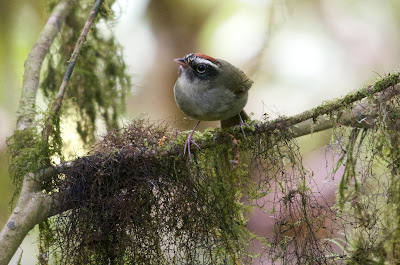 |
| Black-cheeked Warbler ssp. nov? |
As you can see, it was a quite productive trip. We recorded 123 species for the area, including some new ones to Azuero and even one lifer! While walking around 1300 meters above sea level, we found two chicken-sized birds walking in a small ravine... they were Rufous-necked Wood-Rails! That evening, we heard at least two pairs at the campsite... Kilo barely managed to record part of the call with his cell phone (headphones needed).
There are only few reports of Rufous-necked Wood-Rails in Panama, where it is considered a real rarity and this is the first time the species have been recorded away from mangroves in Panama (although it has been recorded in similar habitats in other countries). As you can see, there is still much to learn about this place, and I'm pretty sure this is not the last thing we will heard about discoveries in Cerro Hoya!


 Posts
Posts