Showing posts with label White-tipped Sicklebill. Show all posts

Thursday, March 20, 2014

PAS Fieldtrip to El Chorogo. Part III.

In my previous entries, I posted photos of the specialties found in the forests of El Chorogo (western Panama, Burica Peninsula).  This post will include more widespread species, but also some non-bird inhabitants of these forests.  Two and a half days is probably not enough to discover all what this place has to offer, but we (William Adsett, Antonio Domínguez and your host) were very lucky.  For example, we saw White-crested Coquettes every single day of the expedition, including two gorgeous males feeding in white flowers at the canopy of a tree along the Costa Rica-Panama border trail (in both sides of the trail!).
male White-crested Coquette
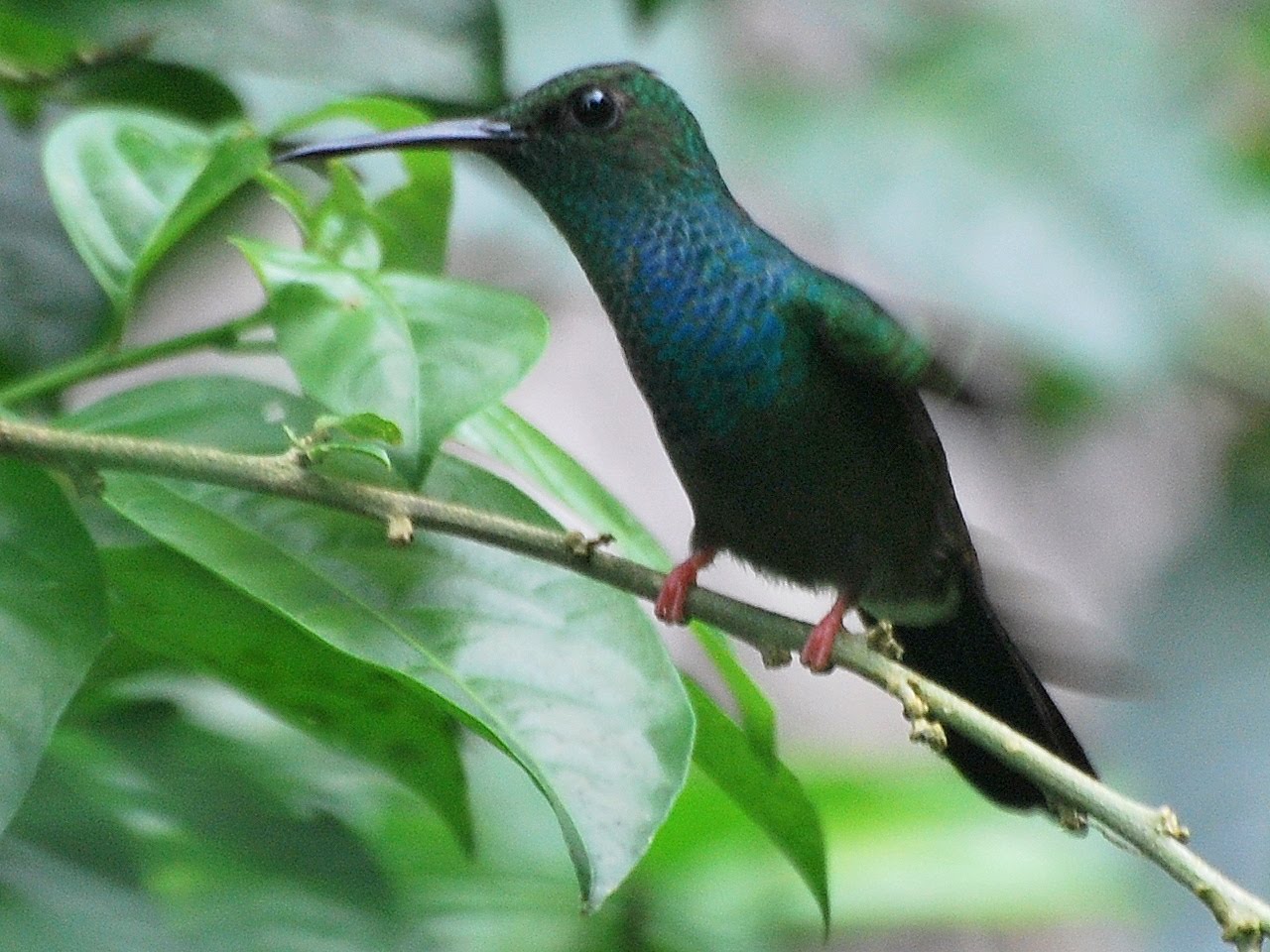
That was my first adult male for that species.  I usually see females in the foothills.  Not a common species anywhere!  We did well with the hummingbirds, probably because we found many flowering trees, including many Inga and Salvia sp., attracting Charming, Snowy-bellied and Rufous-tailed Hummingbirds, Long-billed Starthroat, Blue-throated Goldentail, Stripe-throated and Long-billed Hermits, and tons of Crowned Woodnymphs (abundant inside the forest!).  However, our biggest surprise was this White-tipped Sicklebill that hovered in front of me for some seconds!
White-tipped Sicklebill
Although not unexpected, this is probably the first record for El Chorogo.  Always an impressive hummer to watch!  Another impressive sighting were the Great Tinamous' eggs.  Why?  Because they are of a bright turquoise color!
Great Tinamou's nest with four brightly colored eggs
This is weird because most of the neotropical ground-dwelling bird lay cryptic eggs.  Egg color is probably an intra-specific signal for others tinamous; thus, attracting several females to lay its eggs together because a large clutch is less prone to predation than a small, single female-layed clutch, according to a theory.  We found this nest after flushing the male.  We also flushed another ground-dwelling bird during one of our walks:
Marbled Wood-Quail
Yes!  A Marbled Wood-Quail, this individual decided to froze in a branch, looking at us.  It was a member of a small covey that stayed undercover.  They are frequently heard, but rarely seen this well!  Close to campsite, a boreal migrant became one of my almost-lifers: a Louisiana Waterthrush.  One individual was walking along the waterhole deep inside the forest.
My poor photo is due to the light conditions inside the forest... very dark in fact.  In spite of this, you can see the broad, white eyebrow and the buffy flank of this bird.  I also noticed the snowy white throat (with no streaks) and the chip notes that sounded slightly different to the widespread Northern Waterthrush (that we saw outside the forest).  Also close to campsite, we saw some Spot-crowned Euphonias.
male Spot-crowned Euphonia
In the above photo you can see the "spots", invisible under normal field conditions.  This was the only euphonia found inside the forest, and is restricted to western Panama... specifically to Chiriqui province.  Another Chiriqui-restricted species in Panama, although not a bird, is the Central American Squirrel Monkey.
Central American Squirrel Monkey
In fact, this species is restricted mostly to the Burica Peninsula in Panama (see the comment section for details) due to habitat loss in its formal range (more widespread in Costa Rica).  We found several troops, some with more than 30 individuals and with many females carrying youngsters. They are very agile, roaming the treetops with grace and skill.  Of course, we were careful as we watched the canopy. The reason? The inhabitants of the forest floor, like this harmless snake about 5 feet long.
After some research by Bill, we think this was a Pseustes poecilonotus, known by many common names (like Neotropical Bird Snake, Dos Cocorites, and so on...) and highly variable.  We have no idea of the name of this species when we saw it... but had no doubts when we saw the next one:
Fer-de-lance!  This is a pit viper, the main cause of snake envenomation in Panama, where is widespread and well-known by the locals as "Equis" (meaning "X") because of the dorsal pattern resembling the letter X.  Thank God no one stepped on!  
We added more species in the way out the last day of our expedition, like Gray-crowned Yellowthroat and Great Antshrikes, and had great looks of some raptors nicely perched, like this Laughing Falcon atop a towering tree in the middle of pasture lands.
Laughing Falcon
Or this majestic King Vulture that you usually see flying high overhead.  What a great way to end a terrific trip!
King Vulture
The wildlife found in El Chorogo is the most threatened in Panama due to the destruction of all its formal extension, and we have to support the efforts of Panama Audubon Society and some other ONGs (as well as some particulars) to protect it!

Wednesday, December 8, 2010

No Violetears, but plenty of Sicklebills!

That is right, last sunday I went again to Cerro Azul (central Panama foothills) along with Osvaldo Quintero and Rafael Luck in search of the Brown Violetear reported elsewhere. Contrasting with my last visit, the day was sunny and hot in Panama City when we left it, and it was a clear day too in Birders' View when we arrived, but very windy. The activity was quite low, specially in the flowering trees and bushes that were attracting the hummingbirds, so we did not saw a sign of the Violetear. We decided to bird inside the forest, sheltered from the wind. Eventually we got to the now-famous Heliconia patch, home of the splendid White-tipped Sicklebill, and just few seconds after our arrival, one individual hovered in front of me for three seconds! Despite its dullness, the White-tipped Sicklebill is spectacular if you take into account its size and, of course, its distinctive bill. The combination of curved bill and streaked underparts is unique among Panama's hummingbirds. They are perfectly adapted to the dark understore where they live (just see how much light its eyes reflect when you photograph them with flash), sucking the nectar of the Heliconias flowers with its specialized, 90º curved bill. The purpouse of that extravagant bill become evident when you see its favored flowers (as in the picture). Notice also that they like to perch in the flowers, instead of hovering in front of it, when feeding. We found at least two different individuals, with one of them allowing great pictures while perched, making its insignificant call. After all it was a great, sunny day at Cerro Azul, despite we did not see our main target... but who is complaining?
This post was submitted to Bird Photography Weekly # 119. Check it out!

Sunday, November 21, 2010

Cerro Azul hummers revisited

I'll be sincere. This post is just an excuse to publish some photos of hummingbirds found at Cerro Azul my last time there. Some are OK, others are bad, but still showing some interesting species, most of them for the first time in this blog.
I already posted photos of my year-birds # 600 and 601 (Violet-headed and Violet-capped Hummingbirds), but with my year-bird # 603 I was not as lucky in order to get good photos. Despite that, we got terrific views of several White-tipped Sicklebills at a known spot in Birders' View thanks to their habit of inspecting you while hovering in the air right in your face! These amazing birds have specialized 90º curved bills to extract the nectar from specific Heliconias flowers. In this (bad) picture, the bill is not evident, but the bird is hanging from its favorite Heliconia. You can readily recognize the bird by its streaked underparts, unique among the hummingbirds of that locale. The second (bad) picture is from near El Valle de Anton (Cocle province), just to show the bill and also that it is usually not easy to photograph them because they prefer shaded places inside the forest.
Like the sicklebills, the hermits also have the habit of confronting you. The common species in Cerro Azul is the Green Hermit. These are big hummers with long tails and decurved bills. They exhibit some sexual dimorphism, with the males being greener than females, which exhibit different degrees of gray and tawny on their plumages. These are common feeders visitors, like other big hummers, but they are not dominant on them. They can be very difficult to detect when perched, specially the lekking males low inside the forest. As you can see, both pictures here are of females. Other hermits species are less common at the gardens we visited, including both the Long-billed and Stripe-throated Hermits (both are commoner in the lowlands).
At the Ahrens' place, a very nice Purple-crowned Fairy visits regularly the hummingbird feeders. These hummers are so elegant and delicately patterned in clean white and green that it is hard to believe. The lack of green moustache makes this individual a female, which have longer tails than males. This is not the first time I post a photo of this species, but who can get tired of it? Other big hummer regularly visiting feeders at Cerro Azul is the Long-billed Starthroat. I saw it once in Birders' View, but it seems more regular at the Ahrens' place and at the Lieurance's place (The Petrels in Panama living in Cerro Azul, check their video).
Of course, we also saw more common species like Snowy-bellied, Rufous-tailed and Blue-chested Hummingbirds and White-necked Jacobins, but I have posted photos of them before elsewhere. Somehow, I haven't posted photos of the next species despite its commoness in Cerro Azul: the Bronze-tailed Plumeleteer. This is also a medium to large-sized hummingbird inhabitant of forests and borders that is readily attracted to feeders. It is SO easy to identify due to its conspicuous red-pinkish feet, a mark not shared with ANY other hummingbird in Panama.
Well, the list of hummingbirds recorded at Cerro Azul is impressive, including some species that I still have to find in that place (Green-crowned Brilliant comes to my mind) and others that are present only seasonally, like the Rufous-crested Coquette and the Green Thorntail. I still need many more visits to that charming piece of Panama!

Monday, July 27, 2009

Todies' Land

Nop, I'm not going to write about the Greater Antilles because I'm not referring to those todies. I refer to the Tody Motmots, the smallest member of its mainly Central American family. There is something about these birds... they are rare and little known in Panama, but also very attractive and smart. Last saturday I went with Osvaldo Quintero and Rafael Luck to El Valle de Anton in search of this little friend. We explored a side road close to the little town of Los Llanitos on the way to El Valle. We already had experience with todies on this road last May, seeing at least three different individuals along a little creek at the far end of the road. This time, our plan was to bird from the road itself and quickly we heard the call of one of them. Using a recording, we attracted THREE different todies that soon lost any interest in us. Further ahead on the road we saw and photographed others THREE different individuals. They are not easy to photograph. We always found them in shaded places with lots of tangles, usually always behind a leaf or a branch. In addition, they seem to be unsociable enough, moving away rapidly after a quick inspection of the intruders. Then, from a safe perch, they remain still (usually too far for my lens), moving its tail from one side to another, just like others motmots. I'm surprised of finding such a big population in a disturbed area like that one. In fact, not any of the others species recorded in the area are associated with forest (we saw many common species, and heard a Sepia-capped Flycatcher). I have seen todies before, but usually in large tracks of forest (where they are more entrusted with the observer, for example, in Chucanti). Not enough with this, there are many others reports of todies in El Valle itself, specially around the Canopy Lodge area. Of course we birded the El Valle and La Mesa areas, without finding any other tody (we have never been lucky in that place anyway), but seeing a nice mixed flock in the entrance of the Gaital Natural Monument (Tawny-crested and Silver-throated Tanagers, Bananaquits, Tawny-capped Euphonia, Slate-colored Grosbeak and so on...) and a White-tipped Sicklebill perched on Heliconias along the road to La Mesa. So, if you still needs the Tody for your life list, go to Todies' land and have fun.