Pelagic birding is always fascinating... the idea of chasing birds that only land to nest in remote islands, with some of them crossing the world to visit our seas, is just overwhelming! Our knowledge in Panama about our pelagic birds is limited, so there is plenty of room for new discoveries. That's why I did not think twice when I was offered the opportunity to participate on a pelagic trip off the Azuero Peninsula in central Panama from the charming town of Pedasi, last weekend.
So I joined George Angehr, Rafael Luck and Euclides "Kilo" Campos aboard a 30 ft sport fishing boat anchored at El Arenal beach, just few minutes from town. Our captain Jeff and his crew member "Lito" were willing to make our trip enjoyable as possible, so they received us with a cup of hot coffee and explained some safety issues before departing. Jeff is experienced in this kind of trips, since he was the captain of our last pelagic (back in 2010) and, of course, of the most recent trip earlier this year (report
here).
 |
| Euclides "Kilo" Campos, George Angehr, Jan Axel Cubilla and Rafael Luck |
Good fortune smiled on us from the beginning... the sea was calm as a mirror in El Arenal, and remained so throughout the trip... no seasickness at all (except when Lito mixed up the chum... more on that later). Also, our captain managed to keep us in schedule and to avoid the thunderstorms that approached from several directions! We planned a 8-hours trip out at the sea with the intention to visit two seamounts to the south and south-east of Punta Mala, one of these surrounded by 1000-meters depth where we saw a
Tahiti Petrel (the first for Panama) in 2010. We got some common in-shore species the first hour of the trip, like Brown Pelicans, Magnificent Frigatebird and
Brown Boobies.
.jpg) |
| A shy Brown Booby |
Soon, we started to see more pelagic species. Not exactly tubenoses, but some interesting species like Sooty, Black and
Common Terns. The later prove quite difficult to ID at sea wearing its winter plumage. Of course, we were on the search for some rarer terns (like Artic or Roseate Terns for example)... but the photos were pretty useful for ID purposes.
.jpg) |
| Common Tern |
We reached the first seamount by 8:00 am (N 7º 14' 52.0'', W -80º 1' 0.2''). The idea was to spent at least one hour at each seamount chumming. Our chum consisted in a mixture of fish oil, some cans of tuna, sardines and popcorn. We only had two gallons of fish oil, which is hard to find in Panama. However, I want to thank Fulo Motta and Lily Vallarino who kindly donated the oil and who seemed really interested when Rafael explained them what we would do with it! Instead of throwing bait overboard constantly to create a wake behind the boat, we decided to throw some to create a "stain" to then navigate around it by making wide circles, waiting for the tubenoses!
 |
| Bucket of chum... stinky! |
We were surprised by the strong smell of this modest mixture... as soon as Lito started to mix it up, the stench penetrated directly to our medulla oblongata! Kilo and I struggled to avoid throwing up at the time (we were really close to the chum). Thank
God we got used quickly... and the chum started to work... and boy, it did it! A medium-sized bird approached swiftly gliding low over the waves, arcing and banking with its long wings. Dark brown overall with contrasting, well demarcated white lower breast and ventral parts... Kilo and I shouted at the same time TAHITI PETREL!!!
%2Bfirst%2Bseamount%2B2.jpg) |
| Tahiti Petrel |
%2Bfirst%2Bseamount%2B3.jpg) |
| Tahiti Petrel |
The moment was so sublime that even George thought we were joking... a Tahiti Petrel was inspecting the stain of chum, allowing great views and photos as well (all the bird photos in this post are mine... If you want to see some really great photos of this trip, check Rafael's at the report in Xenornis). Size, all-dark throat, lack of white leading edge to the wings and pale rump separates this species from other very similar (although unexpected) tubenoses, including Phoenix Petrel. In fact, these photos confirm its presence in Panama waters, because it was considered hypothetical for Panama.
%2Bfirst%2Bseamount%2B1%2B.jpg) |
| Tahiti Petrel with southern Azuero in the background |
Eventually, we saw two birds at the same time! I really like the above photo because you can see how close to mainland we were... that is the charm of this region ... the continental shelf ends abruptly near the coast here, allowing us to have these experiences. The Tahiti Petrel was not the only species attracted to by the chum... three species of Storm-Petrels decided to show up as well. I had seen both Wedge-rumped and Black Storm-Petrels before in Peru and Panama... but the Least Storm-Petrel was a life bird for me... the first for the day!
.jpg) |
| The Black Storm-Petrels are not really "black" |
After this success at the first seamount, we decided to go to the next one, which seemed even more promising given the proximity to really deep waters. On route we started to see our first shearwaters, plus another species already recorded, like Brown Boobies and Sooty Terns. The first shearwaters to appear were the Galapagos Shearwaters. This species is regular and common (at least in september and october) and so far all seem to be of the "pale underwing form" (there is
some variation in the underwing pattern of this taxa).
.jpg) |
| Galapagos Shearwaters (pale underwing form) |
Then came the second most common shearwater for this time of the year, the
Wedge-tailed Shearwater. My photos shows an individual in pale-phase, by far the most common out there; however, we also saw a dark-phase individual (photo in Xenornis). Notice the slender profile accentuated by the long tail and long, dark bill.
%2Bdorsal%2Bview.jpg) |
| Wedge-tailed Shearwater (pale phase) |
%2B2.jpg) |
| Wedge-tailed Shearwater (pale phase) |
After two hours, we finally reached the second seamount (N 7º 18' 31.7'', W -79º 39' 43.1'') and started to chum again, this time with no adverse effects at all. This time, the birds were slow to appear; however, the first one to show up was... you guessed it, a
Tahiti Petrel again!!!
%2Bsecond%2Bseamount%2B1.jpg) |
| Our third Tahiti Petrel for the day! |
%2Bsecond%2Bseamount%2B2.jpg) |
| Tahiti Petrel over the waves |
The photos showed a different bird to the two others we encountered before in the first seamount (notice the molt in the flight feathers)... simply amazing! But soon things got better... our captain warned us that a white bird was flying in front of the boat heading to port... so I hurried in that direction in order to catch a distant
Nazca Booby that seemed to be just passing (completely ignoring us).
%2B1.jpg) |
| Nazca Booby |
It was a lifer for me as well! And a long expected one. I managed to get the distant photo above showing the diagnostic orange bill. The bird disappeared in the waves soon after that. And we started to see
Wedge-rumped Storm-Petrels. At one point, we saw three of them at the same time... a low number considering previous experiences with this species in these waters.
.jpg) |
| Wedge-rumped Storm-Petrel |
We were running out of time, so we started the way back. By 12:30 pm, we saw a huge flock of shearwaters and terns close to the surface. According to Lito, this was a feeding frenzy over a school of tuna, so we headed there. The activity was fast... and furious. Soon, a Pomarine Jaeger (the second for the day) inspected our wake, followed closely by our second
Nazca Booby! This time, the bird circled us once (allowing great photos) and lost interest.
%2B2.jpg) |
| Nazca Booby |
We finally managed to spot a definitive
Sooty Shearwater (after several false alarms, including the dark-phase Wedge-tailed Shearwater of which I spoke earlier), the silvery wing linings literally shone. We are pretty sure that it was not alone, but we were not able to inspect all the flock due to lack of time. The big surprise came shortly after this. Three shearwaters were approaching the boat from the bow to port flying just a few feet above the waves... I called them first Wedge-taileds due to their size and general pattern and started to shoot them; however, I realized that they looked stockier and not as long-tailed, so I yelled to Rafael to shoot them with his full-frame camera, which he did when the birds made an U-turn and began to approach from astern.
By that time, I just thought it was a good opportunity to photograph the birds, as they were passing close... I shoot them again, but this time managing only to capture the back of one of them.
It was not until I reviewed my first photo that I realized that these birds were in fact
PINK-FOOTED SHEARWATERS... a species that I had seen twice in Peru in large numbers, but ever recorded for Panama... I grabbed Rafael's camera and started to see his photos as well... simply WOW!!! He managed excellent shots of these birds! The stocky shape, lack of white in the rump and the heavy looking, pale bill with black tip are good field marks.
%2Bcropped.jpg) |
| Pink-footed Shearwater |
In the cropped photo above is evident the underwing pattern... even the pale legs are visible (almost reaching the tip of the tail)! If accepted, this would be a new addition to Panama's bird list. Certainly, a successful trip... two life birds, another two Panama life birds, one confirmed species and another new to the country! This only proves that we need to venture more often to these depths in order to better understand the occurrence and distribution of these pelagic species in our country.
 Our crew knew exactly what we were up to! Our captain Chaka took us immediately to deep waters south of Burica island and then to the east along the Continental Shelf break while mate Jacinto helped us with all our needs and with the chumming process (essentially fish guts and pop corn). They have a lot of experience fishing pelagic billfishes, but this was their first time guiding a group of birders... the essentials tips seems to be the same for both activities (fishing and birding in deep waters). But even before reaching deep waters, we started to have some nice surprises, like the completely out-of-season Elegant Terns close to the lodge (they are supposed to be breeding in Baja this time of the year) and the Humpback Whales swimming extremely close to the town beach (a little bit early, but not unexpected). Bird and whale watching could be some activities that the lodge can offer during the low-season months of fishing, as Christian pointed out.


.JPG)
%2Bdorsal%2Bview.jpg)
 tip of the Azuero Peninsula in central Panama. Worldbirder Björn Anderson kindly organized the trip and invited me (I'm so grateful by the way) and other four birders: Kenneth Allaire, Gonzalo Horna, Darién Montañéz and Rafael Luck. My journey started friday, when Rafael picked me up after work around 3:00 PM. We were loaded with fish leftovers, tuna cans and popcorn (the ingredients of the chum) and with all the excitement of being part of that trip. We all met at the charming town of Pedasí, where we stayed for the night to meet very early in the morning our captain Jeff and his seaworthy assistant, Armando. We followed them to


 We saw four Oceanites storm-petrels that we are calling Wilsons' (thank you Björn for noticing it). The commonest storm-petrel was the

 At 8:30 AM, Björn found the main target of the trip: a Tahiti Petrel (N 07º 20.002' W 079º 36.910). I hurried enough to see the clear dark-and-white pattern of the underparts and to appreciate its agile and swift flight above the sea


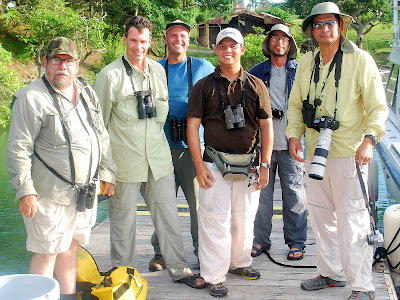 The self-denominated T.P. (Tahiti Petrel) Gang; from left to right: GH, BA, KA, JA, DM and RL.

 Posts
Posts