Nusagandi
 is an area protected by the Kuna people (under the name of Nargana Widlands Area) located at the western corner of the Kuna Yala reservation accesing through the now-improved

El Llano-Carti road, starting in eastern Panama province. It protects humid forest from the foothills at the border with Panama province to the coast and is home of many range-restricted species difficult to find anywhere else in Panama (and, in some cases, in the world!). So I picked up Euclides "Kilo" Campos for then meeting Rafael Luck at his home in order to begin another of what he denominates "FJ Cruiser trips" to this bird-rich

area. After 1.5 hours on the road, we finally reached the reserve. The road has a heavy traffic by people looking to escape during the weekend to the pristine waters of the Caribbean coast or to one of the paradisiac islands of the Kunas. We began to do some road birding, but curiously, the sunny day became to hot, and the activity was low (although it was an EXCELLENT day for all

the beach lovers!). Anyway, I found at least one new year-bird in each stop we made, thanks to my companions. At the first one, a flock of Brown-hooded Parrots; in the second one, a mixed flock with White-vented Euphonia, Sulphur-rumped and
Rufous-winged Tanagers; in the third, a mixed flock of antwrens with a pair of
Russet Antshrikes and in the last one, a Black-and-white Hawk-Eagle soaring not so high, showing its distinctive white edge to the
+female.JPG)
wing. We failed to locate the Slate-throated Gnatcatchers that are very local and scarce in Panama... but despite the heat, we had an already impressive bird list before we decided to walk the trails at the headquarters. After paying the fee for using the trails, we followed Kilo to the Igar Nusagandi (Igar = trail in the Kuna lenguage). We found a
Western Slaty-Antshrike (female in the pic) near the entrance of the trail, but the big surprise (literally) was a
Crested 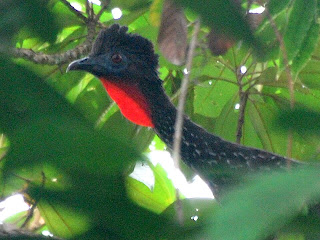 Guan
Guan that showed itself for a brief moment, to stay undercover after that, inspecting us nervously. These big birds have learned to be aware of the humans, and always are cautious and alert (compare this photo with that of a
Black Guan in Altos del María some time ago). The rest of the trail was almost devoid of birds. We followed the trail to the iber (waterfall) after passing the entrance of the Wedar Igar and then the trail became very inclined and slippery to a little creek where we heard a covey of Black-eared Wood-Quails and a Stripe-throated Wren. A Rufous Piha

appeared for a while, always behind a cover, making its loud call
Pi-HAA! Then, we heard the bird of the day (so far), a
Speckled (Spiny-faced) Antshrike. We crawled through the muddy slope to a flat area with dense cover where we found both male and female of this enigmatic species. We got excellent unobstructed views of this Panama near-endemic bird, but the site was so dark that my pictures barely show the bird (I'm sorry about these pictures, but you can check Rafael's photos -which are MUCH better-
here). It is indeed a weird bird, just like its Latin genus states:
Xenornis, no doubt about why Darien named
his website of latest reports of rare birds after it. In Panama, we all call this bird simply the Xenornis,

but if we have to use an english name, we use Speckled Antshrike instead of Spiny-faced (the
setifrons part of its Latin name), for obvious reasons (enlarge the images and tell me, can you see the tiny spine-like bristles around the beak?... me neither!). If this is the only country where you have a chance to see and enjoy this bird, why don't call it like all the natives do? We were so happy that we almost forgot the very inclined slope behind us, but we quickly remember it. Exhausted (well, Rafael and me, Kilo must be a

marathon runner or something), we left the place and drove to the town of Cañita to have a well-deserved cool drink and our lunch. The day became cloudy but fresher, so we were optimists in that it would be good for birds and birding. We explore the side roads beyond the Bayano bridge. In the first one we found, almost immediately, a pair of near-endemic
Black Anthrikes (a male in the picture, and the fourth species of antshrike for the trip), plus Gray-headed Tanagers,

White-flanked Antwren and an immature male Red-capped Manakin. Then, we tried another road, finding a nice mixed flock right by the entrance. Some birds attending were both Cinnamon and One-colored Becards, Ruddy and Blue Ground-Doves, Boat-billed, Piratic and Dusky-capped Flycatchers, Streak-headed Woodcreeper, Black-

cheeked Woodcreeper and a pair of
Orange-crowned Orioles (adult and juvenile). Then, Kilo found the bird of the day after hearing it: a female
Golden-green Woodpecker. This rare woodpecker is found locally in just few sites in Panama, and the subspecies found here (and Colombia) is almost unknown, ornithologically

talking. What a bird, and a lifer for me and Rafael! Its bright yellow crown, malar stripe and throat are unique among our woodpeckers. At this point, we were debating about the bird of the day (as you can imagine), but I stick to my decision toward the woodpecker (the Xenornis was not a lifer, just the first time I saw it after 12 years!). A quick stop at the Rio Mono bridge only produced Bat Falcons, Rufous-winged Antwren (heard), a pair of
Barred Puffbirds vocalizing (its call is SO funny) and a troop of
White-faced Capuchin monkeys. What a great day!


+female.JPG)


 Posts
Posts