Showing posts with label Green-crowned Brilliant. Show all posts

Friday, February 7, 2020

Mount Totumas Cloud Forest's Hummingbirds Gallery

Last year I had the opportunity to travel all over Panama, knowing new birds and sites by the way.  Certainly, one of the Top 5 sites (not only my opinion, but my family's too) was Mount Totumas Cloud Forest, in the western highlands of Chiriqui province.  Taking advantage of some free days in November, I went with my family for a couple of nights at the lodge, which is the highest eco-lodge in Panama (at 1900 meters), surrounded by a beautiful montane forest (as you can see in the top photo).  The well-marked trails are alive, not only with birds, but with all sort of critters, mammals and other wildlife... in fact, the place is known by holding one of the greatest invertebrates collection for Panama and by recording almost all of the feline species on its trails (captured with game cameras).  But a thing that is specially spectacular in Mount Totumas is the hummingbirds show.  Several hummingbird feeders placed strategically around the property, plus plenty of flowering trees and bushes, make Mount Totumas a hummingbird's heaven.
Gloriela using the hummingbird hat (featuring Snowy-bellied and Talamanca Hummingbirds)
The hummingbirds are used to people, so it is not rare to feel them close to you when they pass swiftly.  They will even feed right at your face, if you use the hummingbird hat!  They have a list of more than 25 different species of hummers for the property.  Of course, some are rare or do not visit the feeders, while others are seasonal... but the regular visitors are so amazing that you will spend hours admiring them without noticing it.  With some patience, you will get amazing shots, like the one I'm presenting in the next gallery
HUMMINGBIRDS OF MOUNT TOTUMAS
Glorious adult male Green-crowned Brilliant.
Talamanca Hummingbird.  This adult male is showing why its former name ("Magnificent") was  well earned.
Adult male Violet Sabrewing, one of the largest hummingbird in Panama
Lesser Violetear... what a boring name for such a great creature
Adult male White-throated Mountain-Gem.  The photo make him no justice!
Adult male Stripe-tailed Hummingbird.  A little jewel for sure.
I don't know what I like more, the contrasting Snowy-bellied Hummingbird or its pink perch.
Aptly named Scintillant Hummingbird, and adult male.
The star of the show: adult male Magenta-throated Woodstar.
So, what you think?  Amazing right!

Thursday, August 29, 2013

Not only endemics in Cerro Santiago

Besides the endemic species and subspecies found in our last trip to the mountains of the Tabasará range, we also saw more widespread species of birds as you can imagine (read this entry for example).  The group of intrepid birders consisted of William Adsett, Dan Wade and Charles Davies... and for us, every species was special in its special way.  For example, check out this Spangle-cheeked Tanager... beautiful no matter how common it is!
We crossed several flocks, always three to six birds, most of the time mixed with other tanagers, finches and/or warblers.  One of those times, the mixed flock was accompanied by a female Black-and-Yellow Silky-Flycatcher.  This is an odd silky... it looks more like a colorful thrush, and some even think that this species doesn't belong to the family.
One important element in the Tabasará avifauna are the hummingbirds (as you may know by now).  Besides confusing female Selasphorus, we saw more common species.  In fact, the most common hummer all over the place was the Purple-throated Mountain-Gem.  The ground epiphytes along the road through the slopes of Cerro Santiago were frequently visited by these hummers, allowing nice shots (here, adult and immature males, adult female).
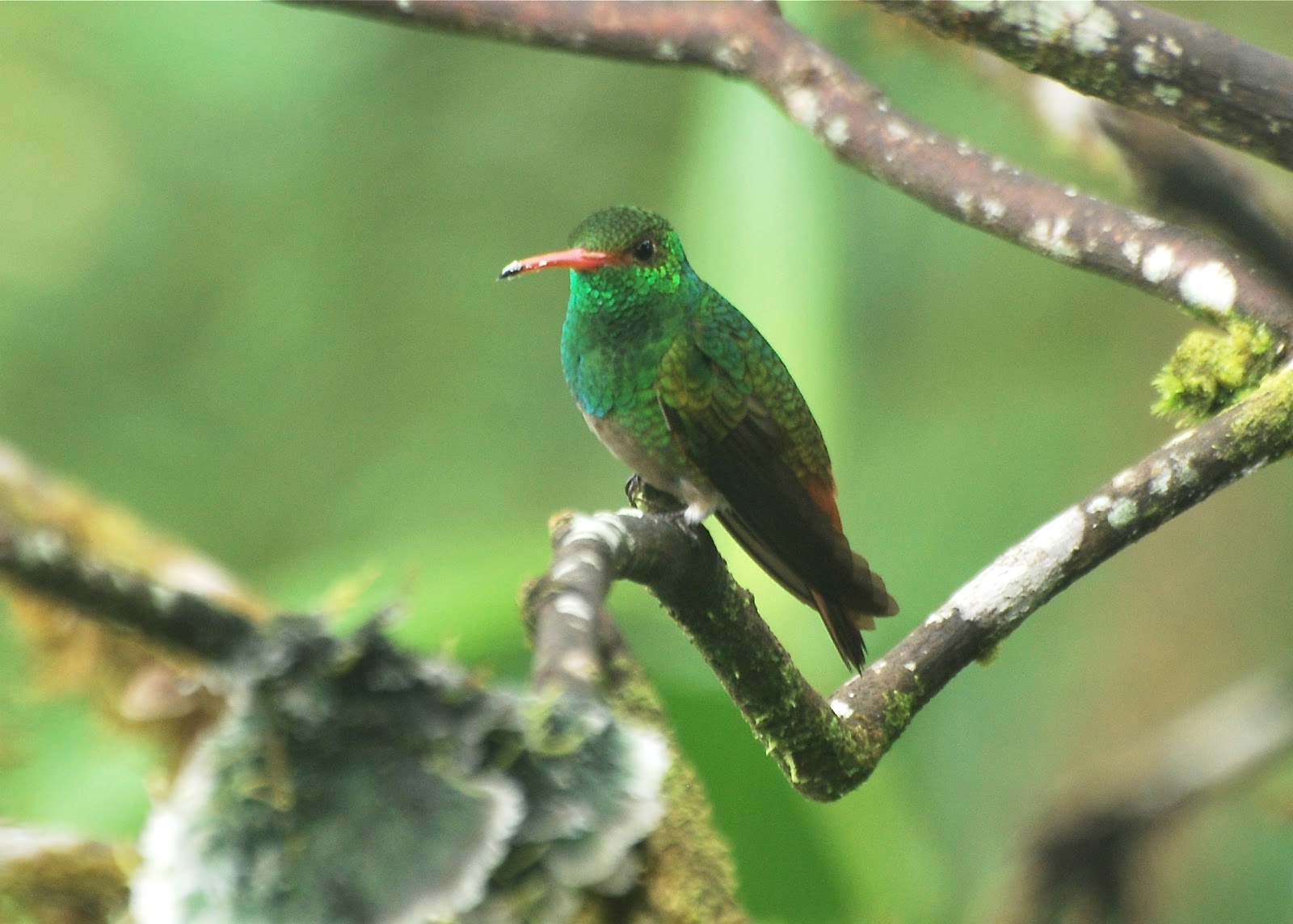
Others hummers for the area included Green Violetear, Violet Sabrewing, White-tailed Emerald, Stripe-tailed Hummingbird, Green-fronted Lancebill and Green-crowned Brilliant.  The male brilliant pictured here is quite blurry... but trust me that it was a real jewel glowing inside a beautiful cloud forest along the Continental Divide trail (above 1700 meters above sea level).
Not only the birds were putting a show, we saw some mammals, like this Pygmy-Squirrel in one of those productive forest patches along the road to the Ngöbe town of Ratón.  We still need some help to ID this little friend.
And the critters were awesome too... Dan was our expert in this field, and we learned a lot.  I will end this post with the photo of one of the coolest critter that I have seen.  Enjoy!

Sunday, April 8, 2012

Who plugs these birds to electricity?

The hummingbirds are famous for various reasons... the smallest birds, the only one that can fly backwards, owners of many records, and, of course, their iridescent plumages.  That's right!, I'm still posting about my last trip to northwestern Ecuador along with Rafael Cortes and José María Loaiza, and now is time to post some really spectacular photos of the masters of iridescence.  All you need is the right angle of light, for example... this Violet-tailed Sylph at Refugio Paz de las Aves looks pretty dull in the feeder... but when it leaves, you see a flash of color.
Even under poor light conditions, you still are able to see its iridescent tail!
Look at this impressive Empress Brilliant at the feeder... huge (for a hummingbird), size alone is enough to motivate some WAOOOs and AAHHHs.
But if you see carefully... they can show you why they are truly spectacular!
But the REAL master of iridescence is the Velvet-purple Coronet.  First a dull photo... that is not easy to get with this bird!
Usually, even the most minimal light is enough to ignite this one!  PAM!!! watch how different it can look depending of the light angle!  Truly electrical!
These phenomena is common to many hummingbirds... and not only at Paz de las Aves as you could guess, just watch this Green-crowned Woodnymph that was visiting the feeders at the Mirador Río Blanco, in Los Bancos (a little lower than Paz de las Aves).
With adequate light, even common hummers look shiny... check out this Rufous-tailed Hummingbird.
The Green-crowned Brilliant is a close relative to the Empress Brilliant showed above... and it shows also a glamorous glow... the female is also very pretty.  We got Green-crowned Brilliants in Panama... but I don't remember seeing them like this!
We also have Green Thorntails back in Panama... but in Mirador Río Blanco... well, they were ridiculously easy!!!  Both males and females are common visitors.
I hope you enjoyed this electrical gallery... the hummingbirds rocks!

Saturday, March 20, 2010

A Resplendant day in Cerro Punta

The journey to Cerro Punta took a little more of what we expected, thanks to the awesome birds we saw in the way. Our original plan was to spent most of the morning searching for an adult male Resplendant Quetzal, which Gloriela had never seen. She had seen quetzals before, but only immature males and females. The first place we visited was the entrance of the road to El Respingo. It was very quiet, and the activity was low. The only birds showing up were White-throated Mountain-Gem, Brown-capped and Yellow-winged Vireos, Black-cheeked and Flame-throated Warblers and Mountain Thrushes. A little drab bird resulted to be a White-fronted Tyrannulet, an scarce member of its family in Panama (yellow underparts, two yellow wing bars and it was quickly raising a wing over the back). Then, we tried the Finca Ríos... only finding Scintillant and Volcano Hummingbirds and both Whitestarts. We decided to visit Finca Dracula, at the town of Guadalupe. It proved to be a good idea since its gardens and feeders were full of birds, but alas, no signs of Quetzals. A pair of Slaty Finches visited the feeders, while a big flock of Rose-breasted Grosbeaks flew around, taking advantage of the feeders too. Most of them were females, but also included was a nice adult male with its complete breeding plumage. A Red-tailed Squirrel scaped with a big banana, while a Yellowish Flycatcher and a Common Bush-Tanager acted only as spectators. A Stripe-tailed Hummingbird fed at the Heliconias in the garden, probably avoiding the insane activity at the hummingbirds' feeders. There, an agressive group of White-throated Mountain-Gem (both males and females) were banishing and chasing all the others species in the area including Magnificent Hummingbirds and Violet Sabrewings. Even a female Green-crowned Brilliant stayed only for a while due to the Mountain-Gems. The Green Violetears preferred to stay away of conflicts, singing from very high perches. It was hard to leave such a great place, but it was clear that we were not going to find quetzals there... so I played my last ace: the entrance to La Amistad International Park in Las Nubes. It was late, so we had lunch at the little restaurant of the entrance. The coocker lady told us that she had seen several pairs of quetzals that season, but not that day. While waiting for the food, we were distracted by the hummingbirds attending the feeder by the dinning room: Violet Sabrewings, Magnificent & Stripe-tailed Hummingbirds and White-throated Mountain-Gems. The only difference with the feeders in Finca Dracula was that this feeder was dominated by males Sabrewings (not by the Mountain-gems). The hummingbirds were not the only attraction. The lady filled a feeder with rice and rapidly some hungry birds appeared: Summer Tanager, a female Flame-colored Tanager and Yellow-thighed Finches. It was almost time to go, so we walked a little bit towards the ranger's station to give a last chance to the quetzals. The habitat and the light was perfect, but the quetzals simply didn't showed up. Then, when we already started the way back, an unmistakable silhouette flew against the canopy, perching very close to us: an adult male Resplendant Quetzal in full view!!!... and Gloriela was seeing it! What a great moment... I was so excited that I forgot to grab my camera. We saw the bird for 30 seconds and then it move to a distant perch (then I remembered my camera). It settled for a while and I managed to obtain a poor photo where you can see how long its tail was (OK, OK, is not its tail, but its elongated tail coverts)... notice that the end of the feathers not even appears in the photo! It was a remarkable experience, an excellent closing to our incursion to the Chiriqui province.

Monday, October 5, 2009

Rainy day

October is one of the most rainy months of the year in Panama, and we verified it last saturday, during our day visit to El Valle de Anton. The day started good, with clear skies, but it became dark rapidly. Our first stop was close to Los Llanitos ("Todies Land") where we recorded ALL the motmots species found in Panama, with Tody Motmot in my saw-and-barely-photographed list (as I have said before, they are very tough to photograph). After a quick hot coffee and a piece of pineapple pie in a little bakery close to the famous "mercado" in El Valle, we headed to the Cerro Gaital Natural Monument where a smiley-faced Brown-throated Three-toed Sloth welcomed us. By mid-morning the day was dark and chilly, with some dropplets falling down, but that didn't stop us. We walked the loop trail (El Convento) reaching only the second station. In the way we saw a nice Green-crowned Brilliant and a mixed flock of Silver-throated Tangers, Common Bush-Tanagers, Bananaquits and very cooperative Black-faced Grosbeaks (a huge group, maybe 15 individuals). A little noise in the understore resulted in a Nine-banded Armadillo who quickly ran away. The migrants were represented by Canada, Blackburnian and Mourning Warblers plus Swainson's Thrushes. It soon began to rain, so we headed back just in time to reach the car when a heavy downspur covered everything. We left El Valle, calling it a day not before a short visit to the lowlands of El Chiru, but it was late and we only saw very common birds (plus a nice Pearl Kite). The return journey was under a rainstorm all the way to Panama city, but at least it was refreshing!