Showing posts with label Black-and-white Warbler. Show all posts

Friday, February 17, 2017

Roatan!

The dry season in Panama has kept me busy... between work and family outings to enjoy our beautiful country, I have not had time to update this blog... and; so far, I have made only short excursions to watch common birds around Panama City.  However, taking advantage of a long weekend last month, I took my family to the island of Roatán, the largest of the Bay Islands off the Caribbean coast of Honduras.  Not a birding trip... but binoculars and camera were both part of my luggage of course.
It could not be easier.  A direct flight right from Panama City domestic airport (mere 10 minutes from our apartment) took us in less than two hours to the paradise island.  The mixture of cultures is felt as soon you get off the plane and everyone is willing to gift you a smile. A short transfer tooks us to our all-inclusive resort.  Only a narrow one-lane bridge connects the main island with the resort, which was a private island by itself, with coralline white beaches, patches of mangroves, deciduous forest, some open areas and, of course, all the resorts amenities you can need... my girls just loved it!!!
I have to admit that my expectations were not high regarding possible lifers... as most islands out there, the avifauna is limited, and the island is close enough to Panama to share many species with us.  Of course some residents birds certainly would be new for my Life and Central American lists, and I made short walks around the resort two to three times a day, each day, looking for them.  Right at the resort grounds, two of such resident were quite common: Mangrove Vireo and Canivet's Emerald... both lifers by the way.
Mangrove Vireo 
female Canivet's Emerald
However, the site was quite good for boreal migrants.  Several species of waterfowls, waders, wood warblers and others call Roatan its home during the winter months.  Some are widely distributed back in Panama, like Yellow and Black-and-white Warblers, Northern Waterthrush and Northern Redstart, while others are considered rarities back there, like Northern Parula, Ovenbird, Yellow-throated, Hooded and Worm-eating Warblers.
Black-and-White Warbler
Worm-eating Warbler
In fact, the Worm-eating Warbler pictured above was only my second one ever!  Most of these birds were seen around the resort or incidentally along the touristic tour that we took around the island.  As I mentioned, this was not a birding trip... but at least I was hoping to get some range-restricted species for Central America in one of the planned side trips: a diving experience to Cayos Cochinos, home of Caribbean Dove and Yucatan Vireo.  Both species are found in Roatan, but are scarce, specially the dove... at the cays, they are more common and easy to see... and I was sure my family would enjoy the sun and the beach of the place.  However, a cold front hit the islands (and most of Central America) the day of the trip, and it was cancelled due to rough sea conditions.
The view from our room during the cold front
Well, in spite of the weather, we enjoyed the resort's amenities and took it easy at the pool and the room.  I found more Roatan residents, including a pair of Brown-crested Flycatcher (not a lifer, but new to my Central America list) and a nice selection of doves and pigeons: feral Rock Pigeons and Eurasian Collared-Doves, White-winged Doves, Common Ground-Doves and White-crowned Pigeons.
Brown-crested Flycatcher
White-crowned Pigeon
The last species was particularly beautiful and conspicuous, specially considering my previous experiences with it in Panama and San Andres island. I saw it very well and quite close, even at the middle of very populated towns, like Coxen Hole and its water treatment facility close to the airport.
In fact, the place was quite birdy, with dozens Blue-winged Teals and American Coots, some stilts and Least Grebes and even a pair of rare (for the island) Ring-necked Ducks.
Ring-necked Duck
The last place we visited was the Carambola Botanic Gardens, in the northwestern coast of the island.  We enjoyed a nice walk, but the trail to the viewpoint at the top of the hill was blocked by the fallen trunks and palm leaves of the previous day cold front. However, I managed to spy a singing Yucatan Vireo in a tangled tree high above us.  I saw the bird for just a fraction of second and ID'd it based on voice... I will include it in my Life List next time I found it with more prolonged views (I hope).
At the end, what a great trip we had... fun, sun, sand, tropical breeze and some life birds of course!   

Wednesday, March 4, 2015

Short visit to Metro Park

I have to admit that I often visit the Metropolitan Nature Park in Panama City despite it is ridiculously close to our house.  Nevertheless, the place is just great for birding... nowhere else you'll find forest birds so close to a large and modern city (actually in the middle of a large and modern city).  For example, during my last visit (some days ago) I found this Forest Elaenia just behind the Visitors' Center.
Forest Elaenia
As its name suggest, this is a forest bird... more often heard than seen because it is a canopy-dweller; but this guy was pretty low catching juicy caterpillars in front of me.  Notice the seldom seen yellow crown patch:
Forest Elaenia... yummy!
Other forest dwellers are pretty common as well... and I'm not talking only about birds because several mammals species are present too.  During my short walk I saw two troops of Geoffroy's Tamarins, one troop of Mantled Howler Monkeys, a Coatimundi and several Central American Agoutis quietly feeding close to the trails.
Central American Agouti
Another conspicuous element in this park during this time of the year are the migrants.  I saw no less than seven species of wood-warblers along the trails, plus Summer Tanager, Baltimore Oriole and Rose-breasted Grosbeak.  I manage some photos of the most cooperative birds: Black-and-white Warbler, Northern Waterthrush and Golden-winged Warbler.
Black-and-white Warbler (male)
Northern Waterthrush
Golden-winged Warbler (male)
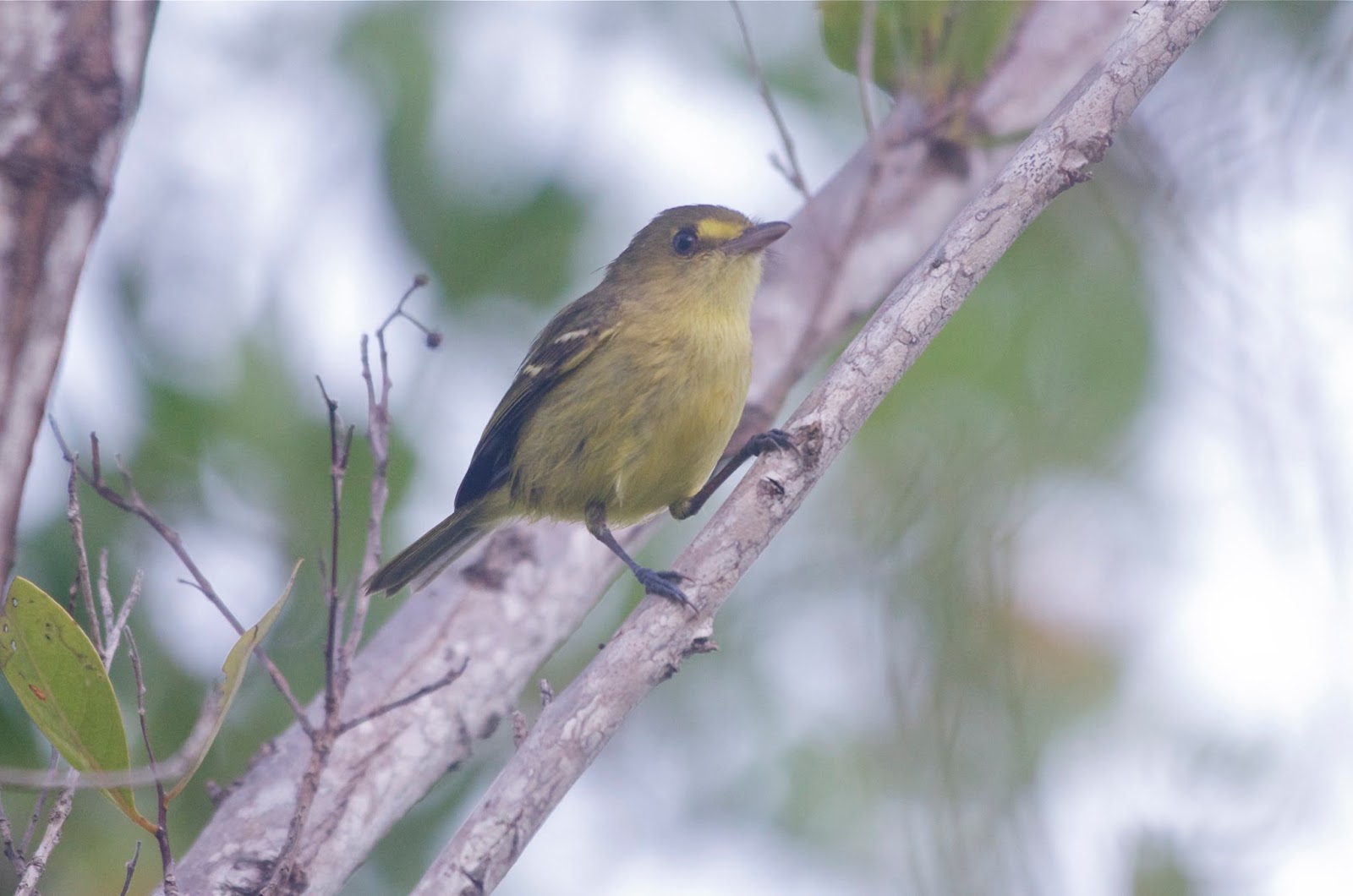
Some of the above came with mixed flocks including resident species, like Lesser Greenlets, White-shouldered Tanagers, Tropical Gnatcatchers and Olivaceous Woodcreepers.  However, one resident species caught my attention: a pair of Yellow-green Tyrannulets.  This species is endemic to Panama, and a canopy-dweller too... so it wasn't easy to take a photo!
Yellow-green Tyrannulet (ENDEMIC!!!)
I managed this poor shot... but you can see the slender profile (similar to a gnatcatcher), two yellow wingbars and white eyering.  I noticed it first by its thrilling call and confirmed the ID after seeing it raising quickly and repeatedly its wing over the back.  Everyday with an endemic is, certainly, a good day... specially so close to home!

Monday, November 17, 2014

At the highlands with family and warblers!

Taking advantage of one of these long weekends, I went with my extended family to spent some time relaxing in the highland town of Paso Ancho, close to Volcán, in Chiriquí province.  Although not a birding trip, I still enjoyed some resident and migrant warblers that call the highlands their home.  We spent most of the days at a comfortable cabin watching the children playing in the garden, grilling on the barbecue or just chatting.
Gabrielle and her cousins, Ana, Givellis and Kevin
Right at the garden, some common species showed up, including Blue-gray and Flame-colored Tanagers, Yellow-billed Siskins and Rufous-collared Sparrows.  However, I was interested in some common migrant warblers.  The first one spotted was the Wilson's Warbler.
A very bad shot of an adult male Flame-colored Tanager... this bird is well-named!
Adult male Wilson's Warbler
This is the most common warbler wintering in the highlands, found essentially everywhere!  The black cap is characteristic of the adult males... but the bright overall yellow coloration is enough to ID this species.  Then, I spied two other migrant species.  These were working the non-native pine trees next to the property.
Black-throated Green Warbler
Black-and-white Warbler 
As you can see, both the Black-throated Green and the Black-and-white Warblers (both females) were close enough to snap a shot... something quite hard with these restless birds.  We call the latter species the "Creeper Warbler" due to its unique habit of climbing trunks, sometimes upside down, very creeper-like.  The Black-and-white Warbler is very common during the winter through all Panama.  At the other side, the Black-throated Green Warbler is also common during the winter, but only at the highlands; however, it is a frequent passage migrant in the rest of the country.  Both these species are, in fact, more common and widespread than some resident species.  One morning, I went with Gloriela to the Macho de Monte canyon, at the foothills below Volcan... there, we saw one of these resident warblers... the smart Buff-rumped Warbler.
Buff-rumped Warbler
Buff-rumped Warbler
In comparison with the typical and familiar warblers, this species exhibit a different behavior.  It is terrestrial, always found close to water... usually rushing streams, flicking its expressive tail from side to side.  Certainly the Macho de Monte canyon is a great place to find this species... and a nice touristic attraction too!
Macho de Monte canyon
The Buff-rumped Warbler was not the only river-dweller bird we saw that morning.  A Spotted Sandpiper and a pair of Black Phoebes were present too.  In previous visits we had seen Torrent Tyrannulets and American Dippers as well!
Spotted Sandpiper and Black Phoebe
Black Phoebe
Well, a trip to the highlands is always a nice trip.  Of course, we ended it with the traditional stop at the dessert shop to enjoy some sweet strawberries with cream!
Gabrielle, Gloriela and... strawberries!

Saturday, October 22, 2011

At the Ancon Hill

I still don't know why I don't visit the Ancon Hill more often. It is in Panama City, VERY close to my place, and holds a good amount of wildlife, not only birds, but also mammals and insects. But, more important, it is a nice migrant trap in the right season, specially october. Several times during the first two weeks of this month, I visited the volunteers of the migrant raptors count, who have reported rare migrants like Black-billed Cuckoo and almost a definitive Painted Bunting this season at the summit of the hill. Despite I saw none of these rarities in my visits, the number of species and individuals of migrants was really amazing. Gloriela (and Gabrielle) accompanied me the last time, and even helped the counters recollecting data on temperature and wind direction for the records. Surely, the most common species (only after the abundant Sawinson's Thrushes) was the Eastern Kingbird. Flock after flock passed by, taking advantage of some fruiting trees in the vicinity of the summit. Some of them also did some flycatching while we were there, sometimes side-by-side with our local Tropical Kingbirds who simply shared the perch without hesitation. The flycatchers were well represented. Not only the Eastern Kingbirds were present, we also saw Great Crested and Sulphur-bellied Flycatchers. The latter is an uncommon transient through the isthmus. We had the opportunity to have side-by-side views of this species with the very similar, resident and much more common and noisy Streaked Flycatcher. Many field marks have been described to separate these two flycatchers, but the most reliable is the black chin and more pronounced black malar stripe of the Sulphur-bellied Flycatchers. You can notice that the chin area of the Streaked Flycatcher is completely white. The amount of yellow in the underparts can be similar for both species, the same with the color of the bill (usually, the Sulphur-bellieds have only little pink in the base of the lower mandible). Perhaps the Streaked Flycatcher is very common, but it can't be more beautiful! In the meanwhile, a single Geoffrey's Tamarin was eating the berries of a tall tree abiove our heads. We noticed it first because one of the berries struck Gloriela in the head! We were able to heard the rest of the group in the trees nearby; they sound like a flock of little birds... or were they laughing at us? We quickly forgot the incident after seeing our first group of migrant Scarlet Tanagers. Even without the breeding plumage, the males are still attractive, with their contrasting jet black wings. They outnumbered the others tanagers, a phenomenon that happens only this time a year. The only other migrant tanager (or should I say "cardinal"?) was the Summer Tanager, with one or two shyly working around the trees bordering the access road. Another representative group was the wood-warblers. Hordes of Yellow, Canada, Blackburnian, Tennessee and Black-and-white Warblers invaded the hill, giving it some color. My photo of the female Black-and-white Warbler is simply to poor to reflect the beauty of this smart, creeper-like warbler. I still need a good photo of most of these warblers, but you know, they simply can not stop... always in the move, usually high in the canopy, in backlight... in summary: a real headache for the amateur photographer (like me)! Sometimes it was hard to focus in a single bird due to the great activity all over the place, but a slim silhouette definitively caught my attention during one of the first visits. The bird in the shade turned out to be the first (of many) Yellow-billed Cuckoo having a huge worm for lunch... I was expecting the Black-billed reported by the volunteers... but you can not win everytime and, after all, it is a good reason to return next year!

Sunday, February 20, 2011

A day in the foothills

Yesterday, I went to Cerro Azul with Osvaldo Quintero and Rafel Luck looking for colourful birds to photograph. The foothills of Cerro Azul are less than a hour-drive from Panama City, and it holds a completely different arrange of birds to what we are used here in the lowlands. Camera in hand, we visited first the section known as Altos del Frente, where we eventually found some activity in a now-usual spot where you can also have a great view of the city in the distance. There, two pairs of Crimson-crested Woodpeckers were displaying, making a lot of noise and flying from one trunk to another chasing each other. We also saw tons of Scaled Pigeos flying all over the place, with some of them calling and others perched atop bare branches, but never allowing us to approach enough to get good pictures. These are spectacular pigeons, with a very conspicuous red to the base of the bill and showy scales to the underparts. A flock of Keel-billed Toucans appeared, announcing their presence with their croacking calls. All these birds were a little far away, but Rafael found a male Masked Tityra close enough to see all the details of its plumage, and for some to take very good photos (not my case as you can see). A little farther in the road, we found a mixed flock with lots of tanagers, euphonias, flycatchers, woodcreepers, among others. The place is very good for tanagers... in that flock we saw Plain-colored, Golden-hooded, Bay-headed, Rufous-winged, Blue-gray and Palm Tanagers. Another tanager was accompanying the flock, at first glance it was dull gray, but then it perched in a Cecropia tree where I saw the white tufts at the sides of the chest: a Sulphur-rumped Tanager! This species is quite local and seldom reported for Cerro Azul, and the most recent reports come from that place precisely. My distant shots (two of them) show the white tufts... and barely part of the sulphur-yellow rump. Those marks are unique in this part of Panama. The flock also included a Black-cheeked Woodpecker and an endemic for Panama, a Stripe-cheeked Woodpecker that we heard first and then saw it briefly. The place became quiet when the flock left, so we moved on, this time to Birders' View, also a hot spot in these foothills. The property keeper, Nando, already told us about a Rufous-crested Coquette he saw the day before, so we waited there for it, watching closely the flowered bushes in the backyard. In the meanwhile, many others species showed up, including a migrant Black-and-white Warbler creeping a trunk close to us. It was an adult male, as you can see by its black cheeks. We also saw many more tanagers, and former tanagers in the form of Summer and Hepatic Tanagers. The former is migratory, the latter is a resident species. Both male and female were working the trees surrounding the backyard. It is hard to imagine these birds as cardinals, but I have to accept that the Piranga tanagers share many characteristics with their now-close relatives (overall coloration, beautiful voices, sexual dimorphism, etc...)... they are simply cardinals with specialized beaks! The first photo is a male, still with some yellow feathers in the body. You can separate them from the similar Summer Tanager by its darker red overall and dark lores. The females of both species are yellow, the head close-up of this female Hepatic Tanager shows well its dark lores, and also its dark bill. After all, we saw no less than 13 tanagers and former-tanagers, even more if we include the species of honeycreepers that we also saw. The coquette did not show up... so we tried another spot, this time the feeders at the Ahrens' place... but that is another story.

Sunday, February 13, 2011

Warblers and Hummingbirds at Altos del María

Altos del María is a huge, private residential development located in the foothills of western Panama province, above the town of Sora. A resident there, Alfred Raab, and his friend from Switzerland, Robert Furrer, kindly agreed to guide me, Osvaldo Quintero and Rafael Luck into this still-little-known hot spot. Due to camera battery issues (I left it at home accidentally!), ALL the photos in this post are copyright Rafael Luck. The place turned out to be warblers' heaven! In the first stop, in second growth habitat, we found both Tennessee and Bay-breasted Warblers (the latter with buffy underparts including the undertail coverts and chestnut flanks) with some common residents like Variable Seedeaters, Plain Wren and Streaked Saltator. A little higher, we stopped at a clearing bordering a forested area around 950 meters above sea level. We immediately noticed the activity of both resident and migrant birds around us. Among a group of Clay-colored Thrushes, I saw for just a few second an infiltrated White-throated Thrush... but when I was about to show it to the others, others birds caught our attention. A big mixed flocks of warblers was passing by the woods. The first one to appear was an adult male Golden-winged Warbler... simply beautiful. Then, we got more Tennessee Warblers, two Black-and-white Warblers, a Black-throated Green Warbler (only seen first by Rafael, but then it showed well for the rest of us) and an absolutely great adult male American Redstart. A winter-plumaged warbler caught my attention... at first, we thought it was a Bay-breasted Warbler, but we noticed its yellower underparts (not buffy) with faint streaks in the chest and sides, plus white undertail coverts... a Blackpoll Warbler! There are just a handful of reports for this species in Panama, and is my first in maaaany years. Others migrants accompanying the flock were the Yellow-throated and Philadelphia Vireos. Both species of vireos were more cooperative than the warblers, moving slower along the branches and with the Philadelphia Vireo even sitting for a while, allowing some photos. This individual was particularly yellowish in the underparts... I'm used to see them with quite whitish underparts in Panama. Eventually, we were not able to follow the flock anymore and decided to move on despite the insistent chipping of a resident Rufous-capped Warbler. Alfred took us into the mountain, into the real cloud forest around 1000 meters above sea level, in a site where he and Robert saw a singing Brown Violetear the day before... and there it was, almost in the same place, singing its loud call (for a hummingbird) in an exposed branch. Despite it was against the sun, Rafael managed to take very good photos, like the one I'm showing here. Altos del María is a regular site for this erratic species in Panama, and Alfred have done a good job figuring out its haunts. In the same forest, but in a different site, Alfred reserved a surprise for us. At the end of a wide trail, he showed us no less than three adult males Snowcaps chasing each other and perching for few seconds near the canopy of a flowered tree. Amazing! These are very special hummingbirds, with a kind of patchy distribution in Panama. The trail also produced a singing Thrush-like Schiffornis, a flock of Black-faced Grosbeaks and wintering Blackburnian and Canada Warblers. In a marshy area we got Mourning Warbler and Northern Waterthrush, while in the nearby forest along a beautiful creek (walking along a brand new paved trail!) we found Spotted Woodcreeper, White-throated Spadebill and heard a Black-crowned Antpitta. What a wonderful place! In total, we saw twelve (12) migrant warblers! And I'm pretty sure that we still have not seen everything in Altos del María. Thank you Alfred for your company and expertise... shall we do this again, don't we?