Showing posts with label Rainforest Discovery Center. Show all posts

Monday, April 1, 2019

This is NOT an April fools!

Certainly NOT!  If you still want to see one of the most elusive bird of Panama, now is when!  The Neomorphus Ground-Cuckoos are the jewels of the crown for the neotropical birders.  Rare, localized and definitively impressive ground-dwelling cuckoos of the interior of humid forests, usually associated with antswarms or following herds of peccaries, having a glimpse of them is like touching gold!
Great Potoo
A pair of Rufous-vented Ground-Cuckoos have been reported at the famous Pipeline Road (north of Gamboa, Colon province, central Panama) since mid-March attending an antswarm.  Pipeline is known for its long list of spectacular bird species, but it happens that the cuckoos (or I may say, the antswarm) have stayed at the same general area since then.  So I took advantage of my break at the office and headed to Pipeline. The staff at the Rainforest Discovery Center were the first to give me the instructions.  I soon find my friend Josanel Sugasti, who had not yet seen the bird today but gave me some tips to find the exact place (after showing to me the roosting Great Potoo over my head!).  The army antswarm is not by the road... you have to walk into the forest some 300 meters along a now-dry creek to find it.  I was not sure of the exact place because I was only hearing Gray-headed Tanagers.  Yes, they DO follow antswarms, but this particular antswarm was supposed to be attracting dozens of other, usually noisy, birds species.
Gray-headed Tanager
Thanks God another friend of mine came to the rescue.  Ismael "Nando" Quiroz (of Tamandúa) was guiding a group of visiting birders.  When I asked if he got THE bird, he said "Yes, only two"... and nope, he was not joking.  Nando pointed me the correct direction.  I followed his detailed instructions and soon started to hear Ocellated, Spotted and Bicolored Antbirds, among others.
Bicolored Antbird
Yes, I was in the middle of a forest at noon, standing on an army antswarm, sweating a lot due to the excitement (and the intense heat and humidity, plus the fact that I was dressed for an air-conditioned office, including shoes, didn't help either).  Just when I started to think that I needed to be on the road back to Panama City in less than an hour, then it happened.  Not one, but two Rufous-vented Ground-Cuckoos were quietly catching preys that were trying to escape the furious army ants.  It doesn't matter if you had seen them before, they are simply magnificent creatures!
Rufous-vented Ground-Cuckoo
I'm very grateful with all the friends that helped me today.  Now you know it.  What are you waiting for to look after them?
Rufous-vented Ground-Cuckoo

Monday, May 9, 2016

Rails and Crakes in Gamboa Ammo Dump Ponds

The Ammo Dump Ponds in the town of Gamboa (former Canal Zone) are probably one of the most birded sites in Panama.  It is a good introduction for the beginner and even veteran birders find it quite enjoyable... and add to this that almost every visiting birder to Panama stop by the ponds on route to the famed Pipeline road.  And with all that attention, it is amazing that some resident species of the pond are rare enough to attract hordes of birders when they decide to show up.  That is the case of the last discovery of my friend Venicio "Beny" Wilson, when he found a Yellow-breasted Crake walking exposed close to shore one week ago.  This species is known to breed there... but there are only few records from the area.  So yesterday I went with Gloriela to the ponds, looking for the elusive bird.  My friend Howard was already there when we started to search the marshy areas.  The day was cloudy and dark... perfect for the rallids (most of them are similarly elusive species), and soon I was able to see the largest of them at the opposite side of the ponds: a Gray-necked Wood-Rail.
Gray-necked Wood-Rail
It is a distant photo, but this bird is not easy to see... not to mention to photograph.  One huge rail in the bag... but we were after the smallest one recorded in Panama, and we knew it wouldn't be an easy task.  Another good sign that the day was good to watch elusive species became in the shape of a Least Bittern flying across the pond and allowing great views with the scopes... another super elusive bird in the bag... but it was not THE bird we were looking for.  Close to us, this Rufescent Tiger-Heron decided to rest quietly.
Rufescent Tiger-Heron
Then, THE bird materialized like a ghost in front of Howard; we were not close to him and all his efforts to invocate the bird again only attracted a group of three White-throated Crakes to the exact place where the Yellow-breasted Crake was.  I know that feeling... when a group of fellow birders are twitching a rarity but you are the only one that manage to see it... you only want that someone else find the bird too just to prove that you are not mad after all. Of course Howard was not mad... he had a photo of THE bird that we missed... that's life!  Hey, but a group of White-throated Crakes feeding exposed is a real treat!  These birds are very common by voice at the ponds, but you never see them... and let me tell you: that was the best sighting ever of White-throated Crakes!
White-throated Crake
A little bit disappointed, we moved to the Rainforest Discovery Center in order to take our lunch... a tasty fried sea bass and some cold drinks, but first we attended a talk offered by, coincidentally, Venicio Wilson.  It was nice to hear him talking about the role of birds in the ecology of the rainforests... he almost made us forget how miserably we dipped on the crake earlier... a l m o s t.
However, after lunch, many birders decided to try the crake's spot in the way out... so we joined them.  Venicio himself showed us the exact site where he originally saw the bird and we chat about a lot of themes... the time flew with them.  Around 3:30 pm, I noticed a tiny bird at the water just in front of the group.  Skeptical, I raised my binoculars ... only could say "THERE IT IS!!!"  Yes my friends, THE bird materialized again in front of the group, nobody else noticed it before... it simply was there.
Yellow-breasted Crake
The Yellow-breasted Crake stayed for close to 15 minutes walking deliberately and feeding quietly.  Then, it flew to a nearby floating island and disappeared.  Venicio thinks that he saw a different bird... I think that only few birds are so beautiful and shy that this one.  A tiny bird... but a HUGE lifer!
Yellow-breasted Crake

Saturday, April 30, 2016

I also went after him

Just a short note.  My friend Natalia, of the Panama Rainforest Discovery Center, posted some photos of a shy bird that is often heard... but very difficult to see.  The bird have been resting in the same general area for about a month... a Vermiculated Screech-Owl.  So, after leaving my daughter at the school, I went with Gloriela to the PRDC where Natalia was waiting for us.  We where in a hurry, the only access to the town of Gamboa, an old one-lane bridge, would be closed to maintenance until noon, so we only had 30 minutes to find the bird.
Vermiculated (Choco) Screech-Owl
As you can see, the little guy was right where Natalia said.  The form present in central and eastern Panama (and northern South America) is sometimes separated as Choco Screech-Owl due to vocal differences compared to the rest of the population en western Panama and Central America.  Thanks Natalia for showing us this sleepy owl!

Sunday, March 1, 2015

Bird of the Month: Crested Owl

The Crested Owl (Lophostrix cristata) is a widespread, strictly nocturnal species found inside humid forests from southern Mexico to Amazonian South America.  Within its distribution, is unlikely to be confused with other species due to its long and pale ear-tufts.
Crested Owl
Its deep growl is a distinctive sound at night in the forest of the Caribbean slope of the former Canal Area in central Panama (where I took these photos).  However, localizing them at night is extremely difficult; this species like to call from the mid to upper level of the trees and always seems to be hidden.
Its diet consist mainly in big insects; however, it can include small mammals as well, like rodents.  That's probably the case with this individual, photographed behind the Panama Rainforest Discovery Center this cloudy morning.
Crested Owl
There are three recognized subspecies, of which two occur in Panama.  The one supposedly found in central and eastern Panama (and northern South America), wedeli, differs from Amazonian nominate in its yellow eyes according to one reference; however, I do not know if this can be evaluated in daylight, but these photos (and many other from central Panama, in daylight as well) show no yellow at all.  The subspecies stricklandi, found from western Panama to southern Mexico, differs in darker head coloration, yellow eyes and vocalizations.
Crested Owl
This species generally roosts by day in tangled thickets, sometimes very low or along streams, and nest in tree holes.  It is always a treat to find a day-roosting owl, and this was not the exception.  For these, and many other reasons, is why we chose the Crested Owl as our Bird of the Month!
Crested Owl
Literature consulted:  
1.  Angehr G, Dean R.  The Birds of Panama. A Field Guide. Zona Tropical 2010.
2.  Mikkola H. Owls of the World: a Photographic Guide. Second edition 2012.
3.  Holt, W., Berkley, R., Deppe, C., Enríquez Rocha, P., Petersen, J.L., Rangel Salazar, J.L., Segars, K.P., Wood, K.L. & Kirwan, G.M. (2015). Crested Owl (Lophostrix cristata). In: del Hoyo, J., Elliott, A., Sargatal, J., Christie, D.A. & de Juana, E. (eds.) (2015). Handbook of the Birds of the World Alive. Lynx Edicions, Barcelona. (retrieved from http://www.hbw.com/node/55052 on 1 March 2015).

Sunday, December 9, 2012

More birds at Gamboa

After a very successful twitch, finding the Lesser Scaups at the marina in Gamboa (Colon province, central Panama) this morning,  Osvaldo and I decided to visit the Gamboa Ammo Dump ponds... after all, it was still very early and we expected a great activity, considering the beautiful day.
And we were right!  First of all, this young Broad-winged Hawk welcomed us by perching completely exposed in good light for us.  At the ponds, we found many common species, but I focused at the Mangrove Swallows perched at the barbed wire, shining with the sun... definitively my favorite swallow in Panamá!
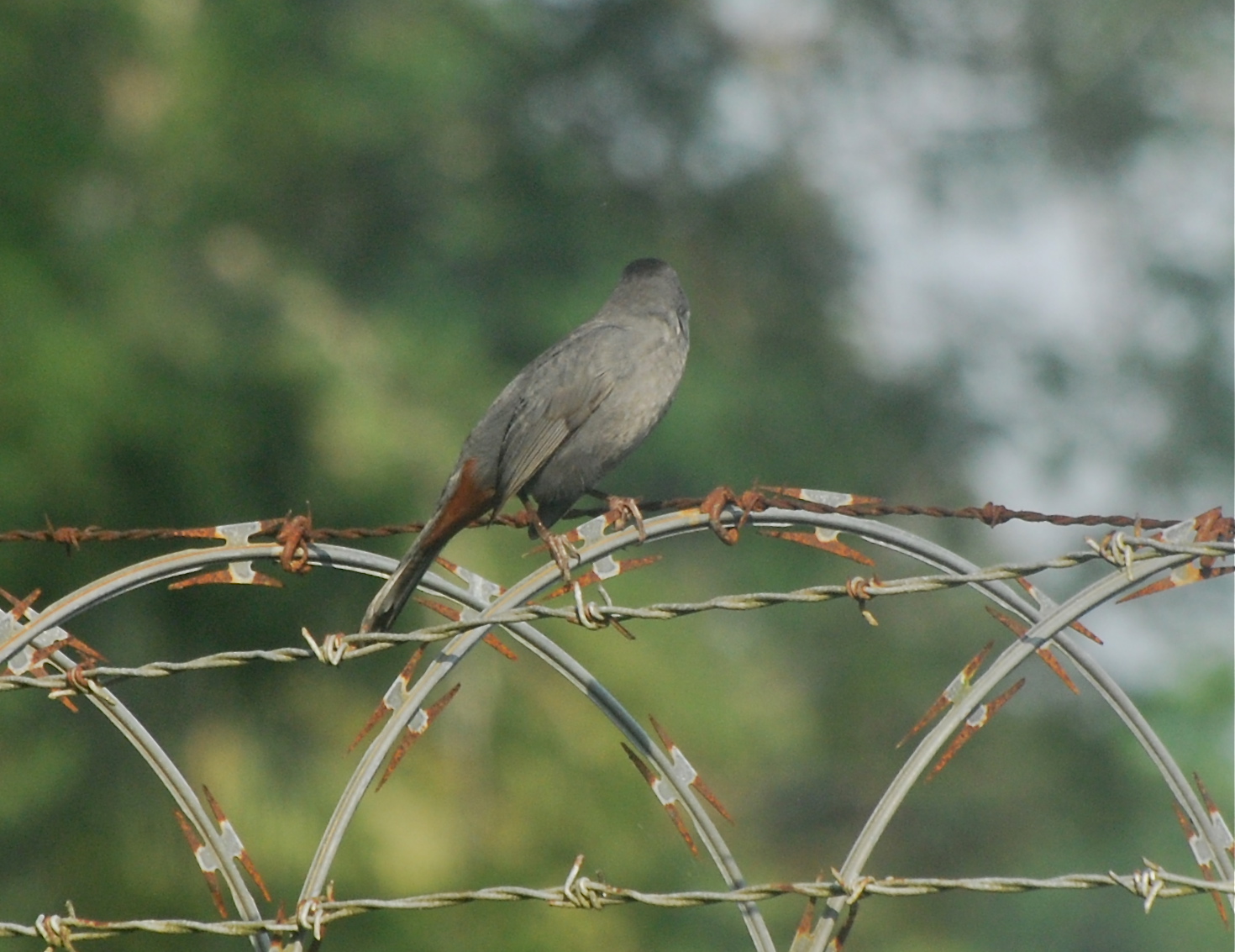
The swallows were so pretty and cooperative that none of us noted at first the dull gray bird at the fence facing the opposite side.
It took me a couple of seconds to realize that it was a Gray Catbird, nicely in the open taking a sunbath.  This bird is not only an uncommon migrant in this part of Panama, but also a hard-to-see skulker... but this guy was simply amazing... it responded to Osvaldo's tape and we got great views!
Very happy with our luck, we headed to the Panama Rainforest Discovery Center, were more than 30 (!) White-necked Jacobins, among other hummers, were trying to drink of the many hanging feeders.
However, it was the antswarm passing right behind the building that attracted our attention... most of the regular ant-followers were attending, like Spotted and Ocellated Antbirds, Plain-brown Woodcreeper, Red-throated Ant-Tanagers (weird, in spite of their name) a Greater Ani (weirder) and a gang of Gray-headed Tanagers.
However, the most cooperative followers were the omnipresent Bicolored Antbirds, jumping just feet of us.
Not bad at all for just half day!

Monday, September 24, 2012

Birders fellowship

It is great how birding can join different nationalities and personalities in a warm environment of fellowship.  That's how you bird with a friend which have never seen before (thanks facebook) and to feel that you have done the same thing for years!  My good friend Carlos Wagner (a colombian birder) visited Panama, attending a forum on wild cats, and I organized an outing around Panama City to show him some birds... and what a better place than the Panama Rainforest Discovery Center to show him.  We entered early enough to try to call out some owls... and we got some responses by a Vermiculated Screech-Owl and a Spectacled Owl... but only a group of Western (Panamanian) Night-Monkeys show themselves in the night (file photo, but form the same site).
Waiting for sunrise in the middle of a rainforest is an interesting experience... the fresh air full with the sounds of the dawn chorus and the silhouettes of the birds and other animals starting to search for their first meal is simply refreshing!
After a hot cup of coffee, we decided to climb up the world-famous 34 meters-high canopy tower... what a marvelous point of view of all those canopy dwellers.  We saw many birds from there, including the Chestnut-mandibled Toucan pictured here, some pigeons, parrots, trogons and puffbirds, and even a flock a noisy Black-bellied Whistling-Ducks in the distance.
We walk the trail leading to the Calamito lake, watching some mixed flocks, mainly with Dot-winged Antwrens, Lesser Greenlets, migrant Black-and-white and Canada Warblers, an impressive male Blue Cotinga, Green Shrike-Vireos, a pair of Fasciated Antshrikes (with nest), among many others.
After watching a flock of antbirds and woodcreepers following an antswarm (including a cooperative Great Tinamou), we decided to left the Center in order to walk the main Pipeline road.
The activity was quite low, we saw more of the same, plus an unidentified snake crossing the road and a troop of Mantled Howler Monkeys.  Pipeline road said good-bye to us by showing a beautiful Sunbittern quietly feeding at the Juan Grande creek... spectacular! 
The rest of the afternoon we visited some sites along the Pacific coast of Panama City, including Amador, the Casco Viejo, Panama Viejo and Costa del Este, adding more and more species... we finished quite late, and I left him at an hostal in the city.  Carlos, it was great having you visiting Panama and hope to see you soon!

Monday, January 24, 2011

2011's First Lifer

Last saturday, january 22nd, after birding during the first hours of the morning in Campo Chagres, the team formed by Gloriela, Rafael Luck, Osvaldo Quintero, Euclides "Kilo" Campos and your blogger host decided to spent the rest of the morning (and the first hours of the afternoon) in Pipeline Road and the Panama Rainforest Discovery Center (PRDC). At the center, we enjoyed some cold beverages and the company of the center's staff, old friends of us. Of course, we also enjoyed the myriad of hummingbirds that visit the center's feeders. We also saw others birds at the center, including Broad-billed Motmot, Scarlet-rumped Caciques and Ruddy-tailed Flycatcher. In the way out, we stopped at the entrance road to the center right where Osvaldo photographed a tiny Golden-crowned Spadebill the last week, but the bird did not show up. Instead, we found a pair of White-whiskered Puffbirds. The male was looking at us in a curious manner, like asking what's up with us? A little after that, Gloriela detected a noise in the understore... an aptly named Scaly-throated Leaftosser was working very close to us in the forest floor, picking the leaves with its long beak and throwing it apart looking for insects and other critters. These birds are more often heard than seen, and their calls are typical voices of the lowlands rainforests. This is the first one I actually see in many years, and was a lifer for Gloriela. We saw all the diagnostic field marks, including the obvious white scalloping to the throat. While admiring the leaftosser, Kilo heard a mixed flock of antwrens. I saw Checker-throated and Dot-winged Antwrens, but Kilo assured me that he also heard a Moustached Antwren, formerly merged with the Pygmy Antwren, now restricted to South America. This beautiful patterned antwren likes the highest part of the trees, where it moves quickly... and habit that, combined with its tiny size, make it quite difficult to watch... now imagine how difficult it is to photograph. But I tried it anyway, when we finally find it high above us. If you enlarge the image, you will see its characteristic shape (with very short tail), yellow underparts and white throat. We were not tired yet, so we walked beyond the Juan Grande creek to see what can we find. We heard more antwrens and found a group of Scarlet-rumped Caciques and Purple-throated Fruitcrows harrasing a magnificent Gray-headed Kite (file photo). Little after that, in a huge Ficus tree, Kilo heard the bird of the day, at least for me: a Gray Elaenia. Its call was confusingly similar to that of the Tropical Gnatcatcher (a pair was present in the same tree), except by the first two or three buzzy notes. When I first saw the bird, it reminded me a becard, due to its gray and black coloration, but its bill shape and habits confirmed the ID. The wing pattern was specially contrasting. I'm pretty sure that most of us overlook this bird due to its call, and the fact that it is a canopy-dweller species (Rafael's photo shows its silhouette high in the canopy against the sky). What a nice surprise, the last of the regular-recorded birds in Pipeline Road that I still was missing, a great life bird to have as first for the year! Well, it seems that I have no more reasons to go back to Pipeline Road (JUST KIDDING!!!, I still need a good photo!).

Monday, November 8, 2010

Blue, red... or iridiscences?

I went to Pipeline road (beyond the town of Gamboa in central Panama) last saturday with Osvaldo Quintero willing to spent half-day there. The activity was very low due to the imminent rain, but before it started we saw two species of manakins in the same tree. Trying to eat some berries, an adult male Blue-crowned Manakin was frequently mobbed by an adult male Red-capped Manakin! What a sight! Two antagonist species side-by-side. The contrasting colours of these birds were simply amazing. Manakins are always funny to see, specially if they are "dancing" or lekking. We enjoyed both birds-in-black with contrasting caps for a while, until it started to rain seriously. We quickly walked to the car and then Osvaldo drove to the Panama Rainforest Discovery Center (PRDC) were we had a hot cup of coffee accompanied by hordes of hummingbirds... as usual! If the black, red and blue of the manakins were impressive, then the iridiscent colours of these tiny birds were spectacular. I always have been astonished by the form in which its feathers reflect the light. If you use the artificial light of your flash to photograph them, the result is a totally different bird! Compare these photos of a Blue-chested Hummingbird and a White-necked Jacobin (in that order) with artificial light
Now, the same species (in the same order) with sunlight:Big difference eh? Of course, I like more the sunlight... they just look superb with it!
P.D.: more photos of the PRDC's hummingbirds at the end of this post.

Wednesday, May 5, 2010

Back to the tropics

After my trip to Toronto, Canada, I have been a little busy. I ended my residency in Internal Medicine (I published a photo album of my graduation in facebook) and I'm finishing the final report of my research, waiting to present it next may 19th. In the meanwhile, I got lot of free time to spend... you guess: birding. I tried a classic spot to start: the Rainforest Discovery Center at the Pipeline Road (central Panama). There have been reports of some species I have missed this year (nop, not the Ground-Cuckoo) and I wanted to say hello to all the personnel that works there. After leaving Gloriela at her hospital, I drove to Gamboa, stopping first at the Ammo Dump. The place was alive with all the Yellow-rumped Caciques that are nesting in the area and all the flycatchers on the trees surrounding the ponds. A Panama Flycatcher was quiet, inspecting some branches close to the gate; contrasting with the pair of Rusty-margined Flycatchers that were very noisy, flying from one spot to another following each other. The yellow crown patch was visible, something that often happens. Others flycatchers present were Social, Boat-billed and Dusky-capped Flycatchers, plus both Kiskadees. A look into the ponds revealed Green Heron, Wattled Jacana, White-throated Crake (only heard), and a female Pygmy Kingfisher that was a new year-bird for me (I missed it in Galeta during the Atlantic CBC in january). Nice introduction for the day! I moved to the Center where I took the trail to the Calamito lake, an arm of the Gatun lake where Sungrebes and Least Grebes have been reported recently. Of course I spent few minutes admiring the excellent show performed by all those thirsty hummingbirds at the feeders and said hello to Julia and Margelys who were ready to attend the visitors. On route I heard, and saw, a Green Shrike-Vireo, and heard a Pheasant Cuckoo, both new year-birds for me. The activity in the lake was slow. I walked a little bit along the shore just to spied the other side of the lake that is not visible from the observation deck... disturbingly followed by a huge American Crocodile! Then I waited... and waited... Eventually the Lesser Kiskadees and the Wattled Jacanas trusted them (and me) enough to get very close, since I already looked like part of the deck, waiting for the grebes to appear. According to Osvaldo, they usually show up by 8:00 AM, but it was 9:00 AM and nothing yet. A Cinnammon Woodpecker started to call just a few feet over my head and a Snail Kite was flying around its territory. By the way, I saw a good number of raptors flying by, including a Zone-tailed Hawk, a Merlin and a Bat Falcon. A pair of Common Moorhens (Gallinules) gave me a false alarm and a flock of Black-bellied Whistling-Ducks took off from some branches where they were hidden. Half-hour later I was about to return when suddenly a little white dot in the distance started to move, crossing the lake. A quick glimpse with my bins showed a distant Sungrebe swimming fast to the other side of the lake. I grabbed my camera and took a few shots just to realize that it was VERY far away... but a Sungrebe anyway! With faith you will see him in the center of the photo (OK, you may need to enlarge it!). I did not wait more for the Least Grebes so I returned to the Center, this time to say good-bye. A quick stop by the Juan Grande creek in Pipeline Road only produced a Western Slaty Antshrike and a Pheasant Cuckoo who crossed the road in front of me... RUNNING! It started to rain, so I headed back to the city, with lots of new year-birds!