Showing posts with label Red-billed Tropicbird. Show all posts

Wednesday, January 8, 2020

Bocas' Birds and Friends

Tranquilo Bay pier, Bastimentos Island, Bocas del Toro
Traveling around the country looking for birds also bring friends together... it is always great to reunite with old friends or to meet social media friends personally.  During one of those trips, I went with my family to Bocas del Toro province, in western Caribbean slope, specifically to the Bocas archipelago.  Apart of the birds, the islands are a nice touristic destination, with exuberant vegetation, delicious foods and pristine beaches.. perfect for a family micro-vacations!
The Cubillas at Colon Island, Bocas del Toro
We stayed at Colon island in a beach resort surrounded by secondary vegetation that produced several western Caribbean slope specialties, like Montezuma Oropendola, Olive-crowned Yellowthroat, Grayish Saltator and even a fly-by Gray-headed Dove to my delight (a year-bird for me).  We were close enough to Bocas town to walk the busy streets visiting the stores and to have traditional dinners there, while enjoying the spectaculars sunsets.
Spectacular sunset at Bocas archipelago
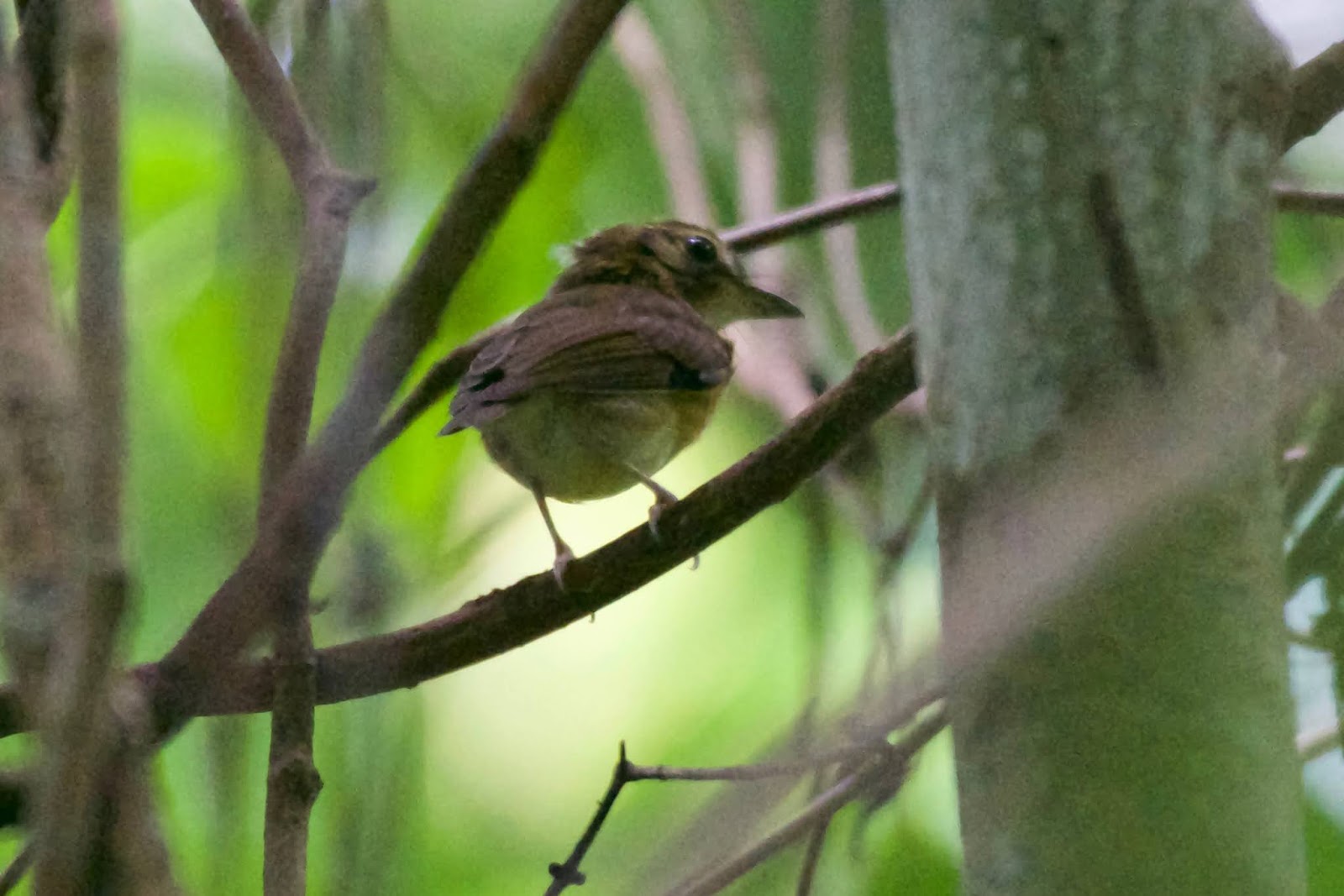
My plan included a visit to Tranquilo Bay Eco Adventure Resort, in Bastimentos island.  The calm waters surrounding the pier (as you can see in the first photo) certainly live up to its name (tranquilo = calm), and the forests around the cabins were alive with bird activity.  As usual, my friends Natalia and Ramón showed me the local specialties, including range-restricted (for Panama) Stub-tailed Spadebill, more Gray-headed Doves and Three-wattled Bellbirds that call the islands home during their non-breeding season.  Stacey Hollis, who also is a resident guide at Tranquilo and one of those social media friend that I finally met that day personally, joined us to find more birds!
Stub-tailed Spadebill
Three-wattled Bellbird, subadult male
We took a boat to a nearby island: Cayo Venado.  My main target there was the Snowy Cotinga, which use the mangrove forest surrounding the channels.  Soon, eagle-eyed Natalia spotted a female cotinga atop a mangrove tree.  Eventually, we saw several adult males and another female cotinga, allowing some nice photos.  What a bird!  Back at the hotel I was able to say Hi to Renee, Jim and Jay (who own and run the lodge with their families) before heading back to Colon island where my family was enjoying the marine breeze by the swimming pool!
Snowy Cotinga, adult male
Ramón, Natalia, Jan Axel and Stacey
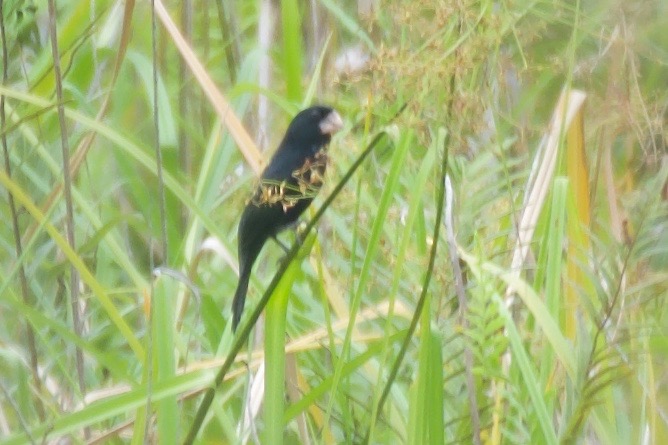
Well, but the mini-vacations were not over yet... I still had some targets in mind.  The next day I met two social-media friends (before that day we knew each other only by emails and WhatsApp messages) at Boca del Drago, at the northern side of Colon island.  Both resident of Colon island, Lukas Bell and Pat Wade (I met his wife Kitty -also a social-media friend- later that day too) joined me to bird along the Snyder channel, an artificial channel that parallels the mainland coast close to Colon island that was used to transport loads of bananas and other merchandises.  We chose that site due to a very localized species: Nicaraguan Seed-Finch.  Our first attempt at the usual sites produced no birds... but the channel and the estuary of the Changuinola river entertained us with many different species.  At the last possible spot, Lukas insistence paid off: an adult male Nicaraguan Seed-Finch was working the grass spikes with its huge, pink bill.  I managed some diagnostic shots, my first pictures of that species!
Nicaraguan Seed-Finch, adult male
Our last target was somewhat easier.  After leaving the channel, our boatman took us to the small Swan Key, home of a colony of seabirds, including dozens of breeding pairs of Red-billed Tropicbirds.   The tropicbirds are almost guaranteed at that location, so with our targets in the bag we made it back to Boca del Drago.  Pat's analogy of my Big Year with the Atlas Stones Competition, where lifting each rock is increasingly tougher... the same as getting new birds while the year advances, was certainly correct.
Jan Axel, Pat and Lukas
Nesting Red-billed Tropicbird
Our twitch ended at Boca del Drago, tasting one of the culinary delights of the Caribbean: the Run down or Rondon.  Simply exquisite!  Lukas took me back at my hotel, but only after checking some prime habitat at Carenero island, adding more species to our growing list.  I spent the rest of the day with my family before departing to Panama City in the last evening flight.  I got many new year-birds... but most important, was able to bird with friends and to spent time with my family at a paradise island as well!

Friday, October 7, 2016

Off shore western Azuero: birds and mammals

It was 5:00 am last October 1st, 2016.  In spite of a not-so-favorable weather forecast, a group of intrepid birders, including George Angehr, Howard Laidlaw, Joris Deruwe, Miguel Siu and your blogger host were standing in the dark while Kees Groennedijk was taking care of the last details for our first pelagic trip of the year.  We were at the dock in Reina beach close to the town of Mariato in western Azuero Peninsula (Veraguas province).  A little "panga" took us along the Negro river and, eventually, to the fishing boat anchored off shore due to tide issues.
Part of the group at the dock in Negro river
Our pelagic trip started in the dark.  It was not after passing the 6:00 am mark that we started to watch some birds... the first one was the silhouette of a Magnificent Frigatebird.  We took the same route we did last year, navigating parallel to the western coast of the Azuero Peninsula to Punta Naranjo (the southwest corner of the peninsula), then off few miles to deep waters along the Continental Shelf break, moving to the west while chumming and then going back to Reina beach more or less in an straight line.
Punta Naranjo
Still within the Continental Shelf, our first highlight was an immature Red-billed Tropicbird that decided to swim quite close to the boat, allowing some shoots before taking off again.  The species seems to be regular in those waters according to Kees, but it was the first time I see it in the Pacific Ocean.  Eventually, we saw three to four different individuals, all of them immatures and within the Continental Shelf.
Immature Red-billed Tropicbird
At Punta Naranjo we only saw two (instead of dozens) Brown Noddies flying close to the rocks.  By that time, it was evident that the most common species present was the Black Tern... loose flocks of up to 50 birds were seen each hour, specially within the Continental Shelf, plus other terns species like Royal and Common Terns inshore and many Bridled Terns well offshore... but also some resting on floating debris close to shore.
Brown Noddy 
Black Tern (basic)
Common Tern (alternate)
Bridled Tern (basic)
This time, our time at deep waters was not very productive.  At the chumming sites we only saw few Galapagos Shearwaters... the only tubenose recorded in the whole trip.  That's right... no other shearwater, petrel nor storm-petrel species that day.  At least, we were expecting two or three different species of storm-petrels... none was seen.  Were they not there?  The chum was not smelly enough?  We were not lucky enough?  Certainly, we still need to know a lot about our pelagic avifauna.
Galapagos Shearwater
Besides the birds (and lack of them), the other highlight was the number of Pantropical Spotted Dolphins that we managed to see.  Several dozens of these intelligent animals accompanied us for a while, they gave us a marvelous show!
And that my friends was our day at the sea.  No new birds for Panama and no life birds, plus a little bit of seasickness for the first time (weird, since the sea was quite calm)... but hey! that's pelagic birding!!!  Can't wait for the next one!

Friday, January 1, 2016

Bird of the Month: Red-billed Tropicbird

The Red-billed Tropicbird (Phaethon aethereus) is a widespread resident of the east Pacific, east and south Atlantic, Caribbean and the northwestern corner of the Indigo Oceans, where it is quite sedentary close to its nesting islands.  Few birds equal in beauty and elegance the tropicbird in flight, and a flock of these birds circling close to their nesting islands is an amazing event!
Red-billed Tropicbird
In Panama, it is regularly found around the Swan Cay (off Colon Island, Bocas del Toro province), where it breeds.  In fact, all the photos of this post are from that colony.  Is very rare elsewhere in Panamanian waters.
Cay off Colon Island, Bocas del Toro (Panama)

The first time we saw this bird, my wife and I were in the islands for our honeymoon.  We took a quick boat trip around Colon Island making several stops in the way, including the Swan Cays, where she took the next photo with her point-and-shoot camera.
Red-billed Tropicbird
Eight years it took to return to see these spectacular birds; this time both of us (plus our daughter and nephew) were able to see them in detail... including their coral-red bills, bicolored feet, bandit-like mask and, of course, the long central tail feathers.
Red-billed Tropicbird
They are powerful flyers, and feed by plunge-diving on flying fish and squids.  The birds that we saw were chasing each other and approaching the cliff edges where other birds were already resting.  They share the cays with Brown Boobies and Magnificent Frigatebird; although doesn't compete directly for nesting sites.
Red-billed Tropicbird
For these, and many other reasons, is why we chose the Red-billed Tropicbird as our Bird of the Month!

Literature consulted:
1. Ridgely R, Gwynne J. A guide to the birds of Panama. Princeton Univerity Press 1989.
2. Angehr G, Dean R. The birds of Panama. A field guide. Zona Tropical 2010.
3. Orta, J., Jutglar, F., Bonan, A., Garcia, E.F.J., Kirwan, G.M. & Boesman, P. (2016). In: del Hoyo, J., Elliott, A., Sargatal, J., Christie, D.A. & de Juana, E. (eds.) (2014). Handbook of the Birds of the World Alive. Lynx Edicions, Barcelona. (retrieved from http://www.hbw.com/node/52607 on 1 January 2016).

Saturday, October 31, 2015

Escape to Bocas. Part III

In the second day of our stay at Tranquilo Bay Eco Adventure Lodge in Bastimentos Island (Bocas Archipelago in the western Caribbean lowlands), I went with my family on a boat trip to one of the hot birding spots reachable from the property: the Snyder Canal.
Gloriela, Gabrielle, Jean-Michael and Jan Axel at the Snyder Canal, Bocas del Toro
The night before, a thunderstorm hits hard the island, and by the morning a light drizzle and dark clouds accompanied us for the first part of the trip.  The bird activity was low, but Ramón took advantage of it and teached us about the canal.  The Snyder Canal, in mainland Bocas del Toro province, was the first Panama Canal in fact.  It is roughly 12-km long and runs paralleling the coast between Changuinola and Boca del Drago (in Colon Island).  It was completed in 1903 and used for the transportation of bananas (and supplies) from Changuinola to Almirante in order to be shipped to its final destination in the United States and Europe.  However, it soon became obsolete because a new railroad system eventually replaced it.
Our boatman Alvaro and Ramon showing us where the "Almirante" Manakins are usually found (I'm trying to imitate one) 
Well, obsolete depending of your point of view... the canal is still used by locals and foreigners, and is exceptionally good for birding since it cross several habitats, from pastures to forests.  Many of the regular birds found there are rare (or simply do not occur) in the rest of the province.  We enjoyed watching tons of migrants, Northern Jacanas, Purple Gallinules, four species of kingfishers, my life "Almirante" Manakin, Ruddy and Blue Ground-Doves, and so on...
male Blue Ground-Dove
We reached the estuary of the mighty Changuinola river on time for lunch.  Some rarely reported species (for Bocas del Toro province, that is) were present along the banks of the river and at the beach: Yellow-headed Caracara, Red-breasted Blackbirds, some migrant ducks and tons of shorebirds... in fact, the beaches at this site are a hotspot for migrant shorebirds... and some very rare species for Panama have been reported in the past.  I have to admit that I'm not used to see that amount of shorebirds away from the sites of the Pacific coast in Panama and Parita Bays.
Collared Plover
Semipalmated Plover
Sanderling
The shorebirds were not the only highlights at this place.  While my family was enjoying the beach, I followed Ramón birding the secondary growths along the coast.  For my surprise, an active warbler showed up quite low and close to us.  The bright yellow head with contrasting black eye-line caught my attention.
Blue-winged Warbler
A Blue-winged Warbler.  This VERY rare migrant to Panama was, in fact, a new addition to the list for the place and a lifer for Ramón!  For the return journey, Ramón had us a surprise.  After leaving the canal we headed north to some well-known islets off Colon Island, the Swan Cays (aka Bird Island).  Eight years ago I visited those islets with Gloriela in our honey moon.  Back then, we saw nesting frigatebirds, Brown Boobies and few Red-billed Tropicbirds... the main attraction of the visit, since these islands are the only known nesting sites for this species in Panama.
Brown Boobies nesting in Swan Cay
However, around sunset, the birds are returning to their nests and the show is sensational! Dozens of elegant tropicbirds swarm around, chasing each other, vocalizing and giving us excellent opportunities to take great pictures.  I counted 40 birds at once... but certainly many more were around!
Red-billed Tropicbird
Officially the best experience of the day!  In the way back we saw some dolphins close to the shore of Colon Island.  I thought they were Bottlenose Dolphins, the same species we saw eight years ago; however, Ramón did note that another dolphin species (genus Sotalia) can be found in these waters: the Tucuxi.  The dolphins we saw were definitively smaller than the Tursiops, but we didn't get close enough to see the critical field marks.
Bottlenose Dolphin in "Dolphins Bay", Bocas (eight years ago)
For the third and last day in Tranquilo Bay, I woke up early for a birding walk with Natalia.  She chose an open area surrounded by forest with an awesome view of the sea.  The birding activity was furious... with tons of migrants, including many almost-near-impossible-to-identify Empidonax flycatchers.  Check this one for example:
Empidonax sp.
I know... the worst approach to ID empids is trying to identify silent birds in migration.  However, notice the long primary projection, relatively short tail and big head, and almost all-dark lower mandible (less than one third of the mandible at the base is orange).  Hammond's Flycatcher is a probability... who is with me?  We joined my family later for breakfast.  Our flight back home was scheduled for the afternoon, so we still had part of the morning to enjoy one of the hidden treasures of the property.  The secluded bay is ideal for kayaking and snorkeling... and what a experience!
Jan Axel and Gabrielle enjoying the calm waters
The coral reef surrounding the bay is like an underwater garden full of life... and both Natalia and Ramón are excellent interpretative guides.  It was a whole different world for all of us, and a wonderful way to end our stay in Tranquilo Bay Eco Adventure Lodge.  For three days we experienced a taste of paradise at our own country, felt right at home, saw amazing birds and wildlife, and most important of all, we made good friends.  I want to thank Natalia, Ramón, Jim, Renee, Jay and their families for inviting me and my family to their piece of paradise... I'm sure we will repeat the experience soon!
Recommended!

Friday, July 30, 2010

AOU changes

Exciting as it sounds, the American Ornithologists' Union (AOU) recently published the 51st supplement of its Checklist. The changes do not affect the total number of species for Panama, but there are lots of changes, both in English and Latin names. Also, there are lots of other taxonomic issues, involving new families and orders. Some changes were already made by the South American Classification Committee (SACC), but I suppose that we will have to wait for the AOU NACC to adopt some other changes, like the splitting of the Blue-crowned Motmot complex, new genera in the Troglodytidae (Wrens), etc... I'll be listing only those changes that directly affect Panama.

Only two changes in English names: 1) the Violaceous Trogon is split into two species, the form occurring in Panama is the Gartered Trogon, Trogon caligatus (notice that its Latin name also changed) 2) The hyphen in Crowned Slaty-Flycatcher was removed, becoming Crowned Slaty Flycatcher ( a recent addition to Panama and North America's lists).

Many changes in Latin names: 1) the White-tailed Trogon is now Trogon chionurus (Trogon viridis -the Green-backed Trogon- is extra-limital) 2) the Brown Jay is now a monotypic species: Psilorhinus morio (a juvenile in the photo) 3) the Blue-winged Warbler becomes Vermivora cyanoptera 4) the Tennessee Warbler becomes Oreothlypis peregrina (formerly in Vermivora) 5) the Flame-throated Warbler becomes Oreothlypis gutturalis (formerly in Parula) 6) both waterthrushes are now in the new genus Parkesia

Other changes of interest: 1) the Osprey recovers its status as monotypic familily, the Pandionidae 2) the Prong-billed Barbet, and the extra-limital Toucan-Barbet, conform the new Semnornithidae 3) all the Lipaugus pihas are officially cotingas (anticipated by Ridgely) 4) the Capitonidae (split from Ramphastidae) only includes New World barbets 5) other two new families arise: the Polioptilidae (gnatwrens & gnatcatchers, split from the Old World Sylviidae) and the Donacobiidae (Donacobius) 6) new orders are: Accipitriformes (kites, hawks & eagles), Eurypygiformes (Sunbittern and extra-limital Kagu), Phaethontiformes (tropicbirds, Red-billed Tropicbird in the photo) and Suliformes (boobies, cormorants, frigatebirds and anhinga) 7) the Pelecaniformes now include the herons, ibises and spoonbills (formerly in Ciconiiformes)

Well, now is time to update my lists!