Showing posts with label Yellow-headed Caracara. Show all posts

Wednesday, January 22, 2014

Raptors at sunset

During a short visit to Penonome (Cocle province, central Panama) last weekend, I took advantage of the last rays of light at sunset and drove the road to El Gago, hoping to see some typical savanna birds.  The warm light is nice for birding... but for this amateur photographer is not exactly the best condition.  Soon I was trying to change the camera settings... but most of my photos were too dark or to overexposed... I had to edit all the photos in this post.
Like the above shot of a pair of Aplomado Falcons enjoying the sunset.  This species is very attractive and always nice to watch... and only frequently encountered in this part of Panama.  Shortly after this, a young Common Black-Hawk landed in a field after flying in front of the car.
Formerly known as the "Mangrove" Black-Hawk and restricted to the Pacific slope, now it is clear that this form belongs to the broad Common Black-Hawk... both forms are almost indistinguishable, specially the immatures.  After a while, I found a Crested Caracara by the road.
This powerful bird landed right in the middle of the road.  I was able to approach it with the car, and noticed that the bird caught a huge grasshopper and was devouring it!
However, it was so distracted, that never noticed the smaller Yellow-headed Caracara that swooped over it.  In matter of seconds, the Yellow-headed ran the Crested and took the grasshopper... I guess that the Crested Caracara was puzzled!
By the end of the day, my last bird was a gorgeous Lesser Yellow-headed Vulture perched atop a pole. It was VERY dark, but somehow I managed some photos.
For just a short trip to the savannas, it was a nice set of raptors!

Tuesday, November 5, 2013

Rain and birds

If your free day starts chilly and rainy, most of us prefer to stay in bed rather to wake up.  I usually do that... however, this time I preferred to grab my binoculars and started to watch through the windows and from the balcony of our apartment, in Panama City.  At first, nothing moved... then, I started to see some species, holding under the rain.
The time was not appropriate for flying... specially for raptors and vultures.  This pair of Black Vultures decided to wait the rain to stop atop the roof of a nearby mall.  In the other hand, this completely wet Yellow-headed Caracara preferred the trees of the little hill facing the balcony.
Any corner is good for shelter, as these Rock Pigeons proved.  They were very close to my window... they not noticed my presence.
However, some species were flying around in spite of the rain, like a flock of Gray-breasted Martins and this Zone-tailed Hawk that, at first, I thought it was a Turkey Vulture.  The similarity is impressive, even the way to fly from one side to another taking advantage of any breeze, making it look effortless.
A nice thing about the rain is that, when it stops, is like a new dawn... all the hungry birds come out... in my case, a pair of migrant Scarlet Tanagers just in front of the balcony!
What a great way to spend a rainy day!

Tuesday, October 26, 2010

Savanna birding

Last sunday, I went very early to the savannas just to the south of Penonome (Cocle province). It was quite foggy, but anyway I found most of the typical birds of this habitat, and more. I noticed that many of the rice fields were flooded, attracting many birds, both residents and migrants. I saw (and photographed) most of the birds while seated in my car, using it as a hide. This technique proved very useful because the birds are used to the cars that regularly transit the dirt road that I explored. Without it, this photo of a pair of Crested Bobwhites would have been very hard to get.
Both, Eastern Meadowlarks and Red-breasted Blackbirds shared the same fields. This comparison makes more sense in spanish, since both species are called "pastoreros". You can see the little amount of pink(ish) colour at the throat of the female blackbird in the second photo.
About passerine migrants, I found Yellow and Mourning Warblers, Northern Waterthrushes, a single Swainson's Thrush and a flock of distant Dickcissels (barely evident in my photo). Also, some non-passerines migrants showed up in the form of Soras (I got glimpses of one, but heard MANY more in the rice fields), five Solitary Sandpipers and my personal highlight: several Wilson's Snipes. They were too shy... I only got a photo of a flying-away bird, but at least you can see its striped dorsal pattern and straight bill (OK, you may need to enlarge the photo). Other shorebird in the area, the Southern Lapwing, is definitively resident. I say so because for the first time in my life I saw a little chick accompanied by three adults. No doubt these birds are doing extremely well.
Of course, you may know by now (if you have read my previous posts about this part of Panama) that the place is very good for raptors.
I took all the next photos while seated in my car, except by the migrant Mississippi Kite (an immature) pictured here flying. It was with a huge flock of migrating Turkey Vultures and Broad-winged Hawks.
Both Crested and Yellow-headed Caracaras were very common.
Not so often you find a perched White-tailed Kite so close. WOW, those eyes are expressive!
This Roadside Hawk was, as you guessed it, by the road.
The Aplomado Falcon is an scarce resident of these open lands. I found a pair of these beautiful birds. The male (judging by its smaller size) was eating and unidentified bird.
Others raptors for the area included Osprey, Savanna Hawk, a migrant Peregrine Falcon and a pair of American Kestrels on a wire.
GREAT DAY AT THE SAVANNAS!

Friday, September 3, 2010

Playful Caracara

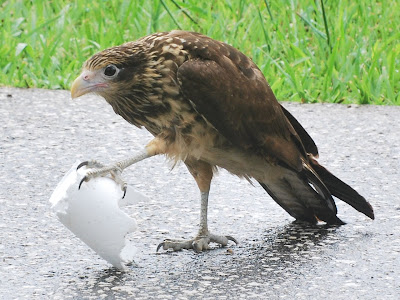
I saw this young Yellow-headed Caracara in Costa del Este (Panama City) with a foam cup. Repeatedly it was taking the foam cup with its claws, then with the beak to drop it or throw it high in the air again and again while screaming. Sometimes, it was ripping out little pieces.
The only thing that I imagine is that this young bird was playing with the foam cup, something that before I had never seen. When it got bored of it, flew directly to a nearby flock of Great-tailed Grackles just to scare them away... and I have to admit that it seemed to be enjoying it until a nasty male grackle started harassing it.

This post was submitted to Bird Photography Weekly. Check it out.

Tuesday, March 2, 2010

Raptors on streetlights

We have been visiting Costa del Este (Panama City) several times during this past weekend trying to locate all those rare gulls that have been reported (with success I must say!). Yesterday, I went with Gloriela and Osvaldo Quintero to the mouth of the Matías Hernández river in Costa del Este where we found two others birders (Cindy & Leslie Lieurance of Petrels in Panama) scoping the flock of gulls. The tide was too high, and the birds so far away, that we decided to drive around the streets and upriver just to see what we can get. It was a good idea since we found some interesting birds, including many raptors perched on the streetlights. Despite the lots of construction projects in the area, there are still some grassy open areas and gallery forest along the river and the coast where this raptors can hunt. By far, the most common raptor in Costa del Este (and in Panama City) is the Yellow-headed Caracara, commonly seen or heard and even very tame in some places. Its raucous screams are heard from far away. Is not unusual to find several individuals of this species. We also found a young Crested Caracara. They are more heavily builted than the Yellow-headed Caracaras, and much more uncommon in the city, but they become commoner just to the west and to the east (specially if the open areas are extensive). Later, we found a pair of American Kestrels perched on streetlights too. This beautiful little falcon is becoming widespread in Panama, just like in other countries. It used to be only an uncommon northern migrant, but now we have a resident population and nest activity have been reported from several places. The new colonizers came from the south. The males can be told apart in the field by differences in the crown and breast patterns (notice the unspotted breast of this individual). Its expansion is similar to that of the Pearl Kite some years ago. The streetlights are not the only perches in Costa del Este, nor the tallest. Other raptors, like Peregrine Falcons and Ospreys, prefer taller lookouts sites. That was true for the Osprey we spotted at the top of a construction crane, wherefrom it was thrown towards the river, probably in search of its next prey. Well, nice to see that some other birds are still surviving there, taking advantage of man-made perches!