Showing posts with label Ecuador. Show all posts

Monday, February 9, 2015

Experiencing "Un Poco del Chocó": Las Tolas Road

This is the third of a series of entries relating the experience both Rafael Luck and I had in the private reserve "Un Poco del Chocó" in northwestern Ecuador in mid-December of 2014 (you can read the second entry here).  For the last day of our stay, our host Wilo gave us a ride along the main road to the nearest town, Las Tolas.  This road reach an elevation of 2000 meters above sea level, thus offering a broader variety of birds species.  Wilo left us in a section known for mixed flocks and we waited for a while.
Las Tolas Road
The morning was chilly and foggy... we started to see shadows and movements through the folliage, but it was not until after a few minutes that the place was cleared enough to identify some species; however, we heard some key species in the mist: Toucan Barbet, Golden-headed Quetzal and Smoke-colored Pewee (we saw it later).
Smoke-colored Pewee
After a while, we started to see some mixed flocks of tanagers... but first a surprise for us.  Rafael found a pair of big woodpeckers downhill.  The expected species at that elevation was Powerful Woodpecker; however, a quick glimpse proved them to be a pair of Crimson-bellied Woodpeckers!  I don't know how, but Rafael got a single shot of his nemesis!
Crimson-bellied Woodpecker
I was relieved. The previous day I observed a pair of this species while walking the trails of the station with our guide Christian... Rafael stayed at the cabin.  That's an unofficial rule of birding: DO NOT quit the group while birding... your nemesis WILL show up!  I guess some good birding karma was with us.  Since then, everything was a bonus... colorful ones!
Golden Tanager
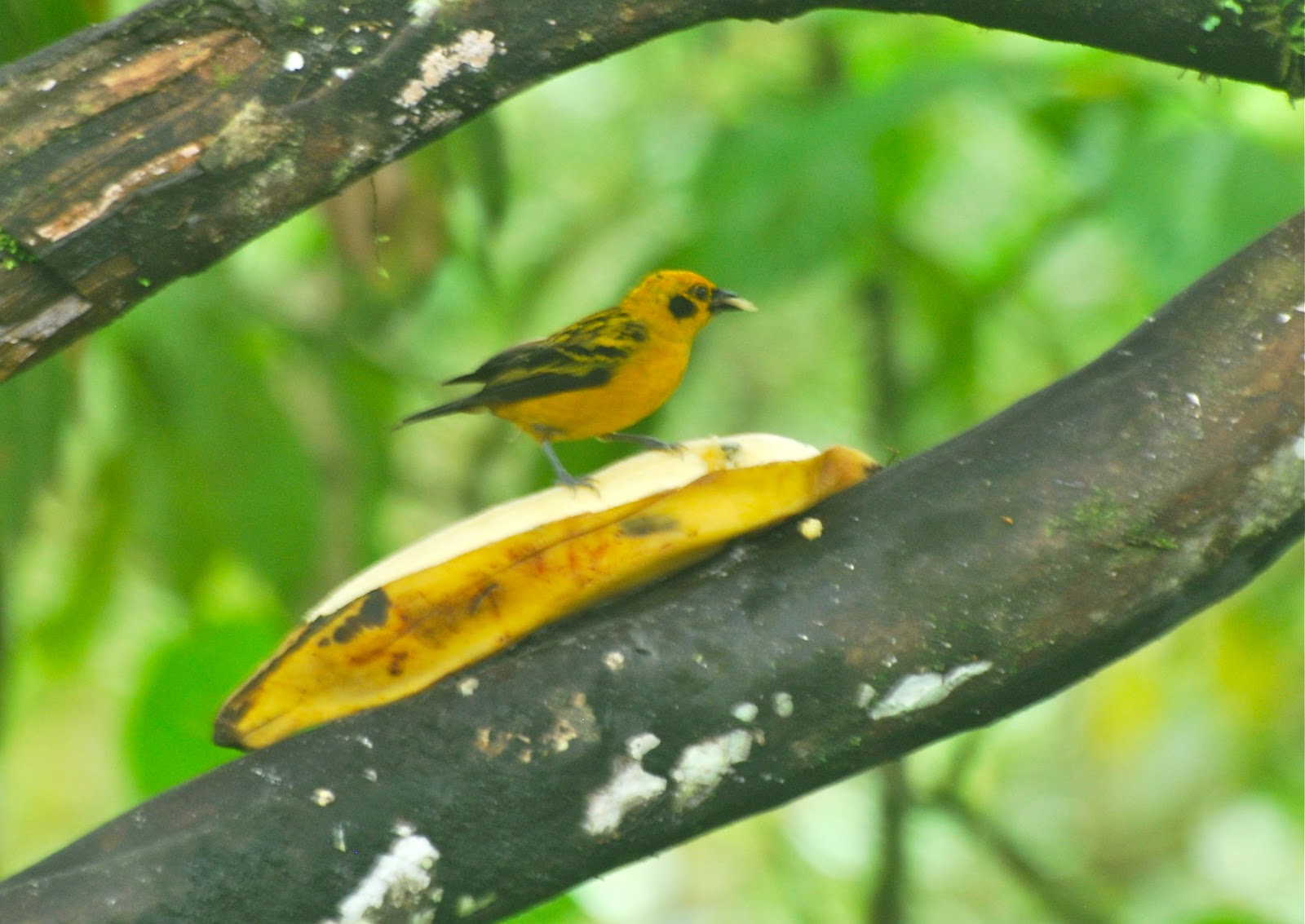
Flame-faced Tanager 
Rufous-throated Tanager
As you can see, we saw Golden, Flame-faced and Rufous-throated Tanagers feeding in some fruits, plus Glistening-green, Beryl-spangled, Golden-naped, Silver-throated, Blue-gray, Palm, White-shouldered and Flame-rumped Tanagers, Blue-winged and Black-chinned Mountain-Tanagers, Tricolored Brush-Finch, Montane Woodcreepers and this male Black-and-white Becard.
Black-and-white Becard
We also saw some bigger species, like Maroon-tailed (Chocó) Parakeet, Chocó and Black-madibled Toucans and Pale-mandibled Aracari.  The last one is considered a subspecies of the widespread Collared Aracari; however, you can see the differences:
Collared (Pale-madibled) Aracari
We spent two and a half terrific days at "Un Poco del Chocó" and are more than pleased with the staff, Nicole, Wilo and Christian, for all the attention they had with us.  We are looking forward for our next visit to "Un Poco del Chocó".

Friday, January 30, 2015

Experiencing "Un Poco del Chocó": the Endemics

As mentioned in the previous entry, I went to Ecuador in mid-December with my friend Rafael Luck and visited the private reserve Un Poco del Chocó in the northwest.  Our hosts did their best for showing us the rich birdlife around the property... and we got many special species, including some Chocó endemic species and subspecies. Many of these were quite common, and some even regular member of the mixed flocks seen daily crossing the garden.  That is the case of the Ochre-breasted Tanager.
Ochre-breasted Tanager
This species is closely related to both Carmiol's and Lemon-spectacled Tanagers, which we know well in Panama.  The lack of prominent field marks is probably its best field mark.  They were important members of the mixed flocks around the garden.  One or two individuals of the next species were constant too with the mixed flocks.
Chocó Warbler
Yes, Chocó Warbler.  Some authorities consider this form conespecific with the Golden-bellied Warbler of the eastern Andes from central to southern Peru, but there are some differences in plumage (the all-yellow supercilium as you can see in the photo) and song.  Another common species (although not in mixed flocks) was the Chocó Tyrannulet.
Chocó Tyrannulet
Typical for Zimmerius tyrannulets, this one stayed high in the canopy and was, thus, difficult to photograph.  This species used to be considered conespecific with the widespread Golden-faced Tyrannulet (and other forms), but song analysis and genetic works proved that it deserved the recognition as full species.  Another species that we found high in the canopy reluctant to show well was the Chocó Trogon.
male Chocó Trogon
This male is easily identified based on his white iris and green & red underparts without white pectoral band.  The "official" name of this taxa is Blue-tailed Trogon, but that name is already in use for a species in Asia and there is no other trogon species restricted to the Chocó bioregion.  We also saw inside the forest Esmeraldas Antbird, Dusky Chlorsopingus and Pallid Dove; all of them more or less restricted to the Chocó.  Along Las Tolas road, we saw/heard Chocó Toucan, Toucan-Barbet, Black-chinned Mountain-Tanagers, Glistening-green Tanager and the pacifica subspecies of Maroon-tailed Parakeet... all of them also restricted to the Chocó.
Maroon-tailed Parakeet (ssp. pacifica)

Maroon-tailed Parakeet (nominate ssp. melanura)
I put these two photos together to point out the differences between these two taxa.  As you can see, the main cis-Andean population (in this case a member of the nominate subspecies, melanura, from Guaviare in Colombia) has conspicuous white eyering and black front, both lacking in pacifica (sometimes known as Chocó Parakeet).
Jan & Rafael looking for endemics!
It is always nice to get lifers... but Chocó endemics... well, that's just great!  Stay tuned to know what else we saw along Las Tolas road in my next entry!

Thursday, January 29, 2015

Experiencing "Un Poco del Chocó": Introduction

The Chocó Bioregion is a narrow zone of wet rainforest that extends from southern Darien province in Panama to northwestern Ecuador, and is home to a great variety of flora and fauna, many of which are not found anywhere else on the planet.  My friend Rafael Luck and I had the opportunity to make a quick trip to northwestern Ecuador in mid-December in order to experience this special and diverse area.  Our basecamp was "Un Poco del Chocó", a private reserve owned by the German Biologist Nicole Büttner and her Ecuadorian husband Wilfrido (Wilo) Vaca.
Biological Station
There, we settled on a modest but comfortable station in the middle of the forest at 1200 meters above sea level.  We shared the station's common areas with some post-grade students and volunteers from the Netherlands, Switzerland and Germany... and enjoyed the delicious meals prepared by Wilo.  In fact, both Rafael and me are thinking on doing an internship at the station just to learn how to cook! But we were there for the birds... and the list for the reserve is impressive.  Of course, we were after the Banded Ground-Cuckoo, a kind of Holy Grail for the Neotropical twitcher that reappeared at the reserve one month before our visit... well, we do not get it... we got to the reserve just few days late... the antswarm followed by the ground-cuckoo moved to an inaccessible site of the reserve.  However, we had a great time watching other species, both common and localized at the reserve.
Well, Gloriela DID get her Banded Ground-Cuckoo (on her T-shirt)
We spend most of the days walking along the well-marked trails (guided by one of the owners or by Christian Montalvo who is part of the reserve staff) or viewing the birds at the feeders by the station.  The trail system goes all the way from the station at 1200 masl to the Pachijal river, at 950 masl.  Every trail is well marked and identified with a different color.  And the names are quite picturesque too.  Every detail was taken into account ... even the steepest areas had steps and even a ladder to help pass.
And what about the birds?  Well, Ecuador is bird paradise for sure, and although it was not our first visit to the country, we still had many lifers.  Not only Chocó endemics (that will be the subject of another entry), but also more widespread species as well... and some with such fancy names like Ecuadorian Thrush or Guayaquil Woodpecker, for example.
Ecuadorian Thrush
Guayaquil Woodpecker
Right at the garden, the flowering Verbenas attracted several species of hummingbirds, including such gems like Green Thorntail and Booted Racket-tails.  You can't get bored of seeing these amazing creatures hovering in front of the delicate flowers!
female Green Thorntail 
male Booted Racket-tail
The altitudinal range covered through the trails contributes to the high variety of bird species possible in and around the reserve, just like the variety of habitats.  For example, Bronze-winged Parrots are very common over both cleared and forested areas, while the White-capped Dippers are found only at the Pachijal river (where we saw a new species for the reserve: Spotted Sandpiper).
Distant Bronze-winged Parrot
Pair of White-capped Dippers
And inside the forest the possibilities are infinite... including crossing an antswarm attended by ground-cuckoos, Esmeraldas, Bicolored and Zeledon's Antbirds, Northern Barred and Plain-brown Woodcreepers, and many more!
male Zeledon's Antbird
Plain-brown Woodcreeper
We spend two and a half days at the reserve and recorded 130 species, including many lifers and special birds.  We dipped on some species, like the Banded Ground-Cuckoo and other Chocó specialties, so we have a good excuse to return!  Thanks to our hosts at Un Poco del Chocó and stay tuned for more photos from our memorable trip.
Christian, Rafael, Wilo and Nicole

Tuesday, April 17, 2012

Memories of a great trip

Click here to enlarge into an interactive map
In retrospective, the experiences during my last birding trip to northern South America were simply overwhelming! It is not everyday that you have the chance to visit THREE different birds-rich countries... and with friends! My great friend and birding companion for ALL the trip was Rafael Cortes, who organized most of it. Above is a map with some of the sites that I visited in Colombia, Venezuela and Ecuador during my three-weeks trip... click on it in order to open an interactive map with Google Earth, where each site have one or more links to a specific post in this blog. Lets talk about some numbers: 18 days of pure birding, nine flights in total (including the 15-minutes flight connecting Maturín and Puerto Ordaz in Venezuela), many different type of habitats, ranging from savanna to paramos, wetlands to lush cloud forests, llanos to amazonia... and more than 500 birds species!
Scarlet Ibis in the colombian llanos
We saw such emblematic birds like Bogotá Rail, Harpy Eagle, both Guianan and Andean Cock-of-the-Rocks, both White and Bearded Bellbirds, Andean Condor, Rufous-bellied Seedsnipe, Plate-billed Mountain-Toucan, Toucan-Barbet, Cream-colored Woodpecker and many more!
Harpy Eagle
But one group of birds deserves a special mention... we saw in total 63 different hummingbirds species! Some of the gems included in our lists were Racket-tailed and Festive Coquettes, Black-bellied and Green Thorntails, Crimson Topaz, Rufous-breasted Sabrewing, Purple-throated, White-bellied and Gorgeted Woodstar, Sword-billed Hummingbird, mind-blowing Velvet-purple Coronet and Giant Hummingbird.
Velvet-Purple Coronet
Not only birds... the trip was also rich in mammals, including four monkeys species, two agoutis, Boto (Amazonian River Dolphin), Prehensile-tailed Porcupine, Tayras, Báquiros (Peccaries), many tracks of big cats, and so on...
Common Squirrel Monkey
(Playa Guio, Guaviare, Colombia)
And all sort of critters, ranging from poison dart-frogs, to tarantulas and even giant earthworms!
Do Giant Antpittas eat giant earthworms?
(BellaVista, Ecuador)
I'm pretty sure that time will pass before I have the opportunity to make such a big trip again... what a memorable experience!

Rafael and Jan Axel with the Antisana Volcano as background

Monday, April 9, 2012

Last full day in Ecuador

The group conformed by José María Loaiza ("Chema"), Rafael Luck and me, plus our driver Washington, spend the morning of our last full day in Ecuador in the Refugio Paz de las Aves watching antpittas, tanagers, toucans, hummingbirds and all sort of feathered beauties, but then we moved a little lower along the main road to the town of Los Bancos, where we payed a short visit to the Mirador Río Blanco to have a beverage and to watch the action at the feeders (I already posted some hummingbirds photos from their feeders).
Río Blanco
The view of the Blanco river valley is simply spectacular, with all those foothill forests surrounding it, and the birds visiting the feeders where nice too.  Many tanagers species made an appearance, including Palm, Blue-grey, Guira, Flame-rumped (Lemon-rumped) and Golden Tanagers.  They were accompanied by many Thick-billed Euphonias and even an Ecuadorian Thrush (which was new for me).  In the way out, we saw my life Masked Water-Tyrant at the roof of a convenience store... a really stunning bird (but no photos... need to return).
Mitad del Mundo
Washington left us at Chema's place (very close to "Mitad del Mundo"), he had an appointment so Chema figured out another way to bird the last 4 or 5 hours of light left and decided to hire a taxi that took us to a nearby place, the Pululahua Geobotanical Reserve.  The road passes through an arid environment, but as soon as you start to descend your way through the inner slopes of the caldera (the Pululahua is an extinct volcano and the site we visited is the crater) the things change... a microhabitat of cloud forest becomes apparent, and the birds are completely different from those at Mitad del Mundo.  We walked the road through the slope while our taxi driver waited for 15 minutes before picking us just to drive a little more and to drop us again in another spot (depending on weather condition and activity) just to repeat the process again.  Birding this way produced Blackish and Ash-colored Tapaculos (both seen!!), Black-crested Warbler, Turquoise Jays, Red-crested Cotinga, Plain-tailed and Rufous Wrens, Rufous Antpitta (singing), Andean Guan and many more!
Pululahua crater view
We were very impressed by the landscape... the huge crater holds a little community, with farms, houses, cattle, and birds of course.  Chema showed us the only colony of Burrowing Owls of the crater (and one bird was perched atop a huge stone in the ground), but he had a surprise for us.  It was quite late when we left the taxi and started to walk a hard-to-follow-at-first trail through short grass that eventually reached some sort of secondary forest with a very tangled and dark understory.  We were after a specialty of the area, a Grallaricula antpitta to complete our list of antpittas for the day.  He played once a recording of the bird and we waited.  Soon I detected some movement on a tangle more or less 6 meters from our position... I focused my binoculars and there it was, an incredible cute Leymebamba Antpitta!!!  Despite my excitement I was able to show it to Rafael.  It was very dark for my camera, so I didn't try to take any photo.  What a creature, and what a great bird to count as our final bird of the trip to Ecuador!  Most authorities consider this form (of Ecuador and Peru) conspecific with the Rusty-breasted Antpitta (of Colombia and Venezuela) despite some physical, vocal and habitat requirements differences... for me, the name Leymebamba is simply more exotic!
Chema and Rafael after seeing the Leymebamba Antpitta
We spend that night as Chema's guests in his house, and celebrated with cold beers the successful end of our quick trip to northwestern Ecuador.  A pre-dawn flight back to Bogota (Colombia) was waiting for us the next day.     

Saturday, April 7, 2012

Birding can't get more easy than this!

For our last day in Ecuador, and after visiting the paramos around Quito the day before, we reserved a visit to one of the iconic place for birdwatching in the neotropics.  The Refugio Paz de las Aves is worldwide known now, the successful history of conservation and dedication of Angel Paz and his family is simply inspiring... and a trip to northwestern Ecuador couldn't be complete without a visit to this amazing place.  So, Rafael Cortes, José María "Chema" Loaiza, Washington and your blogger host headed to the km 66 entrance very early in the morning, meeting Angel before dawn and following him through the trails around his property.
It was still dark, and the only bird we saw close enough to identify were the Sickle-winged Guans that were feeding at Angel's blackberry plantation (photo at the feeders... you'll know what I'm talking about if keep reading).  Notice how similar it is to our Black Guan of western and central Panama.
We first visited the Andean Cock-of-the-Rock lek.  The bright scarlet body and the weird vocalizations made this spectacle a must to see, no matters how many times you have seen this species.  Some mixed flocks passed through as well, including such species like Flame-faced, Golden, Metallic-green and Golden-naped Tanagers, Golden-headed Quetzal, a pair of Powerful Woodpeckers, Ornate Flycatcher, Olivaceous Piha and many more.
Of course, the main attraction of the site are the antpittas... and we saw two species: the shy Moustached Antpitta and the cute Ochre-breasted Antpitta, better known as "Shakira".  I managed no photos of these beauties... I wasn't prepare for the light conditions, and Angel don't allow flashes (I'm OK with that).  The famous "María" (Giant Antpitta) was nesting, so we don't even hear her.  We don't get disappointed, since a spectacle difficult to believe was waiting for us.  We followed Angel (and his brother) to a feeding station and watched him preparing the breakfast.
Soon, a bunch of birds surrounded us, waiting for Angel to finish of setting the table.  The menu included grapes and bananas, and the birds loved it, specially the Sickle-winged Guans, the intrepid Crimson-rumped Toucanets and their bigger cousins, the absolutely gorgeous Plate-billed Mountain-Toucans!
Both Blue-winged and Black-chinned Mountain-Tanagers attended the appointment, taking turns to show up.  Then, an iconic bird did his triumphal entry... my poor shots simply do not reflect how colorful is the Toucan-Barbet... seeing him so easy and so close made me remind my life Toucan-Barbet some time ago in Colombia.
While everybody was entertained watching the feeders, I notice a group of birds approaching us from the lower part of the trail... soon I realized that they were Dark-backed Wood-Quails, and that they were following the voice of Angel's brother, Rodrigo... eventually, the birds took control of the feeders... and I swear that I was never so close to a wood-quail!
This is definitively a place that I want to return: I need better photos, more antpittas (including María), and to show all these birds to Gloriela and Gabrielle... Angel, this is not the last time you hear about me!