Showing posts with label Brown Noddy. Show all posts

Tuesday, July 11, 2017

And the birding continues! Pelagic off western Azuero

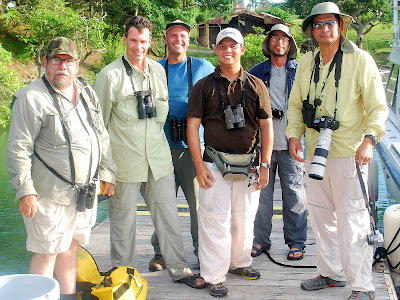
And after exciting 16+ hours of pure birding, we ended at the town of Malena, western Azuero, with our friends Kees and Lowes of Heliconia Inn.  We scheduled a pelagic trip for the next day, and the rest of the participants were already there: Mario Ocaña, George Angehr (yes, the author of "The Birds of Panama" field guide), visiting birder Enos Diestre and Kees Groenedijk as our guide.
That's me, George, Mario, Kees, our captain and Enos
As usual, very early the next day (May 14th) we took a quick breakfast and headed to the dock at Rio Negro, close to the town of Mariato.  With the first lights we started to navigate along the western coast of the Azuero Peninsula, in a route now familiar to some of us who were recurrent in this kind of trips.  It soon became clear that this would be a spectacular journey... since hordes of Black Terns, Brown Noddies and Galapagos Shearwaters started to appear... even close to shore!
We found several of these flocks feeding over schools of Bonitos... the show was simply amazing!  Frenzy feeding action both under and above the waves... it was hard to focus in just one bird.  In fact, among the dozens of goodies and Black Terns, there were other terns species, like Common and Sooty Terns for example.
Brown Noddies
Alternate Black Tern
Common Tern
Sooty Tern
But most important, the first tubenoses were also attending the party.  First a few... then, flocks with up to 50 Galapagos Shearwaters resting on the water or swiftly moving around each good spot.  The Galapagos Shearwaters are always present in these pelagic trips; however, it was the first time I saw so many... reminding me those photos of one of my favorite field guides on pelagic birds.  They allowed some close shots by the way!
Galapagos Shearwater
When we reached the Continental Shelf break, some other tubenoses started to appear... up to three Wedge-tailed Shearwaters started to feed among the Galapagos Shearwaters, while some Black and Wedge-rumped  Storm-Petrels also did some quick appearances... but they were quite shy for photos. Trust me, it is not easy to aim and shoot those little guys from a buoying boat in the middle of the ocean!
Wedge-tailed Shearwater
Wedge-tailed and Galapagos Shearwaters
Wedge-rumped Storm-Petrel
We recorded some other species, including Brown and Nazca Boobies, Bridled Terns and Laughing Gulls out there.  We also had some nice non-avian highlights... like several Hammerhead sharks (unknown species... if you have an idea let me know) and at least two different species of sea turtles, including the one pictured here:
Hammerhead Shark sp.
Sea Turtle sp.
As you can see, a successful trip.  Each one of these trips in Panama help us to understand a little bit more our pelagic avifauna... still a lot to do in this aspect of course.  

Wednesday, December 14, 2016

2016's Last Pelagic Trip Off Western Azuero Peninsula

Pelagic trips are always exciting off Panama coasts.  The pelagic avifauna is so poorly known that effectively no one knows what to expect.  That's why I try to attend every pelagic trip I can... and this trip was not the exception!  My friend Kees Groenendijk, of Heliconia Inn B&B, organized everything, as he has did in the last trips.  He and his wife, Loes Roos, have become real experts in the logistics of these special trips, and I highly recommend them if you plan a visit to that area.
Alfred, Howard, Rolando, Kees, Mikko and Jan Axel
This time, the companions willing to brave the waves, endure the weather conditions, withstand the odor of fish viscera that we use as bait and to ignore the seasickness were Alfred Raab, Howard Laidlaw, Rolando Jordan and Mikko Oivukka.  Kees, as usual, was our guide and in charge of the chumming process (thanks God).  We left Reina beach, close to the town of Mariato, just before dawn.  Watching the sunrise from the deck of the boat was magical.
We did the same route we followed in previous pelagic trips (you can read about them here and here) and the sea was relatively calm in spite of the dark clouds in the horizon.  After reaching Punta Naranjo (Azuero's southwestern corner), we headed directly to the south, to the Continental Shelf break and into deep waters.  At this point, we had only seen common inshore species, except for a jaeger that passed swiftly that we were unable to ID to species.  At the Continental Shelf break, we started to use the chum to attract our first tubenose... a Galapagos Shearwater.
Galapagos Shearwater
This species is regular in Panamanian offshore waters, although the numbers seem to fluctuate each season, we only saw a few of them this time.  The only other tubenose seen in this trip was a Wedge-tailed Shearwater that we were unable to photograph, but was easily ID'd since we had some experience with that species in Panama from the pelagic trips from eastern Azuero.  More interesting was the completely lack of storm-petrels in these waters... they certainly were not there!  We also saw another pelagic species... not a tubenose, but a pair of elegant Sabine's Gulls.
Sabine's Gulls
What a good sight!  The bird with the black terminal band in the tail and brown upperparts is a juvenile; while the other bird is an adult in basic plumage. The conspicuous wing pattern was unmistakable even at long distances.  We recorded at least five individuals of these graceful gulls.  After several hours, we started to head towards mainland.  In the way, we crossed some non-avian highlights.  First, a pod of 20 or may be 30 Short-finned Pilot Whales that stayed with us for more than 30 minutes.
Short-tailed Pilot Whales
spyhopping Short-finned Pilot Whale
Then, an Indo-Pacific Sailfish decided to feed at the surface very close to our boat... it was a lifer for me!  In fact, my first billfish ever!  Amazing!  Curiously, No one on board showed even the slightest interest in catching the fish... such a magnificent beast is better enjoyed free at the sea.
Indo-Pacific Sailfish
In the way to port, we decided to check a seamount known by local fishermen as a good spot for fishing.  As soon as we got there, a flock of Common and Black Terns welcomed us feeding over a school of Bonitos... it was a feeding frenzy.
Black and Common Terns
However, we noticed a different bird with them... in fact, someone mentioned that a "black" bird was feeding close to the surface.  We immediately identified it as a  noddy... certainly a Brown Noddy, the expected and common species in the area... it was a little bit dark to feel comfortable, but what else could it be?  I took several photos, most of them blurry shots...
Black Noddy
Black Noddy
The photos show a dark bird with uniform upper and under wing patterns, a contrasting white crown and forehead and slightly grayer tail; but most important, it has a thin, long bill... a Black Noddy!!!  We saw this bird several time feeding with the terns... you can compare it relative size in the next photo.
Black Noddy with Common and Black Terns
Then, we found a Brown Noddy in a different flock... the bird was evidently "brown" in the field, not black, and the photos show the shorter and stouter bill, the pale bar in the upper wing with contrasting dark flight feathers and the paler underwing.
Brown Noddy
Brown Noddy
The Black Noddy was considered hypothetical for Panama due to a sight record from Islas Frailes many years ago.  These photos confirm the species for Panamanian waters.  The species is not totally unexpected since it is regularly found in waters around Cocos and Malpelo Islands off the coasts of Costa Rica and Colombia respectively.  It was a life bird for me of course, and a great way to end a nice pelagic trip off western Azuero Peninsula!

Friday, October 7, 2016

Off shore western Azuero: birds and mammals

It was 5:00 am last October 1st, 2016.  In spite of a not-so-favorable weather forecast, a group of intrepid birders, including George Angehr, Howard Laidlaw, Joris Deruwe, Miguel Siu and your blogger host were standing in the dark while Kees Groennedijk was taking care of the last details for our first pelagic trip of the year.  We were at the dock in Reina beach close to the town of Mariato in western Azuero Peninsula (Veraguas province).  A little "panga" took us along the Negro river and, eventually, to the fishing boat anchored off shore due to tide issues.
Part of the group at the dock in Negro river
Our pelagic trip started in the dark.  It was not after passing the 6:00 am mark that we started to watch some birds... the first one was the silhouette of a Magnificent Frigatebird.  We took the same route we did last year, navigating parallel to the western coast of the Azuero Peninsula to Punta Naranjo (the southwest corner of the peninsula), then off few miles to deep waters along the Continental Shelf break, moving to the west while chumming and then going back to Reina beach more or less in an straight line.
Punta Naranjo
Still within the Continental Shelf, our first highlight was an immature Red-billed Tropicbird that decided to swim quite close to the boat, allowing some shoots before taking off again.  The species seems to be regular in those waters according to Kees, but it was the first time I see it in the Pacific Ocean.  Eventually, we saw three to four different individuals, all of them immatures and within the Continental Shelf.
Immature Red-billed Tropicbird
At Punta Naranjo we only saw two (instead of dozens) Brown Noddies flying close to the rocks.  By that time, it was evident that the most common species present was the Black Tern... loose flocks of up to 50 birds were seen each hour, specially within the Continental Shelf, plus other terns species like Royal and Common Terns inshore and many Bridled Terns well offshore... but also some resting on floating debris close to shore.
Brown Noddy 
Black Tern (basic)
Common Tern (alternate)
Bridled Tern (basic)
This time, our time at deep waters was not very productive.  At the chumming sites we only saw few Galapagos Shearwaters... the only tubenose recorded in the whole trip.  That's right... no other shearwater, petrel nor storm-petrel species that day.  At least, we were expecting two or three different species of storm-petrels... none was seen.  Were they not there?  The chum was not smelly enough?  We were not lucky enough?  Certainly, we still need to know a lot about our pelagic avifauna.
Galapagos Shearwater
Besides the birds (and lack of them), the other highlight was the number of Pantropical Spotted Dolphins that we managed to see.  Several dozens of these intelligent animals accompanied us for a while, they gave us a marvelous show!
And that my friends was our day at the sea.  No new birds for Panama and no life birds, plus a little bit of seasickness for the first time (weird, since the sea was quite calm)... but hey! that's pelagic birding!!!  Can't wait for the next one!

Sunday, August 16, 2015

Pelagic off Western Azuero

The pelagic avifauna of Panama is essentially unknown.  Very few, if any, pelagic birding trips are done off Panamanian coasts, specially off the Azuero Peninsula (central Panama) where the Continental Shelf break is close to shore.  Several new species for Panama have been recorded in those trips in the last five years, including Tahiti Petrel, Pink-footed Shearwater and Band-rumped Storm-Petrel, while many others have been confirmed and documented adequately.  That's why a pelagic trip in Panama is always exciting.  So, more or less one month ago, we took the opportunity to make a pelagic trip off the Azuero Peninsula again... but this time from its western side... departing from Reina beach close to the town of Mariato.  Our friend Kees Groenendijk (who runs the charming Heliconia B&B in the town of Malena with his wife Loes) organized everything: lodging, boat, captain (Tim), chum and snacks... so it was not difficult to convince George Angehr, Howard Laidlaw, Rafael Luck and Euclides -Kilo- Campos to join us in the adventure!
Rafael, Euclides, Howard, George, Jan and Kees
The Continental Shelf break was still one and a half our away to the south from the departing point, but the inshore waters were full of life, with American Oystercatchers and Collared Plovers at the sand of Reina beach, with over-summering Willets, Whimbrels and a lonely Spotted Sandpiper.  Soon, we started to see the first Brown and Blue-footed Boobies for the day, plus many Magnificent Frigatebirds, Brown Pelicans and even a pod of Bottlenose Dolphins close to Cebaco island.  Kees showed us some rocky islets close to Punta Naranjo (Azuero's southwestern corner) that were covered in Brown Noddies.  This tern is seldom seen so close to shore in Panama.
Rocky islets close to Punta Naranjo (and a Brown Pelican)
Brown Noddies 
The omnipresent Magnificent Frigatebird dwarfed the Brown Noddies, although they are quite large for a tern.
Magnificent Frigatebird and Brown Noddy
At this point we started to see real pelagic birds. The Continental Shelf break drops steeply VERY close to shore in this part of the Azuero Peninsula... in fact, most of the pelagic birding was done having the southern Azuero coast within sight.  Kees started to chum at several spots along the break... soon, we were surrounded by several Black and Wedge-rumped Storm-Petrels attending the slick. I have to admit that this was the first time I saw those species so close and in detail!
Wedge-rumped and Black Storm-Petrels
Black Storm-Petrels
Black Storm-Petrel
Wedge-rumped Storm-Petrel
These small tubenoses are well adapted for the rough seas, in spite of their size.  Most (if not all) of the Black Storm-Petrels seen were in wing molt, probably indicating non-breeding birds on its second cycle (year) at this date.  About the Wedge-rumped Storm-Petrels... I don't know if they can be ID to subspecies in the field.  Both the nominate tethys and kelsalli forms have been recorded in Panamanian waters.  These birds were evidently larger than the Least Storm-Petrels seen nearby and the wings looked narrow and long, with a shallow tail fork (they looked square-tailed in the field and in the photos), all consistent with nominate tethys.  As I mentioned earlier, we also saw some Least Storm-Petrels.  They showed little interest in the chum and only visited the slick for few seconds; however, I managed a diagnostic photo showing the graduated tail and the dark plumage resembling Black Storm-Petrel.
Least Storm-Petrel
The storm-petrels were the highlights of this trip due to the prolonged and detailed views of the birds, but we also recorded several Galapagos Shearwaters (all of them of the "light-winged" variation), a definitive Pink-footed Shearwater (fifth report for Panama, second one documented with photos) and a Nazca Booby flying to the west above the Continental Shelf break.
Galapagos Shearwater
Pink-footed Shearwater
Nazca Booby
The pelagic birds were not the only highlights of this trip.  At some point, we saw no less than four Humpback Whales, with one young animal leaping off the surface almost completely!  This, plus the dozens Pantropical Spotted Dolphins off shore in a feeding frenzy, the Bottlenose Dolphins inshore and the Spinner Dolphins spotted by some of the group (not by me), made it a four-species-day of cetaceans!
Humpback Whale
Pantropical Spotted Dolphin
I wish to thank Kees and Loes for receiving us and for organizing this amazing trip.  I know I'll be back to western Azuero soon... and not only for the pelagic birding because the area is home to many endemic taxa and other nature marvels.  See you soon!

Tuesday, September 14, 2010

Pelagic off Punta Mala

I had the opportunity to join a fine group of birdwatchers last saturday, september 11th, in a pelagic birding trip off Punta Mala, at the tip of the Azuero Peninsula in central Panama. Worldbirder Björn Anderson kindly organized the trip and invited me (I'm so grateful by the way) and other four birders: Kenneth Allaire, Gonzalo Horna, Darién Montañéz and Rafael Luck. My journey started friday, when Rafael picked me up after work around 3:00 PM. We were loaded with fish leftovers, tuna cans and popcorn (the ingredients of the chum) and with all the excitement of being part of that trip. We all met at the charming town of Pedasí, where we stayed for the night to meet very early in the morning our captain Jeff and his seaworthy assistant, Armando. We followed them to a private dock at Punta Mala and were ready to go aboard the 30-feet-long fishing boat "Flora Cristina". You can see in the map the route that we did, reaching 10,000-feet depth waters just outside the continental platform. No more than 20 minutes after we left the dock, we began to prepare the chum when I noticed that the first bird of the trip was following us. I limited myself to say "the chum is working already", but then it was evident the dark plumage of the bird with a conspicuous white trailing edge to the wing, a pattern that I had already seen in Perú: an Inca Tern!!! The beautiful bird followed us for a while and then landed on the boat... amazing!!! Of course everyone was delighted with the bird and almost everyone got excellent photos of it. The bird sailed with us for more or less 20 minutes and then, it followed its own path for never be seen again. What a great way to start a trip... with a bird not reported for Panama in the last 27 years! After the tern, much commoner species started to appear... most of them surely coming from the Frailes Islands to the west: Brown Noddies, Bridled and Sooty Terns. We got distant views first, but at the end of the trip (when we got close to the islands) we got better views, allowing photos (I have to say that trying to photograph pelagic birds aboard a constantly-moving boat is really hard task!). The juvenile Sooty Tern that I'm presenting here was the first one I ever saw of that species. The next photo shows some adults Sooty Terns with two Brown Noodies (one is floating, you can enlarge the photo). After a while, we left the terns and began to find shearwaters and petrels! The first shearwater to appear was the expected Galapagos Shearwater, which offered some close views and photographic opportunities.
We saw four Oceanites storm-petrels that we are calling Wilsons' (thank you Björn for noticing it). The commonest storm-petrel was the Wedge-rumped Storm-Petrel, with one to four birds after our chum in several sites. But more important, a bigger storm-petrel with pointed wings and a definitive narrower rump band turned out to be a Band-rumped Storm-Petrel, id by the experts, the first register for Panama, and a personal lifer! At 8:30 AM, Björn found the main target of the trip: a Tahiti Petrel (N 07º 20.002' W 079º 36.910). I hurried enough to see the clear dark-and-white pattern of the underparts and to appreciate its agile and swift flight above the sea with its long and narrow wings. It was a first for Panama too, and my second lifer for the trip! After the petrel, the things became calmer, with only common species, including Blue-footed and Brown Boobies, a lonely Neotropic Cormorant out there, more Wedge-rumped Storm-Petrels and Galapagos Shearwaters. In one of those calm periods of time, the captain found a little bird in front of the boat that flew away revealing its shorebird shape and lined back: a Red-necked Phalarope (year-bird, like many others).
In our way back, Björn found some Wedge-tailed Shearwaters along with a flock of Brown Boobies. After some maneuvering by the captain, we got close to the shearwaters, allowing great views and photos (compare with that of the Galapagos Shearwater). We were at N 07º 15.883' W 080º 00.146'.
Two years ago, Darien and I reported the first Wedge-taileds' in more than 30 years around the Frailes Islands. Now we have photos!
Well, after all it turned out to be one of those memorable trips that you'll never forget... including new species for Panama (and for me)!The self-denominated T.P. (Tahiti Petrel) Gang; from left to right: GH, BA, KA, JA, DM and RL.
More about this trip here, more photos and a complete bird list at Xenornis.