Showing posts with label Red-legged Honeycreeper. Show all posts

Thursday, November 15, 2012

At the feeders!

As promised in my last entry, this post is about my birding day, last sunday, at the foothills of Cerro Azul, to the east of Panama City, with Osvaldo Quintero, Osvaldo Quintero Jr and the Cerro Azul's residents Leslie and Cindy Lieurance (The Petrels in Panama) and Claudia Ahrens.  Our intention was to look after a local speciality, the Black-eared Wood-Quail which Leslie videotaped at close range in the Calle Maipo trail entrance one week ago or so.
We walked all the trail, watching some forest interior birds and hearing at least two or three different coveys of wood-quails, but they were reluctant to show off for us... instead, we had a great time birding at the more open areas at the entrance of the trail and the main road, where mixed flocks with tanagers and warblers were the main stars.  The Fulvous-vented Euphonia offered a nice show... two adult males  were engaged in full courtship display.  The one I pictured above perched vertically with wings dropped making lots of noise!  Notice its fulvous vent... the female was more interested in eating juicy berries... she is so different to the male, but still distinctive!
After doing some exercise at the trail, we did what every smart birder would do: sit in front of feeders!  Both the Ahrens and the Lieurance keep feeders at their houses, and the diversity is awesome.  At the Ahrens, we checked a banana feeder where the first visitor was this male Hepatic Tanager.
Notice its dark lores and beak, which separates him of the similar looking Summer Tanager, which is a common winter visitor to Panama... this male was waiting its chance to grab a piece of banana.  Also note that the Summer Tanager is lighter red in general, compared with the Hepatic Tanager.
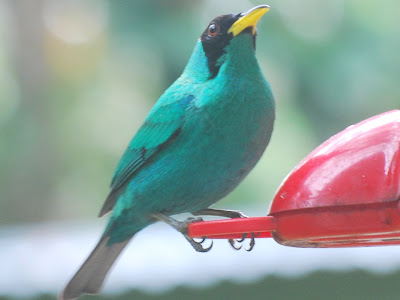
Soon, the action at the feeder became insane, with Bay-headed, Palm and Plain-colored Tanagers fighting for a space on it against Black-cheeked Woodpeckers, this female Green Honeycreeper and this young male Thick-billed Euphonia.
But the most aggressive bird at the feeder was the Clay-colored Thrush; however, in spite of the size difference, this male Red-legged Honeycreeper was not intimidated and took its part of the prize.  Notice that this male is in non-breeding plumage.
Curiously, at the Lieurance feeders, there were males Red-legged Honeycreepers in full or almost-full breeding plumage... they glow!
The Lieurance also have banana feeders, we checked the hanging feeder during the couple of minutes that we stayed, enjoying their hospitality... it is quite curious to see migrants Tennessee Warblers eating banana in the tropics... though it is not the first time!
Well, perhaps we didn't see the wood-quails... but what a great day we got!  Thank you Claudia, Leslie and Cindy! 

Thursday, September 6, 2012

Day at the foothills

One of the few birding trips I made last month was to the foothills close to Panama City... the area of Cerro Azul / Cerro Jefe.  This is a popular weekend destination for the citizen; however, many people lives complete-time up there, including many birder friends.  Osvaldo Quintero, Rafael Luck, Itzel Fong and myself departed from the city in a relaxed trip all the way up to the private neighborhood of Los Altos de Cerro Azul, and went directly to our first destination, the naturals paths at the end of the Paseo Colombia.
The day was partially cloudy, and as soon as we got out of the car, we started to watch birds.  A female Gartered Trogon welcomed us, offering excellent photo opportunities.  The eye-ring color and the undertail pattern are diagnostic.  She ate some Cecropia fruits by hovering in front of them for few seconds.
The mossy start of the path provoked a nasty fall to Osvaldo... thanks God he was not hurt... a tough guy for sure!  Seeing this, we decided to left the paths, and moved one to the highest part of the foothills, to Cerro Jefe.  The elfin forest covering the highest slopes is something special, looks like another world!
We visited the Vistamares lookout and, despite the lacks of birds, we enjoyed the views of the surrounding forests.  Notice how the elfin forest have twisted and dwarfed trees (many of them palm trees), an adaptation of the windy conditions up there... the fancy houses of Los Altos can be seen in the background.
To call it a day, we went to Los Altos Camping Club in order to have lunch.  We decided to seat in the terrace, facing a fruiting tree... for our surprise, the tree was FULL of birds!  We had a great time shooting our cameras at Black-cheeked Woodpeckers, Blue-gray, Palm, Crimson-backed, Golden-hooded and Plain-colored Tanagers, Red-legged Honeycreepers and Scarlet-thighed Dacnis, among others!

Great way to call it a day!  
Panama City, as seen from Cerro Jefe

Thursday, April 26, 2012

Around Penonome

Every time I go to Penonome (Cocle province, central Panama), I try to wander around, taking photos not only of birds, but of every interesting stuff I can find... however, this is a bird-photos post from Penonome.  I traveled with Gloriela, Gabrielle and some relatives, starting around the "finca", in the outskirts of the town, where Gloriela's dad have a cabin surrounded by fruiting trees, including many papayas trees with mature fruits.  It turned out to be a natural feeder for a big bunch of Red-legged Honeycreepers, including several males in alternate plumage (very colorful).
Around the cabin, a little creek surrounded by a not-so-tall gallery forest holds several pairs of Blue-crowned Motmots.  I already posted a rationale about calling these birds Whooping Motmots... they have a distinctive voice; however, the AOU do not recognizes the split, neither the Panama Audubon Society.
We then visited a stretch of the mighty Zaratí river, in a place called Barrigon.  The rapid-flowing river in this part is bordered by huge barrigon trees (Pseudobombax sp.),  with some understore... a perfect habitat for this Cocoa Woodcreeper, despite we usually think on this bird as a forest inhabitant.
Back to our house, even the live fence have its own birds.  The only antbird present in this part of town is the Barred Antshrike.  This species exhibit a strong sexual dimorphism, the male is totally barred white and black, while the female (pictured here) is rufescent.
The White-tipped Dove is very common (but quite shy)... its voice is a familiar sound of the coclesian savanna... reminiscent of blowing through a bottle.
Well, it is always nice to wander around Penonome!

Saturday, January 1, 2011

Bird of the Month: Green Honeycreeper

The Green Honeycreeper (Chlorophanes spiza) is a common member of the former honeycreepers family, now merged with the tanagers, probably closer to the Tangara tanagers. It inhabitates the forest canopy and edges in wet areas of the lowlands and foothills of both slopes along Panama. Compared to others honeycreepers, it is larger and with a thicker, but less downcurved bill (as you can see in the photo, a male Green next to a male Red-legged Honeycreeper). The males are strikingly beautiful... the turquoise-green feathers make them easy to find from long distances. I don't recall any other bird in Panama with such a bright green color! The females are duller, but still recognizable by their bill-shape. In any case, they usually are found in pairs, or alone and are frequent members of mixed-species flocks with tanager, euphonias and other colourful birds. They have a wide distribution, extending from southern Mexico to Brazil and Bolivia, which reflects their adaptability and success exploiting their niche. These birds are omnivorous, that is, they don't only feed on nectar, but also eat fruits and insects... and I have to say it, they can be quite aggresive when looking for food, taking advantage of their larger size to dominate the smaller birds in the best spots (like fruiting trees or feeders). Probably, the bandit mask (the male's black half-hood) is well deserved. For these, and many others reasons is why we choose the Green Honeycreeper as our bird of the month!
This post was submitted to Bird Photography Weekly # 123. Check it out!
Literature consulted:
1. Ridgely RS, Gwynne JA. A Guide to the Birds of Panama. 1993

Monday, December 27, 2010

2010's Central Christmas Bird Count

Yesterday, earlier than usual, I woke still at dark in order to drive to the sleepy town of Gamboa (central Panama) to participate in the Central Christmas Bird Count organized by the Panama Audubon Society (PAS). Under a light drizzle, and in complete darkness, I joined Bill & Claudia Ahrens and Karl & Rosabel Kaufmann at the entrance gate of the famous Pipeline Road. A pouring rain struck the town all night long, and the weather forecast was not promising. As expected, our owling outing ended with just a Pauraque and a Mottled Owl due to the rain. The road was very damaged, so we only reached the area just beyond the former Limbo hunt camp, from where I started to walk (umbrella in hand) towards my own birding area around the Mendoza river, at the 8.8 km mark, hearing no dawn chorus due to the rain, a very bad sign. After a while, the team formed by Rafael Luck, Osvaldo Quintero and Venicio "Beny" Wilson (destined to explore the depths of Pipeline road) passed me swiftly aboard the tough FJ Cruiser without a problem, but it was a huge fallen tree (and not the muddy, potholed road) that stopped them... so I joined them in their quest after birds. We walked a lot on hilly terrain, passing the Syristes river and reaching the 11.0 km mark (photo courtesy of Beny, more at his Picasa Web Album)... and we were rewarded with special birds for this count, like Slaty-backed Forest-Falcon, Buff-throated Foliage-Gleaner, Russet Antshrike, Spot-crowned Antvireo, Tawny-faced Gnatwren, Speckled Mourner, Olive Tanager and even a rare (for that area) White-throated Thrush attending an antswarm. Of course, the antswarm attracted more regular ant-follower birds too, like Bicolored, Spotted and Ocellated Antbirds, Plain-brown and Northern Barred Woodcreepers and a Rufous Motmot. It is always nice to see the Ocellated Antbirds, with their intrincated pattern and bright blue bare-skin around the eye (file photo). Well, despite this list, the activity was desperately low between the mixed flocks, and we covered large tracks of road without seeing or hearing any bird. It was getting late and we started to return, finding a nicely perched nightjar in the open (I will discuss its ID in another post) close to the Mendoza river. Out of Pipeline road, we headed to the town of Gamboa, stopping first at the Ammo Dump's marshes and finding several waterbirds, including at least two adult Rufescent Tiger-Herons and a Muscovy Duck (another heard). We checked our lists at Guido Berguido's place, finding that we saw a good number of birds despite the weather, The house is at the edge of a nice forest and it has bird feeders scattered in the backyard, attracting hordes of colourful Red-legged and Green Honeycreepers (sometimes Shiny Honeycreeper as well, but not that day), Blue Dacnis, Blue-gray, Palm, Flame-rumped and Crimson-backed Tanagers, a stunning Baltimore Oriole just like the one of the baseball caps, Gray-headed Chachalacas, Variegated Squirrels, Central American Agouti, etc, etc, etc.... the backyard list is impressive. For the afternoon, I went with Darien Montañez and Jose Luciani around Gamboa, looking for some missing birds, and we saw many of them... with Great Antshrike, Golden-winged Warbler, Yellow-billed Cacique and Northern Rough-winged Swallows as my personal highlights. Probably not the best count in terms of quantity, but it is quality what matters after all!

Monday, November 29, 2010

Watching birds in Penonome

Taking advantage of the long weekend, I went with Gloriela and some relatives to Penonome (Cocle province, central Panama) in order to relax and to rest a little. Of course, many people did the same, so eventually we all met at Gloriela's dad "finca" in the outskirts of the town where he is constructing a little cabin (OK, is not so little after all). Is not finished yet, but at least it gave some shelter to avoid the noon sun or the november (heavy) rains. He have done a good job with what used to be pastureland... now the place looks more like a woodland with creeks and tons of trees (both native and introduced). Not only humans were attracted, birds were too. I had a great time walking around, taking photos of common (but entertaining) birds. The property is bordered in one side by a shallow river covered under the canopy of a gallery forest, home of species like Lance-tailed Manakins and Rufous-capped Warblers, with one making a brief appearance in response to my "pishing". The bold eyestripes contrast with the rufous head in a very nice way. I walked along the river, enjoying the sound of the running water and the freshness of the air. Eventually, I decided to left the river to explore more hilly parts of the property, with scattered bushes and low trees typical of the coclesian savannah. I found some typical species of this open habitat, including some raptors (Roadside Hawk, Crested Caracara) and the very common Fork-tailed Flycatcher. Several pairs were vocalizing and I even saw a beautiful male doing an aerial exhibition (impressive). These birds are well-known by locals with the name "tijereta", allusive to the long, forked tail. This habitat is also typical of the Mouse-colored Tyrannulet. I heard its distinctive call in several places and saw few individuals briefly. They sound like a tiny evil laugh. The Lesser Elaenias were also common, just like their close relatives, the Yellow-bellied Elaenias. Both of them are known as "moñonas" despite the less obvious "moño" (crest) of the Lessers. The flycatchers are a very important group of birds in this habitat. Other flycatchers seen and/or heard were Social, Streaked, Acadian, Panama and Great Crested Flycatchers, Eastern and Tropical Kingbirds, Eastern Wood-Pewee, Yellow-crowned and Southern Beardless Tyrannulets and a Great Kiskadee. Have you noticed how many medium to large-sized flycatchers exhibit the same facial and overall pattern of the kiskadee? It is suppose that all them evolved to look just like this agressive, adaptable and successful species. Interesting eh? The flycatchers are not the only ones found there. Closer to the cabin, in a quite humid spot with many fruiting trees, I found several tanagers (and former tanagers species) along with some other frugivorous birds and some bathing birds (that had nothing to do with the fruits).. One of those former tanagers was a male Summer Tanager (now merged with the cardinals), representing also the migrant species. More migrants (besides the migrant flycatchers listed before) were both Yellow and Tennessee Warblers (having a bath), many swallows and several Rose-breasted Grosbeaks in basic plumage. The place attracted many other species, like Black-striped Sparrows, tons of Clay-colored Thrushes, Streaked Saltator, Blue-gray and Palm Tanagers, Variable Seedeaters, Yellow-crowned Euphonias and a flock of Red-legged Honeycreepers (a female pictured here, but with the males looking similar except by their black wings). The last birds I photographed were the resident Lesser Goldfinches that were calling constantly. After a couple of hours of birding and trekking along the property, I finally relaxed while having a nice, unobstructed view of the majestic Guacamaya hill in the distance and enjoying the fresh breeze of the coclesian savannah accompanied by Gloriela and maaaany of our nephews!