During

the last
Christmas Bird Count, by the Mendoza river in
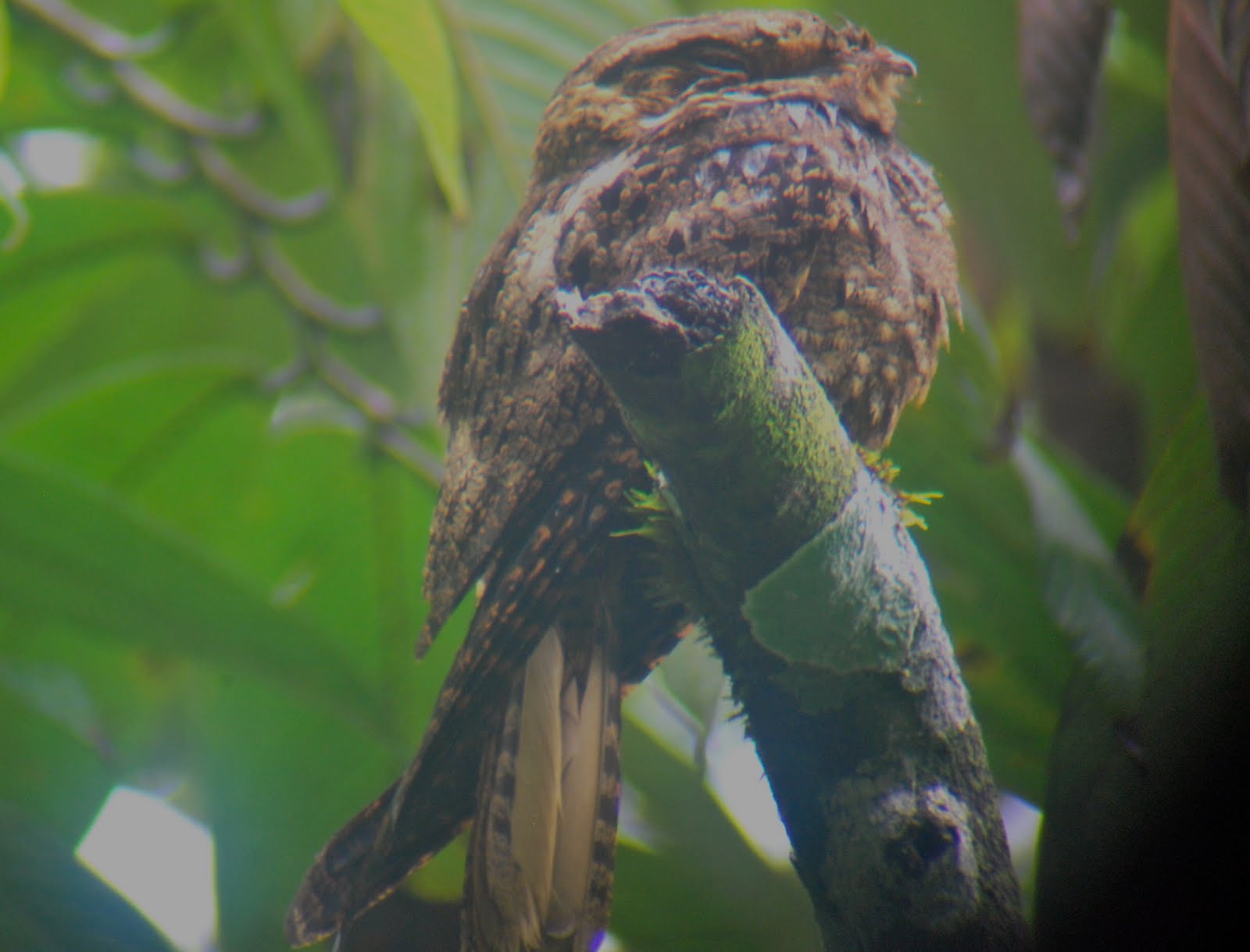
Pipeline road (central Panama), I found an interesting nightjar perched atop a branch in the open, around 11:00 AM, probably a migrant
Chuck-will's-widow (
ChWW). All the team members (
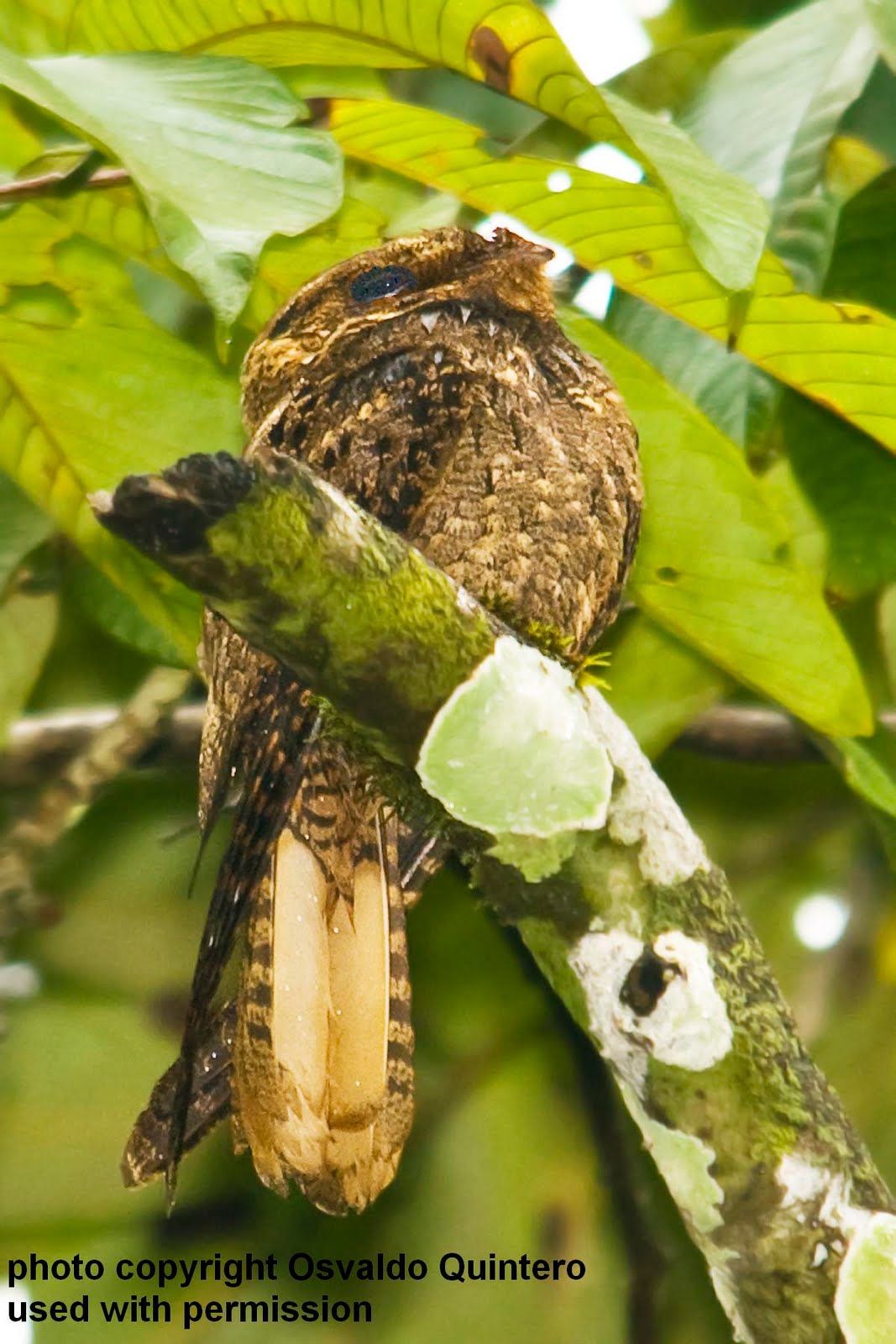
Venicio "Beny" Wilson, Rafael Luck and Osvaldo Quintero) were able to see the bird and to get photographs. The first thing we noticed was its posture, it was vertically perched like a potoo, showing well the undertail pattern but not as well the back nor the crown. We also noticed immediately its hugeness, looking definitively larger than the common nightjar usually found in Panama (Pauraque), approaching the size of a Common Potoo. Essentially, it was a cryptic patterned nightjar, mostly rufous-brown, with darker tones in the wing coverts and paler in the back. The underparts
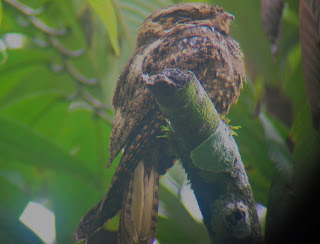
were mostly dark brown, with many rufous spots and fine dark vermiculations. The closed wings almost reached the tail tip, and the primaries were black with rufous barring. More interesting, at least the two external rectrices showed pale buffy tips and buffy white inner webs all the way to the undertail coverts (which were rufous with black barring), with the external webs boldy barred in buff and dark brown. The bird didn't vocalize nor move during the ten minutes or so that we

watched it. Osvaldo and Rafael used their flashes with the camera... my own photo (digiscoped with my DSLR camera) was with natural light (however, the day was cloudy and the lights conditions were not the best). The
Common Pauraque (above photo, a male) can be easily ruled out by tail pattern and lack of conspicuous chestnut cheeks (and less patterned shoulders and wing coverts). The really hard task is to rule out the
Rufous Nightjar (
RNj). The
RNj is one of our resident nightjars, closely related to the
ChWW. It prefers drier habitats in the Pacific slope of the country (second growths, thickets and forest edges), so a bird found deep inside a mature. wet forest in the Caribbean slope as this one will hardly be a
RNj... in the other hand, the
ChWW is

a boreal migrant recorded in a wide variety of habitats in Panama, including mature wet forest, but also the same habitats preferred by the
RNj and even residential areas with big trees. So, habitat favors
ChWW... but birds doesn't read books, and there are some records of
RNj in the Caribbean slope of the Canal area (although in cleared areas), so habitat alone is not enough to separate these birds. Another thing is the size. The
ChWW is our largest nightjar, but we all know that size appreciation in the field is very subjective, and depends of maaaaany factors, including posture. About field marks, these two species are almost impossible to tell apart in the field, specially because we do not hear the characteristic call of the
ChWW in its wintering grounds. In the hand, the
ChWW have lateral filaments to the rictal bristles, absent in the
RNj. Enlarge my photo of a
RNj (above, from Summit Ponds, just across the continental divide in the Pacific slope of central Panama) and you will see the long rictal bristles arising from the base of its mouth. Now, call me crazy, but enlarge Osvaldo's photo (the first of this post)... although the resolution is not the best due to the distance, I can see that the rictal bristles look like a brush! Photo artifact? Lateral filaments? OK, it is hard to tell, so lets forget it. What about plumage marks. Some references list differences in the overall coloration, the color of the crown, the back and the throat to separate these two species in the field, but I have found that these field marks are not reliable after checking LOTS of
ChWW's photos in the internet, and many
RNj's photos as well (there not so many published photos of this species). This probably is due to many contributing factors, like age, sex and race (ssp) of the bird, the photographic settings, the light conditions, etc... but one

characteristic seemed useful to correctly separate these two: the male's undertail pattern. In the
ChWW, the white (or buff) of the inner webs is very extensive, more than that of the
RNj, almost reaching the base of the feather and only skipping the tips. You can see this in Nate's photo, of
The Drinking Bird blog, of a preserved
ChWW specimen. Compare it with our bird. In the
RNj, the white (or buff) is shorter, occupying only the distal half or third part of the feather. This difference is listed and/or illustrated by Ridgely & Gwynne (Birds of Panama), Ridgely & Greenfield (Birds of Ecuador), Hilty & Brown

(Birds of Colombia, attached illustration), Garrigues & Dean (Birds of Costa Rica), just to mention a few! It is not exactly a field mark, because is very unlikely to watch this under normal field viewing conditions, so we were VERY lucky. I'm pretty convinced that our bird is a male
Chuck-Will's-Widow based on tail pattern and habitat, and I want to know if you agree with me via the comments. Happy birding and Happy New Year by the way!
 The Green Honeycreeper (Chlorophanes spiza) is a common member of the former honeycreepers family, now merged with the tanagers,
  probably closer to the Tangara tanagers. It inhabitates the forest canopy and edges in wet areas of the lowlands and foothills of both slopes along Panama. Compared to others honeycreepers, it is larger and with a thicker, but less downcurved bill (as you can see in the photo, a male Green next to a male Red-legged Honeycreeper). The males are strikingly beautiful... the turquoise-green feathers make them easy to find from long distances. I don't recall any other bird in Panama with such a bright green color! The females are duller, but still recognizable by their bill-shape. In any case, they usually are found in pairs, or alone and are frequent members of mixed-species flocks with
  tanager, euphonias and other colourful birds. They have a wide distribution, extending from southern Mexico to Brazil and Bolivia, which reflects their adaptability and success exploiting their niche. These birds are omnivorous, that is, they don't only feed on nectar, but also eat fruits and insects... and I have to say it, they can be quite aggresive when looking for food, taking advantage of their larger size to dominate the smaller birds in the best spots (like fruiting trees or feeders). Probably, the bandit mask (the male's black half-hood) is well deserved. For these, and many others reasons is why we choose the Green Honeycreeper as our bird of the month!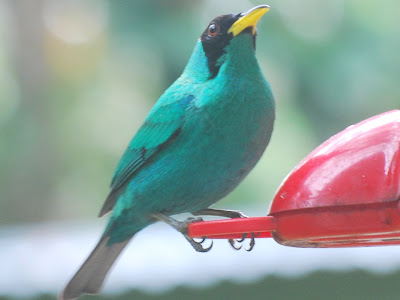






 Posts
Posts