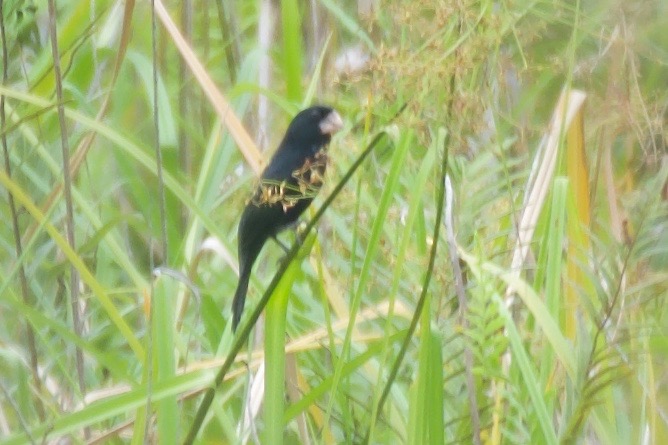
Wednesday, March 4, 2020

From sea level to paramo!

Western Panama is a diverse region.  Only on its Pacific slope, you can explore lush lowland forests (although, currently, there are only a few patches left), coastal wetlands and mangrove stands in the morning, montane and sub-montane forests at midday and visit the paramos of Panama's highest peak, the Baru Volcano, to see the sunset.  I did that itinerary some months ago during my Big Year quest (OK, not exactly in the same order).  If you have the chance to bird Chiriqui province, I suggest you to follow this itinerary, starting at Chiriqui's capital city, David.
Northern Jacana
Sunrise caught me in Quebrada Berlina, at the David-Querevalo road, very close to busy David city in fact.  As you guess, I saw many common water birds, including hundreds of Cattle Egrets, Anhingas, Cormorants, gaudy Northern Jacanas, etc...  But the reason why I went there so early was not the water birds, but an emblematic species of western Panama.  Ages ago, Scarlet Macaws used to fly wild all over our western Pacific lowlands, but the pet trade, habitat loss and the use of their long and colorful feathers for regional folkloric dances decimated them, to the point that they were extirpated from mainland Panama (it last stronghold was Coiba island, off Veraguas province).  Since some years now, Scarlet Macaws have returned to the David - Querevalo area.  It is not clear if they arose from an informal re-introduction program or escapees... the truth is that now there are no doubts about the wildness of this population.
Scarlet Macaw
As expected, at least three pairs of Scarlet Macaws flew above me, with one pair staying on nearby trees, detected by their raucous calls.  I hope this population continues to grow and, eventually, reoccupy its former distribution in western Panama.  From there, I drove through agricultural landscapes and cattle pastures to the highlands.  In fact, I was willing to visit Cerro Punta area, but a car accident blocked the only access road, so I stayed around the town of Volcan, looking for mid-elevation species and mixed flocks filled with migrants... and they didn't disappoint!  A huge mixed flock with mostly migratory species showed up almost as soon as I got off the car:  Yellow-throated and Philadelphia Vireos, Yellow-bellied Flycatcher and hordes of warblers, including Louisiana Waterthrush, Black-and-white, Blackburnian, Black-throated Green, Golden-winged, Tennessee and rare Yellow-throated Warblers allowed great views and some photos!
Yellow-throated Warbler
But I was more interested in some resident warblers.  Soon, I also found both of them... both Gray and Olive-crowned Yellowthroats.  The Gray-crowned Yellowthroat was a year-bird for me, while the Olive-crowned Yellowthroat was... well, kind of complicated.  The form present in Panama (and adjacent Costa Rica) was considered conspecific with South American Masked Yellowthroat and known as "Chiriqui Yellowthroat".  However, the last taxonomic review considered it only a form of the more widely distributed Olive-crowned Yellowthroat... a species I already saw for the year.  They sound similar, although are quite different in their head patterns.  So it was not a year-bird, but it was the first time I managed to actually see the "Chiriqui" form for the year (I heard it few months before in the same site).
Gray-crowned Yellowthroat (file photo)
Olive-crowned "Chiriqui" Yellowthroat (file photo)
Olive-crowned Yellowthroat (file photo)
After noon, I hit the road again, this time I took the road that connects Volcan to Boquete, at the opposite flank of the Baru volcano.  This road transects some nice patches of forests and also get you to one of the best sites in Panama for bird photography (yes, I'm talking about Birding Paradise)... but I was in a hurry and drove directly to the charming town of Boquete, where I met my friends Howard, Dodge and Lorna.  We hired in advanced another two friends who are excellent bird guides for western Panama: Jason Lara (of Jason Lara Tours) and Raúl Velásquez.  Using a high-clearance, modified 4WD vehicle, we started our ascent to the summit of the Baru volcano around 3:00 pm.  The rough and steep 13 km-long road to the summit is only accesible with that type of vehicles, and some restrictions apply for entering it.  Of course, Jason and Raul took care of all the permits well in advance.  Of course, the road transects several habitat types, and we birded them all.  The lowest part (but well above 1800 meters) produced such beauties like Scintillant Hummingbirds, Long-tailed Silky-Flycatchers, Flame-colored and Spangle-cheeked Tanagers, more resident and migrant warblers and an exquisite pair of Resplendant Quetzals feeding on an "aguacatillo" tree.  The quetzal is the essence of the western highlands... a bird that arouses emotions both in experienced  and novice birders and even in the general population.
Adult male Resplendent Quetzal
Jason and Raul had a surprise for us.  At a known site, they started to search for a special bird for us.  Some activity of Volcano and Fiery-throated Hummingbirds, plus alarm calls of Sooty Thrushes confirmed our suspicions... a top predator was close.  Some searching and there it was: a fierce Costa Rican Pygmy-Owl was steering at us trying to ignore the hordes of hummingbirds and other little birds mobbing him.
Costa Rican Pygmy-Owl
We left the pygmy-owl with his fans and keep ascending through the windy road.  Above 3000 meters, the landscape changes abruptly to paramo, the only easy accesible paramo in Panama.  Not only the vegetation, but the wildlife is very different up there.  These paramos hold very unique species for the country, including three of them that are essentially restricted to this habitat (present only in another mountain top in Panama apart of the Baru volcano) both in Panama and Costa Rica (and nowhere else), descending to lower elevations only seasonally and/or occasionally. The most common is the previously mentioned Sooty Thrush.  In spite of the boring name, this bird is really attractive and with attitude, showing no fear to the humans intruders of its reign.
Sooty Thrush
The second one is the aptly named Timberline Wren.  A real skulker, difficult to photograph, but easily detected by its nice song.  Notice how much patterned is this guy, with vibrant white facial marks and underparts.
Timberline Wren
Lastly, but not less important, a real high-elevation specialist.  The next species is rarely seen away of the paramo.  It is also the most difficult one to find... for me that is... it takes to climb all the way to the highest part of the volcano, right a t the top of it to find it... the southernmost junco, the Volcano Junco!  That is another fearless, fierce-looking marvel:
Volcano Junco (file photo)
The above is a file photo.  It took me two ascents to the Baru volcano top to finally add the junco to my year-list.  But all the effort of climbing to the roof of Panama has its benefits.. like awesome sunsets and chilly weather!
Clouded sunset from the summit
That's me at the summit of Baru volcano
At dark, it is time for owling.  The star of the show is, by far, the Unspotted Saw-whet Owl.  However, it also took me two volcano climbings to add him to my year-list.  At the other hand, we were lucky enough to have crippling views of a cooperative Bare-shanked Screech-Owl.  Its distinctive vocalization was heard at several sites along the road, but this guy decided to show up right in front of us and at eye level after calling it only once.  I only took some quick shots while the bird was in the spotlight, to not disturb it.
Bare-shanked Screech-Owl
Descending the volcano road in the dark is quite scary at places, but is an exciting experience anyway!  We heard some other species in the way down, like Dusky Nightjar, but essentially were focused on the road.  We arrived at our hotel in Boquete around 11:00 pm.  As you can see, it is possible to bird starting at sea level and ending at the high paramo of the highest peak in Panama... all of this in one day.  Try it once, you won't regret it!

Friday, February 21, 2020

Birding anywhere!

Many years ago, an invasion of rare rails and crakes close to Panama City attracted dozen of birders to former Tocumen marshes.  Back then, I was doing my fellowship in Internal Medicine and, literally, was living at the hospital with no possibilities to go out to birdwatch.  One of the rarest birds there was the Paint-billed Crake.  With just a handful of records, this species was not only rare, but naturally evasive and difficult to see due to secretive habits and dense habitat.  I missed it, of course, and it was not after 11 years later that a group of experienced birders found a new reliable site.
But there were two problems.  First:  the site is far away west of Changuinola, in Bocas del Toro province.  With limited time due to my work obligations, I had to take a midday flight to Changuinola, rent a car and then drive to where they found the crake.  Second: the site is a dump!  Yes, a swampy, smelly dump filled with millions of flies... but what a place to bird!  Sometimes birding takes you to unexpected places... but as soon as I approached I realized why others had entered the site looking for birds.  Hordes of egrets, vultures and Pale-vented Pigeons were seen from the road, the residual waters had shorebirds and teals, and dozens of flycatchers, grackles, meadowlarks, seedeaters and seed-finches adornated the surrounding bushes.  But I was after the crake after all, so I sited among the flies and waited.  Soon, a Paint-billed Crake walked around some flooded reeds, allowing great views, but few -poor- photos.
Paint-billed Crake
What a sight!  Another one of my nemesis bit the dust!  The rest of the afternoon I was able to relax, doing some birding in the surroundings.  At the hotel in Changuinola that night, I planned the next day to leave the lowlands very early to catch the first light at the Continental Divide in Fortuna area, almost two and a half hours away.  And I did it.  The scenery could not be more different from the previous day:  pristine humid pre-montane forest, fresh air and chilly temperature.  I even got some little rain, but nothing to worry about.  Instead of taking the Continental Divide trail, I tried a shorter one known as the "Umbrellabird trail".
This trail goes steeply downhill from the main road; however, I only bird the first couple of birds, and that time was not the exception:  a huge mixed flock with tanagers, antbirds, Golden-bellied Flycatchers, chlorophonias and woodcreepers entertained me for a while, while some skulkers were easily heard in the understore, like both Black-headed and Rufous-breasted Antthrushes, Silvery-fronted Tapaculos and a Northern Schiffornis.  Then, my main target started to call... a sweet whistled note.  After 30 minutes imitating it back and forth, the forest denizen finally showed up:
Ochre-breasted Antpitta
Ochre-breasted Antpitta! Any day with an Antpitta is an excellent day.  The Ochre-breasted Antpitta is very localized in Panama, it was a country lifer for me (I got my life Ochre-breasted Antpitta -Shakira- in Ecuador some years ago).  I started my way back to Changuinola, making few stops along the way.  For example, close to town, I visited the road to "El Silencio", where I made two additions to my year-list, in the form of White-collared Manakin and Northern Bentbill.  After that, and still having some time before my flight back to Panama City, I followed the instructions of my friend Euclides "Kilo" Campos to look after a relative recent addition to Panama's avifauna.  After the split of former Gray Hawk into two separate species, a gap of distribution was immediately evident in western Panama.  Recent sightings confirm that the form present there is in fact Gray Hawk (Buteo plagiatus), and not the widely distributed -in Panama- Gray-lined Hawk (Buteo nitidus). Well, finding a pair of vocalizing Gray Hawks was quite easy with the detailed instructions of Kilo.
Gray Hawk
The Gray Hawk was also a Panama lifer for me, a great addition by the way since this species is only found in lowland Bocas del Toro.  I got prolonged views, photos and voice recordings and was able to check all the field marks that separate both forms.  That is the way to get a lifer... and all of these on time to catch my afternoon flight back to Panama City!

Friday, February 7, 2020

Mount Totumas Cloud Forest's Hummingbirds Gallery

Last year I had the opportunity to travel all over Panama, knowing new birds and sites by the way.  Certainly, one of the Top 5 sites (not only my opinion, but my family's too) was Mount Totumas Cloud Forest, in the western highlands of Chiriqui province.  Taking advantage of some free days in November, I went with my family for a couple of nights at the lodge, which is the highest eco-lodge in Panama (at 1900 meters), surrounded by a beautiful montane forest (as you can see in the top photo).  The well-marked trails are alive, not only with birds, but with all sort of critters, mammals and other wildlife... in fact, the place is known by holding one of the greatest invertebrates collection for Panama and by recording almost all of the feline species on its trails (captured with game cameras).  But a thing that is specially spectacular in Mount Totumas is the hummingbirds show.  Several hummingbird feeders placed strategically around the property, plus plenty of flowering trees and bushes, make Mount Totumas a hummingbird's heaven.
Gloriela using the hummingbird hat (featuring Snowy-bellied and Talamanca Hummingbirds)
The hummingbirds are used to people, so it is not rare to feel them close to you when they pass swiftly.  They will even feed right at your face, if you use the hummingbird hat!  They have a list of more than 25 different species of hummers for the property.  Of course, some are rare or do not visit the feeders, while others are seasonal... but the regular visitors are so amazing that you will spend hours admiring them without noticing it.  With some patience, you will get amazing shots, like the one I'm presenting in the next gallery
HUMMINGBIRDS OF MOUNT TOTUMAS
Glorious adult male Green-crowned Brilliant.
Talamanca Hummingbird.  This adult male is showing why its former name ("Magnificent") was  well earned.
Adult male Violet Sabrewing, one of the largest hummingbird in Panama
Lesser Violetear... what a boring name for such a great creature
Adult male White-throated Mountain-Gem.  The photo make him no justice!
Adult male Stripe-tailed Hummingbird.  A little jewel for sure.
I don't know what I like more, the contrasting Snowy-bellied Hummingbird or its pink perch.
Aptly named Scintillant Hummingbird, and adult male.
The star of the show: adult male Magenta-throated Woodstar.
So, what you think?  Amazing right!

Wednesday, January 8, 2020

Bocas' Birds and Friends

Tranquilo Bay pier, Bastimentos Island, Bocas del Toro
Traveling around the country looking for birds also bring friends together... it is always great to reunite with old friends or to meet social media friends personally.  During one of those trips, I went with my family to Bocas del Toro province, in western Caribbean slope, specifically to the Bocas archipelago.  Apart of the birds, the islands are a nice touristic destination, with exuberant vegetation, delicious foods and pristine beaches.. perfect for a family micro-vacations!
The Cubillas at Colon Island, Bocas del Toro
We stayed at Colon island in a beach resort surrounded by secondary vegetation that produced several western Caribbean slope specialties, like Montezuma Oropendola, Olive-crowned Yellowthroat, Grayish Saltator and even a fly-by Gray-headed Dove to my delight (a year-bird for me).  We were close enough to Bocas town to walk the busy streets visiting the stores and to have traditional dinners there, while enjoying the spectaculars sunsets.
Spectacular sunset at Bocas archipelago
My plan included a visit to Tranquilo Bay Eco Adventure Resort, in Bastimentos island.  The calm waters surrounding the pier (as you can see in the first photo) certainly live up to its name (tranquilo = calm), and the forests around the cabins were alive with bird activity.  As usual, my friends Natalia and Ramón showed me the local specialties, including range-restricted (for Panama) Stub-tailed Spadebill, more Gray-headed Doves and Three-wattled Bellbirds that call the islands home during their non-breeding season.  Stacey Hollis, who also is a resident guide at Tranquilo and one of those social media friend that I finally met that day personally, joined us to find more birds!
Stub-tailed Spadebill
Three-wattled Bellbird, subadult male
We took a boat to a nearby island: Cayo Venado.  My main target there was the Snowy Cotinga, which use the mangrove forest surrounding the channels.  Soon, eagle-eyed Natalia spotted a female cotinga atop a mangrove tree.  Eventually, we saw several adult males and another female cotinga, allowing some nice photos.  What a bird!  Back at the hotel I was able to say Hi to Renee, Jim and Jay (who own and run the lodge with their families) before heading back to Colon island where my family was enjoying the marine breeze by the swimming pool!
Snowy Cotinga, adult male
Ramón, Natalia, Jan Axel and Stacey
Well, but the mini-vacations were not over yet... I still had some targets in mind.  The next day I met two social-media friends (before that day we knew each other only by emails and WhatsApp messages) at Boca del Drago, at the northern side of Colon island.  Both resident of Colon island, Lukas Bell and Pat Wade (I met his wife Kitty -also a social-media friend- later that day too) joined me to bird along the Snyder channel, an artificial channel that parallels the mainland coast close to Colon island that was used to transport loads of bananas and other merchandises.  We chose that site due to a very localized species: Nicaraguan Seed-Finch.  Our first attempt at the usual sites produced no birds... but the channel and the estuary of the Changuinola river entertained us with many different species.  At the last possible spot, Lukas insistence paid off: an adult male Nicaraguan Seed-Finch was working the grass spikes with its huge, pink bill.  I managed some diagnostic shots, my first pictures of that species!
Nicaraguan Seed-Finch, adult male
Our last target was somewhat easier.  After leaving the channel, our boatman took us to the small Swan Key, home of a colony of seabirds, including dozens of breeding pairs of Red-billed Tropicbirds.   The tropicbirds are almost guaranteed at that location, so with our targets in the bag we made it back to Boca del Drago.  Pat's analogy of my Big Year with the Atlas Stones Competition, where lifting each rock is increasingly tougher... the same as getting new birds while the year advances, was certainly correct.
Jan Axel, Pat and Lukas
Nesting Red-billed Tropicbird
Our twitch ended at Boca del Drago, tasting one of the culinary delights of the Caribbean: the Run down or Rondon.  Simply exquisite!  Lukas took me back at my hotel, but only after checking some prime habitat at Carenero island, adding more species to our growing list.  I spent the rest of the day with my family before departing to Panama City in the last evening flight.  I got many new year-birds... but most important, was able to bird with friends and to spent time with my family at a paradise island as well!

Friday, December 6, 2019

Chiriqui Highlands clean-up!

The advantage of having a small birding community in Panama is that you know most of the avid birders of the country.  That is specially useful when you are doing a Big Year because you need to find local specialties with limited time (specially if you are doing a Big Year AND still have a regular job unrelated to birds or traveling).  After noticing that there was a big gap of Talamanca endemics in my Year List, I called a great friend of mine, Genover "Ito" Santamaria, and planned to spend half-day in his reign, looking for those specialties.  Ito is a nice guy and also a great birder, something you can experience by contacting him through Tamandua Nature & Photo Travel Panama.  Why you should?  Well, keep reading and you will see!
Talamanca endemic Ochraceous Pewee
As mentioned before, I only had half-day to find a list of targets, most of them endemics of the Talamanca mountain range shared by Costa Rica and western Panamá.  So I spend the night at the town of Guadalupe and went to bed after having a hot chocolate with marshmallows (specially good when the temperature outside is 12ºC).  Very early the next morning, Ito joined me with his modified 4WD truck (just after hearing my first target of the list, a Dusky Nightjar, above his house!).  Knowing the we were short of time, he planned to visit some key sites in a quick succession in order to maximize our chances.  The first stop was a road near the town of Las Nubes that crossed several habitats, including some nice patches of forests.  Quickly he started to point out some nice additions to my Year List.  Some forest border specialist, like Ochraceous Pewee and Black-capped Flycatcher were quickly noticed, while some skulkers took a little bit more of time (Buffy Tuftedcheek and Streak-breasted Treehunter).
Streak-breasted Treehunter (also a Talamanca endemic)
We crossed several mixed flocks with flycatchers, tanagers, chlorophonias and redstarts.  The activity was intense... actually, we noticed that it was very intense!  Soon, we realized that a bird we called earlier was vocalizing  and that probably all the clutter was due to its presence.  We started to search every tree, but following the hooting notes to its source was not easy.  However, experienced Ito knew exactly where to look and soon he found it!  A fierce-looking Costa Rican Pygmy-Owl in all its glory showed itself.  We got more-than-excellent views through the spotting scope... only my second sight ever and -by far- the best one!
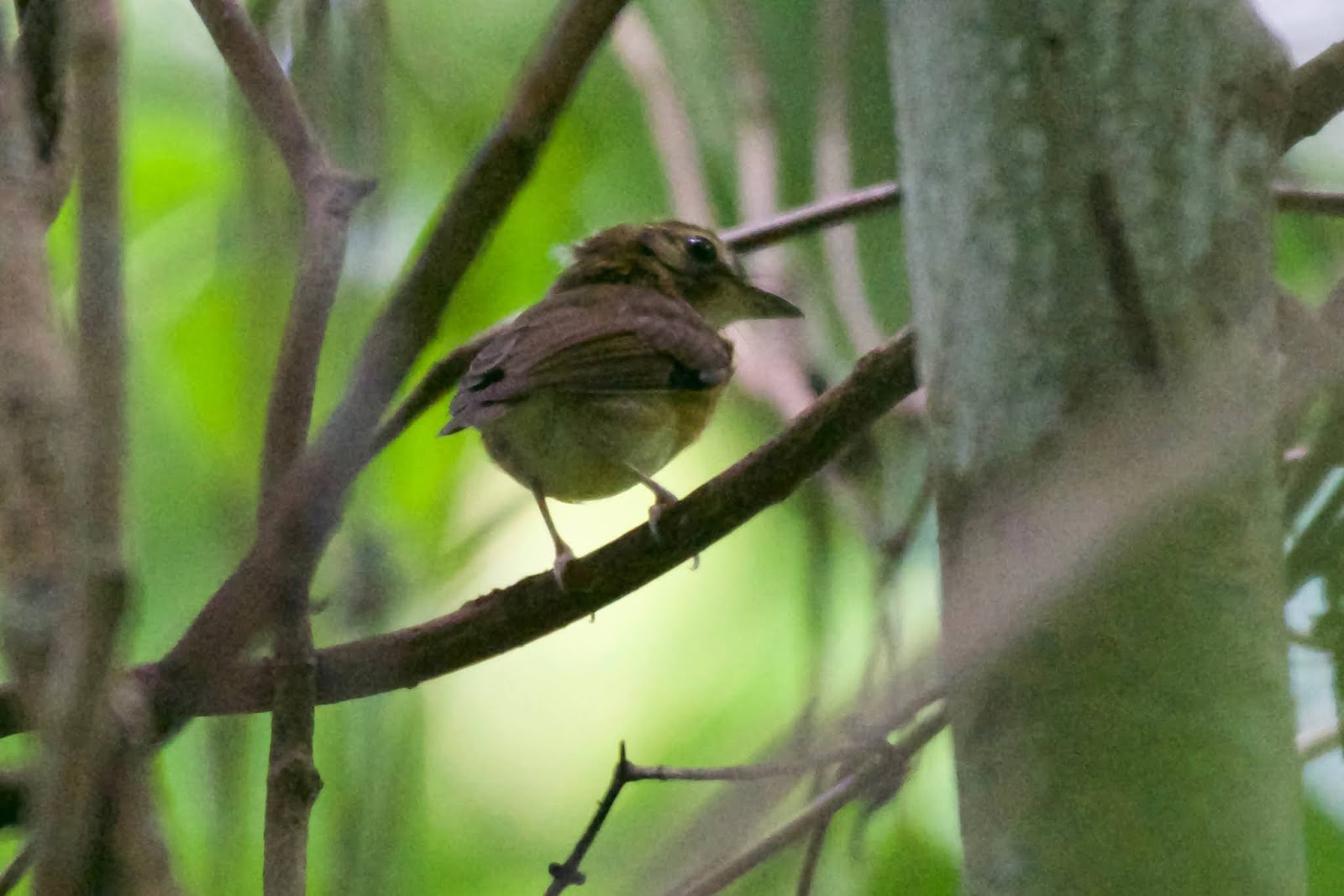
Costa Rican Pygmy-Owl
Well, with most of my targets in the bag, we moved to another spot nearby where we got more birds, some of them also new year-birds.   Although some of them were not endemics, I was amazed to be able to include in my list some birds that I had not seen in many years in Panama.  Actually, two of them where species that I had seen only once before... in both cases (White-throated Flycatcher and Barred Becard), Ito was also involved in showing them to me for the first time.
White-throated Flycatcher
If you think this is a quick summary, well it is!  We moved from site to site very quickly, always looking for new birds.  We finally visited the last scheduled site, Volcan lakes.  It was almost noon, but the forest surrounding the lakes was alive with singing birds!  We were particularly lucky with flycatchers (with Slaty-capped Flycatcher and Eye-ringed Flatbill being new year-birds) and furnariids.  The mega skulker Ruddy Foliage-Gleaner allowed short -but nice- views... it was a Panama lifer, while both Chiriqui Foliage-Gleaner and Costa Rican Brushfinches offered an unforgettable show, posing for photos and I could even record audio.
Chiriqui Foliage-Gleaner
Costa Rican Brushfinch
What a memorable morning!  But it was time to say good-bye.  Curiously, the target that was still missing was also a widespread and common highland endemic: Long-tailed Silky-Flycatcher.  We were not able to find it at its usual haunts in Guadalupe, but Ito gave me the directions to find it in my way back to David city.  Well, as you guess it, the bird was exactly where Ito told me!
The Long-tailed Flycatcher was my year-bird #700 for Panama!  At the same spot, I got more year-birds, including my life Townsend's Warbler!  So... YES!  It was an amazing quick-trip to the western highlands, full of endemics, specialties and new year-birds but more importantly, it was a birding trip with a good friend!

Friday, October 25, 2019

Visiting Escudo and Rio Cañas

Escudo de Veraguas is an isolated island in the Caribbean coast of the Ngöbe-Bugle comarca in western Panama, re-known by its remoteness, pristine beaches, mangrove canals and rock formations.  My wife and I visited it twice before, more than 10 years ago, before it became the touristic boom it is today.  Apart of the landscapes, the island is a living lab where different species have flourished isolated from mainland relatives and, in some cases, becoming distinct species.
Lizette, Jan Axel, Gabrielle and Gloriela at Chiriqui Grande
We took advantage of one of those organized tours that ran during weekends by Machoemonte, starting at the coastal town of Chiriqui Grande.  Aboard the boat, twelve of us (including Gloriela and Gabrielle) started the adventure to the remote island.  It was not a birding trip per se, but there was another birder in the group, Lizette, who is an ebirder too!  The trip to Escudo from Chiriqui Grande takes almost two hours through both calm (at the Chiriquí Lagoon) and rough waters (after passing the Valiente Peninsula).  We reached the island close to noon since we departed late due to rain and bad weather  conditions... but by the time we reached the island the sky was blue and the heat made us jump right away to the turquoise waters.
Right at the beach we were able to watch some early migrants and common residents of the island.  I was particularly interested in finding resident White-crowned Pigeon and Escudo Hummingbird.  The pigeon is rare everywhere else... only in Escudo de Veraguas (for Panama) is almost a guaranteed sight.  The hummingbird is still considered by many authorities part of Rufous-tailed Hummingbird, but Panama Audubon Society treat it as an endemic species... one with a tiny range (restricted to the island).  Both would be new year-birds for me.  To my surprise, both were right at the first beach we visited!
White-crowned Pigeon (file photo)
Escudo Hummingbird
I know the hummingbird photo is horrible... but you only need to imagine a plumeleteer-sized Rufous-tailed Hummingbird after all!  Of course we saw more species on the island, including endemic forms of Blue-gray Tanager and Bay Wren... but I took few photos since this was more a beach trip.  After having lunch, we visited other sites around the island, including the mangroves channels and a rocky cove with an arch formation that is popular among the visitors.  It was at the mangroves were our boatman pointed out a sleepy Pygmy Sloth (Bradipus pygmaeus), endemic to the island and considered critically endangered.
Pygmy Sloth
It was a great day at Escudo enjoying the sun and the breeze, plus finding endemic birds and mammals as well, but our time there was limited.  We arranged to stay that night at the Ngöbe town of Río Cañas, in mainland comarca facing the island.  It was around 5:00 pm when we started to head that way.  In the middle of the transect, a swift black-and-white shearwater flew by the boat.  It allowed great views and I saw evident dark vent and noticed it small size: Audubon's Shearwater!  A lifer for both Lizette and me (and certainly for most of the passengers too).  There are very few records of this species in Panama, even considering that -supposedly- breeds in some rocky islets in Valiente Peninsula (close to my sighting).  My camera was inside a plastic bag deep in my backpack of course!  When we finally arrived to Río Cañas, a representative of the local women's cooperative welcomed us and guided us to our rooms.  They have a little community project to receive local and foreign tourists.  After a tasty dinner, we enjoyed a demonstration of typical dances (all inspired in local fauna) and handcrafts.  That night, away of the electric lights, we enjoyed a starred sky and profound silence... we sleep like queens and kings with all that peace!
Ngöbe women
Adult male Olive-backed Euphonia
The next morning I keep adding new year-birds to my list: Bronzy Hermit, Olive-throated Parakeet, and Olive-backed Euphonia among others.  We left Río Cañas after breakfast, heading back to Chiriqui Grande.  But first, we planned another stop along the route at Isla Tiburón (Shark Island).  The gentle sound of the braking waves invited us to relax lying on the white and fine sand of the island.  Panama really have spectacular places with potential to compete with major destinations of the world... but at the other hand, I really liked the feeling of being in a little-known corner of paradise with my family!
Cubilla family at Isla Tiburon