Showing posts with label Cinnammon Woodpecker. Show all posts

Sunday, January 1, 2012

Bird of the month: Cinnamon Woodpecker

This edition of "Bird of the month" features a species selected as "Bird of the year 2012" by the Panama Audubon Society... yes, you're right, I'm talking about the Cinnamon Woodpecker (Celeus loricatus). For such a common species, in the right habitat, this is a beautiful bird. It is well
distributed at our Caribbean slope forests all over Panama, but also in the Pacific slope from central Panama eastward. It looks also comical, with its bushy crest and cinnamon color. As you can see, the female lacks almost all the red color that the male shows in the head, like many others woodpecker species. The Celeus woodpeckers inhabits a broad range of habitats, and all have contrasting patterns in their plumages, with some being absolutely gorgeous
patterned in yellow, black, chestnut or cinnamon. The first photo is the same individual of the winning photo, however, is not exactly the same photo due to contest rules. It is always a thrill to find such a photogenic beauty so close! For these, and many others reasons is why the Cinnamon Woodpecker is our bird of the month (and of the year)!

Literature consulted
1. Angher G, Dean R. The birds of Panama. 2010

Thursday, December 15, 2011

Bird of the year!

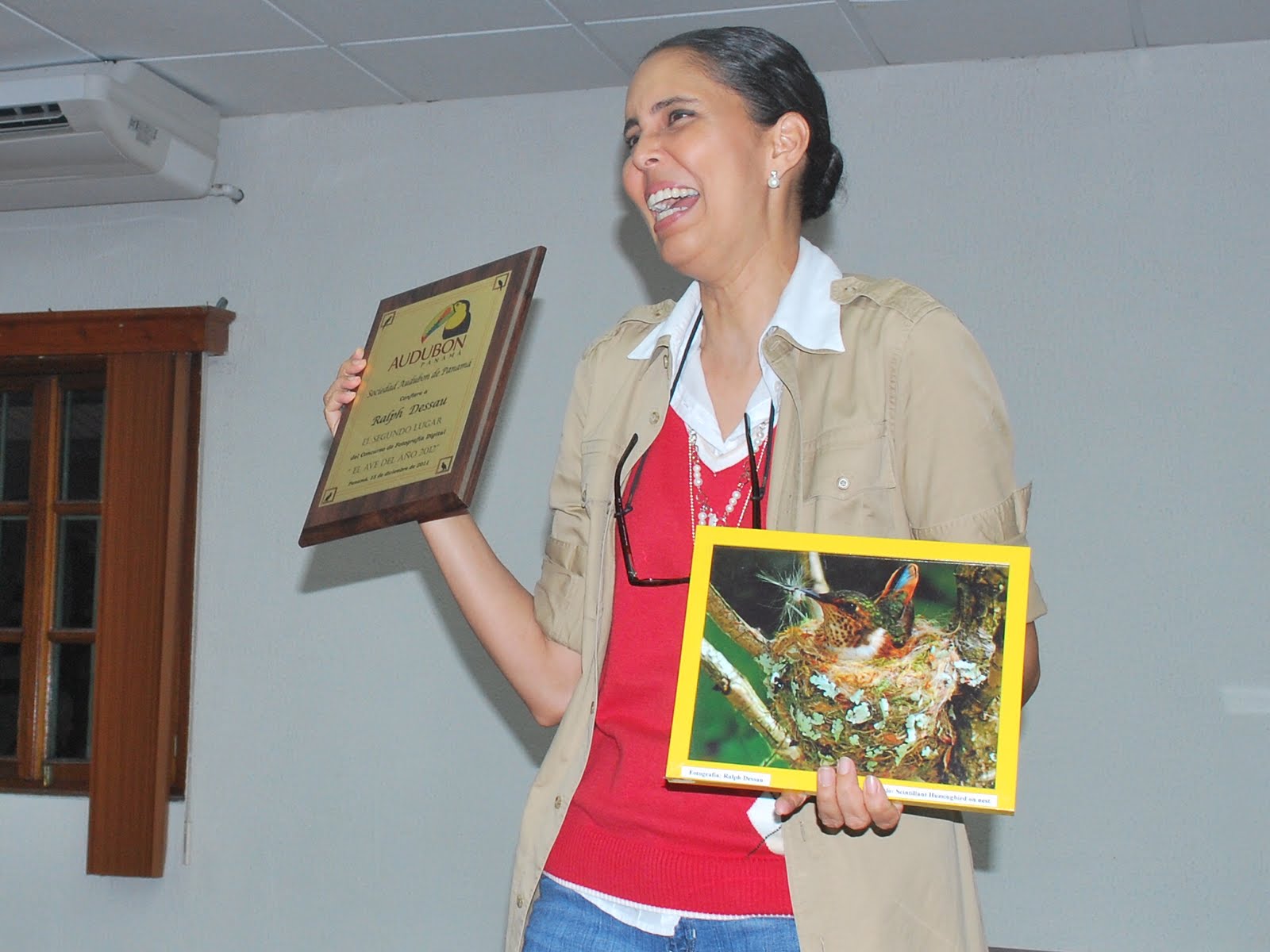
The Panama Audubon Society's pot-luck dinner was the perfect scene for the announcement of this year winners of the "Bird of the year" photography contest. PAS members, directives, friends, and even members of The 600 Club shared a very nice evening. Darien Montañez, PAS president, talked about the Christmas Bird Counts and how we are going to organize ourselves for these events, the first of them will be this sunday, december 18th (Pacific CBC). As usual, the food and beverages were excellent, just like the photo stream presentation (both of birds and birders) of Jennifer. By the end, Rosabel Miró announced the winners. My friend Rafael Luck obtained the third place with its Royal Tern in Boca del Drago, Bocas del Toro province. The second place was for Ralph Dessau with its lovely photo of a female Scintillant Hummingbird on a nest. This year's bird is the male Cinnamon Woodpecker which I took last april in Metetí, Darien. I'm so grateful with the judges and with the PAS for this honor!
Finally, Rosabel also announced the winners of the dish of the night, with three winners by popular election, two curry chicken dishes and a traditional "arroz con pollo", so congratulations for all the chefs and see you at the counts!

Thursday, April 28, 2011

Easter Holidays in Darien. Part III

After an excellent day near El Salto town, in central Darien province (eastern Panama), our last day in Darien province started with a Pied Water-Tyrant at the grounds of our hotel in Meteti acting as a House Sparrow. This elegant bird was hunting the insects attracted during the night to the parking lot lamp. A couple of photos and we (Rafael, José Carlos, Mahelis, Gloriela and I) were ready to visit the Filo del Tallo Hydrological Reserve, to the south of Meteti. The first part of the trails, until the first creek, is full of Heliconias patches, thus making it Hermits' heaven! In fact, we saw five hermits species, including the one of the photo. The light conditions were awful, but you can see the long central rectrices tipped in white (ruling out Rufous-breasted Hermit and Band-tailed Barbthroat, both seen), the greenish back and the quite-straight-for-a-hermit bill (ruling out Long-billed and Stripe-throated Hermits, also seen), making it a Pale-bellied Hermit. Like the hermit, another eastern Panama specialty was hanging around the creek, a male Black Antshrike appeared allowing some photos (a female was there too, but was shyer). As its name suggest, it is completely black, but you can recognize the shrike-like, heavy bill characteristic of this genus. After a while, the trail runs along the border of the forest and a cleared patch with regenerative vegetation. The bird activity was great probably due to this mixture of habitats. We saw a Forest Elaenia working VERY low (it is usually a canopy-dweller, only detected by its calls), allowing us to see its yellow crown patch and an unexpected Mangrove Cuckoo (probably the first record for the Darien province)... but the bird that definitively stole the show was a very cooperative Cinnammon Woodpecker making a hole in a dead trunk right by the trail, almost at eye-level allowing GREAT photos!

Photographic oppotunities like that can not be wasted, so we spent almost 30 minutes with the woodpecker! After that, we continued our walk, entering the forest again. It was magical, with tall trees and hanging bridges, tons of butterlies and, of course, birds.

We started hiking uphill, finding Slaty-tailed Trogon, Golden-crowned Spadebill and an Olivaceous Flatbill in the way. Eventually, we reached our main target: a Golden-headed Manakins lek. It was crazy... around twenty gorgeous males were together in the same group of contiguous trees, making noise, exhibiting themselves, doing the "moonwalk" dance (moving backwards on its perch rapidly without evidently moving the feet... amazing!), and acting as really wackoes each time a female approaches (which occurred very often, so I suppose the competence was fierce). We even saw an immature male (notice the bright soft parts) performing the dances! The place was quite dark, so most of my photos of the gaudy males are not good enough to show you how really great are these birds. The deep black body contrasting with the bright yellow head and those expressive white eyes visible from far away are hard to forget! Again, we stayed long enough to impress that amazing spectacle in our minds and, reluctantly, started the way back. The raucous calls of a Red-throated Caracara helped us to locate the bird just under the canopy of a distant tree, but despite the distance I think the photo was very good. Formerly well distributed in Panama, now it is mainly restricted to the eastern part of the country, with scattered records from the western half, one of them recently from the Chiriqui highlands. In the way back to Panama City, we stopped at the San Francisco Reserve, near the town of Torti, and again in the Rio Mono bridge (both in eastern Panama province), adding more eastern Panama's specialties (with One-colored Becard at the bridge as highlight). After all it was a succesful trip, full of special birds, many of them not found in any other part of Panama, nor Central America (notice that I posted photos of thirteen species not found any further than Panama into North America in this three-parts account, starting here with Part I). We hope you enjoyed them as much as we did!

Sunday, April 18, 2010

Birding the San Francisco Reserve

After reading the excellent report by Guido Berguido of Advantage Tours; Osvaldo Quintero, Rafael Luck, Roberto Medina and your host decided to visit the San Francisco Reserve in eastern Panama province, close to the town of Tortí. This private reserve protects one of the few remaining lowland forest patch of eatern Panama province apart of the Bayano region, and it connects with the forests at the Maje range (which part can be seen at the background of the picture). It holds many of the Darien birds specialties, which were our targets of course. It was the first time birding this reserve for most members of the group. I used to visit it frequently, accompanying Guido in his trips to Chucantí (Maje range) some years ago. A very early start and a non-stop drive to our first destination, the Río Mono bridge after the Bayano bridge, permited us to watch the first birds of the trip taking advantage of the first lights of the day. The first bird I saw was a male White-eared Conebill feeding close to the road. This is one of the most reliable sites to find this species in Panama (and North America!). There were many Cocoi Herons flying around and in the river. Soon we found a pair of One-colored Becards making its nest. The male seemed to be an immature, since it only have patches of slaty feathers in its body (specially in the head). The female was very busy bringing nesting material to the nest, while trying to banish the pair of Thick-billed Euphonias that was spying in the surroundings. She was vocalizing... something strange in this particular species. The always-present-there Streaked Flycatcher was vocalizing too... something nothing strange at all in this species. Curiously, in the other side of the bridge was a pair of Cinnammon Becards making its nest too... and vocalizing too. They allowed great pictures from very close. Since I show photos of both females becards here, might you guess which is which? We leave the place in order to continue our trip to the reserve. Once there, we found that the Franciscan priest who runs the reserve was out in Tortí buying some supplies and we needed his permission in order to get in. The option was to enter the reserve with a local guide, my old friend Arquimedes, and pay later. We found him at his home close to the entrance of the reserve and he agreed to went with us. We started to bird a section of the reserve with an access dirt road through an small creek. The activity was low maybe because of the heat. Slowly, we started to find some birds while climbing the road. The noisiest were the Golden-collared Manakins, with their petard-like sounds made with the wings. A cooperative Broad-billed Motmot spied us quietly from one side of the road while we were hearing a Whooping Motmot in the background. It started to make its deep call when we approached him too close. A patch of Heliconia flowers was attended by several species of hummingbirds, including Blue-chested, Snowy and Scaly-breasted Hummingbirds plus Long-billed and Stripe-throated Hermits and a White-vented Plumeleteer. Behind the flowers, a female Golden-headed Manakin was picking some nesting material from a spiderweb. We heard the characteristic cacophony of a Red-throated Caracara, but we were unable to find it. We reached a second creek and immediately found a pair of Royal Flycatchers that responded to playback (moderately used), allowing great pics. We saw a bit of color at the crest in their otherwise hammer-shaped head, but they never displayed it (as usual). Despite that, they offered an excellent show. In the way back we heard, and then saw, a pair of Black-headed Tody-Flycatchers making a nest. I managed to get some belly pics of the birds. Notice the bill shape and the white throat of this species. Is because of that bill that the members of the genus Todirostrum are named in spanish as espatulillas (tiny spatula), at least in Panama. The three species found in Panama share their tiny sizes and yellow bellies, but differ in their habitats and habits. This one is mostly a canopy dweller, where is hard to detect until you recognize its distinctive call, which we did. Later in the road, we found a mixed flock with more Cinnammon Becards, Red-capped and Golden-collared Manakins, Cocoa Woodcreeper and a pair of Black Antshrikes. The male is mostly black as its name suggest, but the female is marked in black and rusty with fine streaks in the head and underparts... simply beautiful. She escaped from me very soon... only the male stayed for photos. I include my poor photos here because it is a specialty of eastern Panama, only shared with Colombia. By the entrance, we hit other mixed flock... this time with Gray-headed, Golden-hooded, Summer and Scarlet Tanagers, Bananaquits and one (maybe two) Canada Warbler. Someone saw a Band-tailed Barbthroat (which I missed) and a female Violaceous Trogon spied us from a safe perch. We headed to a road that was bordering the forest, but it was too hot and we don't stay too much. During the short walk we found both Pied and Black-breasted Puffbirds flycatching. Others birds sighted were Long-tailed Tyrant, Thick-billed and Yellow-crowned Euphonias, Marbled Wood-Quails (OK, we heard them only when they flew away.... I'm not including them in my Year List), Red-eyed Vireo, Great Crested Flycatcher and a contrasting White Hawk against the forest. We left the place, finding the priest and paying the entrance fee at the main offices of the reserve. We dropped Arquimedes at his home (where we dipped on the Spot-breasted Woodpecker that he always find there) and drove back to the Bayano region, entering one of the several side roads used for selective logging. We were looking for Golden-green Woodpeckers, but finding instead a Cinnammon Woodpecker and a female Black-tailed Trogon. Once again at the Rio Mono bridge we found the becards, plus two Blackburnian Warblers and a Rufous-winged Antwren... both species were new year birds for me. The return journey was under a heavy rainfall (maybe the dry season is coming to an end?) and the only I have to report are approximately 2000+ Laughing Gulls in a huge flock flying to the west over the Pacora river. Great day in eastern Panama province!