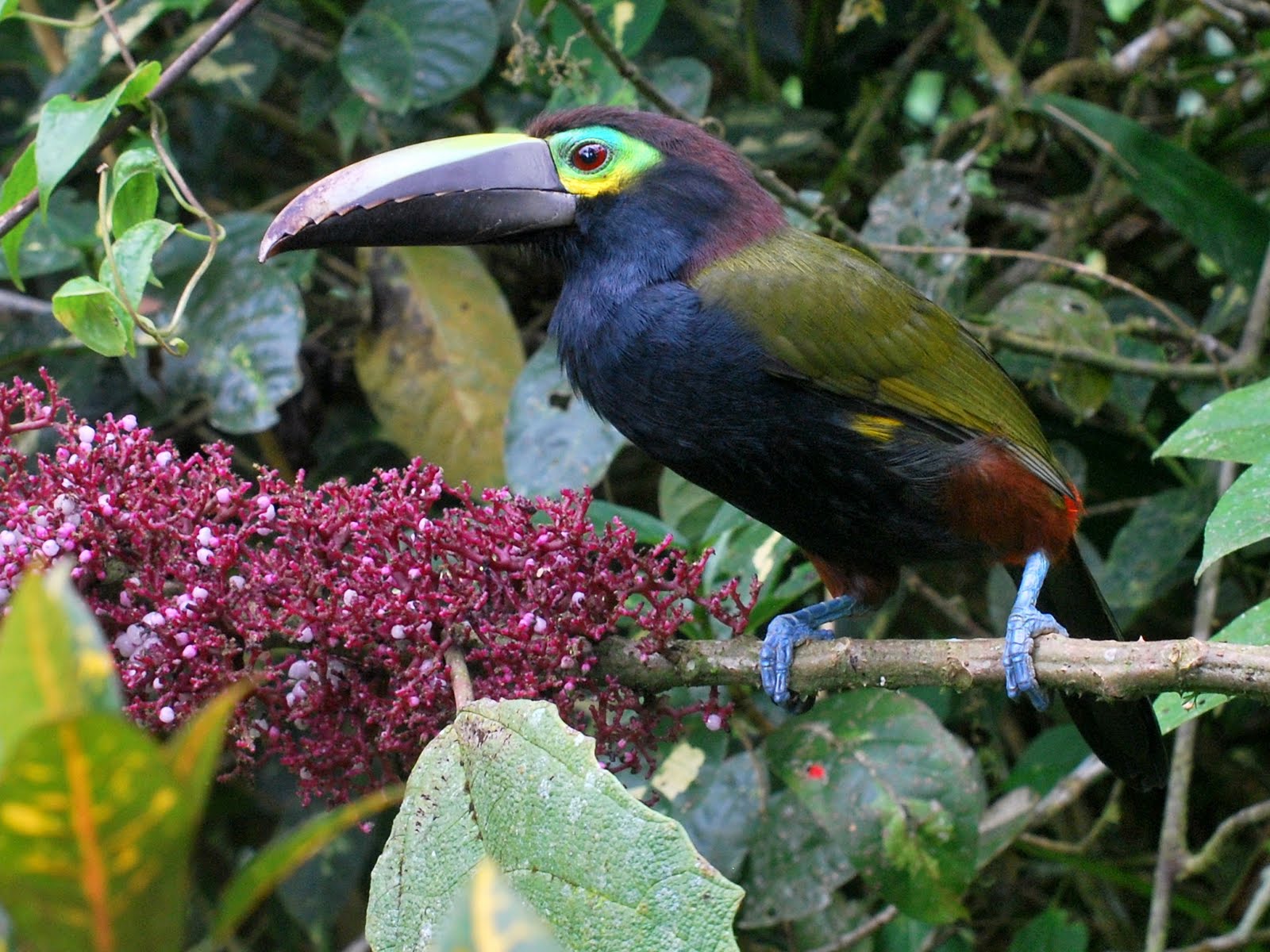
Showing posts with label Yellow-eared Toucanet. Show all posts

Saturday, November 26, 2016

A Record-breaking day!

And for a second year in a row, a world birder visits our isthmus in his quest to record the largest number of birds species in a year.  Arjan Dwarshius' attempt to break the world's big year record of 6042 species recorded in a year, set by Noah Strycker just 11 months ago, was about to make history!  After spending his first day in Panama last November 3rd, Arjan was just 11 birds away of the record!  This was not coincidence... Arjan and, his uncle Fred, chose the local advantage to make the most of their time in our country... they were guided by Guido Berguido who runs Advantage Tours and who is the head of the local NGO ADOPTA Panama Rainforest... and also an old, good friend of mine!  Also joining them was another friend of mine, birder extraordinaire and, since recently, an excellent, independent birding guide Ismael "Nando" Quiroz.
Elfin forest at Cerro Jefe, above Cerro Azul (file photo)
I took the late night bus from Penonome town (about two hours from Panama City), where I was resting with my family during the holidays (yes, the first days of November are holidays in Panama), in order to join the group in the record-breaking day!  Very early the next day, we headed to the gated community of Cerro Azul in the foothills to the east of Panama City, and headed directly to the upper slopes of Cerro Jefe and its stunning elfin forest, home of many range-restricted birds.  The day started quite low, but with some new year-birds for Arjan.  At the Vistamares trail we crossed a mixed flock with Shining and Green Honeycreepers, Rufous-winged, Emerald, Speckled and Black-and-yellow Tanagers, migrant Red-eyed Vireos, Tawny-capped, Fulvous-vented and White-vented Euphonias, Paltry Tyrannulets and White-ruffed Manakins, among others.
Black-and-Yellow Tanager (male)
After a while, Guido managed to attract an endemic Stripe-cheeked Woodpecker allowing scoped views... but the desired Black-crowned Pittasoma refused to show up...  but a pair of handsome Yellow-eared Toucanets were a nice consolation price instead.  Eventually, we managed to find 10 new birds for Arjan's list.  Year-bird 6042 was the Black-eared Wood-Quail that we actually managed to see thanks to Nando's advice (it was a life bird for me; although I have heard it several times previously).  After that, the activity dropped sharply... and we decided to have lunch before heading to Calle Maipo trail.
Yellow-eared Toucanet (male)
At Maipo, the record-breaking bird arrived quite unexpectedly when a Tody Motmot (very rare in the area) responded to a recorded call played by Guido... we tried hard to see the bird but it turned out to be very shy... but we saw a pair of Crimson-bellied Woodpecker that were Panama lifers for me as well (not a new year-bird for Arjan of course).  After realizing that we were not going to see the bird, we accepted that the record-breaking species was a heard-only record... of course, lots of high-fives, big smiles and congratulations continued!  Uncle Fred surprised all of us (including Arjan) when he opened a Champaign bottle and a nice banner to celebrate the moment... I'm impressed of his organization!
He did it!
We ended the day at the-now-famous Finca Bayano, were we managed to find the Long-billed Dowitchers reported earlier in the season... they were new year-birds for him, as well as three other species in spite of the short time we spent there.  And in spite of the short time I shared with Arjan, I can tell that he is passionate about birds and birding... he really seemed to be enjoying each little brown job that, desperately, we were pointing to him hoping it to be a new year-bird for him... but what can you show to a man that already has seen more than 60% of the extant birds of the world! I recommend you to track his progress HERE... the numbers are just amazing!  Not only that, remember that he is birding as a fundraiser for the BirdLife Preventing Extinctions Programme , so enter the webpage and make a donation!  I had to said good bye after leaving Finca Bayano... a long journey back with my family was awaiting me.  He spent five more days in Panama, watching amazing birds in Chucanti, Nusagandi, Yaviza, Aligandi and even right here in Panama City before taking his flight to Costa Rica.  Check this POST and you'll see that he is VERY lucky as well! 
FAREWELL, MY FRIEND.... I know 7000 birds for this year is plausible!

Wednesday, December 1, 2010

Bird of the month: Yellow-eared Toucanet

The Yellow-eared Toucanet (Selenidera spectabilis) is an attractive, sexual dimorphic inhabitant of wet forests in the lowlands and (specially) foothills along Panama's Caribbean slope and locally in foothills of the Pacific slope. It ranges from Honduras to NW Colombia and NW Ecuador, being the only Selenidera toucanet in these areas. Like others members of this group, the males show a yellow ear patch, while the female have less black in the plumage. Despite most references mention that they are found alone or in pairs, I have seen loose flocks of this spectacular species at the elfin forest of Cerro Jefe (above Cerro Azul, where I took the photos of the cooperative female I'm showing here and where Osvaldo took his of a male). These are inconspicuous birds, despite their colourfulness, because are found high on the trees, but they get closer to the ground in suitable places near the forest border. They are not quite vocal, but when they are, they give a croacking call distinctively bi-syllabic. Among the toucans, these are medium-sized birds, with the Emerald Toucanet (of the foothills and highlands) being smaller and the Ramphastos toucans (mainly in the lowlands, but also in foothills) being considerably larger. We have seen this species in at least five different localities in the Pacific slope, where it is quite local (and where most part of the panamanian population lives), so we consider ourselves as lucky guys. Just think about encountering such a beautiful bird in the wild, pretty amazing don't you think? That is why we choose the Yellow-eared Toucanet as our bird of the month!
Literature consulted:
1. Ridgely RS, Gwynne JA. A guide to the birds of Panama. 1993
2. Hilty SL, Brown WL. A guide to the birds of Colombia. 2001
3. Garrigues R, Dean R. The birds of Costa Rica. 2007

Wednesday, November 17, 2010

Lazy birding ?

Last saturday, Osvaldo Quintero, Itzel Fong and your blogger host visited the foothills of Cerro Azul, one hour to the east of Panama City. The bird activity was SO intense that we saw, heard and/or photographed at least 40 species in a single garden (at Birders' View, thanks Rosabel) and then added some more in the garden at the Ahrens' place (thanks Bill & Claudia). That is why I ask if this is lazy birding... all these birds were seen with VERY little walking and without wakening too early! At Birders' View, after finding my year-bird # 600, we noticed that the berries of two plants (Ortiga - above with white/pinkish berries in a purple florescence and a bonus female Green Honeycreeper on top- and Ortiguillo -with yellow berries- according to Nando, the house's handy man and keeper, but also an excellent birder) were attracting tons of birds, including no less than 12 tanagers species! My favorites were the six Tangara tanagers, with all their contrasting patterns and brightly-coloured plumage, including the Plain-colored Tanager that I'm not picturing here, but have a look at the other five (all of them in the Ortiguillo), starting with the Golden-hooded Tanager... common but gorgeous!
This Emerald Tanager is showing that the guys that named it were absolutely right!
The Speckled Tanager was a little shy. Notice its yellow face and blue margins to the wings.
Despite its commoness, I got my first close-up shot of a Bay-headed Tanager that day.
The Rufous-winged Tanager is regular in that garden. Compared to the Bay-headed Tanager, it has more yellow on the back, less blue in the underparts and, of course, rufous in the wings.
OK, I know that the Hepatic, Summer and Scarlet Tanagers are not tanagers, but cardinals... but we still need to assimilate that. This female Scarlet Tanager was very cooperative while feeding at the Ortiga berries.
The euphonias (former tanagers) and the honeycreepers were well-represented as well. Here, in quick succession, I'm showing the Fulvous-vented and Tawny-capped Euphonias (all males) and a male Green Honeycreeper... all at the Ortiga.
We DID walk a little... but only 15 minutes in one of the well-kept trails, finding several White-tipped Sicklebills in an Heliconia patch inside the forest. Returning to the natural feeders at the house, Itzel noticed that a new bird joined the party at the Ortiga below us... a female Yellow-eared Toucanet just feet from us!
She eventually got VERY close, less than a meter from me and Osvaldo was able to photograph her with his cell phone!
Some books mention that the Selenidera toucanets are shy... certainly she did not read those books!
We barely left the place due to such amazing activity, but it was getting late. In the way out, we visited our friends Bill and Claudia at their beautiful place, where they showed us the furious activity at the hummingbird feeders (that is a male Violet-capped Hummingbird -year-bird # 601) and the technique to dissappear a bunch of bananas in few seconds (just left it at their feeders, the Palm Tanagers and the Black-cheeked Woodpeckers, among maaaany others, will take charge).
What a great day... full of colourful birds in close proximity and good friends sharing them with you... this is birding all about!