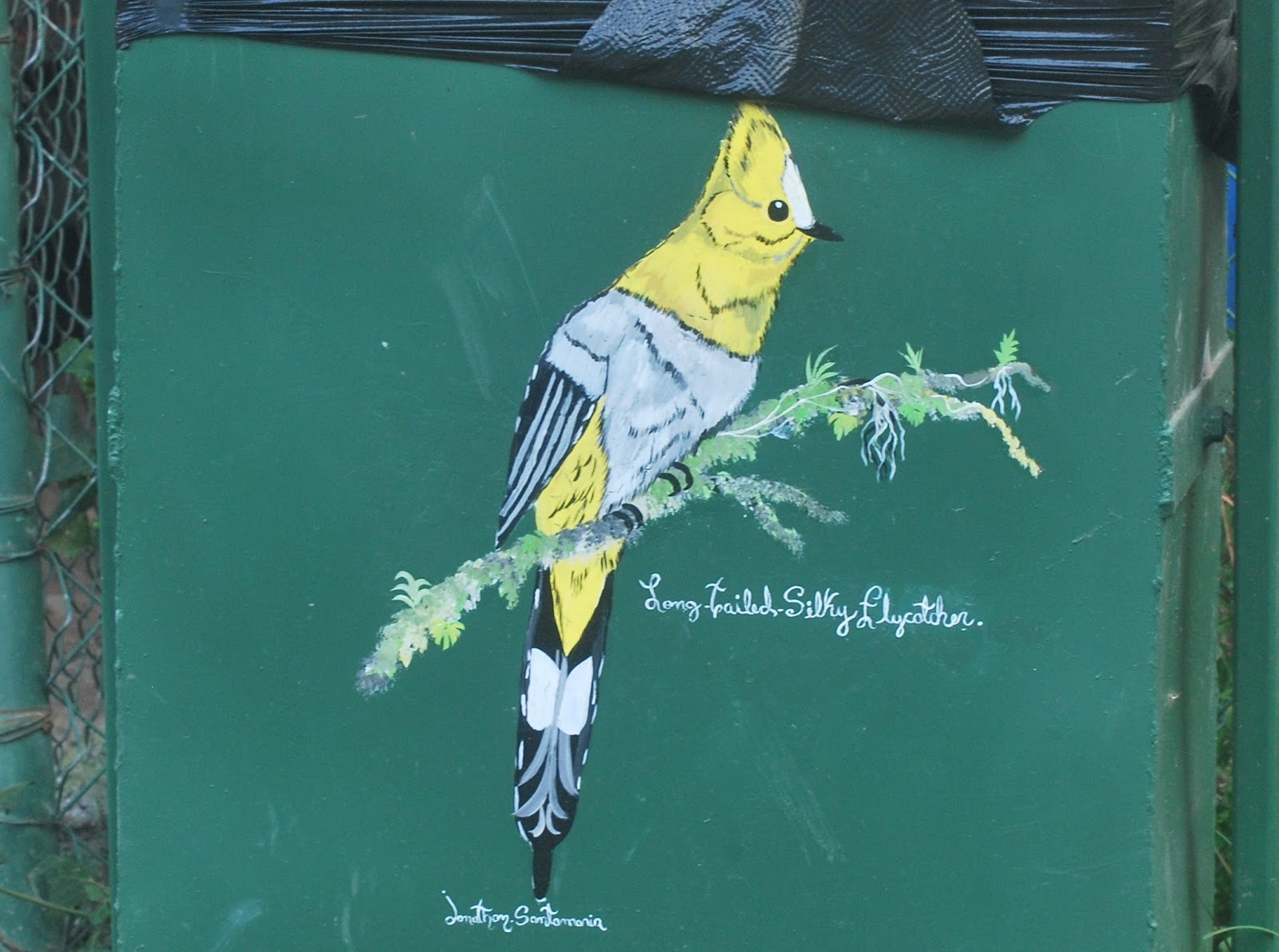
Showing posts with label Long-tailed Silky-Flycatcher. Show all posts

Friday, December 6, 2019

Chiriqui Highlands clean-up!

The advantage of having a small birding community in Panama is that you know most of the avid birders of the country.  That is specially useful when you are doing a Big Year because you need to find local specialties with limited time (specially if you are doing a Big Year AND still have a regular job unrelated to birds or traveling).  After noticing that there was a big gap of Talamanca endemics in my Year List, I called a great friend of mine, Genover "Ito" Santamaria, and planned to spend half-day in his reign, looking for those specialties.  Ito is a nice guy and also a great birder, something you can experience by contacting him through Tamandua Nature & Photo Travel Panama.  Why you should?  Well, keep reading and you will see!
Talamanca endemic Ochraceous Pewee
As mentioned before, I only had half-day to find a list of targets, most of them endemics of the Talamanca mountain range shared by Costa Rica and western Panamá.  So I spend the night at the town of Guadalupe and went to bed after having a hot chocolate with marshmallows (specially good when the temperature outside is 12ºC).  Very early the next morning, Ito joined me with his modified 4WD truck (just after hearing my first target of the list, a Dusky Nightjar, above his house!).  Knowing the we were short of time, he planned to visit some key sites in a quick succession in order to maximize our chances.  The first stop was a road near the town of Las Nubes that crossed several habitats, including some nice patches of forests.  Quickly he started to point out some nice additions to my Year List.  Some forest border specialist, like Ochraceous Pewee and Black-capped Flycatcher were quickly noticed, while some skulkers took a little bit more of time (Buffy Tuftedcheek and Streak-breasted Treehunter).
Streak-breasted Treehunter (also a Talamanca endemic)
We crossed several mixed flocks with flycatchers, tanagers, chlorophonias and redstarts.  The activity was intense... actually, we noticed that it was very intense!  Soon, we realized that a bird we called earlier was vocalizing  and that probably all the clutter was due to its presence.  We started to search every tree, but following the hooting notes to its source was not easy.  However, experienced Ito knew exactly where to look and soon he found it!  A fierce-looking Costa Rican Pygmy-Owl in all its glory showed itself.  We got more-than-excellent views through the spotting scope... only my second sight ever and -by far- the best one!
Costa Rican Pygmy-Owl
Well, with most of my targets in the bag, we moved to another spot nearby where we got more birds, some of them also new year-birds.   Although some of them were not endemics, I was amazed to be able to include in my list some birds that I had not seen in many years in Panama.  Actually, two of them where species that I had seen only once before... in both cases (White-throated Flycatcher and Barred Becard), Ito was also involved in showing them to me for the first time.
White-throated Flycatcher
If you think this is a quick summary, well it is!  We moved from site to site very quickly, always looking for new birds.  We finally visited the last scheduled site, Volcan lakes.  It was almost noon, but the forest surrounding the lakes was alive with singing birds!  We were particularly lucky with flycatchers (with Slaty-capped Flycatcher and Eye-ringed Flatbill being new year-birds) and furnariids.  The mega skulker Ruddy Foliage-Gleaner allowed short -but nice- views... it was a Panama lifer, while both Chiriqui Foliage-Gleaner and Costa Rican Brushfinches offered an unforgettable show, posing for photos and I could even record audio.
Chiriqui Foliage-Gleaner
Costa Rican Brushfinch
What a memorable morning!  But it was time to say good-bye.  Curiously, the target that was still missing was also a widespread and common highland endemic: Long-tailed Silky-Flycatcher.  We were not able to find it at its usual haunts in Guadalupe, but Ito gave me the directions to find it in my way back to David city.  Well, as you guess it, the bird was exactly where Ito told me!
The Long-tailed Flycatcher was my year-bird #700 for Panama!  At the same spot, I got more year-birds, including my life Townsend's Warbler!  So... YES!  It was an amazing quick-trip to the western highlands, full of endemics, specialties and new year-birds but more importantly, it was a birding trip with a good friend!

Wednesday, August 7, 2013

AOU Checklist changes affecting Panamá

Last month issue of The Auk (the American Ornithologist's Union -AOU- publication) includes a supplement of the checklist with some important changes affecting the taxonomy of the birds in North America (and Hawaii).  I will mention only those affecting the birds found in Panamá, and I'm including not only splits and lumps, but also name changes and other issues.
In taxonomic order, I will start with the shorebirds.  Now, many species considered monotypical are now included within the genus Calidris.  That means, we now list the Surfbird as Calidris virgata, Buff-breasted Sandpiper as Calidris subruficollis and Ruff as Calidris pugnax.  The order of the species within the genus Calidris also changed, as well as the sequence of the families within the Charadriiformes order.
There are three Calidris virgata in the flock
The Green-crowned Woodnymph is re-lumped with the Violet-crowned Woodnymph and re-adopt the name Crowned Woodnymph (Thalurania colombica) based on better understanding of the ranges and intergrades within these two forms in Colombia (however, they are not known to come into contact in our country).
Former Green-crowned Woodnymph from Ecuador
Black-crowned Antshrike (Thamnophilus atrinucha) is the new name for the Western Slaty-Antshrike due to genetic evidence indicating that our form is not related to the "real" south american slaty-antshrikes, in spite of the physical similarities.  Both subspecies of Immaculate Antbird found in Panamá (Myrmeciza i. zeledoni from Costa Rica and western Panamá, and M. i. macrorhyncha from eastern Panamá and western Colombia and Ecuador) are now called Zeledon's Antbird (Myrmeciza zeledoni), a new species different from the Immaculate Antbird restricted now to Colombia and Venezuela.  Also, the latin name of the Rufous-rumped Antwren change to Euchrepomis callinota.
Black-crowned Antshrike (it's going to be difficult to get used to this name)
As expected, the Thrush-like Schiffornis was split into four species, with two forms occurring in Panamá: the dull, uniformly olivaceous Northern Schiffornis (S. veraepacis) found in both lowlands and highlands of western Panamá, and highlands of central and eastern Panamá (except the Alturas de Nique massif) and the more rufous, gray-bellied Russet-winged Schiffornis (S. stenorhyncha) found in lowlands of central and eastern Panamá (and all elevations of the Alturas de Nique massif).
Bad photo of a Northern Schiffornis, from Altos del María
The Green Manakin is called now Xenopipo holochlora, and both Red-capped and Golden-headed Manakins changed their genus to Ceratopipra instead of Pipra.  Also, the checklist sequence of the manakins changed.
Ceratopipra mentalis
According to Gregory and Dickinson (2012), Ptilogonys (and Ptilogonatidae, the latin name of the Silky-Flycatchers family) is an incorrect spelling and has no nomenclatural standing.  The checklist corrects this and now the name of the family is changed to Ptiliogonatidae and the genus to Ptiliogonys, affecting the latin name of the Long-tailed Silky-Flycatcher to Ptiliogonys caudatus.
A minor misspelling was corrected in the latin name of this common species
The latin name of the Common Bush-Tanagers changed to Chlorospingus flavopectus (however, there are no splits in this group).
Common Bush-Tanager... I was expecting splits in this species!
Some issues are pending, other were not even mentioned... notably the Blue-diademed/Whooping Motmot.  Surely more studies are needed before a formal pronunciation of the AOU.

Thursday, May 2, 2013

Birding the forest or the backyard?

When birding the Chiriquí highlands in western Panamá, the variety birds is so high, that even inside the forest you can cross a huge flock with many different species.  In other parts, usually you see more birds in the open habitats and the forest borders, but here... well, you'll see.  During our last journey to the highlands, I managed to get some shots of both forest and backyard birds.  Lets start with the common ones, we found the next species in the gardens and streets of the little town of Guadalupe, above Cerro Punta.  Of course, the ubiquitous Rufous-collared Sparrow is impossible to miss!
Not only singing adult birds, also immatures were around, as you can see in the second photo.  Another singing bird was this male Flame-colored Tanager.  We saw several pairs of these well-named tanagers.
With a sweet voice too, these Yellow-bellied Siskins were quite busy feeding in these bushes.  Male, female and immature male in quick succession.
Another hard-to-miss species in the highlands is the Slaty Flowerpiercer.  Notice the unique bill, adapted to steal the flowers' nectar.
An impressive (and common) bird in the highlands is the Long-tailed Silky-Flycatcher.  Usually is seen perched very high in the trees, but this individual was very low taking some berries.
However, it is in the forest were most of the rare and elusive species are (except, of course, if you find a Lincoln's Sparrow sharing a field with Rufous-collareds!).  Just minutes from Guadalupe,  La Amistad International Park offers an excellent opportunity to see these special birds, like the Barred Becard attracted after playing a tape of its call.
Or the Large-footed Finch feeding in the forest floor.
A hard-to-see bird is the strange-looking Wrenthrush (though I prefer its spanish name: Zeledonia).  More often heard, my marginal photo shows at least the main field marks of this species, the ball-shaped body and the contrasting orange crown.
The last bird we saw in the park is a relatively common one; however, for some reason I had missed this one in my more than 15 years of birding in Panama (and other countries)... my life Lineated Foliage-Gleaner really really put on a show for us, giving exceptionally good views and photograph opportunities.
That is the way to end a trip to the highlands!  

Tuesday, November 2, 2010

Weekend at the highlands. Part I

Yeap! We saw the chance, and we took it. After attending an appointment in Penonome last friday, we decided to drive farther west to the Chiriqui highlands (western Panama) to see what we can get. After a very early start, and after a quick breakfast at Santiago, we reached the Concepcion - Volcan road around 8:00 am. As usual, I decided to stop at Cuesta de Piedra to have a look at the Macho de Monte river. The day was very cloudy and the light awful for photography, but anyway Gloriela and I managed to find some interesting species, including a new year-bird for me and some lifers for her. Probably the most interesting sight was the ocurrence of all the four resident river-dwellers in the same general area: a Black Phoebe (photo of a previous trip), two Buff-rumped Warblers, four (two pairs) Torrent Tyrannulets and an American Dipper. Not only that, we also found a Northern Waterthrush and a Spotted Sandpiper working at the same rivers... making the place very productive. We saw other species as well, including my year Yellow-bellied Flycatcher (lifer for Gloriela) and a Blue-crowned Motmot of the ssp lessoni. This is the first time I see this form since its recognition as a valid species by the AOU's South America Classification Committee (SACC) under the name of Blue-diademed Motmot... a change not yet recognized by the North America Committee (neither by the Panama Audubon Society -PAS). Anyway, this motmot was very shy. We checked all the distinctive field marks (including its general greener coloration, specially to the underparts) except its vocalization. When I fot closer in order to take a picture, the motmot concealed itself behind the leaves! Well, we left the place and headed to Volcan, where we got a room in town. For the afternoon, we decided to walk the road to El Respingo, above Cerro Punta. The weather did not improve, so we were accompanied by a light rain almost all the way up. By the entrance we found a mixed flock with Sooty-capped Bush-Tanagers, Black-cheecked Warblers and my year Philadelphia Vireo (plus Yellow-winged and Brown-capped Vireos too). Next to them, a Long-tailed Silky-Flycatcher was eating some berries, not paying attention to us. Higher on the road, another mixed flock brought to us a cooperative pair of Collared Whitestarts, a Slate-throated Whitestart as well, two Ruddy Treerunners, an Spot-crowned Woodcreeper, a Yellowish Flycatcher, more Black-cheeked Warblers and a beautiful Flame-throated Warbler. Not far from us, at the edge of a big clearing, a handsome Black-capped Flycatcher was quietly perched on some bushes. It was a lifer for Gloriela and only my second time ever (so, it was a year-bird for me). For an Empidonax flycatcher, it is very distinctive! After 1.5 hours climbing, we finally reached the Respingo rangers' station, at 2500 meters above sea level. The smiley park ranger welcomed us and showed us the place, which have all the facilities for staying during a night or more. After paying the entrance fee, we walked a little around the station finding Yellow-thighed Finches, Black-and-yellow Silky-Flycatchers, tons of Band-tailed Pigeons, a flock of Sulphur-winged Parakeets perched (lifer for Gloriela) and a pair of Volcano Hummingbirds doing exhibition flights... amazing how fast and high these little birds get during these flights! After enjoying the magnificent view of the Cerro Punta valley from El Respingo, we went down to Volcan to enjoy a well deserved dinner at the hotel. We scheduled a visit to the Volcan lakes for the next morning, so stay tuned!