Showing posts with label American Swallow-tailed Kite. Show all posts

Monday, September 14, 2015

Birds migrate, eBirders count!

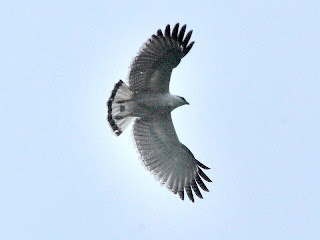
And it is again the time of the year where some impressive flocks of migrant birds can be seen in the sky on their annual southbound passage to South America through the Panama isthmus.  This is certainly true for the daylight migrants, like the raptors.  Since yesterday, some impressive flocks of both Plumbeous and Mississippi Kites have crossed Panama City's skies... although few Panamanians are aware of that.  For me, it was kind of special because I recorded for the first time a flock of Swallow-tailed Kites from my balcony.
Swallow-tailed Kites
Swallow-tailed Kite
Yes, now my balcony list stands at 118 species!  Just second before I recorded a huge flock of Plumbeous Kites that were new for my list too.  These birds approached from the southwest, took the thermal current very close to my apartment (thus I was able to see the black tails with white bars and the rufous primaries) and leave it very high flying eastward.
Plumbeous Kite
However, today was truly spectacular... at first, a little flock of 50 Plumbeous Kites flew low enough to see the same field marks I witnessed yesterday; then, a second group follow them with some Black Vultures... however, this were congeneric Mississippi Kites.  Notice the pale heads and pale secondaries of these birds.
Mississippi Kites and Black Vultures
While seeing this second flock, I noticed some "tiny spots" in the background.  After focusing it properly, I realized the these "tiny spots" were thousands of kites very high in the sky... too high to ID properly to species.  They were Ictinia kites for sure.  Immediately, I started to estimate the number of individuals in this Mississippi/Plumbeous Kites flock.  First, I quickly counted 100 individuals, got a sense of the proportion of the flock they take up and then extrapolated by hundreds the rest of the flock.  My estimation was 6000 birds.  It sounds straight forward... but it needs some practice; however, after a while you will make it automatically.  A very interesting article about counting birds can be found in the eBird main (or just click HERE).  Of course, to use this method you need a fairly uniform flock of the same species/group.  For example, this photo shows approximately one third of the flock I saw today:
All those dots are Mississippi Kites, with at least three Black Vultures mixed in (you may need to enlarge the photo)
For purely educational purposes, I divided this photo into four equal parts and counted individuals in one of these parties (which represent 1/12 of the original flock).  Do not pay attention to the size and shape of the red circles ... I only drew them for not count the same individual two or three or ten times!
533 Mississippi/Plumbeous Kites (and a Black Vulture); thus, a flock of 6396 individuals (533 x 12)
I did the same with the next picture, which I took with a larger zoom, and representing approximately one tenth of the flock:
Many Mississippi/Plumbeous Kites
578 Mississippi/Plumbeous Kites; thus, a flock of 5780 birds (578 x 10)
Using both estimates, I calculated an average: 6,088 Mississippi/Plumbeous Kites in that single flock (6396 + 5780 / 2).  That's why I wrote down that number in my eBird checklist and not my first estimate of 6000 birds... although they are pretty similar!  So what are you waiting for... it is time to practice and to look up for migrant flocks of birds!

Tuesday, July 13, 2010

One day, two destinations

By the end of the last month, some of us were compiling our year lists just to see how far we were for becoming members of The 600 Club - Panama. That is why Rafael Luck and his nephew Daniel invited me, Venicio "Beny" Wilson and Osvaldo Quintero to a one-day quest of those birds that some way or another have eluded us so far. We visited in the same day both the entrance road to Cerro Campana National Park and El Valle de Antón. The trip was a complete success, and I got several new year-birds for my list (I'll number each of them in the text). Our first destination were the hills of the entrance road to Cerro Campana National Park. This park (the first one of the republic) protects the remaining patches of humid forest in the foothills of Capira (western Panama province), but we were interested in the more degraded habitat that occurs in its lower elevations by the entrance road next to the rangers station, the grassy slopes with scattered rocks, the main habitat of our targets: Wedge-tailed Grass-Finch (1) and White-tailed Hawk (2). We stopped by the "Mirador" (from where we got the magnificent view of the Chame bay in the photo with the first light of the day) and started the search. We saw many common species like White-tipped Dove, Lesser Elaenia and Tropical Kingbirds while several American Swallow-tailed Kites patrolled the skies. Soon, we saw a pair of the grass-finches singing atop some rocks, but always close to cover. Then, Beny found with his scope a distant and huge raptor also perched atop a rock. Mostly white with a dark half-hood: a White-tailed Hawk! We got our targets within 15 minutes of our arrival! Very happy, we headed to the west, to El Valle de Anton in the Cocle province. On route, we stopped near the town of Los Llanitos (you know, Todies' Land) for a short walk. Soon, we were looking for the Tody Motmots (3) that responded to the tape, at least three individuals. Eventually we saw one of them very close to us, but it didn't allowed photos. Other birds in the area included Sepia-capped Flycatchers (4), Black-chested Jays, Cocoa Woodcreeper, two White-thighed Swallows (5), several Rufous-capped Warblers with juveniles and a Ruddy-tailed Flycatcher. With more new year-birds in the bag, we finally entered the picturesque town of El Valle and headed to La Mesa, where Beny suggested to explore a side road. It was a good idea since we found a perched White Hawk very close to the road. The elegant bird then took off from the branch and circled us a couple of times before dissapearing behind the hill. We followed the road by foot, which passes through the border of a nice moss-covered forest with lots of bromeliads. We found a nice mixed flock with Silver-throated, Common Bush and Hepatic Tanagers (6), Tawny-crowned Euphonias, Olive-striped Flycatcher, and a pair of Tufted Flycatchers that were nesting in the area. A flock of Tawny-crested Tanagers (7) catched our attention with their calls, the same for a pair of Great Black Hawks (8) flying high in the skies. Then, we tried the entrance of the Gaital Natural Monument, but it was raining so we only saw a group of Dusky-faced Tanagers (9), several Violet-crowned Woodnymphs and a Spot-crowned Antvireo (10) in a mixed flock with more Tawny-crested and Lemon-rumped Tanagers. After a late lunch in town, we spent the last hours of light in Mata Ahogado, close to El Valle. We saw more common birds including Gray-capped and Social Flycatchers, Barred Antshrike; Silver-throated, Plain-colored, Lemon-rumped, White-lined, Palm, Blue-gray and Crimson-backed Tanagers, Paltry Tyrannulet, Buff-throated and Streaked Saltators and a calling Bran-colored Flycatcher (11). A car crash prevented us to continue the road leading to Altos del María so we called it a day and started the return to Panama City, after a successful day with tons of pretty new year-birds!
Saturday, August 29, 2009

Visiting Altos del Maria

I just came from Altos del María, a gated community in the foothills of western Panama province that have proved to be a good birding spot. Along with Osvaldo Quintero and Alfred Raab, an Altos' resident who kindly guided us through the area, we explored some nice areas with good access roads and good birds. Alfred was constantly saying that we were lucky because we found a sunny day without fog in the upper part of the housing development (La Rioca), where we walked La Coruña street finding a nice mixed flock right in the entrance, with Silver-throated Tanager and Common (very common) Bush-Tanagers, along with Rufous-capped Warblers (feeding youngs), Tufted Flycatcher, Thick-billed and White-vented Euphonias, at least two Yellow-billed Caciques and an Ochraceous Wren that Alfred immediately recognized by its Winter Wren-like call. A little farther we took a trail that leads to an observation tower, attracted by the frog-like call of two Purplish-backed Quail-Doves that eluded us despite our efforts... but bonus birds were the male Purple-throated Mountain-Gem and a shy Black Guan plus a spectacular view of the Cerro Trinidad in the distance. At the tower, we had a terrific view of the pacific lowlands, and of the forest at the foothills. It is possible to see both oceans in a clear day. We decided to visit some other sites before the fog covered everything. Among other species recorded were White Hawk, Pale-vented Thrush, a bright female Shiny Honeycreeper, Paltry and Southern Beardless Tyrannulets, Yellow-margined Flycatcher, Golden-hooded and Bay-headed Tanagers.
We start to return, stopping at the Styria gate (the "pyramid") from where you can see all the lower valley of El Maria, where the main community is. We found a big group of American Swallow-tailed Kites plus a Short-tailed Hawk soaring in a thermal. You don't very often see these birds at eye level, nor from above, so we enjoyed the sight for a few minutes. Then, we descended to the valley, to Alfred's place. Alfred have done a good job in his property, hanging feeders and making trails that hold many birds. Only in few minutes around noon we saw or heard Rosy Thrush-Tanager, Black-striped Sparrow, Plain, Rufous-breasted and Rufous-and-white Wrens, a nesting Streaked Saltator and Lance-tailed Manakins... all of them typical of drier forest (like the Metropolitan Natural Park here in the city) than the humid mossy-covered forest that we found in La Rioca (which lies over the 1100 meters above sea level and on the Continental Divide). After a quick lunch, we headed to El Valle road (that connects Altos del Maria with El Valle de Anton), but as soon we got to the forest, the rain and the fog showed up. This part of the valley was full of flowering Inga trees that are very good for small hummingbirds (we only saw Rufous-tailed Hummingbirds) Despite our waiting, the rain didn't stop, so we decided to head back to Panama City after a great day in the foothills. Alfred: thank you for everything, I hope to see you soon!

Wednesday, June 17, 2009

Las Nubes, Cerro Azul

Last thursday, Gloriela, Osvaldo Quintero, Osvaldo Quintero Jr. and myself went to Las Nubes of Cerro Azul, a very quiet and pleasant community no more than 45 minutes to the east of Panama City. Our main objective was to find (and photograph) one of the American Swallow-tailed Kites' nests that are around. We arrived late in the afternoon, finding a cold, wet and foggy environment. Soon we got common backyard birds: Yellow-faced & Blue-black Grassquits, Variable Seedeater, Tropical Pewee, Tropical Kingbird, White-tipped Doves, Blue-and-gray, Palm and Plain-colored Tanagers. We also saw some kites soaring over us but, alas, no nests.It wasn't until we found a local worker, who showed us an Eucalyptus tree that was holding an active nest, that we were able to watch two overgrown chicks. Later, we found another nest with an adult kite on it. My distant and cropped picture shows one of the chicks on the first nest (better pictures by Osvaldo at Xenornis)It was a nice, after-work, relaxing trip. Except by the mud on my shoes, everything went right as planned (we found the birds and spend a wonderful time).