Showing posts with label Bananaquit. Show all posts

Saturday, May 3, 2014

San Andres Island hotspots. Part II

In the second day of our trip to San Andres Island (Colombia), we decided to travel around the island, visiting its touristic attractions.  I already showed you some of these hotspots.  After stopping for a while in Cove Bay (and watching our life San Andres Vireo), we continue southward along the island's  western rocky shore.  After passing several natural pools, we reached the southern tip of the island.  There, a tiny hole in the rocky beach brings a nice show to the tourists... it is known as the "Blowing Hole".
This hole is the only exit tract to a cave systems that reach the beach.  When the waves push the water inside the caves, the air is expelled through this hole... but beware, depending on the tide, the air can be followed by the water as well (just watch this video).  This rocky shore is coralline in origin... perfect for the Ruddy Turnstones.  They were the most common shorebird in the island.
Ruddy Turnstone
After turning at the southern tip, we drove north along the east coast, where most of the white-sand beaches are located.  These beaches are coralline too, and protected by a coral reef where most of the cays surrounding the island can be found.  Al these cays are major attractions, but we decided to spent the afternoon relaxing at Rocky Cay (the entrance road was property of the Archbold-Suarez family)... its warm and crystalline waters were perfect!
Two thirds of the Cubilla-Archbold family
Rocky Cay
The next day, we hired a boat in order to visit the other cays.  They are close to shore, so you can visit them in one morning.  Our first destination were Haynes and Rose Cays.  The later is known also as the aquarium due to its coral reef filled with multicolored fishes.  In the way to the cays, we crossed a replica of an ancient Pirate Ship.
Rose Cay as seen from Haynes Cay (San Andres urban center in the background)
At Rose Cay we took a tour through the reef aboard a boat with glass floor... simply amazing.  At Haynes Cay we had little time to walk around the tiny cay, finding two other waders (Willet and two Spotted Sandpipers) and a Contopus pewee that didn't vocalize.
Spotted Sandpiper
Then, our boat took us to Johnny Cay, to the north.  This cay is a popular destination due to its white beaches and Caribbean-style... you can have a Coco-loco (a local drink) while hearing Bob Marley or any other reggae or calypso rhythm.  However, the surf was pretty strong for Gabrielle... so we decided better to enjoy the music.  Only Bananaquits and Magnificent Frigatebirds in this cay for the record.
Bananaquit
Magnificent Frigatebird (male)
That was our last day in San Andres Island, and we hurried to make the check-out at our resort.  We still had some time on the island and decided to spend it well, but that's another story.

Tuesday, April 29, 2014

Escape to San Andres Island

San Andres Island certainly is a paradise tucked away in a corner of the Caribbean.  Politically belongs to Colombia, but Panama is closer (only a 50 minutes flight) and even closer to Nicaragua. This is a popular touristic destination, and we decided to spent a relaxing weekend enjoying its sandy beaches and Caribbean culture.  This was a familiar trip, I went with Gloriela and Gabrielle... NOT a birding trip... but I birded anyway!
Rose and Hayne Cays, San Andres Island
And we chose well!  Look that sea (and I'm not a beach lover)! We stayed at an all-inclusive resort builded over the waves, our room had a balcony facing the sea and nothing is more relaxing that the sound of the breaking waves in the morning.
The first day we walked along the beach front and enjoyed the swimming pools of our resort (and of a nearby one of the same chain).  I carried my bins and my camera... just in case.  Soon I started to see some common residents... and the most common of them all were the Bananaquits.  They were everywhere... they reminded me our ubiquitous Blue-gray Tanagers.
Bananaquit
While watching the Bananaquits, a hummer appeared feeding in some red flowers.  It was easy to ID, since the only regularly occurring hummingbird in the island is the Green-breasted Mango.
Green-breasted Mango
This was a male.  Notice its chestnut tail and slightly downcurved bill.  Gabrielle was more interested in another resident of the gardens, a big crab (I'll need some help to ID this one).
Can you see the crab?
And right at the gardens, I got my first lifer.  It puzzled me at first... a dull olive flycatcher with two faint wing bars.  However, the bright orange lower mandible and, specially, the lack of eyering gave me some clues.
Caribbean Elaenia
My first Caribbean Elaenia!  Later, I saw many more... but the first is always special.  I got three more lifers the next day... do you want to know which ones?  Stay tuned for the next part of this post!

Monday, April 2, 2012

More than hummingbirds at the garden

If you read my previous post, then I have to say that we saw more birds at the Enchanted Garden (in San Francisco de Sales, Cundinamarca, Colombia).  Except for the hummingbirds (of course), the most common bird at the hummingbirds feeders were the Bananaquits... dozens of them were competing with the hummers for the sugared water!
Others common species stayed close to the ground, inspecting the bushes and all the leftover around... including several Shiny Cowbirds (a female pictured here) and two or more family groups of Saffron Finches.
They also have banana feeders, attracting many tanagers, including this male Crimson-backed Tanager.  Notice the male Thick-billed Euphonia out of focus behind the tanager.
Another thraupid at the feeders was the Scrub Tanager.  They are quite common, but I can't get tired of watching them.
I'm pretty sure than many more species visit this place, but we only stayed for an hour, more or less... but what an hour!

Sunday, February 26, 2012

Back to the coclesian lowlands!

After spending most of the morning at the chilly foothills of Cocle province (central Panama) and having a refreshing bath at Las Yayas (both above El Cope), Rafael Luck, Luis Isaza and your host decided to have lunch in the lowlands around Aguadulce, and that was how we change from misty cloud forest to very hot scrubs, savannas, saltponds and the Pacific ocean in less than one hour!
We crossed the Aguadulce Salinas (saltponds), that were essentially devoid of birds, directly to El Salado beach and town, where we did saw some interesting species despite the midday's heat. Interesting in fact was the Bananaquit that we found in the garden of a house, because we also saw two of them earlier in the morning accompanying a mixed flock in the cloud forests above El Cope, and now it was alone in a desert-like habitat... how amazing is that!
We enjoyed a delicious fried fish with smashed green plantains in a restaurant close to the beach, a most for every visit to this part of Panama, and now a tradition for me and Rafael. In the way back, we saw some shorebirds and waders in a little pond, so we decided to took a side road to have a better look.
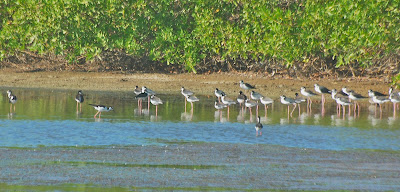
The number of Black-necked Stilts was amazing, these elegant birds are always welcomed to our day lists. The ponds proved to be like an oasis in the middle of a desert for many birds, including several heron species, Greater Yellowlegs, several groups of migrants Blue-winged Teals, Wattled Jacanas, and so on...
Others species typical of this habitat were both Yellow-headed and Crested Caracaras, distant White-winged Doves, Plain-breasted and Ruddy Ground-Doves, Groove-billed Anis, Pearl Kite, and a Common Black-Hawk that left me take this series of photographies showing him perched on a telephone pole, taking off and then landing on the wires.


You can see the rufous-colored flight feathers that supposedly separates this form (known as the Mangrove Hawk) of the Pacific coast from the "real" Common Black-Hawk of the Caribbean coast (in Panama I mean). Nice way to end a day full of contrasts and birds!

Monday, September 21, 2009

A Beautiful Desert

After visiting Herrera's wettest place in the morning, we drove to the driest one in the evening. The Sarigua desert is not a true desert actually, but a fragile coastal ecosystem known as "albina". Most of its tree-less landscape is due to the deforestation during the last century, though the area is also known as an important archaeological site. It is protected by its own national park, located in coastal Herrera, close to the town of Parita. Of course, we were looking for birds in this arid habitat. Our first stop was at the Visitor Center where we walked a little trail through cacti and xerofitic vegetation, following the call of a Crested Bobwhite nearby, and finding Prothonotary Warbler, Blue-black Grassquit, Eastern Wood-Pewee and Mouse-colored Tyrannulet. A Bananaquit was eating in a cactus. I'm amazed by the adaptability of this little friend. You can find it in humid montane forest, residential gardens, and is doing just great in that arid site! We climbed the observation tower near the Center to have a panoramic view of the surroundings. There were some shallow lagoons in the distance that seemed to be full with birds, so we decided to drive in that direction. Shortly after we started to drive, a couple of ground-doves flew to the side of the road. A quick search and soon we were watching a beautiful pair of Common Ground-Doves. This dove is only common, as its name suggests, in this part of the country, being absent in places just to the north or south. They were the first of many pairs that we encountered later. When we reached the lagoons, soon we identified most of the birds. Most of them were Western and Semipalmated Sandpipers with few Least Sandpipers. A group of plovers proved to be Collared, while some Black-necked Stilts and Black-bellied Plovers were feeding in the open. The lagoons next to the mangroves in the other side of the park seemed promising, so we headed in that direction too. The road didn't reach those lagoons, so we parked the car and walked through a fantastic landscape of rocky formations for a kilometer or two. We found tons of herons and egrets, Yellow-crowned Night-Herons, Whimbrels, Black-bellied Whistling-Ducks, White Ibis, Laughing Gulls and Least Terns. We wanted to get closer, but it was getting late, so we started to return. We found more birds in the way back, including migrating Eastern Kingbirds and Barn, Bank and Cliff Swallows, Fork-tailed Flycatchers and flocks of Yellow-crowned Amazons going to roost. It was a long day, full of contrasting experiences, a really nice way to taste some of Panama's great diversity.