Just to spent time of our free weekend, Gloriela and I decided to make a quick visit to Punta Culebra, in Panama City. The place is well-known by its marine exhibitions (operated by the STRI), but is also very quiet, close to the city, and with an interesting array of common birds and other animals that it is always a good choice. Typical of the dry season, the Bougainvilleas were completely bloomed in a variety of bright
colors, including the scarlet-pink one being visited by a female Garden Emerald. This is just one of several species of hummingbirds residing there, and probably Punta Culebra is the most reliable site within the city to find it (pretty easy in fact). Some usually-hard-to-see species are more confident there, probably they are used to the
visitors and are not longer afraid of them. That is the case of the Plain Wren. Several pairs are found around the installations, very easy to see, specially when singing (which they do a lot). Usually, this species (as many others wren species) prefers the entangled and dark understore of forested areas, where even a
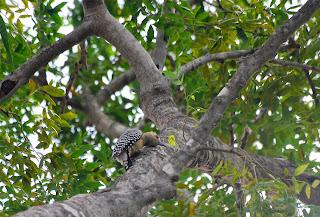
glimpse of them becomes difficult. After a couple of minutes, it started to rain, so we sheltered in our car, and had a nap before continuing with our walk, finding immediately a Red-crowned Woodcreeper working the main trunk of the tree at the parking lot (you can enlarge the photo). These "zebra-backed" woodpeckers are the most common member of the family in the city (and all over Panama), and exhibit a wide variation of color tones and patterns. This particular one was quite brown to the head and underparts, while
others are immaculate white in these parts. We found many more common city birds, including tons of Variable Seedeaters feeding both in the ground and high in the trees. The females and immatures outnumbered the adult males, like the one I'm showing here with the spike. Other common birds recorded were Blue-gray, Palm and Crimson-backed Tanagers, Tropical
Mockingbird, Scrub Greenlet and Great-tailed Grackles. We also saw a family group of Yellow-crowned Euphonias, with several females (photo) and a singing male that remained elusive. By the end, again at the parking lot, a group of confiding Crab-eating Racoons were assaulting a trash can, like real bandits. One did not resist the curiosity and climbed a fence to watch us better... great way to call it a day!
Showing posts with label Garden Emerald. Show all posts
Sunday, January 16, 2011
Monday, December 20, 2010
2010's Pacific Christmas Bird Count
Yesterday, the Panama Audubon Society carried out the first (of three) Christmas Bird Counts in central Panama, with a great assistence and some good birds showing up. Like last year, I counted in the Farfan/Veracruz area (Panama Canal's west bank) in the morning... but this time alone because Gloriela stayed in home with a cold. I started very early, as usual, finding many of the specialties for the area (shorebirds, waders
and open land birds). First, I checked Veracruz beach walking along the tide line in rubber boots finding tons of Willets and Whimbrels in the same flock along with a White Ibis, a Ruddy Turnstone, and some Collared, Wilson's and Black-bellied Plovers. I also found two Lesser Yellow-headed Vultures (so far the only two of the count) and
heard a Striped Cuckoo in an adjacent grassland. Then, I checked Farfan beach, finding maaany herons and egrets, including my new-for-the-year Boat-billed Heron inside a mangrove and several Great Blue Herons. The highlights were two American Oystercatchers spotted far away in the rocky shores, also the only two for the count. Other birds related to the aquatic environment were the Amazon and Ringed Kingfishers at the
river, several Northern Waterthrushes, a single Prothonotary Warbler and a flock of Greater Anis making a guttural call. These are shiny and good-looking birds compared to the Smooth-billed Anis found before. I like its expressive yellow eyes...
not to be confused with the abundant Great-tailed Grackle). I moved to Amador where I entered Punta Culebra, the most reliable site inside the count circle to find the Northern Scrub-Flycatcher... and one of these little friends was perched on the entrance sign! Notice its pattern, quite similar to the Myiarchus flycatchers. You can identify it by its smaller size, short bill and different voice. The site is also
very good for Sapphire-throated Hummingbird (only one male seen), Garden Emerald (up to four different birds of both sexes present) and "Mangrove" Warblers (with several seen). I also saw both Brown and Blue-footed Boobies (following a ship entering the Canal!) INSIDE the count circle. By midday, all the groups met at the Chiva Chiva ponds (beyond the Miraflores locks) to compilate the preliminar list and to organize the plans for the afternoon journey. After checking the missing birds, I went to different sites with Darien Montañez (PAS president, this CBC main compilator and XENORNIS editor) looking to add more birds to the day list, with moderate success. The very first stop was at the first of the two Chiva Chiva ponds, were we scoped several Common Gallinules (aka Moorhens), an American Coot and four (probably more) Pied-billed Grebes, the latter two were new year-birds for me! At the mangroves of Diablo Heights, Darien
showed me a female American Redstart (new year-bird!) and we saw a quite grayish Cocoi Heron (white thighs and solid black crown, so its grayness was probably age-related). We failed to locate the Cattle Tyrant at its former usual haunts in Amador, but added Shiny Honeycreeper and Black-tailed Flycatcher at the Metropolitan Natural Park (with Venicio "Beny" Wilson and Olmedo Miró). The day ended doing some owling at Beny's place in Ancon... 15 hours of intense birding! Great count with great birds!
Wednesday, March 31, 2010
Penonome pics
Our vacations are almost over, and we spent great part of it at our home in Penonome, Cocle province in central Panama. Now, we are in the city again, but I took some photos of common birds, wildlife and landscapes along the roads and rivers (specially the Zarati river, which we visited at least in four different sites) that I want to share.
Penonome is very hot, considering that we are in the middle of the dry season, and the trees and other plants are blooming or having fruits, allowing the wildlife (specially birds) to feed their youngs. This is the case of the House Wrens and the Blue-gray Tanagers that nest by the roof of our neighbors... always busy looking a fresh meal for their youngs.
The great variety of flowers that the people keep in their gardens attract many hummingbirds, including the Garden Emeralds (a female in the picture).
Also, it is time for lot of singing... and the most perseverant singers are the Clay-colored Thrushes and the Rufous-browed Peppershrikes. They even sing in the hottest part of the day!
Even the all-black birds shine in these bright days, like the Great-tailed Grackles and the Bronzed Cowbirds. No matter their abundance... they look simply great with a suitable light.
The insects also enjoy this time of sun... including the pair of damselflies I found in the shores of the Zarati river.
Well, these were good vacations, I hope you enjoyed the pics... now, back to the real life!
Sunday, November 8, 2009
Inspecting the finca, and its birds
Despite we still have a lot of work in hand, taking care of some details at our new house in Penonome, we decided to rest a little and to visit the environs, passing by the finca. Gloriela's relatives were already there, having a picnic day. We joined her father, sister and nephews in a tour through the property, inspecting the conditions of the plants sowed during the past dry season and the advances in the construction of the cabin under a refreshing drizzle. I grabbed my camera and bins, noticing activity around the shrubbes and the wild flowers. Eventually, I left
the group while following the calls and whistles of the birds in the surroundings. By the way, I added some new species to the growing bird list for the finca. The migrants were represented by Yellow Warblers and Northern Waterthushes, while the residents honeycreepers and euphonias (Bim-bim) were all around the place. A covey of Crested Bobwhites scared me when suddenly took off few feet from me; then, an angry individual was yelling Bob-Bobwhite from its perch on a tree, but still invisible to my eyes. In the wettest and most entangled area of the land, close to the creek, several males Lance-tailed
Manakins were lekking incessantly, but I only got glimpses of them. An emerald-green flash over some flowers plus a quick shot with my camera produced the blurry (but nicely irridiscent) male Garden Emerald that I pictured here, looking like a flying jewel; while some Snowy-bellied Hummingbirds chased each other all over the place. The list is not complete without the flycatchers, with Lesser and Yellow-bellied Elaenias, Social and Streaked Flycatcher and Tropical Kingbirds being the commonest; but also recording Sepia-capped Flycatcher, Southern Beardless-Tyrannulet and, for the first time there, Mouse-colored Tyrannulet (small size, dull
brown upperparts with buffy wingbars, eyering + eyebrow instead of only eyering as in Lesser Elaenia, etc...). Also, we wanted to know the surrounding, including other fincas and communities. A short drive took us to three different rural communities in less than 60 minutes: Santa María, Cañaveral and Cerro Gordo. The last one was specially charming, a little town with traditional clay houses. There is located the beautifully arranged Finca La Peregüeta, owned by a former Panama Audubon Society president and an old friend: Norita. She transformed her land in a private natural reserve that holds a good number of birds (check out the section Birds to see at La Peregüeta on her webpage). By the way, peregüeta is a common tree in the area that produces little black fruits. Is good to know that some people care about preserving the environment for the next generations. With that in mind, we are back in the big city, hoping to return next weekend to that piece of land in Penonome.

Labels:
Garden Emerald,
Mouse-colored Tyrannulet,
Penonome
Subscribe to:
Posts (Atom)