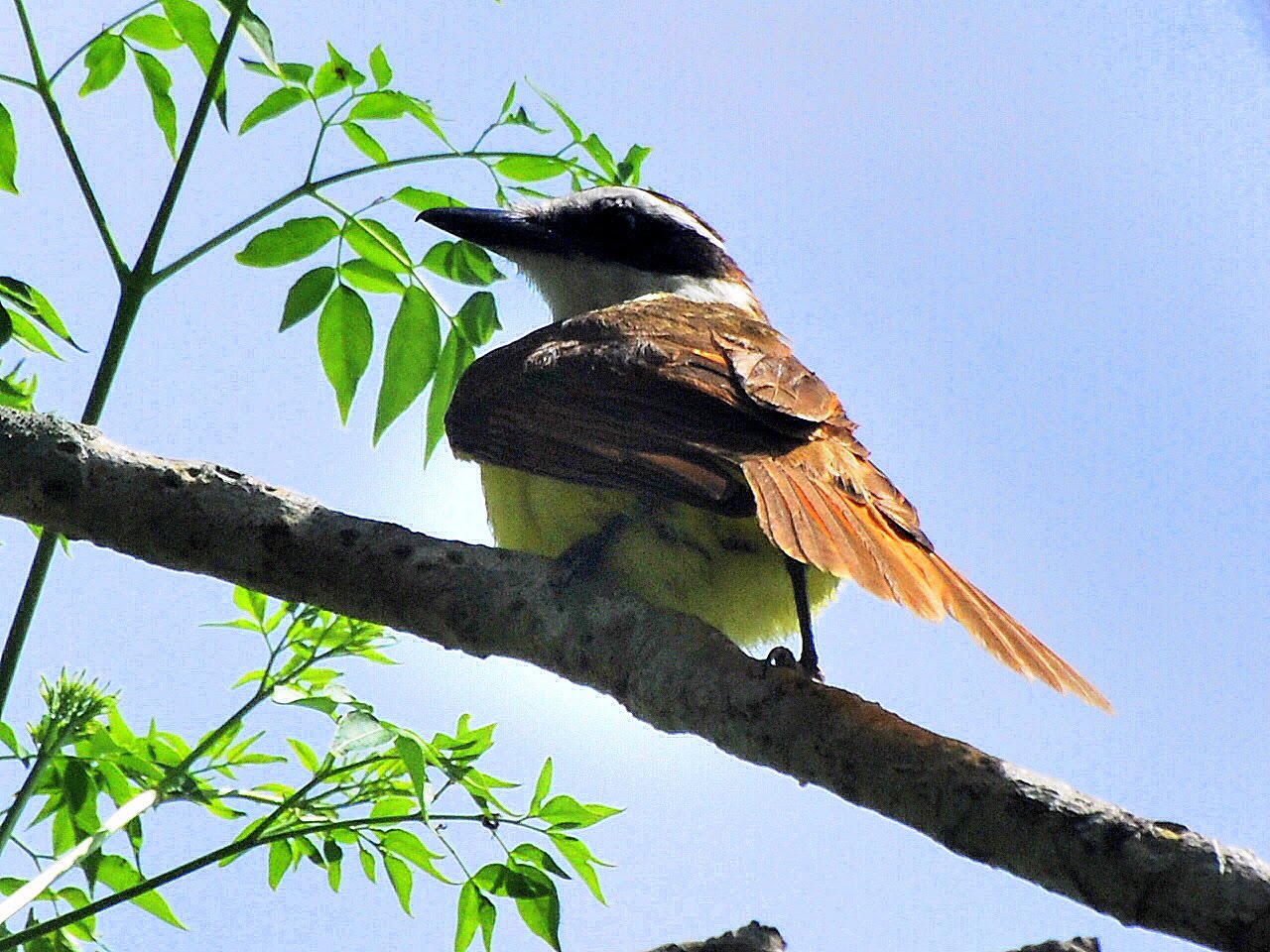
Showing posts with label Great Kiskadee. Show all posts

Wednesday, February 17, 2016

Gamboa's Ibis

The news spread like fire on summer dry grassland in Coclé (OK, I know it only makes sense to the Panamanians, sorry about that)... a country first-record was twitchable in the town of Gamboa, in central Panama, mere 30 minutes from Panama City.  A group of visiting birders photographed a Plegadis ibis right at the one-lane bridge over the Chagres river but it was not until they review the pictures back at the lodge they were staying that realized that it was a White-faced Ibis, a species ever recorded in Panama.
White-faced Ibis spot, with the Gamboa bridge in the background
The next day, many local and foreign birders re-found the bird in the same spot early in the morning.  It stayed most of the day feeding in the muddy banks of the river.  Certainly is the most photographed and documented first-record for Panama!  My duties prevented me to be part of the crowd admiring that day, so I coordinated with Itzel (who also failed to attend the event) to go get it early the next day.  We where at the bridge at first light, and I even managed to see the White-faced Ibis from the car while crossing it.
Great Kiskadee (and yes, THE ibis is in the background)
The bird was feeding right where we were told, but the light was awful for photos... it took a while before it got close enough for decent shots at least.  As I mentioned before, the occurrence has been extensively documented, and some impressive photographs of this particular bird are available, so I consider my photos just mere record shots.  No matter that, it still shows the red iris and bronzy-green sheen to the back.
White-faced Ibis
It is always a treat finding or relocating a rarity.  It was not a lifer for me, this species breeds in temperate zones of both North and South America, where I saw one a couple of years ago (in central Argentina).  The North American population is partially migratory, reaching northern Central America with an old record from Costa Rica, so this sighting is a big deal for us.  Officially, the Panama list of birds includes 1002 species, a HUGE number for such a tiny country... and I'm pretty sure it will continue to grow!
White-faced Ibis

Monday, November 29, 2010

Watching birds in Penonome

Taking advantage of the long weekend, I went with Gloriela and some relatives to Penonome (Cocle province, central Panama) in order to relax and to rest a little. Of course, many people did the same, so eventually we all met at Gloriela's dad "finca" in the outskirts of the town where he is constructing a little cabin (OK, is not so little after all). Is not finished yet, but at least it gave some shelter to avoid the noon sun or the november (heavy) rains. He have done a good job with what used to be pastureland... now the place looks more like a woodland with creeks and tons of trees (both native and introduced). Not only humans were attracted, birds were too. I had a great time walking around, taking photos of common (but entertaining) birds. The property is bordered in one side by a shallow river covered under the canopy of a gallery forest, home of species like Lance-tailed Manakins and Rufous-capped Warblers, with one making a brief appearance in response to my "pishing". The bold eyestripes contrast with the rufous head in a very nice way. I walked along the river, enjoying the sound of the running water and the freshness of the air. Eventually, I decided to left the river to explore more hilly parts of the property, with scattered bushes and low trees typical of the coclesian savannah. I found some typical species of this open habitat, including some raptors (Roadside Hawk, Crested Caracara) and the very common Fork-tailed Flycatcher. Several pairs were vocalizing and I even saw a beautiful male doing an aerial exhibition (impressive). These birds are well-known by locals with the name "tijereta", allusive to the long, forked tail. This habitat is also typical of the Mouse-colored Tyrannulet. I heard its distinctive call in several places and saw few individuals briefly. They sound like a tiny evil laugh. The Lesser Elaenias were also common, just like their close relatives, the Yellow-bellied Elaenias. Both of them are known as "moñonas" despite the less obvious "moño" (crest) of the Lessers. The flycatchers are a very important group of birds in this habitat. Other flycatchers seen and/or heard were Social, Streaked, Acadian, Panama and Great Crested Flycatchers, Eastern and Tropical Kingbirds, Eastern Wood-Pewee, Yellow-crowned and Southern Beardless Tyrannulets and a Great Kiskadee. Have you noticed how many medium to large-sized flycatchers exhibit the same facial and overall pattern of the kiskadee? It is suppose that all them evolved to look just like this agressive, adaptable and successful species. Interesting eh? The flycatchers are not the only ones found there. Closer to the cabin, in a quite humid spot with many fruiting trees, I found several tanagers (and former tanagers species) along with some other frugivorous birds and some bathing birds (that had nothing to do with the fruits).. One of those former tanagers was a male Summer Tanager (now merged with the cardinals), representing also the migrant species. More migrants (besides the migrant flycatchers listed before) were both Yellow and Tennessee Warblers (having a bath), many swallows and several Rose-breasted Grosbeaks in basic plumage. The place attracted many other species, like Black-striped Sparrows, tons of Clay-colored Thrushes, Streaked Saltator, Blue-gray and Palm Tanagers, Variable Seedeaters, Yellow-crowned Euphonias and a flock of Red-legged Honeycreepers (a female pictured here, but with the males looking similar except by their black wings). The last birds I photographed were the resident Lesser Goldfinches that were calling constantly. After a couple of hours of birding and trekking along the property, I finally relaxed while having a nice, unobstructed view of the majestic Guacamaya hill in the distance and enjoying the fresh breeze of the coclesian savannah accompanied by Gloriela and maaaany of our nephews!

Tuesday, May 25, 2010

Las Macanas marsh

After checking the ponds and mudflats in El Agallito beach, I decided to pay a visit to Las Macanas marsh in my way back to Penonomé last saturday. Las Macanas marsh, located in the Herrera province of the Azuero Peninsula, is a protected area with an observation tower overlooking a shallow lake very good for aquatic species. It holds also some typical species of very dry habitats, as you will see here. It was very hot by the time I arrived the marsh, but anyways I managed to hear and locate some species. Both the Great Kiskadees and the Rufous-browed Peppershrikes were very vocal, with one or two almost always within "hearing" distance. There was a group of locals maintaining the trails and a public area, preparing it for an Ecological Fair next month. It is always good to see the local people taking care of their reserves and protected areas, understanding the importance of the conservation of our nature marvels for the next generations. Above the lake, there were tons of Black-bellied Whistling-Ducks flying from one side to another, but I did not saw any Fulvous Whistling-Ducks that also nest in the area. From the tower, while inspecting the surroundings with my binoculars, I found a distant Roseate Spoonbill, two or three Limpkins, many Southern Lapwings and some Glossy Ibises. Once in the base of the tower, I heard the characteristic guffaw-like call of a Mouse-colored Tyrannulet and soon was watching it. The call and the ochraceous wing bars (plus habitat) are diagnostic. I planned to spent only one hour or so in the place, so I decided to return when suddenly a flushed bird took off almost from my feet. It was a female Common Pauraque that landed a few meters ahead in the trail. It is a rare sight to find a caprimulgid during daylight, so I took advantage of the opportunity to take photos. In my way out, a found MANY raptors, including a White-tailed and Snail Kites, Roadside and Common Black Hawks (formerly Mangrove Hawk), both Crested and Yellow-headed Caracaras, both Bat and Aplomado Falcons and a very cooperative and huge Savanna Hawk, peched on a fence.
Great birds for only a one-hour visit!

Sunday, October 25, 2009

Time to pay attention to the bamboo?

Today I spent the morning searching for birds with Osvaldo Quintero in the Old Gamboa road (aka Summit Ponds road). This is an easy walk, with many birds due to the variety of habitats and close to the city... it is perfect for those seeking a long list in few hours or if you want to have prolonged views of emblematic neotropical birds like toucans, caciques, trogons, kingfishers and so on... We started at the ponds itself, where we saw Amazon and Green Kingfishers waiting over the surface for a victim, and a Collared Aracari that deigned in giving a glimpse over its shoulder. A pair of Great Kiskadees were on a wire, paying attention to all our movements. Soon we realized that the commonest birds now were the migrants, with Northern Waterthrushes and Eastern Wood-Pewees in almost every corner. Others migrants recorded were Prothonotary, Chestnut-sided and Yellow Warblers plus a lonely Great Crested Flycatcher. That activity was low, but constant, with common birds comming to us like Blue-and-gray, Crimson-backed and Gray-headed Tanagers, a pair of Orange-chinned Parakeets excavating a nest, Clay-colored Thrush and others. A quick search of the skies produced migrating flocks of swallows plus some unidentified Chaetura swifts. Also, we got a migrating flock of Swainson's and Broad-winged Hawks accompanying a greater group of Turkey Vultures (more on them in another post, I promise). I must say that not everything is good in paradise... part of the trail has been widened and cleared in order to improve an access road to some installations of the ACP (Panama Canal Authority), but we still managed to find some specialties of the area, including a Jet Antbird (although only heard). A bit discouraged by the scene, we reached the group of bamboo close to the half way, most of it now lying on the floor. For our surprise (and I mean BIG surprise), we heard the characteristic loud and buzzy thrill of a Slate-colored Seedeater right above us in the bamboo!! We played a tape and then a second male with a female appeared, allowing us to take some shots. We stayed for 15 minutes or so, appreciating these nomadic seedeaters. Very happy with the finding, we decided to go to the Metropolitan Natural Park, just to see if we can catch up the migrating flock of raptors over the city. One hour later we were in the lookout, but with no luck this time (no raptors). We started to return through "La Cienegüita" trail. Few minutes later, I heard what I thought first was an auditive hallucination caused by the dehydration: a loud and buzzy thrill over a bunch of bamboo!! And guess what... for the second time in the day we were watching two males Slate-colored Seedeaters singing with all their forces. Well, I imagine that it is time to pay more attention to the bamboo. Considering that all those bamboo-associated birds are quite rare and nomadic (at least in Panama), and that this particular month of october has produced some reports of these birds (Barred Parakeet, Peg-billed and Slaty Finches here; Slate-colored Seedeater here) is logical to think that maybe IT IS HAPPENING... the flowering of the bamboo... or maybe I'm just overreacting and all these are coincidences? It is supposed to be one of the rarest sight in the botanical world, an event that occurs every 10 to 120 years and when it occurs; well, all the bamboo plants of that species flower at the same time and then die at the same time too... is not amazing? I'm not going to take any risk and I will organize a birding trip to the western highlands, searching for those bamboo-specialists that I still need. Want to join me?