After our excellent
first day in Cerro Montezuma within Tatamá NP in Colombia, the plan for the second day included to bird the higher slopes of

the hill, home of so many specialties and rare birds. We planned to reach the 2240 meters above sea level, a place known as "Los Chorros" (a waterfall) where some of our main targets have been reported. In order to accomplish that, we started very early that day, at 3:30 AM riding the horses in complete darkness along the road to the hill. I'm used to ride horses in Panama... but in complete darkness?, well that was new. The night was very quiet and a drizzle accompanied us while the horses slowly found their way up along the forested road. Two and a half hours later it started to clear, and we started to

hear, and see, the first birds. Everything was new for me and I was getting anxious because I was unable to identify all those songs. The first birds I saw enough to identify was a pair of Dull-colored Grassquits feeding in the road, followed by a Yellow-breasted Antpitta and a Chestnut-capped Brush-Finch... two life birds in less than 30 seconds. Then, Rafael, Jaime and Sergio started to call me and Luis Francisco (we were at the back of the line of horses) because they were seeing the first Gold-ringed Tanager of the day. Wait a second...
GOLD-RINGED TANAGER!!! I hurried up and soon was watching this range-restricted ENDEMIC and endangered bird. An

individual was quietly perched atop a bare trunck, inspecting us and its environs. According to Sergio, it is an usual habit of this and others
Bangsia tanagers. My camera was still in its bag, so I miss the opportunity to photograph it in that moment... but anyway, it was a great sighting, a magnificent and little-known bird. Later in the day I got many photographic opportunities due to its peculiar behavior, as you can see by the pics that I'm showing here. Its spanish name reflects its true rarity: Bangsia de Tatamá. Just few meters above that site, we saw our first
Black Solitaire, another of our main targets. It is a shy bird... I only saw it with my bins for three seconds before it flied away, a situation that was about to repeat

several times during the day! It is also an striking black bird with contrasting white cheeks and a tail that flashes when the bird flies. It is also restricted to the Choco bioregion (just like all our targets). The birds were showing fast and furious, one behind another, including two individuals of other colombian ENDEMIC, the
Munchique Wood-Wren feeding in the road. They looked like the Gray-breasted Wood-Wren but darker and, of course, with a different song that we were fortunate to hear. All this before reaching Los Chorros and with the very first lights of the day! Close to Los Chorros, a female
Lyre-tailed Nightjar welcomed us allowing great shots while nicely perched in the open close to a landslide. Then, we heard Sergio calling us desperately... he

was seeing THE bird:
Tanager-Finch. Again, I hurried to reach the place (I was getting used to that) from where he was seeing the bird and there it was... not one, but two Tanager-Finches feeding in front of us in the ground, hopping like oversized Brush-Finches very close to Los Chorros. What a great pair of birds, with a very restricted range too (only scattered sites in Colombia and Ecuador). I managed to get a couple of photos while the rest of the group had breakfast by the waterfalls (yeap, all this before breakfast!). While trying to photograph the Tanager-Finches, I heard a trilling song in my back. I turned my head and then saw a little black mouse-like bird singing atop a bush, but it immediately covered when I located it. A Tapaculo!

I ask about the identity of the bird to the rest of the member of the group (who also heard the bird) and I was surprised with their answer: it is a bird without a name... a new species of
Scytalopus Tapaculo only find in this little mountain range (thus an ENDEMIC to Colombia) that is about to be described, probably with the name of
"Altos de Pisones" Tapaculo or something like this. Wow, it is my first bird without a name! In the meanwhile, a
Green-and-black Fruiteater started to call and soon we were admiring two males and a female of this stunning bird. The birds barely left us to start descending our way to the lower slopes of the hill... we were frequently interrupted by mixed flocks! One of them contained Beryl-spangled, Black-crowned and Saffron-crowned Tanagers, Black Solitaire,

an absolutely awesome pair of Purplish-mantled Tanagers (come on!, that blue is unreal), Fulvous-dotted Treerunners and a gaudy male Orange-breasted Fruiteater. Even a male Club-winged Manakin appeared for few seconds, just to disappear high in the canopy of a fruiting tree (yes, in the canopy!). The list of hummingbird was also impressive, with such gems like
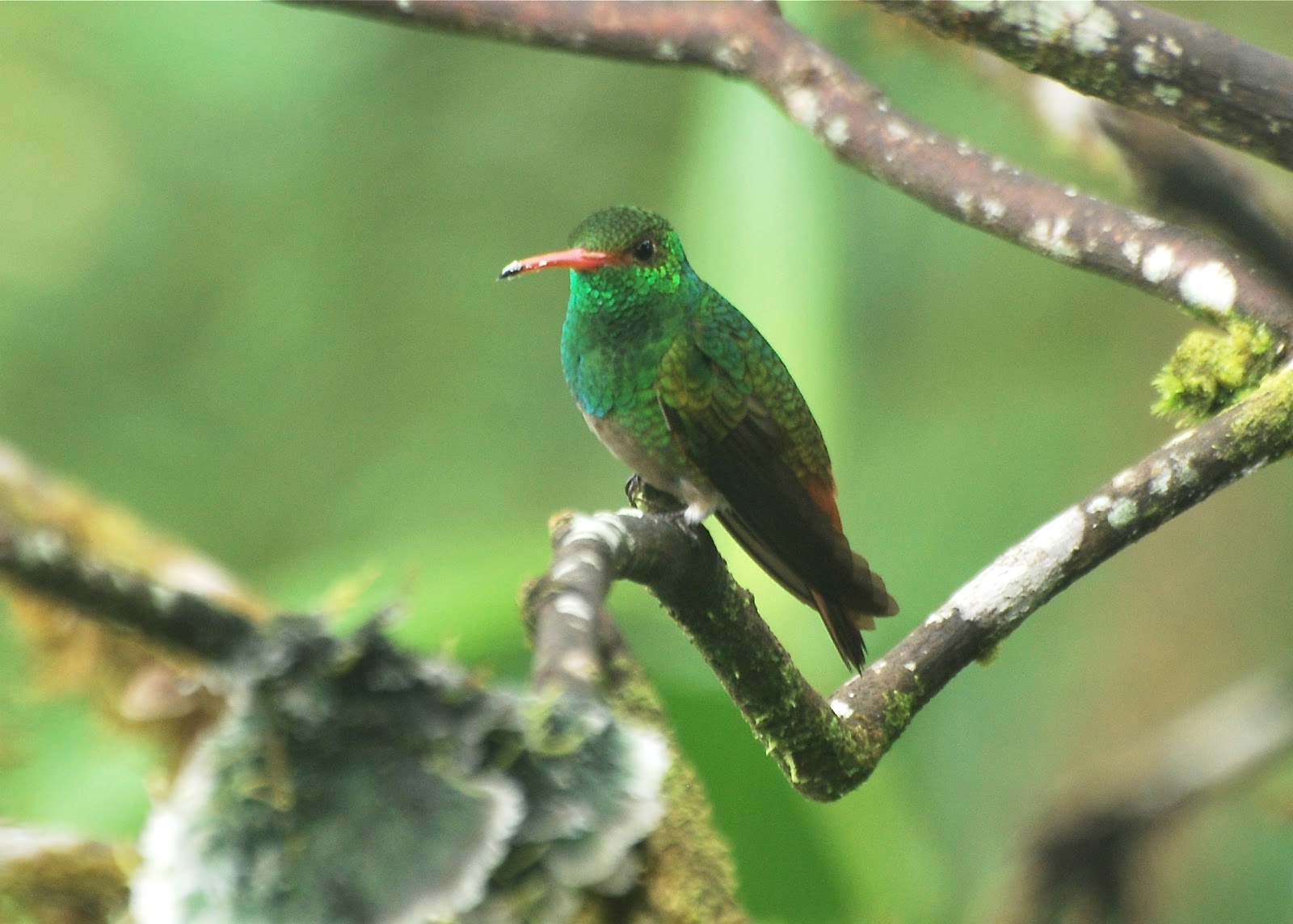
Violet-tailed Sylph (an immature male pictured above), Brown Inca, Purple-throated Woodstar (female in a nest), Greenish Puffleg, a female Empress Brilliant and Velvet-purple Coronets. The coronets were common, usually a dark hummer with flashy white tail, but often they perched and then, with a suitable light they showed their absolutely incredible colors! We also saw some members of the
Tyrannidae family, just to add variety to our bird list. Species included were Golden-faced

Tyrannulet, Black-throated Tody-Tyrant, Flavescent,
Cinnamon and
Handsome Flycatchers, plus several Smoke-colored Pewees heard and one seen. We found a group of three active and cooperative Handsome Flycactchers. I admit that they doesn't exhibit the showy colors that appear in the plate of the Birds of Colombia fieldguide, but anyway they were in fact handsome. An impressive list of birds, and we were only at the half of the way down. We planned to descend to the point that we reached the day before, about 1500 meters above sea level in order to find others specialties not found higher, nor lower in the hill. More about them in
the second part of this post!




 Posts
Posts