Showing posts with label Green-crowned Woodnymph. Show all posts

Wednesday, August 7, 2013

AOU Checklist changes affecting Panamá

Last month issue of The Auk (the American Ornithologist's Union -AOU- publication) includes a supplement of the checklist with some important changes affecting the taxonomy of the birds in North America (and Hawaii).  I will mention only those affecting the birds found in Panamá, and I'm including not only splits and lumps, but also name changes and other issues.
In taxonomic order, I will start with the shorebirds.  Now, many species considered monotypical are now included within the genus Calidris.  That means, we now list the Surfbird as Calidris virgata, Buff-breasted Sandpiper as Calidris subruficollis and Ruff as Calidris pugnax.  The order of the species within the genus Calidris also changed, as well as the sequence of the families within the Charadriiformes order.
There are three Calidris virgata in the flock
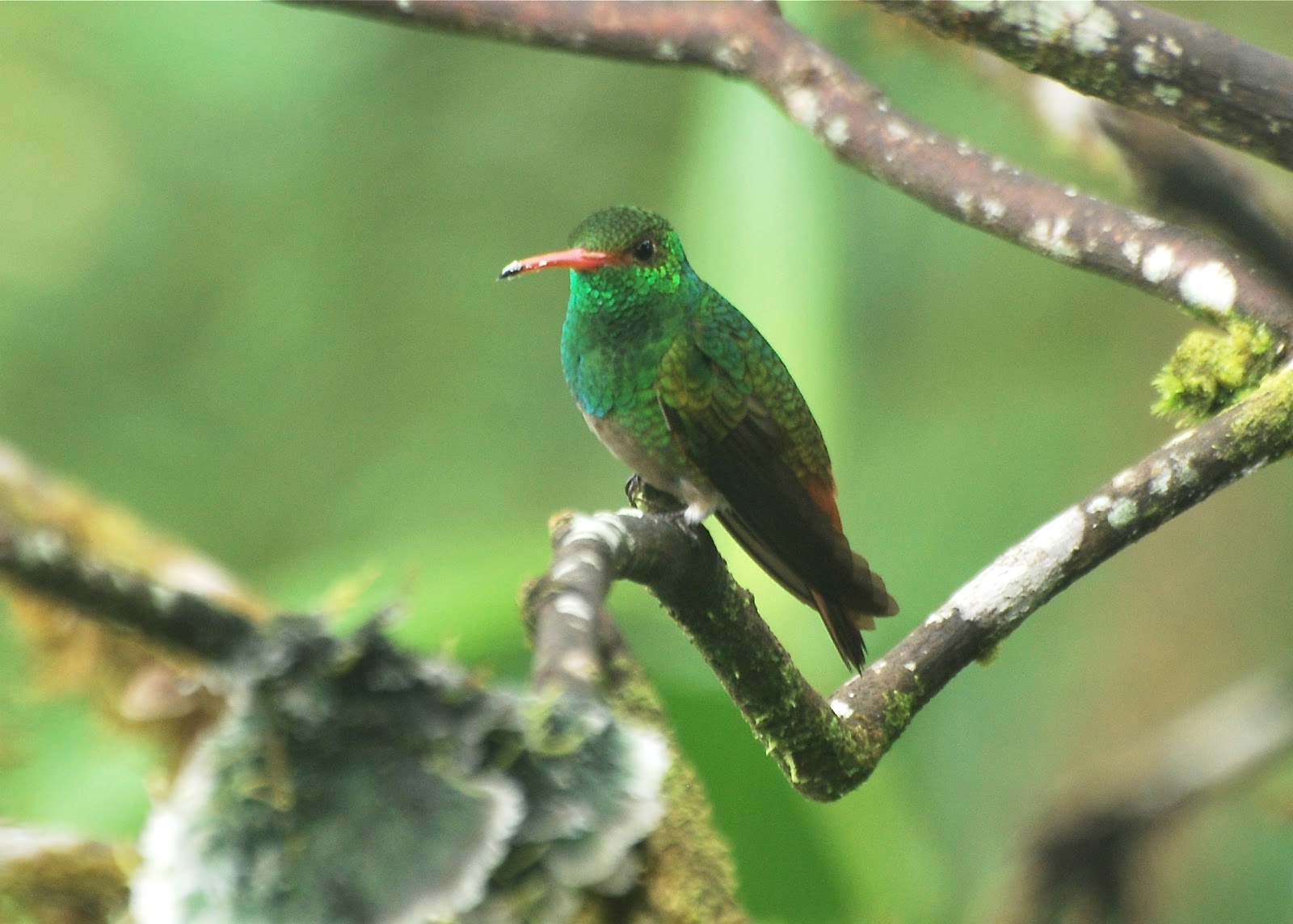
The Green-crowned Woodnymph is re-lumped with the Violet-crowned Woodnymph and re-adopt the name Crowned Woodnymph (Thalurania colombica) based on better understanding of the ranges and intergrades within these two forms in Colombia (however, they are not known to come into contact in our country).
Former Green-crowned Woodnymph from Ecuador
Black-crowned Antshrike (Thamnophilus atrinucha) is the new name for the Western Slaty-Antshrike due to genetic evidence indicating that our form is not related to the "real" south american slaty-antshrikes, in spite of the physical similarities.  Both subspecies of Immaculate Antbird found in Panamá (Myrmeciza i. zeledoni from Costa Rica and western Panamá, and M. i. macrorhyncha from eastern Panamá and western Colombia and Ecuador) are now called Zeledon's Antbird (Myrmeciza zeledoni), a new species different from the Immaculate Antbird restricted now to Colombia and Venezuela.  Also, the latin name of the Rufous-rumped Antwren change to Euchrepomis callinota.
Black-crowned Antshrike (it's going to be difficult to get used to this name)
As expected, the Thrush-like Schiffornis was split into four species, with two forms occurring in Panamá: the dull, uniformly olivaceous Northern Schiffornis (S. veraepacis) found in both lowlands and highlands of western Panamá, and highlands of central and eastern Panamá (except the Alturas de Nique massif) and the more rufous, gray-bellied Russet-winged Schiffornis (S. stenorhyncha) found in lowlands of central and eastern Panamá (and all elevations of the Alturas de Nique massif).
Bad photo of a Northern Schiffornis, from Altos del María
The Green Manakin is called now Xenopipo holochlora, and both Red-capped and Golden-headed Manakins changed their genus to Ceratopipra instead of Pipra.  Also, the checklist sequence of the manakins changed.
Ceratopipra mentalis
According to Gregory and Dickinson (2012), Ptilogonys (and Ptilogonatidae, the latin name of the Silky-Flycatchers family) is an incorrect spelling and has no nomenclatural standing.  The checklist corrects this and now the name of the family is changed to Ptiliogonatidae and the genus to Ptiliogonys, affecting the latin name of the Long-tailed Silky-Flycatcher to Ptiliogonys caudatus.
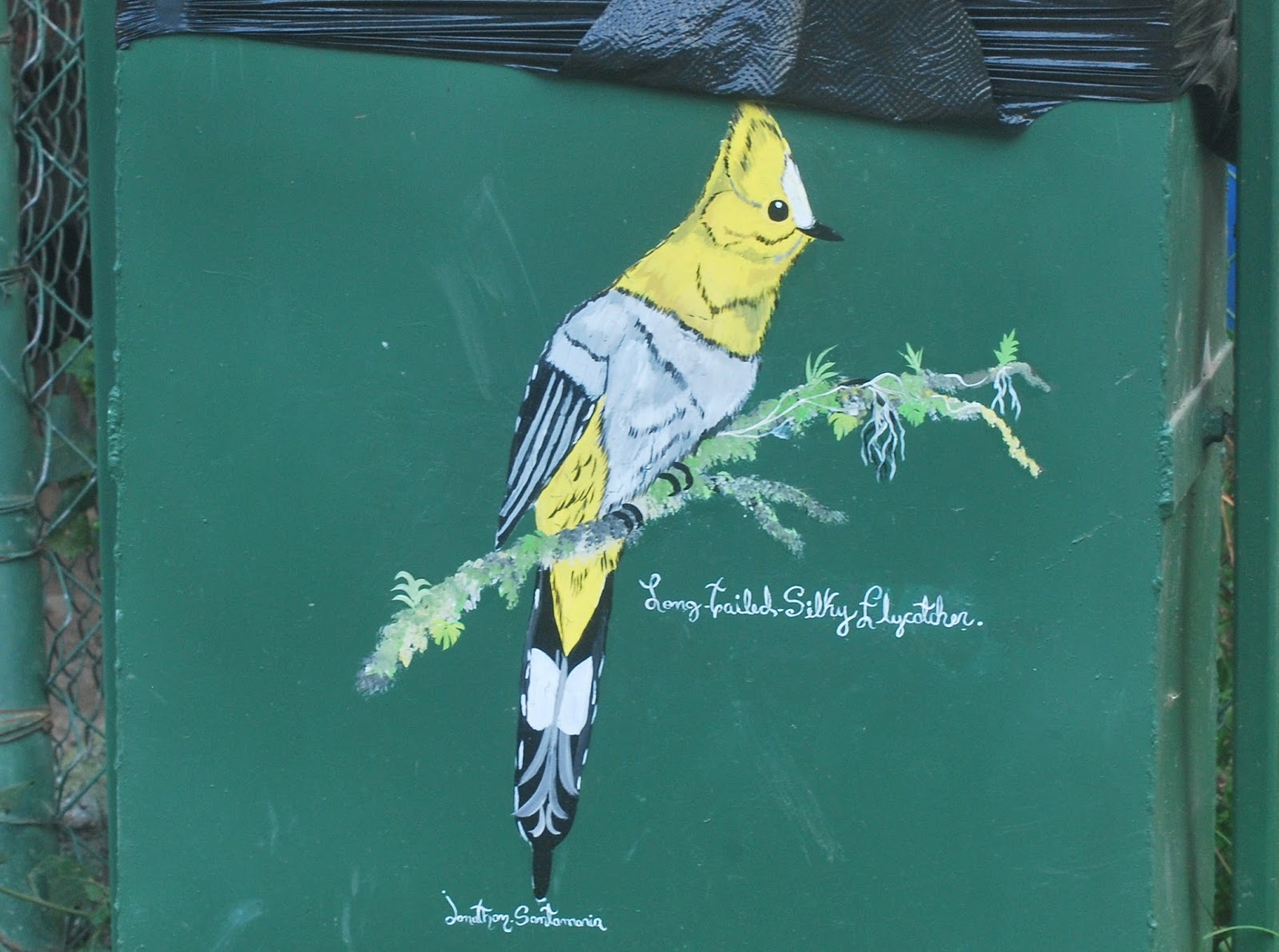
A minor misspelling was corrected in the latin name of this common species
The latin name of the Common Bush-Tanagers changed to Chlorospingus flavopectus (however, there are no splits in this group).
Common Bush-Tanager... I was expecting splits in this species!
Some issues are pending, other were not even mentioned... notably the Blue-diademed/Whooping Motmot.  Surely more studies are needed before a formal pronunciation of the AOU.

Sunday, April 8, 2012

Who plugs these birds to electricity?

The hummingbirds are famous for various reasons... the smallest birds, the only one that can fly backwards, owners of many records, and, of course, their iridescent plumages.  That's right!, I'm still posting about my last trip to northwestern Ecuador along with Rafael Cortes and José María Loaiza, and now is time to post some really spectacular photos of the masters of iridescence.  All you need is the right angle of light, for example... this Violet-tailed Sylph at Refugio Paz de las Aves looks pretty dull in the feeder... but when it leaves, you see a flash of color.
Even under poor light conditions, you still are able to see its iridescent tail!
Look at this impressive Empress Brilliant at the feeder... huge (for a hummingbird), size alone is enough to motivate some WAOOOs and AAHHHs.
But if you see carefully... they can show you why they are truly spectacular!
But the REAL master of iridescence is the Velvet-purple Coronet.  First a dull photo... that is not easy to get with this bird!
Usually, even the most minimal light is enough to ignite this one!  PAM!!! watch how different it can look depending of the light angle!  Truly electrical!
These phenomena is common to many hummingbirds... and not only at Paz de las Aves as you could guess, just watch this Green-crowned Woodnymph that was visiting the feeders at the Mirador Río Blanco, in Los Bancos (a little lower than Paz de las Aves).
With adequate light, even common hummers look shiny... check out this Rufous-tailed Hummingbird.
The Green-crowned Brilliant is a close relative to the Empress Brilliant showed above... and it shows also a glamorous glow... the female is also very pretty.  We got Green-crowned Brilliants in Panama... but I don't remember seeing them like this!
We also have Green Thorntails back in Panama... but in Mirador Río Blanco... well, they were ridiculously easy!!!  Both males and females are common visitors.
I hope you enjoyed this electrical gallery... the hummingbirds rocks!

Monday, April 5, 2010

Easter Holidays in Darien. Part I

Where in Panama can you find Spot-breasted Woodpeckers on TV antennas? El Real de Santa María is one of such places, surrounded by pristine habitat and lots of avian specialties of the eastern Darien lowlands. This is my second visit to this historical place, again with a Panama Audubon Society's trip, so well organized by Rosabel Miró and cols. I joined them in the last minute, so I went to El Real by my own, and after six hours in a bus and a ride with a family on a boat I met this year participants. It was late when I arrived to El Real, so all the others participants told me about the birds they found few hours before in El Mercadeo road, in route to the town, including a pair of these woodpeckers nesting in a telephone pole, among others. My room mate, Rafael Luck, showed me all the excellent photos he took during the short walk (that I missed), so I resigned myself to wait until the next day (Good Friday) to enjoy the birding around the town and tried to sleep, realizing that it was not an easy task considering the brutal heat of the place and the fact that the town gets noisy during the holidays. Early the next day, we went to Doña Lola's restaurant for breakfast, finding a Pale-bellied Hermit right in front of it, in a little bush. Everything was ready for the day, so we headed to Piji Basal... our destination was the Pirre rangers station at the Darien National Park. On route we saw many birds, including Plumbeous and Mississippi Kites, the first of many Roadside Hawks, Pied Puffbird, Spot-crowned Barbet, a pair of Muscovy Ducks and a Wood Stork flying, and so on... We did not reach Piji Basal because of the road conditions so we started to walk the trail to the station, finding almost immediately a beautiful male Green-crowned Woodnymph showing all its irridiscense. The birding was a little bit slow inside the forest, maybe because of the heat of the day. We heard many Chestnut-backed Antbirds in the way and found a lek of Golden-collared Manakins. We also found other wildlife (mammals, insects, frogs and reptiles), but I'll be posting about them in another entry. Other birds found in the way to the station include Olivaceous Flatbill, Ruddy-tailed and Sulphur-rumped Flycatchers, White-whiskered and Black-breasted Puffbirds, Black and Crested Oropendolas and a very quiet White-fronted Nunbird (nicely found by George Angehr). Notice the pale wing covert, typical of the pallescens race of eastern Panama. It took several hours to reach the rangers station, but once there we rested a bit before looking for birds again. We tried the Mirador trail, but the heat and the roughness of the trail prevented us from advancing. Anyway, we heard a Ruddy Pigeon, a Buff-throated Foliage-gleaner and an antswarm with Bicolored Antbirds and Plain-brown Woodcreepers. In the way down Rosabel found a gorgeous Semiplumbeous Hawk perched nearby and a mixed flock with Red-eyed Vireos, Scarlet and Yellow-rumped Tanagers and Chestnut-sided Warblers. We tried the orchard for some forest border birding, hearing at least two Red-throated Caracaras that only allowed great views later in the day. We started our return journey, and most members of the group (including me) decided to have a refreshing dive in the waters of the Peresenico river, accompanied by a Buff-rumped Warbler. The way back was uneventful, and we found scattered birds, including more oropendolas, Chestnut-mandibled Toucans, more caracaras and a life bird for me: a pair of White-headed Wrens working in the canopy while calling. The last stop in the road produced Collared Aracaris, more barbets, Limpkin, and an Orange-crowned Oriole for the delight of the group. It was too late when we arrived to El Real, so we decided to have our dinner at Doña Lola's and then returned to our hotel to make the list of the day. The plans for the next day included a visit to Uroseca and to Pinogana.

Monday, June 22, 2009

Fieldtrip to El Real, Darien. Part II

Saturday morning caught us early having our breakfast at Doña Lola's. The weather forecast was not good, the sky was completely gray, with an imminent threat of rain. It prevented me to carry my camera, but not to keep ongoing our adventure. Actually, the only shot I got of a bird is that of a rooster in the middle of one street in El Real before it starts to rain (just a drizzle, but I didn't wanted to take any risk). We took an arranged pick-up (courtesy of Guido Berguido from Advantage Tours) and headed to Pirre 1 through pastures and nice forest patches. We saw (and heard) the first Yellow-breasted Flycatcher of the trip, a Laughing Falcon and a Crane Hawk. At the end of the road, in the little town of Pirre 1, we got a Capped Heron, a pair of Spot-breasted and Red-rumped Woodpeckers, and a pair of Pied Puffbirds excavating a nest very close to the road, for the delight of those with cameras (that means, not me).
The trail to Rancho Frío, a ranger station in the Darien National Park, was wide and muddy... and I mean very muddy. The first part is through secondary forest patches and open areas before it enters the primary forest. Soon we found a mixed flock that kept us animated. Yellow-breasted and Yellow-margined Flycatchers, Bananaquit and White-shouldered Tanagers delighted us while feeding high in the canopy. Then, I spotted a little yellowish tanager with a gray belly. It wasn't until we saw a male Yellow-backed Tanager when I confirmed my initial I.D. Later in the day we got closer looks of this Darien specialty in association with orioles, tityras, becards, other tanagers and flycatchers. My life Pale-bellied Hermit was chasing a Rufous-breasted and then perched at a ridiculous shooting range for a minute or so (only happens when I'm not carrying my camera). Inside the forest the activity was low, but still we managed to found Black-breasted and White-whiskered Puffbirds, Blue Cotinga, Purple-throated Fruitcrow, Bright-rumped Attilas, Crested Oropendola and even a perched male Green-crowned Woodnymph that allowed us to study it in detail. After many hours of slow motion walk on the muddy trail, we decided to return (not before a rapid dive in the Peresenico river) to have our packed lunch. We had an uneventfull drive back to El Real, where we met Guido and his group. In the stretch of road between the pumphouse and the water tank we found 4 different woodpeckers (Red-crowned, Red-rumped, Spot-breasted and Crimson-crested), tons of seedeaters (Variable and Ruddy-breasted), more anis, and many more. We walked to the airstrip finding the bird of the trip (at least for me, thanks Guido): a pair of singing Black-capped Donacobius. I don't know what impressed me more: the beautiful contrast of the black, brown and buffy tones, the expressive yellow iris, the loud voice or the choreography that they monted whenever they were singing antiphonally. What a spectacular pair of birds... and everything within ten or 15 feet (and my camera?). The day ended with four lifers, plus a Panama life bird.
Next (last) day we tried the Pinogana road. This one is a more open road than the Pirre one, also in good conditions. The more open areas produced such birds like the White-necked Puffbird and the Roadside Hawk pictured above (I brought my camera), plus lots of commoner birds. New birds for the trip were the female Black Antshrike working in the tangles at the first part of the road and a group of Gray-headed Chachalacas. We got better looks of the Laughing Falcon, Crane Hawk, Yellow-breasted Flycatcher and the Black Oropendolas (not the best picture, but the only one I managed and I think it is recognizable). Then we moved to the airstrip trying again for the Donacobius, but only heard it far away (I brought my camera). We saw again the Large-billed Seed-Finches, but no Yellow-hooded Blackbirds this time. We had our mid-morning breakfast (after seeing a Black-headed Tody-Flycatcher in a tree over the restaurant in the middle of the town and an inmature male Lesser Goldfinch over the hospital) and then, back to our hotel to pack our things. We had a dry ride to Yaviza where we finished the fieldtrip with a big smile in our faces, after seeing lots of birds and always remembering those Donacobius dancing for us. I didn't had a chance for a picture. Good excuse to return.
Only one last thing. On route we stopped in Metetí (central Darien) in a gas station to fill the tank. We saw several individuals of House Sparrow there. For sure I'm not the first one that have seen this bird in Darien, but it is seldom reported (if reported at all). So I got some pictures!