Showing posts with label White-necked Jacobin. Show all posts

Sunday, December 9, 2012

More birds at Gamboa

After a very successful twitch, finding the Lesser Scaups at the marina in Gamboa (Colon province, central Panama) this morning,  Osvaldo and I decided to visit the Gamboa Ammo Dump ponds... after all, it was still very early and we expected a great activity, considering the beautiful day.
And we were right!  First of all, this young Broad-winged Hawk welcomed us by perching completely exposed in good light for us.  At the ponds, we found many common species, but I focused at the Mangrove Swallows perched at the barbed wire, shining with the sun... definitively my favorite swallow in Panamá!
The swallows were so pretty and cooperative that none of us noted at first the dull gray bird at the fence facing the opposite side.
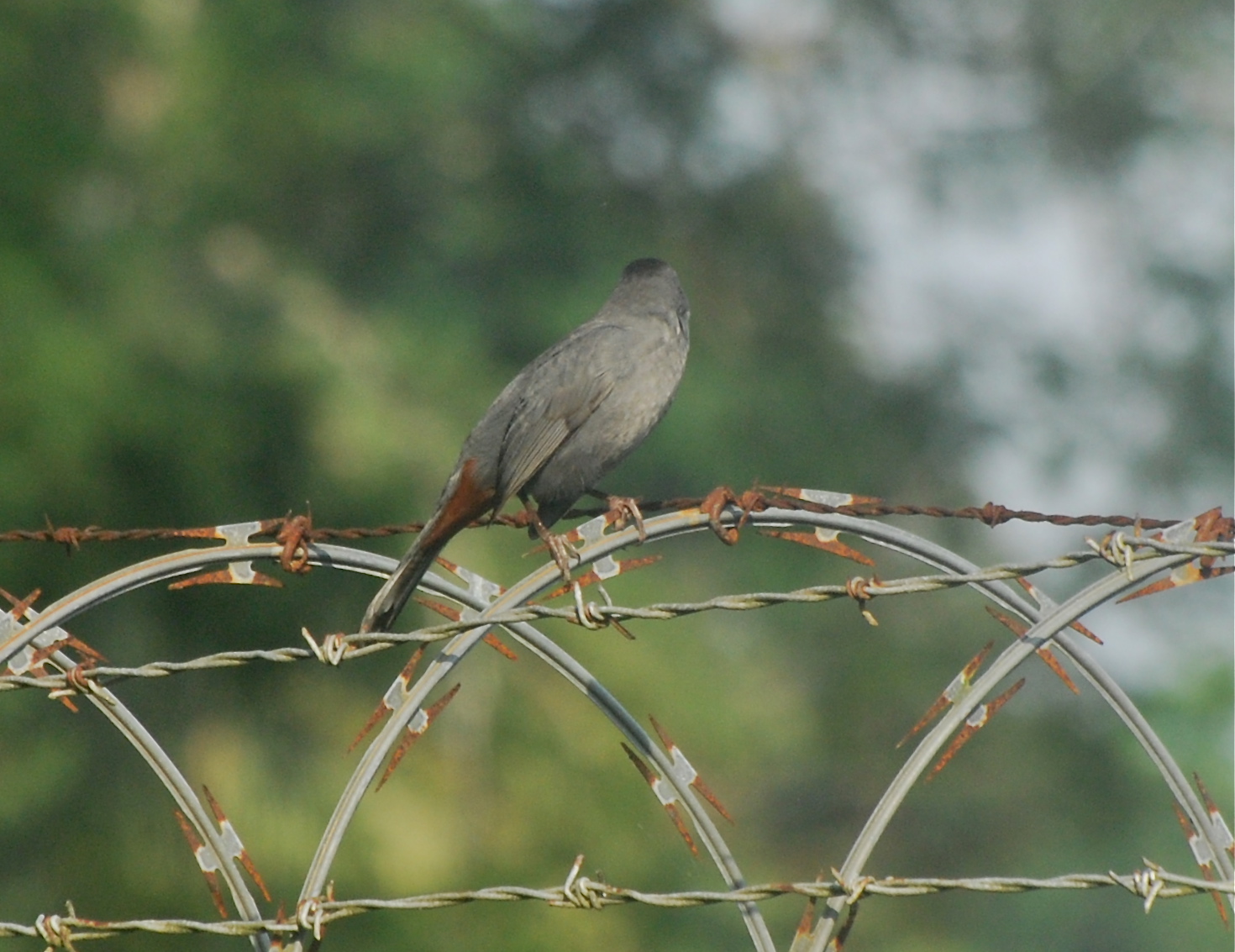
It took me a couple of seconds to realize that it was a Gray Catbird, nicely in the open taking a sunbath.  This bird is not only an uncommon migrant in this part of Panama, but also a hard-to-see skulker... but this guy was simply amazing... it responded to Osvaldo's tape and we got great views!
Very happy with our luck, we headed to the Panama Rainforest Discovery Center, were more than 30 (!) White-necked Jacobins, among other hummers, were trying to drink of the many hanging feeders.
However, it was the antswarm passing right behind the building that attracted our attention... most of the regular ant-followers were attending, like Spotted and Ocellated Antbirds, Plain-brown Woodcreeper, Red-throated Ant-Tanagers (weird, in spite of their name) a Greater Ani (weirder) and a gang of Gray-headed Tanagers.
However, the most cooperative followers were the omnipresent Bicolored Antbirds, jumping just feet of us.
Not bad at all for just half day!

Sunday, November 11, 2012

Today's hummingbirds of Cerro Azul

This post is an excuse to show you the nice collection of hummingbirds that visit he feeders at Cerro Azul, a gated community in the foothills east of Panama City.  Osvaldo Quintero, Osvaldo Quintero Jr., and myself visited the Ahrens' house, invited by Leslie and Cindy Lieurance (The Petrels in Panama), where Claudia received us for a while before we headed to a nearby trail to birdwatch (that story in another post).  I will show the hummingbirds in, more or less, taxonomic order.  All the photos were taken today at the Ahrens or Lieurance feeders (except for one, you'll see).
And the taxonomic list starts with a VERY beautiful hummingbird: the White-necked Jacobin is simply spectacular... and the most common hummingbird in both houses.
The hermits are not exactly colorful hummingbirds, but impressive in their own way.  This Stripe-throated Hermit is the smallest of the hummingbirds seen today, and this one in particular preferred the semi-hidden feeder below the table!
In the other extreme, the Green Hermit was the largest hummingbird we saw... it will fly right in front of you just for curiosity!
The stars at the Ahrens' feeders were the two (probably three) Brown Violetears present since some time ago.  This species is particularly rare and erratic in Panama, so having them visiting feeders is simply good news!
In the other hand, the star at the Lieurance's feeders was the single Long-billed Starthroat that waited patiently to drink among the numerous jacobins.  The shiny red throat is hard to see, and to photograph of course.
Among the panamanians hummingbirds, the Bronze-tailed Plumeleteer is unique due to those conspicuous red feet!
Usually, the male Violet-crowned Woodnymph looks quite dark, almost black, under normal light conditions... but this bird really glows with the adequate angle.
The Amazilias hummingbirds are a very distinctive group present in almost every feeder... and the most ubiquitous is the Rufous-tailed Hummingbird... this one was singing! (can you see the "rufous"?).
The Blue-chested Hummingbird only showed itself for two seconds... this photo is from Cerro Azul, but of a different trip.
In spite of the bad light, the Snowy-bellied Hummingbird is unmistakable due to its sharply demarcated white belly and metallic call.
And last, but not less important, the tiny Violet-capped Hummingbird is almost endemic to Panama, barely reaching Colombia and the single member of it genus Goldmania (named in honor of Mr. E. A. Goldman, who collected the type specimen in Cerro Azul, back in march of 1911).  Cerro Azul is certainly the easiest place in the world to see this bird.  This is a female, the glorious male didn't want photos!
Eleven species!  Not bad for a single day just sitting in front of well-kept feeders!

Wednesday, December 8, 2010

Mid-week Twitch

Imagine the worst day to bird in the foothills of Cerro Azul (central Panama): dark, rainy, foggy, windy and cold. Well, that day was yesterday... and despite it Osvaldo Quintero, Gloriela and I visited the site in an after-work twitch to see the Brown Violetear reported there a week ago. It was the third visit for me (and the second for Gloriela and Osvaldo) in less than seven days, I already posted the story of my previous two visits. We reached the Cerro Azul gate quite late (around 4:20 PM) due to a huge traffic jam in the city... this because of the shopping madness for the mothers' day and the heavy rain all day long. Despite the weather, Cerro Azul had surprises for us... starting with a Fasciated Tiger-Heron standing on a rock close to the road by the Río Jefe... and I was just telling Osvaldo that finding that bird was very unlikely because the torrential made the usually-clear-and-nice forest creek into an unleashed, mighty, roaring river! Did I mention that it was a long-desired Panama life bird for me and a lifer for Gloriela? Great way to start.
When we finally reached Birders' View, it was very dark and windy... not very promising. But Osvaldo's networking showed to be useful when he received the information that we can try Birders' View's neighbors "Smithy" and Rachelle, who keep hummingbirds and banana feeders in their property. So we introduced ourselves and the couple kindly received us willing to show their incredible feeders, completely FULL of colourful birds and hummers! We simply got distracted by all that activity, tons of hummers zipping right at our faces, lots of tanagers, euphonias, grassquits and others begging for bananas, bread and seeds... wordless! Then, I saw a big hummer at one of the several hummingbirds feeders of the backyard: a BROWN VIOLETEAR!!! A lifer for all of us! It was comparable in size to the White-necked Jacobins accompanying it at the feeder, and considerable bigger than the Snowy-bellied and Rufous-tailed Hummingbirds of the picture. If the Jacobins were approaching too close, it was confronting them opening its erectile violet ears... amazing! Its green-and-blue gorget was also evident while perched on the feeders (Jacobin in the foreground, Violetear in the background). It made several visits to the same feeder, to then perch in the same Hibiscus plant (popular known as "Papo"). It appeared just in time because the light was dissapearing fast (it was almost 6:00 PM!). The Brown Violetear is a rare and erratic hummingbird in Panama, with just a handful of records, including only two other previous records for this locale. So, despite the rain, the fog and the wind I can't think on a better day in Cerro Azul!

Monday, November 8, 2010

Blue, red... or iridiscences?

I went to Pipeline road (beyond the town of Gamboa in central Panama) last saturday with Osvaldo Quintero willing to spent half-day there. The activity was very low due to the imminent rain, but before it started we saw two species of manakins in the same tree. Trying to eat some berries, an adult male Blue-crowned Manakin was frequently mobbed by an adult male Red-capped Manakin! What a sight! Two antagonist species side-by-side. The contrasting colours of these birds were simply amazing. Manakins are always funny to see, specially if they are "dancing" or lekking. We enjoyed both birds-in-black with contrasting caps for a while, until it started to rain seriously. We quickly walked to the car and then Osvaldo drove to the Panama Rainforest Discovery Center (PRDC) were we had a hot cup of coffee accompanied by hordes of hummingbirds... as usual! If the black, red and blue of the manakins were impressive, then the iridiscent colours of these tiny birds were spectacular. I always have been astonished by the form in which its feathers reflect the light. If you use the artificial light of your flash to photograph them, the result is a totally different bird! Compare these photos of a Blue-chested Hummingbird and a White-necked Jacobin (in that order) with artificial light
Now, the same species (in the same order) with sunlight:Big difference eh? Of course, I like more the sunlight... they just look superb with it!
P.D.: more photos of the PRDC's hummingbirds at the end of this post.

Sunday, July 25, 2010

There will always be hummingbirds to impress

Yesterday, I went to Pipeline road beyond the town of Gamboa (central Panama) in order to show some nature to my nephew Michael. Along with Gloriela and Osvaldo Quintero, we drove all the way to the sleepy town, stopping as usual at the Ammo Dump. The place was very quiet, with few birds present except by the numerous Rusty-margined Flycatchers and a flock of Keel-billed Toucans. We heard a pair of Yellow-backed Orioles and the always-present White-throated Crakes. The vegetation in the ponds was very tall, so it was difficult to spot anything. Other birds in the area included Greater Anis, Red-lored Amazons and Scrub Greenlets in good numbers, and many seedeaters and Gray-breasted Martins at the entrance of the ponds. We decided to go directly to the first bridge in Pipeline road to walk from there. The activity was unusually low and we only recorded some common species like Dot-winged and Checker-throated Antwrens, Western Slaty Antshrikes, Black-faced Antthrush, a single Stripe-chested Antpitta (only heard), Brown-capped Tyrannulets, Purple-throated Fruitcrows and a pair of Blue-black Grosbeaks feeding on a palm tree. The slaty-antshrikes were particularly conspicuous, with a pair quite often found along the road. We found also a cooperative pair of White-whiskered Puffbirds, one of them allowed some photos. It became clear that the activity was not going to get any better, so we decided to head back before reaching the second bridge. I worried about the interest of my nephew, but he seemed to be doing just fine, considering that EVERYTHING was new for him (he is essentially a city boy), including not only the birds, but also the Howlers Monkeys, the agoutis, the anoles, the Green Iguanas and all the wildlife that we found in the road (including the Brown-throated Three-toed Sloth that we found later). To keep him interested, we drove to the Panama Rainforest Discovery Center (PRDC) in order to have a snack and to watch the hummingbirds' show. Trust me, the hummingbirds at the Center never fail to impress... hordes of thirsty hummingbirds all around, chasing each other and perching very low (want to experience it... check this old video). Here is a small gallery of the hummingbirds that showed up, more or less in taxonomical order (some photos are of previous visits):This Long-billed Hermit was lekking with other males close to the Center allowing great shots.The tiny Stripe-throated Hermit hurries to drink before being thrown by the other species.Usually, the White-necked Jacobin is one of the most abundant and aggresive species at the feeders.
One or two males Violet-crowned Woodnymphs are always present. They usually look dark in the field (not the case of this photo!).
The Violet-bellied Hummingbird is one of the most abundant species at the feeders. A real jewel.
The Blue-chested Hummingbird could be impressive too, with the suitable light! The female is more modest.So agressive in the city, in the PRDC the Rufous-tailed Hummingbird is dominated by several bigger species.The White-vented Plumeleteer is quite big... and agressive too!
Is not only the variety of species... it is also the numbers. And those were only the species that we saw yesterday! The list of hummingbirds recorded in this feeders ascend to 13 different species, which is an excelent number for the lowlands. Now you see why I think that place is simply great if you want to introduce somebody into nature and outdoors activities (like birdwatching). In the way out, it was another thing that impressed my nephew: the sighting of a huge ship crossing the Panama Canal in front of us, with the forest as background... great way to call it a day!