The dry season in Panama has kept me busy... between work and family outings to enjoy our beautiful country, I have not had time to update this blog... and; so far, I have made only short excursions to watch common birds around Panama City. However, taking advantage of a long weekend last month, I took my family to the island of Roatán, the largest of the Bay Islands off the Caribbean coast of Honduras. Not a birding trip... but binoculars and camera were both part of my luggage of course.

It could not be easier. A direct flight right from Panama City domestic airport (mere 10 minutes from our apartment) took us in less than two hours to the paradise island. The mixture of cultures is felt as soon you get off the plane and everyone is willing to gift you a smile. A short transfer tooks us to our all-inclusive resort. Only a narrow one-lane bridge connects the main island with the resort, which was a private island by itself, with coralline white beaches, patches of mangroves, deciduous forest, some open areas and, of course, all the resorts amenities you can need... my girls just loved it!!!

I have to admit that my expectations were not high regarding possible lifers... as most islands out there, the avifauna is limited, and the island is close enough to Panama to share many species with us. Of course some residents birds certainly would be new for my Life and Central American lists, and I made short walks around the resort two to three times a day, each day, looking for them. Right at the resort grounds, two of such resident were quite common: Mangrove Vireo and Canivet's Emerald... both lifers by the way.
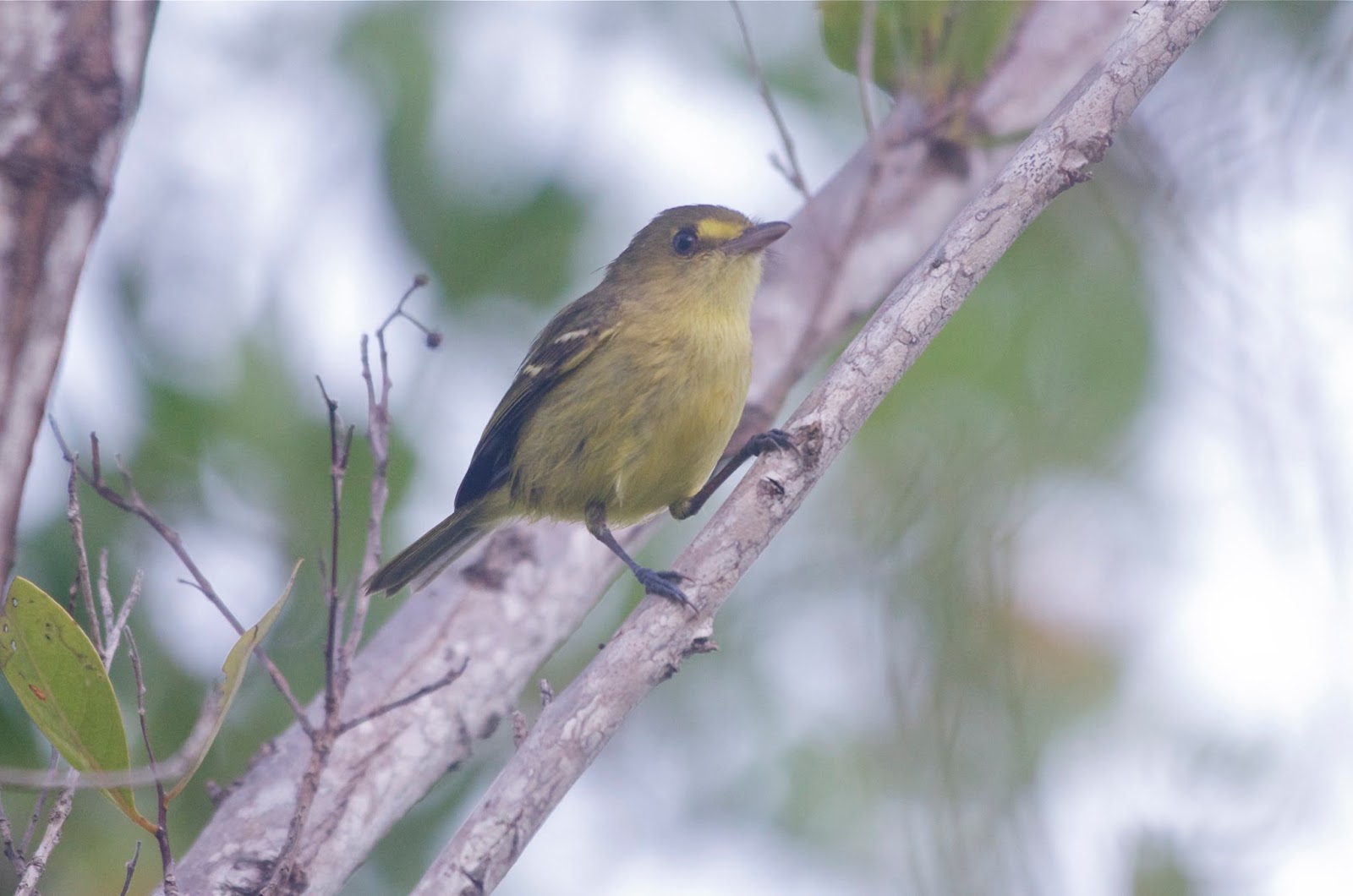
 |
| Mangrove Vireo |
 |
| female Canivet's Emerald |
However, the site was quite good for boreal migrants. Several species of waterfowls, waders, wood warblers and others call Roatan its home during the winter months. Some are widely distributed back in Panama, like Yellow and
Black-and-white Warblers, Northern Waterthrush and Northern Redstart, while others are considered rarities back there, like Northern Parula, Ovenbird, Yellow-throated, Hooded and
Worm-eating Warblers.
 |
| Black-and-White Warbler |
 |
| Worm-eating Warbler |
In fact, the Worm-eating Warbler pictured above was only my second one ever! Most of these birds were seen around the resort or incidentally along the touristic tour that we took around the island. As I mentioned, this was not a birding trip... but at least I was hoping to get some range-restricted species for Central America in one of the planned side trips: a diving experience to Cayos Cochinos, home of Caribbean Dove and Yucatan Vireo. Both species are found in Roatan, but are scarce, specially the dove... at the cays, they are more common and easy to see... and I was sure my family would enjoy the sun and the beach of the place. However, a cold front hit the islands (and most of Central America) the day of the trip, and it was cancelled due to rough sea conditions.
 |
| The view from our room during the cold front |
Well, in spite of the weather, we enjoyed the resort's amenities and took it easy at the pool and the room. I found more Roatan residents, including a pair of
Brown-crested Flycatcher (not a lifer, but new to my Central America list) and a nice selection of doves and pigeons: feral Rock Pigeons and Eurasian Collared-Doves, White-winged Doves, Common Ground-Doves and
White-crowned Pigeons.
 |
| Brown-crested Flycatcher |
 |
| White-crowned Pigeon |
The last species was particularly beautiful and conspicuous, specially considering my previous experiences with it in Panama and San Andres island. I saw it very well and quite close, even at the middle of very populated towns, like Coxen Hole and its water treatment facility close to the airport.
In fact, the place was quite birdy, with dozens Blue-winged Teals and American Coots, some stilts and Least Grebes and even a pair of rare (for the island)
Ring-necked Ducks.
 |
| Ring-necked Duck |
The last place we visited was the
Carambola Botanic Gardens, in the northwestern coast of the island. We enjoyed a nice walk, but the trail to the viewpoint at the top of the hill was blocked by the fallen trunks and palm leaves of the previous day cold front. However, I managed to spy a singing
Yucatan Vireo in a tangled tree high above us. I saw the bird for just a fraction of second and ID'd it based on voice... I will include it in my Life List next time I found it with more prolonged views (I hope).
At the end, what a great trip we had... fun, sun, sand, tropical breeze and some life birds of course!
 Right at the beach we were able to watch some early migrants and common residents of the island. I was particularly interested in finding resident White-crowned Pigeon and Escudo Hummingbird. The pigeon is rare everywhere else... only in Escudo de Veraguas (for Panama) is almost a guaranteed sight. The hummingbird is still considered by many authorities part of Rufous-tailed Hummingbird, but Panama Audubon Society treat it as an endemic species... one with a tiny range (restricted to the island). Both would be new year-birds for me. To my surprise, both were right at the first beach we visited!




 Posts
Posts