Showing posts with label Royal Tern. Show all posts

Friday, August 19, 2016

Rare migrant at the saltflats

The month of August marks the beginning of the migratory season in Panama.  All over  the country, the early migrants are showing up in both expected and unexpected sites.  One of the historical migrant traps in Panama are the Aguadulce Salinas (saltflats) in Cocle province (central Panama), where I did a quick stop with my family last weekend, finding some goodies.
Black Skimmers and Royal Terns
The huge flock of Black Skimmers was accompanied with impressive numbers too of Royal Terns... none of these breed in Panama, but they are found year-round in Panama.  The skimmers, particularly, are regular in these saltflats.  Another species present year-round in Panama is the Black-necked Stilt, but they do breed in Panama... and the saltflats are one of the few breeding sites known in the country.
Black-necked Stilt
But I was more interested in those long-distance migrants that use the saltflats as a re-fueling stop in their journey to higher latitudes... some of them only spent few weeks at our country.  After checking flocks of peeps and larger shorebirds (specially both Yellowlegs), I finally found a lonely Wilson's Phalarope frenetically swimming in circle picking food from the surface.  It was far away, so my pic is essentially for documenting purposes.
A distant Wilson's Phalarope
But my big surprise was the single Stilt Sandpiper found with some Yellowlegs and Dowitchers in a shallow lagoon.  The long legs, slightly downcurved, thin bill and white eye-brow were diagnostic.
Stilt Sandpiper
The Stilt Sandpiper is a rare passage migrant through Panama. Curiously, this is my second sighting this season because we saw at least two of them some days ago to the east of Panama City in Finca Bayano.  It seems that this is going to be a good migratory season!

Monday, March 14, 2016

Next stop: endemic island!

I finally managed to escape Panama City for two and a half days in order to accept the great opportunity my friend Kees Groenendijk (of Hotel Heliconia Bed & Breakfast) offered time ago... a quick visit to famed Coiba Island (off-shore central Panama) in order to clean-up the endemics and specialties it has to offer.  Isolated from mainland some 12,000 to 18,000 years ago, many of its inhabitants had diverged since then into distinctive subspecies and even completely new species restricted to this island, the largest of Central America's Pacific coast.
I joined a couple of visiting Dutch birders in this journey.  With Kees as guide, we boarded our boat at the Palo Seco beach in western Azuero (close to the town of Malena where the hotel is) and headed directly to Los Pozos trail in Coiba Island.  As soon as we landed, the birds started to show up.  A mixed flock included Scrub Greenlet, Blue-gray and Crimson-backed Tanagers, Streaked Saltator, House Wren and a pair of Tropical Gnatcatchers.  All these species are represented by endemic subspecies restricted to Coiba and adjacent islands.  Most of them look very similar to the mainland congeners, except by the greenlet and the gnatcatchers.  The endemic subspecies cinericia of Tropical Gnatcatcher is distinctively darker below than other subspecies, as you can see in this male.
male Tropical Gnatcatcher (ssp. cinericia)
Los Pozos trail is flat and easy to bird.  Along it we found more Coiba's endemic subspecies, including tons of Barred Antshrikes, some Tropical Pewees, a smart Rufous-capped Warbler, a Southern Beardless-Tyrannulet and several Red-crowned Woodpeckers.  We also saw a pair of Yellow-bellied Elaenia and a Red-rumped Woodpecker.  The subspecies subpagana of Yellow-bellied Elaenia is not endemic... but is the only site in Panama where it is found; while the woodpecker is VERY rare (essentially absent) from western Panama.  Then, Kees noticed a call he recognized immediately... it was our main target... the endemic Coiba Spinetail!  The little bird crawled along some tangled vines carrying some nesting materials... and then it entered a nest.
Coiba Spinetail's nest
I can't show you a photo of the Coiba Spinetail... but I can show you its nest, a globular mass with a lateral entrance.  There is nothing like the Coiba Spinetail in the adjacent mainland of Panama... and the most similar species, the Rusty-backed Spinetail, lives in a different habitat at the other side of the Andes in South America!  It was a huge lifer for me!  I promise you some photos next time.
Mangroves along the San Juan river, Coiba Island 
Around noon, we left Los Pozos trail and headed to a different habitat; this time navigating through the San Juan river, admiring the impressive mangrove forest along its banks.  Many waders, herons, Yellow -Mangrove- Warblers and Great-tailed Grackles call this forest their home, but Kees was looking after a special resident for the area... a species extirpated from adjacent mainland Panama: Scarlet Macaw.
Scarlet Macaws

Coiba Island is a reserve of macaws and the only wild and viable population in Panama of this striking species.  After a couple of minutes, Kees was able to localize a pair resting under the canopy following their raucous  calls (photo above).  In spite of their size and plumage, they can be difficult to detect sometimes.  We were lucky to have this pair close enough for photos.  They were new birds for me as well.... a very colorful lifer!  After leaving the mangroves, we stopped by the former penitentiary... hundreds of Sandwich and Royal Terns were resting at the remains of the old pier, with some Black and Elegant Terns mixed in (including an anomalous Elegant Tern with red legs).
Black Tern
Elegant, Royal and Sandwich Terns 
Elegant, Royal and Sandwich Terns
We also visited Los Monos trail in order to find another endemic subspecies for Coiba.  Taxonomically talking, the situation of the next species is not clear.  Most authorities consider the Gray-headed Dove as a polytypic species spreading from SE Mexico to western Colombia; however, the form present in the Pacific slope of central Panama (essentially Azuero Peninsula and off-shore islands) is isolated from other populations, have a brighter plumage, apparently is vocally different too and probably deserves species status as Brown-backed Dove, an endemic species for Panama and represented in Coiba Island by its own endemic subspecies nominate battyi).  Well, after walking for a while, Kees located a pair of these doves on the ground.  It was dark and tangled, and my poor photos barely shows how bright this bird looks in the field.
Brown-backed Dove 
Brown-backed Dove
It is almost pale blue in the crown (instead of gray) and bright rufous in the back, with pinkish breast... simply beautiful.  By far this was my best experience with this species... not a lifer, but I only got glimpses of it during my last visit to Coiba Island many years ago.  We saw many more birds in that trail, including Lance-tailed Manakins, Tropical Parulas and White-throated Thrushes... but it was getting late and Kees had another surprise in store for us.  Our boat took us to some rocky islets to the north of the main island.  After some searching, we found three stock shorebirds with yellow legs and long bill.
Wandering Tattler
They were Wandering Tattlers, elsewhere a VERY rare migrant to Panama, but in these islets seems to be regular and even present year-round!  It was my third lifer for the day, something hard to say for me in Panama.  I want to thank Kees for this very quick trip to Coiba... I have to return someday to take better photographs!

Wednesday, January 16, 2013

At first light in El Ciruelo

After an exciting previous day at Isla Iguana, my family and friends stayed for the night at a friend's house in El Ciruelo, facing the ocean.  The morning of sunday, january 13th, I woke up, walked to the balcony and saw literally hundreds of pelicans, gulls, terns and other birds frenetically feeding at the beach!
I took my bins and camera and headed to the beach (5 minutes away) with Gloriela (the only one awake that early)... mostly Brown Pelicans and Laughing Gulls were in attendance.
Among the dozens Laughings, I found two (probably more) Franklin's Gulls, and Gloriela was able to compare both species side-by-side.  Shorter legs, smaller bill, more extensive black hood, more prominent eye crescents, etc...
The first tern I saw turned out to be a Royal Tern.  Notice the poor light of the early morning sun, but still enough to pick this species out of the flock, with its large size and orange bill.
But soon we realized that the other orange-billed terns in the flock were not Royals (again in poor light)...
I was listing the differences in comparison to the Royal Tern: smaller, thin bills, obviously crested with solid black crown extending to the eye (no white eyerings)... Elegant Terns!
The Elegant Tern is uncommon in Panama, so seeing four at the same time was great.  The fourth individual also exhibited anomalous red feet.
The last tern in the area was the Sandwich Tern, a lonely individual flew over the flock several times before disappearing in the sea.
Nice way to start the day, with two lifers for Gloriela and not one, or two, nor three, but four Elegant Terns allowing photos... and all before breakfast!  

Tuesday, January 8, 2013

Long weekend. Part I

My family and I decided to spent this long weekend at our house in Penonomé (Coclé province, central Panamá), in order to enjoy some fresh air and to share with our relatives.  Of course, I also took advantage of these free days to do some birding... and accompanied by Osvaldo Quintero and Rafael Luck, we visited some localities along the Panamerican highway, starting at El Chirú.  Most of the former savanna habitat was turned into a corn field, but still we managed to find some common birds, like Brown-throated Parakeets and even a White-winged Dove, but perhaps the change was too much for the Grassland Yellow-Finches that we used to find there regularly.
We moved closer to the coast, to Juan Hombrón, passing first by the extensive rice fields where we saw last year a Long-winged Harrier... this time we saw plenty of egrets and herons, and a flock of more than fifty Glossy Ibises, that weren't completely unexpected... but a good sight away of Las Macanas marshes, specially in such numbers.
The secondary growths along the road produced many species typical of these dry areas, like Lance-tailed Manakins, Blue-black Grassquits, Streaked Flycatcher (the only one allowing photos), Yellow-crowned Euphonias and many more.
At the beach, we saw the usual suspects: Brown Pelican, Neotropic Cormorant and Laughing Gulls... but it was an Osprey that allowed the best views and photographic opportunities.  This is an impressive eagle and, thanks God, a common one!
We left Juan Hombrón with a huge day-list of birds... but we wanted more, so we visited Punta Chame (to the east, coming closer to Panamá City), a well-known site for waders, and many more aquatic and marine birds.  Also, we enjoyed a nice fried fish as lunch after checking the beach.  It was only after reviewing my photos of a flock of gulls and terns resting in the sand that I realized that we didn't see the two Common Terns among the numerous Sandwich and Royal Terns and the Laughing Gulls!  Can you identify them in the next pic?
But the real surprise came in the way out.  We did a routine stop to check a section of beach by the road, noticing a group of ducks in the far shore... it took me a while, but eventually I recognized the huge beaks and the unmistakable plumage of an adult male Northern Shoveler with four female-plumaged birds!  These ducks are rare in Panama... and we were seeing five of them!  They were quite distant... but you can notice the beak shape in my cropped photo (OK, I recognized it, this is an awful photo).
That was a nice way to call it a day.  Rafael and Osvaldo left me at the Panamerican highway... they were going to Panama City and I was going back to Penonomé... the weekend was just starting!

Thursday, December 15, 2011

Bird of the year!

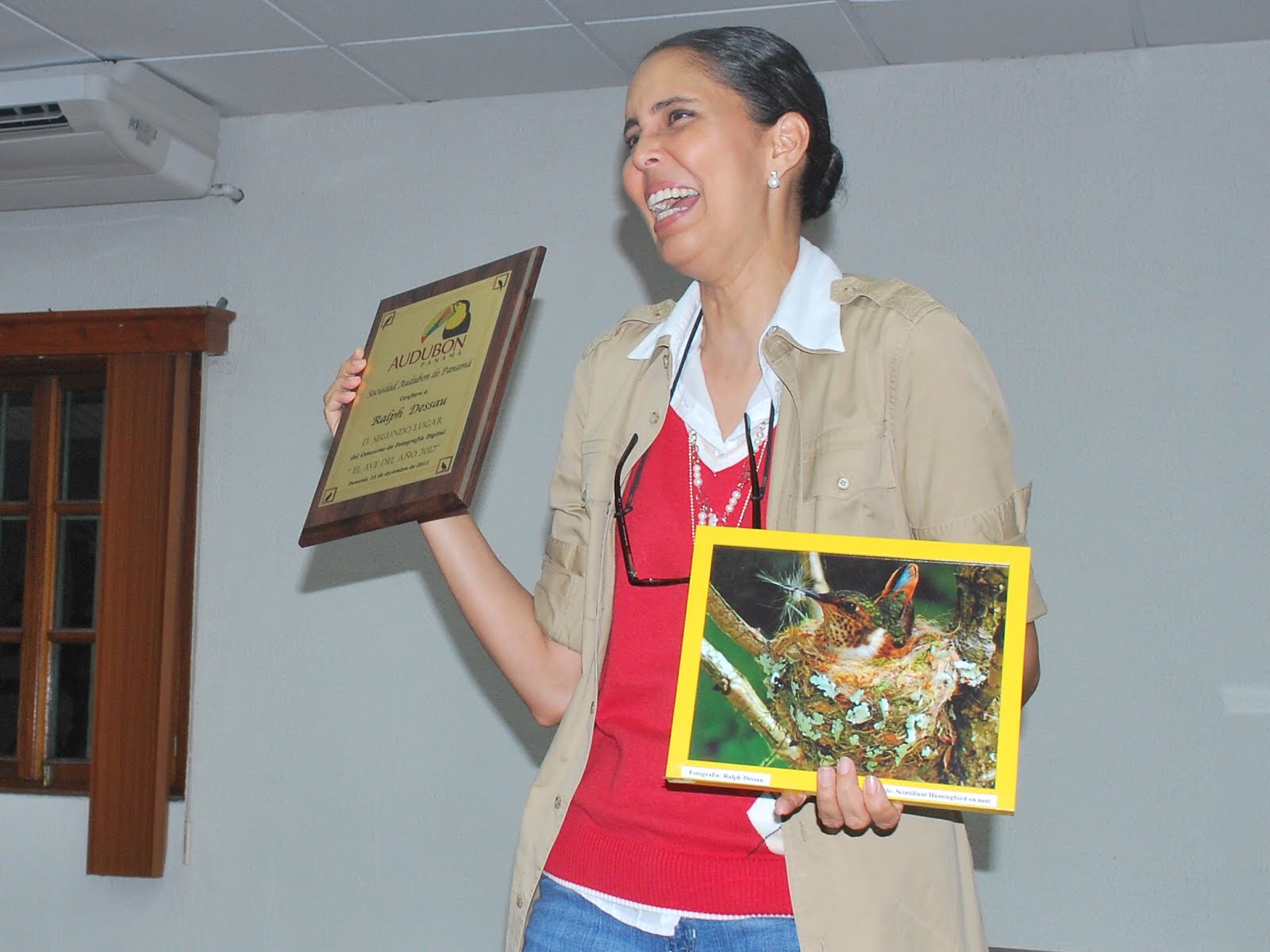
The Panama Audubon Society's pot-luck dinner was the perfect scene for the announcement of this year winners of the "Bird of the year" photography contest. PAS members, directives, friends, and even members of The 600 Club shared a very nice evening. Darien Montañez, PAS president, talked about the Christmas Bird Counts and how we are going to organize ourselves for these events, the first of them will be this sunday, december 18th (Pacific CBC). As usual, the food and beverages were excellent, just like the photo stream presentation (both of birds and birders) of Jennifer. By the end, Rosabel Miró announced the winners. My friend Rafael Luck obtained the third place with its Royal Tern in Boca del Drago, Bocas del Toro province. The second place was for Ralph Dessau with its lovely photo of a female Scintillant Hummingbird on a nest. This year's bird is the male Cinnamon Woodpecker which I took last april in Metetí, Darien. I'm so grateful with the judges and with the PAS for this honor!
Finally, Rosabel also announced the winners of the dish of the night, with three winners by popular election, two curry chicken dishes and a traditional "arroz con pollo", so congratulations for all the chefs and see you at the counts!

Wednesday, November 3, 2010

Happy Birthday PANAMA!!!

Today, all the panamanians celebrate our separation of Colombia, 107 years ago! This is the first of many important days during this month, including our flag's day (tomorrow) and the independence day (november 28th). Like many panamanians, we spent the day at the crowded beach of Santa Clara (central Panama), where we enjoyed the breeze, the sand and the sun with our friends... and I even saw some birds like Laughing Gulls, Neotropic Cormorants, Magnificent Frigatebirds and Royal Terns, a lonely Sanderling, and even a new year-bird for me: Common Tern. Now, I'm at 599 species for this year!

Monday, September 27, 2010

A bit of colour at the beach

It is a fact that most shorebirds and coastal species in Panama are dull-coloured birds. That is because almost all the species dress its basic plumage (the non-breeding one) most of the time they spend in our country. That is why many panamanian birders simply don't like shorebirds, despite they are so close and easy to see. But some species exhibit an unusual bright or contrasting pattern in their bodies. I saw that this morning in the west bank of the Panama Canal. I went to Veracruz beach taking advantage of the early high tide. The day was cloudy and fresh, but the light was not the best for photography. Anyway, I put on my rubber boots and started to walk in the sand, finding almost immediately an amazing amount of birds. A flock of Brown Pelicans was fishing close to shore. The adults were showing an attractive pattern in white, yellow and blue in the head. In the mouth of the river at the easternmost end of the beach was a huge flock of resting shorebirds and waders. The most common were the Willets and the Whimbrels, with more or less 60 individuals in total. As usual, the plovers were well-represented: Black-bellied, Semipalmated, Wilson's and Collared Plovers all over the place. This site is the only one so far near the city where the Wilson's and Collared Plovers outnumber the migratory Semipalmated Plover. The waders were also well-represented, with Snowy and Great Egrets, Little Blue, Great Blue and Tricolored Herons and Yellow-crowned Night-Herons too (did you notice the Collared Plover at the Great Egret pic?). So far no peeps, which are patterned mostly in white and gray, but colourful plovers (specially those Collareds'). To add more colour, a single Elegant Tern joined the flock awhile, showing its orange bill and even a pale rose tone to the chest (which sadly is not apparent in the photo). I'm posting also a photo of a Royal Tern (that I found later) for comparison.Can you separate them? The Elegant Tern have a proportionally longer and thinner bill, which also is more downcurved. Also have more black around the eye (the eye is surrounded by white feathers in the Royal Tern). The Elegant Tern is pretty uncommon in Panama, so this was a very nice finding. And if we are talking about colourful shorebirds, then some pics of Ruddy Turnstones are mandatory! Despite they are wearing its basic plumage, they still are one of the most colourful birds in the beach.But this is not all. I left Veracruz and stopped at Farfan, closer to the city. Following an advice that I received in situ, I decided to walk along the beach to inspect the vast mudflats and the rocky shore exposed during the low tide (thanks Líder). After awhile, I saw a pair of strongly-patterned shorebirds flying low in the distance: a pair of American Oystercatchers! I slowly approached them until I got close enough to start shooting.This must be the most colourful shorebird in Panama! The oystercatchers are quite rare in Panama City, but Farfan have proved to be a regular site for this handsome shorebird. What a great way to end the day!