Showing posts with label Mouse-colored Tyrannulet. Show all posts

Monday, May 26, 2014

Code 5: Maguari Stork

Yesterday, late in the afternoon, I received a message in my phone with a cropped picture attached.  My friend Venicio "Beny" Wilson send me a picture of a bird that he just saw some minutes before, along with Rosabel Miro and Celeste Paiva (the spotters).  The picture quickly filtered to social networks...  they just found a new species for Panama: Maguari Stork (first report in Xenornis here).  Knowing how huge this was, I planned a trip to Juan Hombron area, where the bird was found.  I knew time was against me... these vagrants don't stay long... but I had to go to work, and could only escape after noon with my friend Rafael Luck.  In the meanwhile, my friend Osvaldo Quintero, along with Rafael Lau and Beny, went to the area this morning... finding not one, but two Maguari Storks!  Osvaldo kindly let me use one of his photos.
Maguari Stork.  Copyright Osvaldo Quintero, used with permission.
This was great!  Two individuals still in the same place where Beny saw it the day before.  Beny waited for us close to the site and showed us the exact place where they saw the birds just some hours before.  Our expectations were high, and we checked every corner of the huge lagoon where they saw the birds.
As you can see, I left without even wasting time changing my outfit!  The excitement of twitching a rarity is enough to left everything behind, even your rubber boots and most of your birding gear!  I'll kill the suspense right now: we do not find the bird.  Big disappointment considering that it would be a lifer for both Rafael and me (as it was for Beny the day before).  Nonetheless, we saw some common inhabitants of these dry pastures, like Mouse-colored Tyrannulet and Straight-billed Woodcreeper (both noticed first by voice).
Mouse-colored Tyrannulet
Straight-billed Woodcreeper
I also managed my first Bare-throated Tiger-Heron for these pastures.  In fact, this bird was showing its bare, yellow throat.
Bare-throated Tiger-Heron
OK, we do not find the bird... but we tried hard... and that's the idea after all.  I hope that it still remains in the area although seems improbable, maybe we can have another chance.  In the meanwhile, I'll try to focus in another code 5 for our area (yes, two code 5 in one month for Panama)... so stay tuned!

Saturday, April 30, 2011

How many tones of yellow you see?

Recently, during one of those weekends that Gloriela and I spent in Penonome (central Panama), I noticed that most, if not all, of the birds that I photographed were mostly yellow... Mother Nature have an infinite variety of tones and mixtures of colors, making the word "yellow" not good enough. For example, what can be more yellow than a Yellow Warbler? By this time of the year most of the individuals are gone, and those that you are lucky to see exhibit the bright yellow plumage honoring its name. Nice yellow don't you think? But then a male Yellow-crowned Euphonia appears and you have to re-define your concept of "bright yellow"!


Probably the contrast with the black parts makes its yellow to look brighter... or maybe it is simple BRIGHTER! Well, now compare these two with the modest Yellow-bellied Elaenia's yellow belly. I think it is attractive in spite of its dullness, giving a bit of color to a mostly grayish bird.

In general, the small tyrannids are simply duller than others species. In a short walk near the stream, bordering the property, I found almost side-by-side a Mouse-colored Tyrannulet (thanks to its characteristic call, which to me sounds like a maniac little laugh) and a Pale-eyed Pygmy-Tyrant (also by its pretty loud call, specially considering that it is a really tiny bird). Both are dull yellowish, one with brown tones, the other more greenish. Notice the pale legs and the white iris of the Pygmy-Tyrant. Both species are typical of dry areas, so its ocurrence around Penonome is completely expected because the town is located almost in the heart of Panama's dry arch, the area of coastal lowlands in the Pacific slope of central Panama with a marked dry season. Of course we found others birds typical of this habitat too, like Lesser Goldfinches, Lance-tailed & Golden-collared Manakins (the former with no yellow at all I have to admit, but seriously gorgeous), Tropical Kingbirds, and Rufous-sided Warblers showing also its nice yellow underparts. I found several of these active and curious warblers while walking along the stream, in the most shaded areas. I think they are my favorite birds in Penonome due to their curious behavior and the contrasting patern of the head with the underparts. It was a nice combination of yellow tones and good birds!

Tuesday, May 25, 2010

Las Macanas marsh

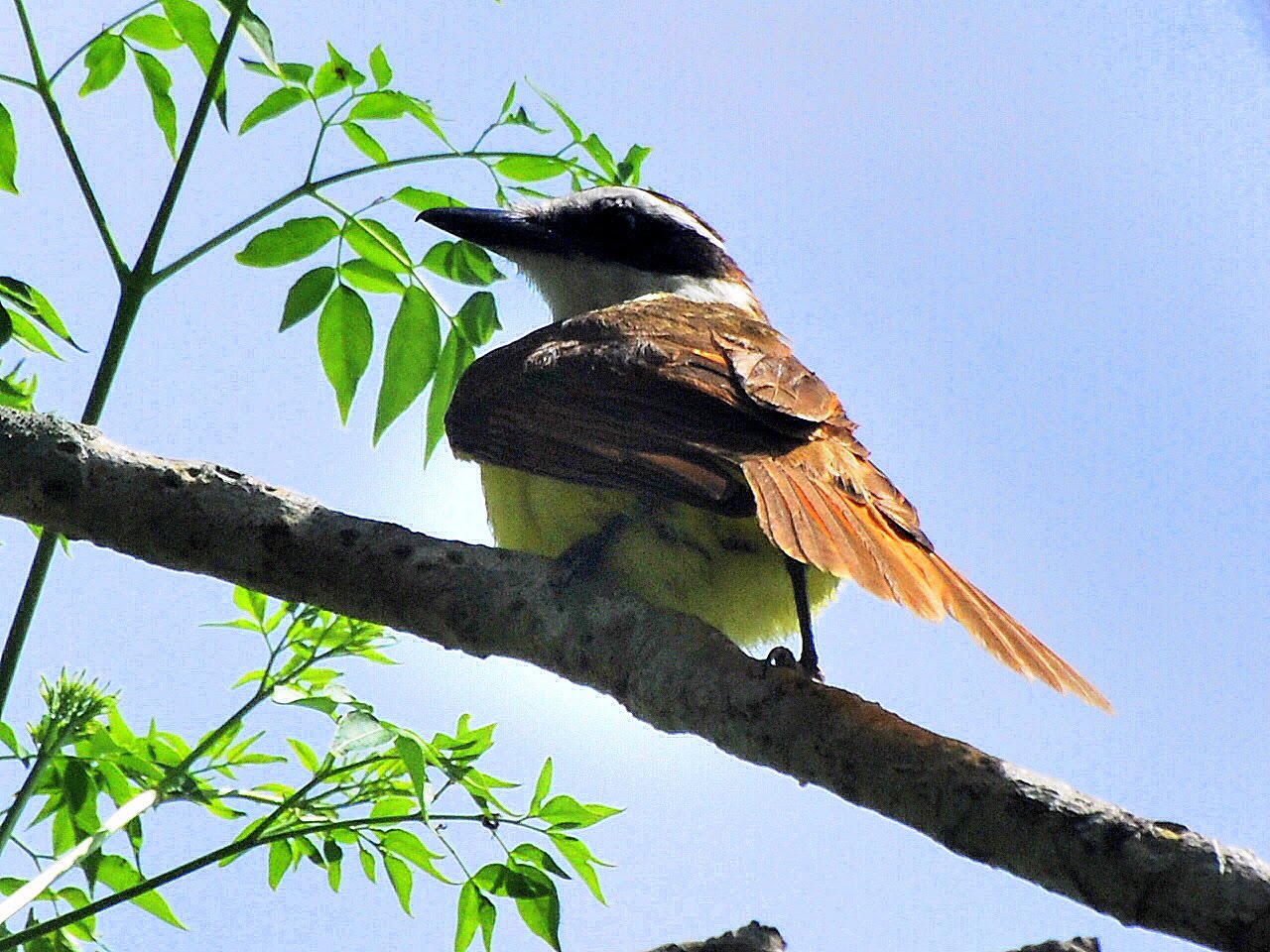
After checking the ponds and mudflats in El Agallito beach, I decided to pay a visit to Las Macanas marsh in my way back to Penonomé last saturday. Las Macanas marsh, located in the Herrera province of the Azuero Peninsula, is a protected area with an observation tower overlooking a shallow lake very good for aquatic species. It holds also some typical species of very dry habitats, as you will see here. It was very hot by the time I arrived the marsh, but anyways I managed to hear and locate some species. Both the Great Kiskadees and the Rufous-browed Peppershrikes were very vocal, with one or two almost always within "hearing" distance. There was a group of locals maintaining the trails and a public area, preparing it for an Ecological Fair next month. It is always good to see the local people taking care of their reserves and protected areas, understanding the importance of the conservation of our nature marvels for the next generations. Above the lake, there were tons of Black-bellied Whistling-Ducks flying from one side to another, but I did not saw any Fulvous Whistling-Ducks that also nest in the area. From the tower, while inspecting the surroundings with my binoculars, I found a distant Roseate Spoonbill, two or three Limpkins, many Southern Lapwings and some Glossy Ibises. Once in the base of the tower, I heard the characteristic guffaw-like call of a Mouse-colored Tyrannulet and soon was watching it. The call and the ochraceous wing bars (plus habitat) are diagnostic. I planned to spent only one hour or so in the place, so I decided to return when suddenly a flushed bird took off almost from my feet. It was a female Common Pauraque that landed a few meters ahead in the trail. It is a rare sight to find a caprimulgid during daylight, so I took advantage of the opportunity to take photos. In my way out, a found MANY raptors, including a White-tailed and Snail Kites, Roadside and Common Black Hawks (formerly Mangrove Hawk), both Crested and Yellow-headed Caracaras, both Bat and Aplomado Falcons and a very cooperative and huge Savanna Hawk, peched on a fence.
Great birds for only a one-hour visit!

Sunday, November 8, 2009

Inspecting the finca, and its birds

Despite we still have a lot of work in hand, taking care of some details at our new house in Penonome, we decided to rest a little and to visit the environs, passing by the finca. Gloriela's relatives were already there, having a picnic day. We joined her father, sister and nephews in a tour through the property, inspecting the conditions of the plants sowed during the past dry season and the advances in the construction of the cabin under a refreshing drizzle. I grabbed my camera and bins, noticing activity around the shrubbes and the wild flowers. Eventually, I left the group while following the calls and whistles of the birds in the surroundings. By the way, I added some new species to the growing bird list for the finca. The migrants were represented by Yellow Warblers and Northern Waterthushes, while the residents honeycreepers and euphonias (Bim-bim) were all around the place. A covey of Crested Bobwhites scared me when suddenly took off few feet from me; then, an angry individual was yelling Bob-Bobwhite from its perch on a tree, but still invisible to my eyes. In the wettest and most entangled area of the land, close to the creek, several males Lance-tailed Manakins were lekking incessantly, but I only got glimpses of them. An emerald-green flash over some flowers plus a quick shot with my camera produced the blurry (but nicely irridiscent) male Garden Emerald that I pictured here, looking like a flying jewel; while some Snowy-bellied Hummingbirds chased each other all over the place. The list is not complete without the flycatchers, with Lesser and Yellow-bellied Elaenias, Social and Streaked Flycatcher and Tropical Kingbirds being the commonest; but also recording Sepia-capped Flycatcher, Southern Beardless-Tyrannulet and, for the first time there, Mouse-colored Tyrannulet (small size, dull brown upperparts with buffy wingbars, eyering + eyebrow instead of only eyering as in Lesser Elaenia, etc...).
Also, we wanted to know the surrounding, including other fincas and communities. A short drive took us to three different rural communities in less than 60 minutes: Santa María, Cañaveral and Cerro Gordo. The last one was specially charming, a little town with traditional clay houses. There is located the beautifully arranged Finca La Peregüeta, owned by a former Panama Audubon Society president and an old friend: Norita. She transformed her land in a private natural reserve that holds a good number of birds (check out the section Birds to see at La Peregüeta on her webpage). By the way, peregüeta is a common tree in the area that produces little black fruits. Is good to know that some people care about preserving the environment for the next generations. With that in mind, we are back in the big city, hoping to return next weekend to that piece of land in Penonome.