Showing posts with label Green Honeycreeper. Show all posts

Monday, March 2, 2015

Coquettes of Cerro Azul

For most Panamanians, a coquette is a graceful and beautiful girl full of live; therefore, it is not surprising for us that the name is used to designate this group of handsome hummingbirds that delight us.  Along with my friend Osvaldo, I went some days ago with my two coquettes (Gloriela and Gabrielle) to the foothills of Cerro Azul (just to the east of Panama City) to spend the afternoon comfortably seated on the terrace of Birder's View, watching the hummingbird feeders.
Gabrielle and Gloriela at the feeders
A swarm of hummingbirds buzzed around us, with White-necked Jacobins and Snowy-bellied Hummingbirds as the most numerous, but with other five species present too and even some other nectivores taking advantage of a free meal too.
Shining Honeycreeper
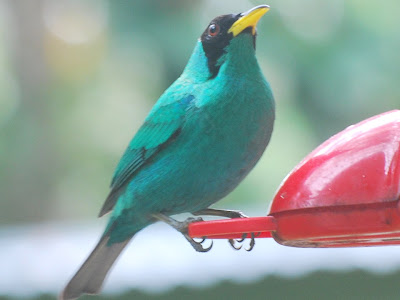
Green Honeycreeper
After a while, we noticed a bee-like hummingbird side-by-side at the feeders with the most common (and aggressive) species, standing against the bullying and harassment... a female Rufous-crested Coquette.
female Rufous-crested Coquette
Notice the orangish face and throat and, specially, the white rump band.  Its paused flight was characteristic too.  Eventually, we saw two female birds at the feeders... but Osvaldo warned us that an adult male was working the flowers in the backyard (not visiting the feeders).  After a while, a beautiful male Rufous-crested Coquette pop-up from behind the flowers.
male Rufous-crested Coquette
What an amazing day... three Rufous-crested Coquettes in the same backyard!  And what a backyard by the way... you can see hundreds and hundreds of acres of pristine humid forest (part of the Chagres National Park) in the background of the next photo featuring again my two coquettes.
Gloriela and Gabrielle (with Chagres N.P. in the background)
Good birding!

Thursday, November 15, 2012

At the feeders!

As promised in my last entry, this post is about my birding day, last sunday, at the foothills of Cerro Azul, to the east of Panama City, with Osvaldo Quintero, Osvaldo Quintero Jr and the Cerro Azul's residents Leslie and Cindy Lieurance (The Petrels in Panama) and Claudia Ahrens.  Our intention was to look after a local speciality, the Black-eared Wood-Quail which Leslie videotaped at close range in the Calle Maipo trail entrance one week ago or so.
We walked all the trail, watching some forest interior birds and hearing at least two or three different coveys of wood-quails, but they were reluctant to show off for us... instead, we had a great time birding at the more open areas at the entrance of the trail and the main road, where mixed flocks with tanagers and warblers were the main stars.  The Fulvous-vented Euphonia offered a nice show... two adult males  were engaged in full courtship display.  The one I pictured above perched vertically with wings dropped making lots of noise!  Notice its fulvous vent... the female was more interested in eating juicy berries... she is so different to the male, but still distinctive!
After doing some exercise at the trail, we did what every smart birder would do: sit in front of feeders!  Both the Ahrens and the Lieurance keep feeders at their houses, and the diversity is awesome.  At the Ahrens, we checked a banana feeder where the first visitor was this male Hepatic Tanager.
Notice its dark lores and beak, which separates him of the similar looking Summer Tanager, which is a common winter visitor to Panama... this male was waiting its chance to grab a piece of banana.  Also note that the Summer Tanager is lighter red in general, compared with the Hepatic Tanager.
Soon, the action at the feeder became insane, with Bay-headed, Palm and Plain-colored Tanagers fighting for a space on it against Black-cheeked Woodpeckers, this female Green Honeycreeper and this young male Thick-billed Euphonia.
But the most aggressive bird at the feeder was the Clay-colored Thrush; however, in spite of the size difference, this male Red-legged Honeycreeper was not intimidated and took its part of the prize.  Notice that this male is in non-breeding plumage.
Curiously, at the Lieurance feeders, there were males Red-legged Honeycreepers in full or almost-full breeding plumage... they glow!
The Lieurance also have banana feeders, we checked the hanging feeder during the couple of minutes that we stayed, enjoying their hospitality... it is quite curious to see migrants Tennessee Warblers eating banana in the tropics... though it is not the first time!
Well, perhaps we didn't see the wood-quails... but what a great day we got!  Thank you Claudia, Leslie and Cindy! 

Sunday, February 27, 2011

Visiting the Metro Park

I don't know why I don't visit more often the Metropolitan Natural Park. It is right here in Panama City and holds a huge list of both resident and migrant species. Trying to change that, I went this morning to the Mono Titi trail, where I joined Osvaldo Quintero. The park is quite popular, and we crossed several groups of joggers, birders, trekkers, or people simply having a walk through nature. At first, we saw mostly big-sized birds, like the always-present Blue-crowned Motmot, Crimson-crested Woodpecker, White-tipped Doves, at least three Scaled Pigeons high on a tree, some Slaty-tailed Trogons heard and a female Black-throated Trogon that welcomed us with her calls. Is when you see the female of this species that you understand why its scientific name is Trogon rufus. Then, we started to see the smaller species of tanagers, greenlets, flycatchers and warblers that are very common in these forests. Of course, we were paying more attention to the warblers and other migrants. In the lookout, the fruiting trees were full of migrants, including several Bay-breasted Warblers, some of them acquiring parts of their breeding plumage. Other migrants present were tons of Great Crested Flycatchers, Yellow-throated Vireos vocalizing and Chestnut-sided and Yellow Warblers. Soon the lookout got crowded with a group of little children, and the place became quite noisy... time to move on. In the way out, we find others common residents of the park, like the Red-throated Ant-Tanagers, both Scarlet and Yellow rumped Caciques, and a immature male Lance-tailed Manakin calling and displaying, allowing some great pictures. As you can see in the photo, this male still have some olive in its plumage. At the entrance, by "The Fortress", a mixed flock stopped us for a while. We saw one active Black-tailed Flycatcher, fanning its tail and exposing its yellow rump, several Southern Bentbills, Yellow-margined Flycatchers and Greenish Elaenia. We also got more Chestnut-sided and Bay-breasted Warblers plus another Yellow-throated Vireo and resident Plain-colored Tanagers. A calling bird out in the open turned out to be a Northern Scrub-Flycatcher, who stayed for photos. We waited in front of a fruiting tree waiting for the mixed flocks to pass, but we only got some Red-legged Honeycreepers and more Plain-colored Tanagers. In the other side of the field, a group of birders, guided by our friend José Carlos, were focused on a patch of tangles where they heard, and then saw, a rare White-eyed Vireo (!!!), and a coperative Pale-eyed Pygmy-Tyrant that showed well when we finally arrived to the place (but the vireo left). The pale eye of the pygmy tyrant is not very conspicuous in the field, but you can see in my photo its pale legs and mandible, plus its compact size. By the end, at a mango tree right in the entrance, a pair of Green Honeycreepers were inspecting the dead leaves... both of them stopped their duties to have a look at me. For a short walk, we saw tons of birds... definitively I will try to visit more often this place!

Saturday, January 1, 2011

Bird of the Month: Green Honeycreeper

The Green Honeycreeper (Chlorophanes spiza) is a common member of the former honeycreepers family, now merged with the tanagers, probably closer to the Tangara tanagers. It inhabitates the forest canopy and edges in wet areas of the lowlands and foothills of both slopes along Panama. Compared to others honeycreepers, it is larger and with a thicker, but less downcurved bill (as you can see in the photo, a male Green next to a male Red-legged Honeycreeper). The males are strikingly beautiful... the turquoise-green feathers make them easy to find from long distances. I don't recall any other bird in Panama with such a bright green color! The females are duller, but still recognizable by their bill-shape. In any case, they usually are found in pairs, or alone and are frequent members of mixed-species flocks with tanager, euphonias and other colourful birds. They have a wide distribution, extending from southern Mexico to Brazil and Bolivia, which reflects their adaptability and success exploiting their niche. These birds are omnivorous, that is, they don't only feed on nectar, but also eat fruits and insects... and I have to say it, they can be quite aggresive when looking for food, taking advantage of their larger size to dominate the smaller birds in the best spots (like fruiting trees or feeders). Probably, the bandit mask (the male's black half-hood) is well deserved. For these, and many others reasons is why we choose the Green Honeycreeper as our bird of the month!
This post was submitted to Bird Photography Weekly # 123. Check it out!
Literature consulted:
1. Ridgely RS, Gwynne JA. A Guide to the Birds of Panama. 1993

Monday, December 27, 2010

2010's Central Christmas Bird Count

Yesterday, earlier than usual, I woke still at dark in order to drive to the sleepy town of Gamboa (central Panama) to participate in the Central Christmas Bird Count organized by the Panama Audubon Society (PAS). Under a light drizzle, and in complete darkness, I joined Bill & Claudia Ahrens and Karl & Rosabel Kaufmann at the entrance gate of the famous Pipeline Road. A pouring rain struck the town all night long, and the weather forecast was not promising. As expected, our owling outing ended with just a Pauraque and a Mottled Owl due to the rain. The road was very damaged, so we only reached the area just beyond the former Limbo hunt camp, from where I started to walk (umbrella in hand) towards my own birding area around the Mendoza river, at the 8.8 km mark, hearing no dawn chorus due to the rain, a very bad sign. After a while, the team formed by Rafael Luck, Osvaldo Quintero and Venicio "Beny" Wilson (destined to explore the depths of Pipeline road) passed me swiftly aboard the tough FJ Cruiser without a problem, but it was a huge fallen tree (and not the muddy, potholed road) that stopped them... so I joined them in their quest after birds. We walked a lot on hilly terrain, passing the Syristes river and reaching the 11.0 km mark (photo courtesy of Beny, more at his Picasa Web Album)... and we were rewarded with special birds for this count, like Slaty-backed Forest-Falcon, Buff-throated Foliage-Gleaner, Russet Antshrike, Spot-crowned Antvireo, Tawny-faced Gnatwren, Speckled Mourner, Olive Tanager and even a rare (for that area) White-throated Thrush attending an antswarm. Of course, the antswarm attracted more regular ant-follower birds too, like Bicolored, Spotted and Ocellated Antbirds, Plain-brown and Northern Barred Woodcreepers and a Rufous Motmot. It is always nice to see the Ocellated Antbirds, with their intrincated pattern and bright blue bare-skin around the eye (file photo). Well, despite this list, the activity was desperately low between the mixed flocks, and we covered large tracks of road without seeing or hearing any bird. It was getting late and we started to return, finding a nicely perched nightjar in the open (I will discuss its ID in another post) close to the Mendoza river. Out of Pipeline road, we headed to the town of Gamboa, stopping first at the Ammo Dump's marshes and finding several waterbirds, including at least two adult Rufescent Tiger-Herons and a Muscovy Duck (another heard). We checked our lists at Guido Berguido's place, finding that we saw a good number of birds despite the weather, The house is at the edge of a nice forest and it has bird feeders scattered in the backyard, attracting hordes of colourful Red-legged and Green Honeycreepers (sometimes Shiny Honeycreeper as well, but not that day), Blue Dacnis, Blue-gray, Palm, Flame-rumped and Crimson-backed Tanagers, a stunning Baltimore Oriole just like the one of the baseball caps, Gray-headed Chachalacas, Variegated Squirrels, Central American Agouti, etc, etc, etc.... the backyard list is impressive. For the afternoon, I went with Darien Montañez and Jose Luciani around Gamboa, looking for some missing birds, and we saw many of them... with Great Antshrike, Golden-winged Warbler, Yellow-billed Cacique and Northern Rough-winged Swallows as my personal highlights. Probably not the best count in terms of quantity, but it is quality what matters after all!

Wednesday, November 17, 2010

Lazy birding ?

Last saturday, Osvaldo Quintero, Itzel Fong and your blogger host visited the foothills of Cerro Azul, one hour to the east of Panama City. The bird activity was SO intense that we saw, heard and/or photographed at least 40 species in a single garden (at Birders' View, thanks Rosabel) and then added some more in the garden at the Ahrens' place (thanks Bill & Claudia). That is why I ask if this is lazy birding... all these birds were seen with VERY little walking and without wakening too early! At Birders' View, after finding my year-bird # 600, we noticed that the berries of two plants (Ortiga - above with white/pinkish berries in a purple florescence and a bonus female Green Honeycreeper on top- and Ortiguillo -with yellow berries- according to Nando, the house's handy man and keeper, but also an excellent birder) were attracting tons of birds, including no less than 12 tanagers species! My favorites were the six Tangara tanagers, with all their contrasting patterns and brightly-coloured plumage, including the Plain-colored Tanager that I'm not picturing here, but have a look at the other five (all of them in the Ortiguillo), starting with the Golden-hooded Tanager... common but gorgeous!
This Emerald Tanager is showing that the guys that named it were absolutely right!
The Speckled Tanager was a little shy. Notice its yellow face and blue margins to the wings.
Despite its commoness, I got my first close-up shot of a Bay-headed Tanager that day.
The Rufous-winged Tanager is regular in that garden. Compared to the Bay-headed Tanager, it has more yellow on the back, less blue in the underparts and, of course, rufous in the wings.
OK, I know that the Hepatic, Summer and Scarlet Tanagers are not tanagers, but cardinals... but we still need to assimilate that. This female Scarlet Tanager was very cooperative while feeding at the Ortiga berries.
The euphonias (former tanagers) and the honeycreepers were well-represented as well. Here, in quick succession, I'm showing the Fulvous-vented and Tawny-capped Euphonias (all males) and a male Green Honeycreeper... all at the Ortiga.
We DID walk a little... but only 15 minutes in one of the well-kept trails, finding several White-tipped Sicklebills in an Heliconia patch inside the forest. Returning to the natural feeders at the house, Itzel noticed that a new bird joined the party at the Ortiga below us... a female Yellow-eared Toucanet just feet from us!
She eventually got VERY close, less than a meter from me and Osvaldo was able to photograph her with his cell phone!
Some books mention that the Selenidera toucanets are shy... certainly she did not read those books!
We barely left the place due to such amazing activity, but it was getting late. In the way out, we visited our friends Bill and Claudia at their beautiful place, where they showed us the furious activity at the hummingbird feeders (that is a male Violet-capped Hummingbird -year-bird # 601) and the technique to dissappear a bunch of bananas in few seconds (just left it at their feeders, the Palm Tanagers and the Black-cheeked Woodpeckers, among maaaany others, will take charge).
What a great day... full of colourful birds in close proximity and good friends sharing them with you... this is birding all about!