Showing posts with label Black-cheeked Warbler. Show all posts

Saturday, April 30, 2016

The Cerro Hoya Expedition

The Azuero Peninsula, in south-central Panama, is known by its infamous history of deforestation that began with the Spanish colonization.  However, there are still patches of wooded areas, mainly in the highlands of the southern extreme of the peninsula, specially in the Cerro Hoya massif.  This is not coincidence... the roughness of the area, and its inaccessibility prevented the destruction of this natural treasure... but also prevented its exploration, thus becoming one of the most unknown areas in Panama, ornithologically talking at least.  Home to some range-restricted and globally threatened species, the Cerro Hoya massif also host a number of montane species represented by distinct forms, isolated from similar populations by at least 150 kms.
That's why my friend Euclides "Kilo" Campos and I were so interested in climbing that mountain.  Accompanied by a visitor birder, Macklin, and organized by Kees Groenendijk (of Hotel Heliconia, he also accompanied us), the four of us set camp at 1160 meters above sea level last week... after six hours of climbing along a winding and steep trail.
Campsite 
Of course we birded along the trail, finding some very nice species.  We started to hear, and see, Brown-backed Doves above the 400 meters mark and to hear Azuero Parakeets above the 1000 meters mark.  Both are endemic forms, still considered subspecies of wider-ranged species, in this case, Gray-headed Dove and Painted Parakeet, respectively.  The Panama Audubon Society considers both full species, endemics to the country... quite restricted endemics by the way!
Brown-backed Dove
Also above the 400 meters mark the characteristic calls of the Three-wattled Bellbirds started to be more and more common, as well as sightings of White-ruffed Manakins.  These populations seem to reside in the area year-round.  About the bellbirds, some experts think that these birds differ vocally to the populations of the western highlands.  The far-carrying calls are impressive.  However, in spite of the loud calls, these beautifully patterned birds are quite difficult to see.  We were lucky enough to spy some males, and I managed some photos as well.
male White-ruffed Manakin
male Three-wattled Bellbird
We stayed two nights in the forest, spending one day almost entirely above the 1200 meters mark looking for montane subspecies, finding both expected and new ones for this region.  The montane forest made us wonder if we were still in the Azuero Peninsula!  There are some curiosities up there... for example, some lowlands species are found all the way up to the montane forests, like Scaly-throated Leaftosser and Cocoa Woodcreeper, certainly due to the lack of their montane counterparts in this region (in these cases, Tawny-throated Leaftosser and Spotted Woodcreeper respectively).
Scaly-throated Leaftosser
Other montane species are shared with other remaining (although lower) montane areas in the Azuero Peninsula, like El Montuoso Forest Reserve.  Some of these species are widely distributed, like the Golden-crowned Warbler, while other are more local, sometimes hard to find... like the beautiful White-winged Tanager.  Cerro Hoya is probably the most reliable site to find this beauty!
Golden-crowned Warbler
male White-winged Tanager
But we were after the forms only found in the Cerro Hoya massif... and we found three of them (only missing the Selasphorus sp., probably due to lack of appropriate habitat up there).  All of them were above 1200 meters above the sea level.  The most common was the Purple-throated Mountain-Gem.  This form is certainly a new subspecies... and probably a new full species!
male Purple-throated Mountain-Gem ssp. nov.
Check this post with the rationale of why this could be a good species... you can see the differences with other forms in my photos.  The other endemic form was the White-naped Brush-Finch, ssp. azuerensis.  This form was darker in the underparts and browner in the upperparts than other forms found in Panama... it was also more arboreal and quite shy.
White-naped Brush-Finch ssp. azuerensis
The last form was the most difficult to find... in fact, we only saw two pairs, both above the 1300 meters mark: Black-cheeked Warbler.  Phenotypically, the only difference we noticed was its olive(ish) upperparts, instead of grayish.  These birds responded to recorded calls of Black-cheeked Warblers from the western highlands.
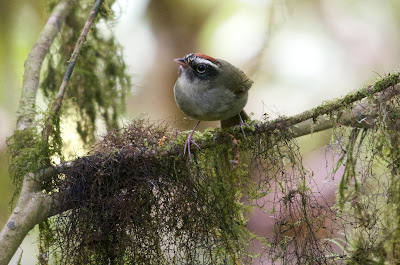
Black-cheeked Warbler ssp. nov?
As you can see, it was a quite productive trip.  We recorded 123 species for the area, including some new ones to Azuero and even one lifer!  While walking around 1300 meters above sea level, we found two chicken-sized birds walking in a small ravine... they were Rufous-necked Wood-Rails!  That evening, we heard at least two pairs at the campsite... Kilo barely managed to record part of the call with his cell phone (headphones needed).
There are only few reports of Rufous-necked Wood-Rails in Panama, where it is considered a real rarity and this is the first time the species have been recorded away from mangroves in Panama (although it has been recorded in similar habitats in other countries).  As you can see, there is still much to learn about this place, and I'm pretty sure this is not the last thing we will heard about discoveries in Cerro Hoya!

Saturday, August 17, 2013

Birding the Tabasará range. Part II

In my previous post, I talked about the last trip we made to the mountains of the Tabasará range in western Panamá.  In company of William Adsett, Dan Wade and Charles Davies, we explored some forest patches at both the Pacific and Caribbean slopes, finding interesting species.  In this post, I'll show you some of those special (aka endemics) forms and species that we found.
Continental Divide
Ok, probably not all the endemics, since I'll be discussing the status of the Selasphorus hummingbirds we saw up there in another post.  But we also saw the other national endemic living in these mountains: Yellow-green Finch.  It was quite common, we found them several times in three different sites, although in small numbers, usually two or three individuals each time.  This species is pretty similar to the Yellow-thighed Finch, both physical and vocally.
Of the endemic subspecies, the most common (by voice) was the chiriquensis race of Silvery-fronted Tapaculo.  In spite of great looks (for a tapaculo!), obviously we were not able to snap a shot!  The bush-tanagers were also pretty common.  We found several groups of Common Bush-Tanagers in both slopes, sometimes with mixed flocks.  The subspecies found there, punctulatus, spreads along the highlands and foothills all the way to central Panamá, including El Valle de Antón and Altos del María.
I know is not the best photo, but at least you can see the very dark head and the characteristic drop-like postocular spot.
But we also saw Sooty-capped Bush-Tanagers, both along the road to Ratón as well in the Continental Divide trail up to 1750 meters above sea level.  The form present there was once described as a valid subspecies, diversus, supposedly with yellower underparts.  They looked quite similar to the birds found around the Barú volcano in western Panamá, except for the white lateral crownstripe... its looked thinner in those birds.  My photo doesn't shows this, but this photo by William (of a previous visit) shows well what I mean.
We didn't know this, but the Ruddy Treerunners that we saw in both slopes were also represented by endemic subspecies, boultoni.  This form is redder in the under and upperparts.
However, the most interesting endemic subspecies (for me), was the bensoni race of Black-cheeked Warbler.  Reported as rare, it is seldom reported at all from the area, and surely not from the most accessible areas  along the paved road.  We saw them three different days in two sites, only one or two birds, as you can see in the excellent photo by Charles.
copyright Charles Davies, used with permission
I was unable to remember the differences with other races back then, but we all were convinced that they looked different.  Notice the slaty-gray back (with no olive tones).  Also, the lack of yellow tones to the underparts was quite obvious in the field.
Not bad at all... what you think?

Friday, April 19, 2013

A mix of widespread and endemic birds

Western Panamá highlands form part of the Talamanca range, a well-recognized endemic bird area shared with Costa Rica, and a birding trip to this part of Panamá always is full of a great diversity of both Talamanca endemics and more widespread species.  During our last incursion to the highlands, Osvaldo Quintero, Rafael Luck, your blogger host and our guide, Ito Santamaría,  experienced this diversity.  We visited the Bajo Frío area, above Cerro Punta, looking primarily for quetzals (and we eventually saw and photographed them) and finding tons of birds in the way, starting with some common, widespread species.
See what I mean?  Who can't recognize an Acorn Woodpecker?  This clown-faced birds are quite noisy and conspicuous, a common sight in this part of the country.  And talking about common sights, nothing is more common in the highlands than Mountain Elaenias.  This species is found from northern Central America to northern South America.
While looking for quetzals, a covey of Spotted Wood-Quails started to sing close to us.  Ito attracted them with a recorded tape.  Eventually, we got amazing looks of several individuals, but capturing a photo is another theme.  These wood-quails are found from southern Mexico to western Panama; in fact, I have seen this species in Costa Rica as well.
As we moved to higher slopes, along the road to El Respingo, the avifauna changed, and we started to find Talamanca's endemics birds..., like this cooperative Black-cheeked Warbler, part of a flock with five or six birds foraging low in the understore.  This one was taking a sunbath!
There are too MANY endemic birds in those mountains, so I'm only showing a few... in this post of course.  However, we found the next two endemics high at El Respingo, in spite of the weird sign (as I said before, "beware of dog" is not enough in Chiriquí):
"No trespassing, tiger running free"
The Fiery-throated Hummingbird is a specialty of these high altitudes.  The "fiery" throat is hard to see (and this bird liked to stay in dark places), but the tiny white post-ocular spot and the blue tail are good marks.
Also endemic, the Volcano Hummingbird is a tiny gem.  This male was making impressive aerial displays.  The pointed throat usually looks dark, but in the right angle, it glows in an splendid purple tone!
Stay tuned for more highland specialties in the next posts!

Thursday, November 5, 2009

Birding in PILA (birding a lot)

PILA are the initials for Parque Internacional La Amistad; but, in our panamanian spanish, to say "en pila" means "a lot"... an appropiate title for this entry since Gloriela, Darien Montañez (of the Xenornis) and your host blogger watched many birds yesterday in that huge park, which Panama shares with Costa Rica. As I told you, we were seeking bamboo specialist... so we met at the small restaurant close to the hotel where Darien was staying, ate our breakfast (accompanied by a Stripe-tailed Hummingbird) and headed towards the settlement of Las Nubes, where the park's headquarters are located. It is a picturesque road across farmlands, streaming rivers and a small agricultural community. The entrance to the park gives you an idea of the impressive forest that this park protects. Tall moss-covered trees and giant tree ferns hold tons of birds and other animals. The humid and foggy environment is ideal for the survival of the epiphytes, which in turn are ideal for the furnariids. There is something about the furnariids... they aren't the most colourful nor beautiful birds, but they are so scarce in the lowlands (where I do most of my birding) that the opportunity of finding any of them thrills me. Of course, we found many furnariids in tne form of Buffy Tuftedcheek, Ruddy Treerunner and Streaked Woodhaunter. We also got many Spot-crowned Woodcreepers, but deep inside me I still feel uncomfortable by including the woodcreepers (which are very common in the lowlands) into the furnariids. We took the "El Retoño" trail, finding Ruddy-capped Nightingale-Thrush, Black-faced Solitaire, Wrenthrush, Silvery-fronted Tapaculo, Gray-breasted Wood-Wren, Rufous-browed Peppershrike, among others before reaching the large tracks of bamboo (Chusquea sp.). Once there, we didn't see any bamboo specialist, but we were entertained by a mixed flock composed mainly by Black-cheeked Warblers and Yellow-thighed Finches, but including also Wilson's & Black-and-white Warblers, Collared Whitestart and even a Hairy Woodpecker. We got also a nice selection of hummers, including Green Violetears, Magnificent & Stripe-tailed Hummingbirds, White-throated Mountain-Gems, Violet Sabrewing and the bird of the day: a cute Green-fronted Lancebill flycatching over the stream. It was getting late for our return journey to Penonome, so we lunched at the small restaurant in the park's entrance and said goodbye to Darien, who stayed in the area... looking for more birds (and hearing a flock of Barred Parakeets later). On the way, we found the parade celebrating the national day of our flag... a particular way to end a birding morning in the highlands.