Showing posts with label Black-crowned Antshrike. Show all posts

Tuesday, February 18, 2014

An extraordinaire day

The definition of "extraordinaire day" is different for each person.  For some, a day is extraordinaire if everything goes as planned; for others, you need a special event to occur.  For me, ANY day with a GROUND-CUCKOO is an extraordinaire day!  And, after hearing that a family group of Rufous-vented Ground-Cuckoos were attending an antswarm in Pipeline Road (central Panama) allowing nice views for the visitors, I decided to accept the invitation of my friend Osvaldo to bird the area last saturday.
We started at the marina in the town of Gamboa.  We were expecting to find some migratory ducks, but it seems that this is not a good year for them.  The place was full of Common Gallinules as usual, and Wattled Jacanas (like the one pictured above).  After walking along the access road, we found many species of both resident and migrant birds.  My favorite was an adult Rufescent Tiger-Heron hunting quietly behind the access gate.
After a while, we decided to move to the famed Pipeline Road.  The furious activity at the marina deviated us from our main destination, the same happened in the other stops we made before reaching the entrance to Pipeline Road.  For example,  this Crimson-crested Woodpecker entertained us at the Ammo dump.
And a mixed group of warblers, antbirds and antwrens did the same right before entering Pipeline.  There, two species of antshrikes were inspecting a patch of forest close to the ground.  Considering that others birds were in the same area (like Black-bellied and Song Wrens, Dusky Antbirds and Black-faced Antthrush), I suspect that there were some ants or something in the ground.  Notice the heavy bill of this male Fasciated Antshrike.
And the black crown of this aptly named Black-crowned Antshrike.  This is a male, of course.  The female is patterned in brown and buff, with little black.  This species used to be called Western Slaty-Antshrike... but it is not closely related to other Slaty Antshrikes in South America.
A little before 11 am, we finally reached the Pipeline Road.  One kilometer after the entrance, we noticed a foreign birder standing aside the road.  We joined him and immediately heard the Bicolored Antbirds attending an antswarm.  The birder quickly showed us a photo in his bridge camera... a Rufous-vented Ground-Cuckoo appeared in the screen.  We waited for a while and then, the bird materialized above a log more or less 4 meters from us.  What a sight!  The long tail and powerful legs, plus the expressive crest is unmistakable.
File photo
Unfortunately, we could not take pictures.  I took the above photo five years ago almost exactly in the same site!  The Rufous-vented Ground-Cuckoo is a very rare ground-dwelling species that is found almost exclusively around antswarms.  Pipeline Road is, perhaps, the best place to see it, specially during our dry season.  So, now you see why that was an extraordinaire day?  

Wednesday, August 7, 2013

AOU Checklist changes affecting Panamá

Last month issue of The Auk (the American Ornithologist's Union -AOU- publication) includes a supplement of the checklist with some important changes affecting the taxonomy of the birds in North America (and Hawaii).  I will mention only those affecting the birds found in Panamá, and I'm including not only splits and lumps, but also name changes and other issues.
In taxonomic order, I will start with the shorebirds.  Now, many species considered monotypical are now included within the genus Calidris.  That means, we now list the Surfbird as Calidris virgata, Buff-breasted Sandpiper as Calidris subruficollis and Ruff as Calidris pugnax.  The order of the species within the genus Calidris also changed, as well as the sequence of the families within the Charadriiformes order.
There are three Calidris virgata in the flock
The Green-crowned Woodnymph is re-lumped with the Violet-crowned Woodnymph and re-adopt the name Crowned Woodnymph (Thalurania colombica) based on better understanding of the ranges and intergrades within these two forms in Colombia (however, they are not known to come into contact in our country).
Former Green-crowned Woodnymph from Ecuador
Black-crowned Antshrike (Thamnophilus atrinucha) is the new name for the Western Slaty-Antshrike due to genetic evidence indicating that our form is not related to the "real" south american slaty-antshrikes, in spite of the physical similarities.  Both subspecies of Immaculate Antbird found in Panamá (Myrmeciza i. zeledoni from Costa Rica and western Panamá, and M. i. macrorhyncha from eastern Panamá and western Colombia and Ecuador) are now called Zeledon's Antbird (Myrmeciza zeledoni), a new species different from the Immaculate Antbird restricted now to Colombia and Venezuela.  Also, the latin name of the Rufous-rumped Antwren change to Euchrepomis callinota.
Black-crowned Antshrike (it's going to be difficult to get used to this name)
As expected, the Thrush-like Schiffornis was split into four species, with two forms occurring in Panamá: the dull, uniformly olivaceous Northern Schiffornis (S. veraepacis) found in both lowlands and highlands of western Panamá, and highlands of central and eastern Panamá (except the Alturas de Nique massif) and the more rufous, gray-bellied Russet-winged Schiffornis (S. stenorhyncha) found in lowlands of central and eastern Panamá (and all elevations of the Alturas de Nique massif).
Bad photo of a Northern Schiffornis, from Altos del María
The Green Manakin is called now Xenopipo holochlora, and both Red-capped and Golden-headed Manakins changed their genus to Ceratopipra instead of Pipra.  Also, the checklist sequence of the manakins changed.
Ceratopipra mentalis
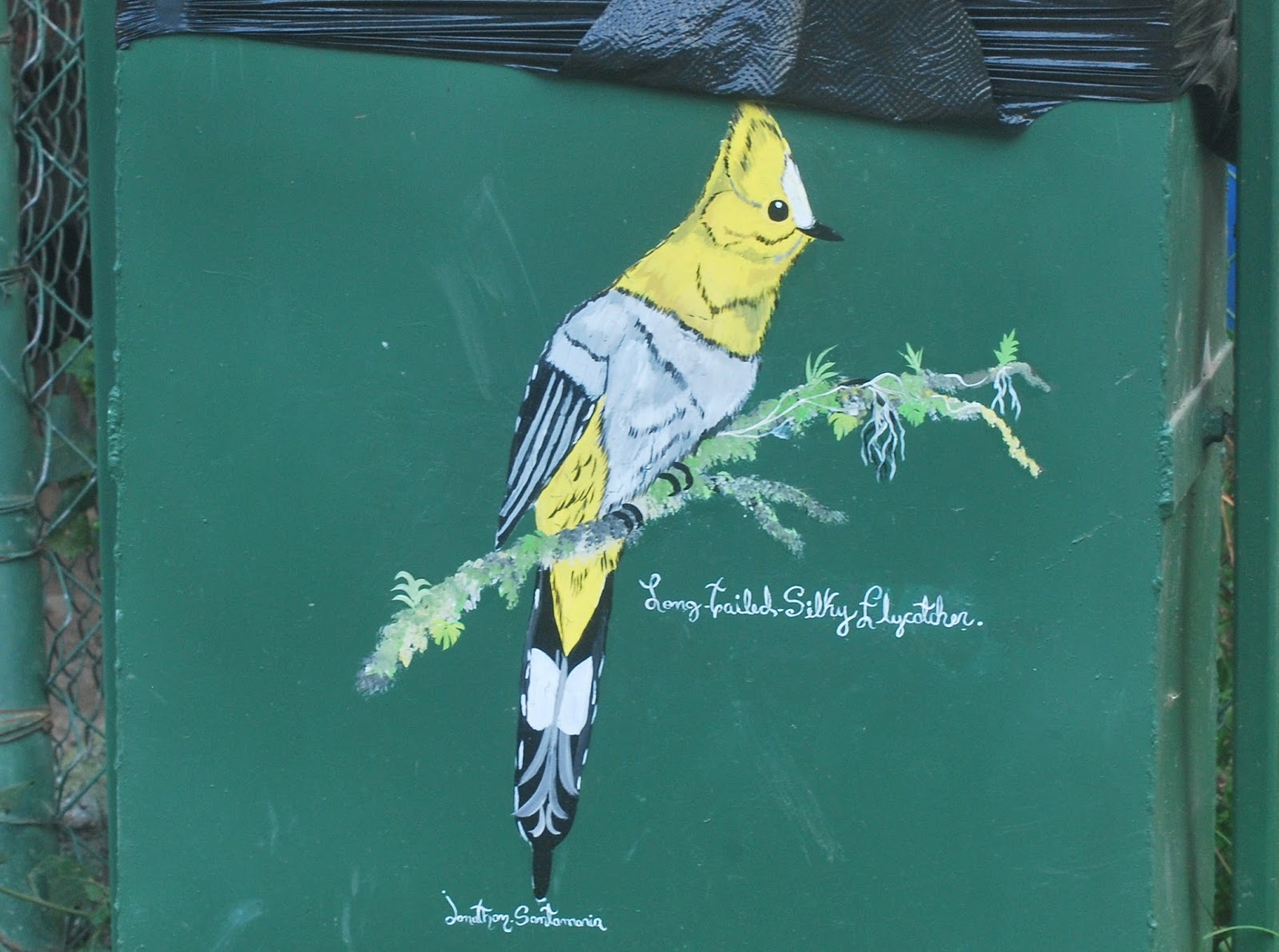
According to Gregory and Dickinson (2012), Ptilogonys (and Ptilogonatidae, the latin name of the Silky-Flycatchers family) is an incorrect spelling and has no nomenclatural standing.  The checklist corrects this and now the name of the family is changed to Ptiliogonatidae and the genus to Ptiliogonys, affecting the latin name of the Long-tailed Silky-Flycatcher to Ptiliogonys caudatus.
A minor misspelling was corrected in the latin name of this common species
The latin name of the Common Bush-Tanagers changed to Chlorospingus flavopectus (however, there are no splits in this group).
Common Bush-Tanager... I was expecting splits in this species!
Some issues are pending, other were not even mentioned... notably the Blue-diademed/Whooping Motmot.  Surely more studies are needed before a formal pronunciation of the AOU.