Showing posts with label Common Potoo. Show all posts

Wednesday, October 9, 2013

Celebrating Panama Audubon Society's 50 years!

That's right, Panama Audubon Society (PAS) turns 50!  And for the occasion they have organized a series of activities to share with members and general public, celebrating our birds.  We started last weekend with the first of a series of Sunday trips.  Many members of the board of directors (including me) accompanied our guide for the day, my friend Justo Camargo, very early at the Metropolitan Natural Park, where we met the participants.  Former PAS president, Darien Montañez, opened the event before heading to the trails.
However, I decided to accompany Rosabel Miró (PAS Executive Director), Yenifer Díaz (and his mom) and Celeste Paiva, who expected a very special group of participants to the event: a group of 16 fifth-grade kids and teachers of one of the Elementary Schools where PAS conducts its environmental education program "Aulas Verdes" (Green Classrooms).
Rosabel and Yenifer in front of the group!
Rosabel gave them commemorative t-shirts as a gift, and lent them binoculars.  After a little introduction to birdwatching, we walked slowly around the installations, bordering the forest. The experience of sharing your love for nature and birds with those kids is amazing.  They were curious and interested in everything I was saying...
And everything we were showing...  thanks God the birds were particularly cooperative, allowing great scoped views... like this day-roosting Chuck-will's-widow.
Or this Common Potoo at the little park by the gate of the main trails.
The event was a great success, and we will repeat the experience every sunday of this month... here is the schedule for the trips to come: 
1.  Sunday, october 13th: Parque Municipal Summit (7:00 am - 9:30 am)
2.  Sunday, october 20th: Cerro Ancon (8:00 am - 12:00 pm)
3.  Sunday, october 27th: Panama Viejo (7:30 am - 11:00 am)
Join us and celebrate with us our 50 years!

Wednesday, August 11, 2010

Birds bonanza in Metro Park

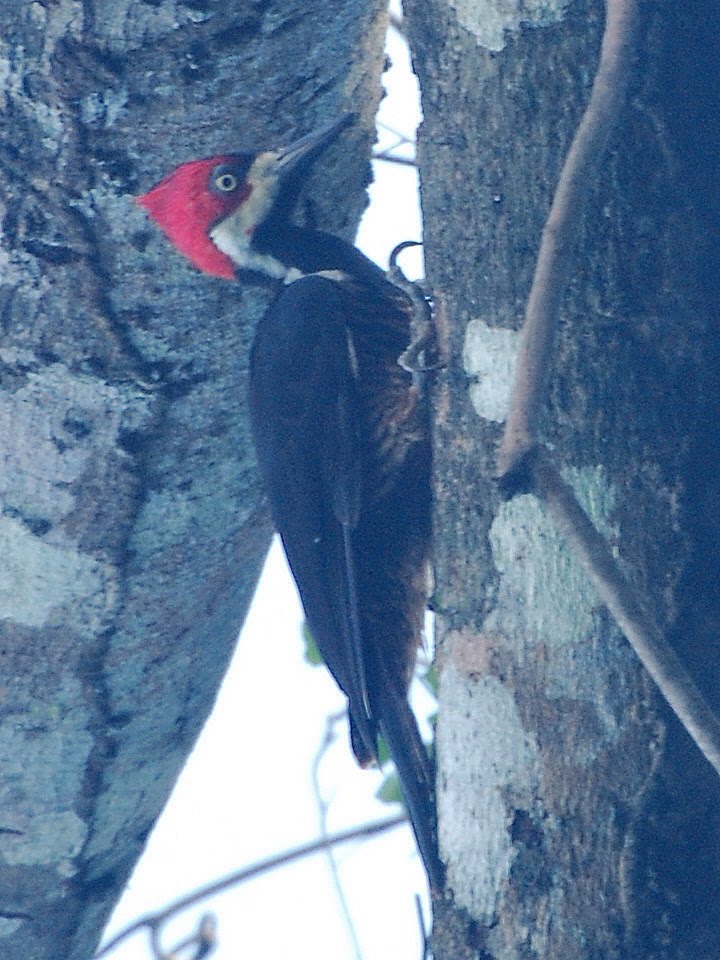
Yesterday, I went to the Metropolitan Natural Park following the directions of Osvaldo Quintero who told me that the trees at the lookout were full with fruits and birds since the last week. I just wanted to see what it was all about up there so my plan was to walk without resting all the way to the lookout, which is at 135 meters above sea level in Cedro hill. I took the Mono Tití trail because is wider and fresher than La Cieneguita trail, which starts behind the rangers' station. Of course, my plan of walk directly to the lookout without stopping on route was quickly interrupted due to bird activity. Close to the first lookout (in the way up), a dead trunk attracted three different couples of birds: one of Crimson-crested Woodpeckers, other of Lineated Woodpeckers and a pair of Orange-chinned Parakeets excavating a nest in a termite nest... all in the same trunk. Both pairs of woodpeckers were working in different branches, ripping apart and throwing huge pieces of bark from the trunk while looking for worms and other insects, without agressions or shouts, everything in harmony. The parakeets stopped what they were doing to have a look at me, they are so curious! The understory that surrounded some fallen branches and roots of the dead trunk was also alive in birds. A pair of Fasciated Antshrikes were inspecting every corner while a Dusky Antbird sang from a cover. It is fascinating how a dead trunk have so many niches to occupy. Back on route, I started to hear the flocks of birds while approaching the lookout. And then I realized why... many of the trees bordering the lookout were full in fruits, just like Osvaldo told me. Many species were taking advantage of this, not only the frugivores, but also many insectivores as well. I also noticed lots of butterflies and other insects in the area, and many mammals too (more about them in my next post). I simply sat down and waited. The birds appeared in waves. First a flock (yes, a flock) of Tropical Kingbirds, more or less 20 birds eating fruits and flycatching, accompanied by one, possible two Dusky-capped Flycatchers. Also, many Yellow-green Vireos were feeding at the trees, probably preparing themselves for their journey to South America. The frugivores were represented by Blue-gray, Palm, White-shouldered and Plain-colored Tanagers and also Blue Dacnises. Even a Squirrel Cuckoo showed up, also eating fruits! Then, I found a single Double-toothed Kite nicely perched just below the canopy. At first, it was far away, but got closer while following a troop of Geoffrey's Tamarins. That was not the first time that I see those kites following monkeys. If you have any doubt about why they are called double-toothed, check the close-up that I made of its head. A mixed flock of swifts and swallows patrolled the air over the lookout, with Short-tailed and Vaux's Swifts, and Gray-breasted Martins. Sometimes, they were so close that I thought they were going to hit me! I spent more or less three hours at the lookout! In the way out, I checked the spot of the Common Potoo reported elsewhere, finding only the downy fledging acting already as an adult potoo... it is not the cuttest thing?

Tuesday, July 20, 2010

Looking for a particular branch

I went yesterday to the Metropolitan Natural Park in Panama City to photograph a particular bird that has been reported for that place since a month ago, more or less. You might think that I was very optimistic considering that I was looking for a bird reported a month ago, but when the bird looks like and acts as the branch of a trunk, then it is possible. As you guessed, I wanted to find the Common Potoo that resides near the ranger station. Months ago, I photographed one of them in La Cieneguita trail behind the station (pic here) and I simply wanted to get another pic. Prepared with my bins and camera, I asked the ranger if he knews the bird that "looks like a branch" and he answered "you mean the potoo? I'll show you". I followed him to the park-like forested area between the station and the main street and there it was... ridiculously exposed and close to the station, a Common Potoo in full daylight, resting, trusting in its camouflaged plumage to go unnoticed. The red eye in the second photo is due to my flash, an adaptation for its nocturnal habits. It took me merely three minutes to find the bird (with the help of the ranger of course). And that's all folks. Just kidding. I decided to walk the Mono Titi trail despite the heat of the day (after all I was there... why not?). Of course I heard many birds... but to see one was other thing because the time of the day (almost noon). The calls of a Collared Forest-Falcon encouraged me to continue. It sounded like a distant weeping in an enchanted forest. I found a troop of monkeys of which the trail takes its name. They are not "tities", but tamarins.... Geoffrey's Tamarins to be exact. I think they were as curious as I was. A White-nosed Coati and a pair of Central American Agoutis completed my mammals list for the day. Some birds in my heard-only list were (apart of the forest-falcon) Rosy Thrush-Tanager, White-bellied and Dusky Antbirds, Rufous-breasted, Rufous-and-white and Black-vented Wrens, Orange-billed Sparrow and Green Shrike-Vireo; but in the other hand I got great views of a Blue-crowned (Whooping) Motmot, a female Slaty-tailed Trogon, a Cocoa Woodcreeper inspecting a hole in a trunk, at least three flocks of Red-throated Ant-Tanagers (only a female stayed for a poor photo) and a colourful mixed flock with Blue Dacnises, White-shouldered Tanagers and Yellow-backed Orioles. Nice walk after all and I saw my potoo!

Tuesday, January 19, 2010

The Metropolitan Natural Park

Panama is the only latinamerican capital city blessed with a tropical dry forest within its boundaries. The Metropolitan Natural Park is considered the lung of Panama City, and it holds an amazing diversity of plants and wildlife (including birds) considering its proximity to the busy city. After spending a couple of hours at Veracruz beach and leaving an unexpected passenger at the main buildings of the park last sunday (january 17), we decided to walk La Cieneguita and the Mono Tití trails just to see what we can shoot (with the cameras). It was about 10:30 AM so the activity was low, but anyway we managed to find some birds. At our first stop, one of the rangers pointed us a branch that at first glance looked like any other, but with the binoculars we verified its identity: a Common Potoo perfectly patterned for disguising like a tree. What a beautiful creature, in spite of its reputation... this bird is the famous "Tulivieja" (a kind of witch) of our peasants due to its lugubrious (but enchanting) song. We delighted ourselves photographing this magnificent bird, but soon we were shooting other one: a pair of highly vocal Crimson-crested Woodpeckers in courtship display. A little farther in the trail we heard the characteristic buzzy call of the Slate-colored Seedeater and soon one male answered to our recordings (always close to the bamboo). This seedeater used to be very rare, but it has become regular at the bamboo in this park since last year. Other birds seen were Dusky and White-bellied Antbirds, Red-throated Ant-Tanagers and a Rosy Thrush-Tanager. We crossed some birders in the trails including a group, guided by our friend José Carlos, trying to spy an Orange-billed Sparrow, but having great views of a Slaty-tailed Trogon instead. We said goodbye to them, heading to the exit, but the musical whistles of a pair of Yellow-backed Orioles delayed us. As you can read, it was a very busy morning!