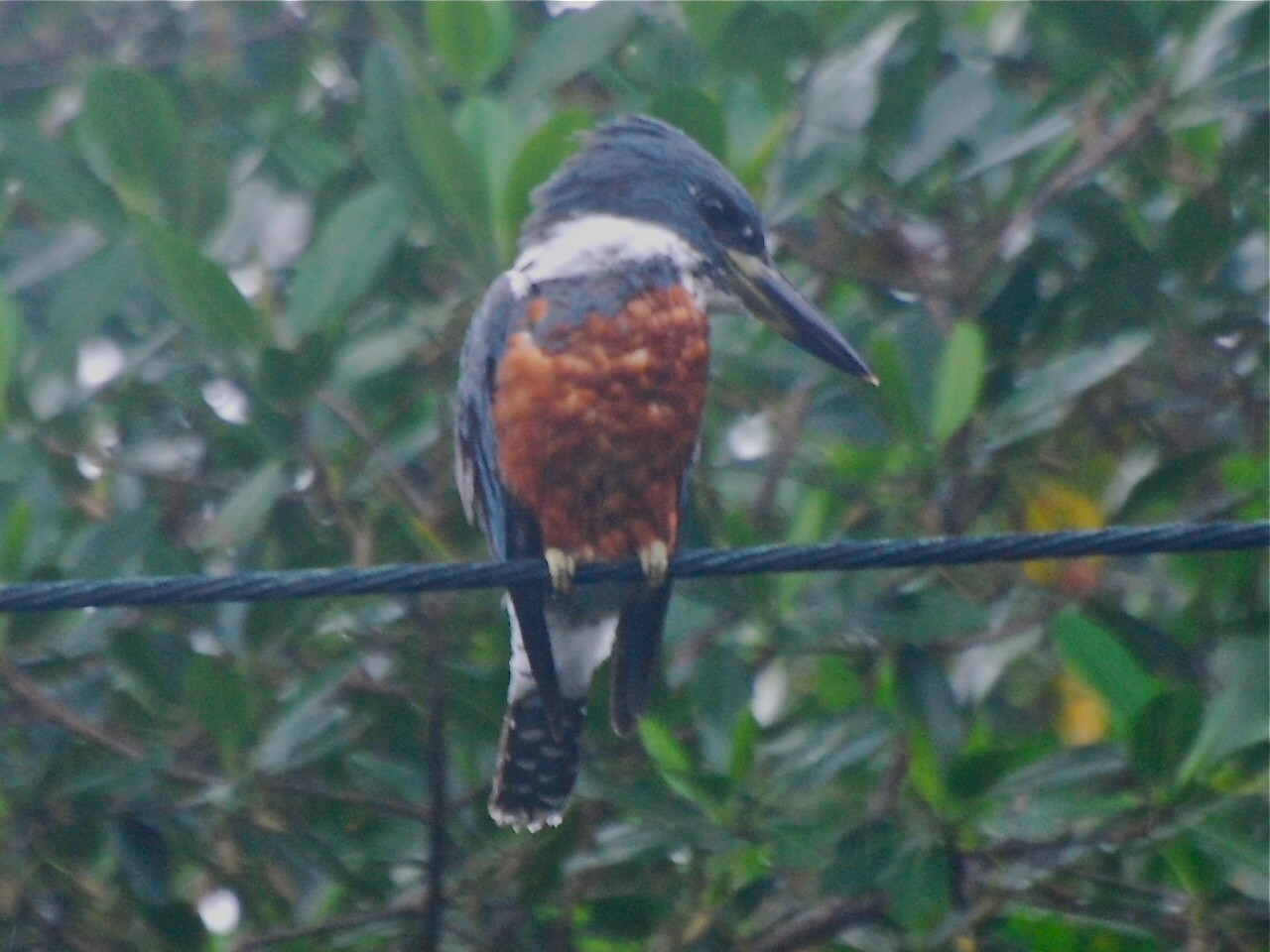
Showing posts with label Ringed Kingfisher. Show all posts

Tuesday, July 30, 2013

Still looking for THE heron

It seems that the only thing we did last month was to look for the vagrant Whistling Heron reported elsewhere by Kevin Easley et al.  And last weekend was not the exception!  However, this time accompanied by Rafael Luck, Osvaldo Quintero and his son-in-law Joaquín, we stopped first at some marshes just east of Panamá City, the former Tocumen marshes.  Like other days, we found the typical avifauna of these habitats, but dip on the heron again.  Well, nothing to sorry about because we knew it was very unlikely to find the bird so far away of the original spot, but we did have a nice day photographing all sort of birds species, including HUGE numbers of Wood Storks, Neotropic Cormorants all over the place (see the photo above), and many Cocoi Herons, like the one pictured below.
These marshes are also very good for raptors, and we saw or heard Roadside, Common Black and Gay-lined Hawks, plus Pearl and White-tailed Kites too.  This one was perched close to the road allowing some photos.
The site is the only reliable one for Yellow-headed Vulture close to the city, and we found at least three individuals resting close to the road.
We found no less than six Ringed Kingfishers in one stretch of a creek... soon we realized that they were nesting in the sandy banks.  This image remind me the photos of bee-eaters at their colonies... after all they are related.
We went to the spot near Chepo, but the day was hot and we only found more birders trying, unsuccessfully, to relocate the heron... so we called it a day.  The next day, I joined Karl and Rosabel Kaufmann and, very early, went to the spot near Chepo.  Though we had a good day, we were not able to relocate the Whistling Heron.  We checked miles of dirty roads, finding more Wood Storks and a beautiful Capped Heron sharing the pond with one of the storks.
Again, we saw many raptors, like Roadside and Great Black Hawk, White-tailed Kites, and several pairs of American Kestrels.  Again, notice the absence of spots in the underparts... probably the same individual we photographed some weeks ago in the same spot.
New for our list of the site was this Bat Falcon perched in some wires.  It allowed us to approach closely, a very cooperative bird.
Well, I don't know if the Whistling Heron will be found again... but that area surely will reveal many surprises in the future!

Thursday, December 20, 2012

2012 CBCs: Pacific circle

December is a month of festivities... but also of bird counts!  The Panama Audubon Society organizes three Christmas Bird Counts in central Panama, and I pretend to participate in all of them.  In fact, I already participated last sunday, december 16th, in the first count, the Pacific circle.  As usual, my count area was the coastal strip of the west bank of the canal, including Farfan, Palo Seco and Vercaruz, accompanied this time by Rafael Luck, Jennifer Wolcott, Dan Heinrichs and Neville Lincoln.
The tide was pretty high early in the morning, so we concentrated first in the huge pond at Farfan, finding many waterbirds, like Roseate Spoonbill, Neotropic Cormorants, ton of egrets and White Ibises, both Belted and Ringed Kingfishers and many more.
One good thing about our counting area is the variety of habitats... we visited mudflats, ponds and mangroves before moving to a dry forest three minutes away... the forests around the (former) Palo Seco Hospital.  In spite that it has been abandoned for a couple of years now, the jungle already took it and only some buildings are evident now.
The forest was very quiet, however, we still recorded Lesser Greenlets, Tropical Gnatcatcher, Lance-tailed Manakin and the particular sight of both Turkey and Black Vultures resting side-by-side.
Most of the main targets at our count area were waders, and the best place to look after them is around Veracruz beach.  This year, we didn't see many shorebirds compared to other years, but we got at least the cutest of them all: Collared Plovers!
The final habitat visited was the taller and wetter forest just north of Veracruz, where we found different species like Lineated Woodpecker, Cocoa Woodcreeper and, surprisingly, a group of five White-vented Euphonias.
However, it was almost noon when we reached this patch of forest, and by that time, the forest borders and the open areas were more productive than the forest itself... just check the cooperative Gray Kingbird and the bright Saffron Finch that we found.
We recorded 113 species in total, not a bad number for only six hours of birding!

Sunday, October 30, 2011

At the castle

To end well the weekend, I went with Gloriela (and Gabrielle of course) to the Caribbean coast of central Panama, to the Colon province. Specifically, we tried the San Lorenzo National Park and the former Fort Sherman. In the way, we drove through heavy rain and dense mist along the Transisthmic highway, but as soon as we reached Colon, the weather improved, and a radiant sun illuminated us. The road to Sherman is very picturesque, as I have said before, passing through grasslands, primary forests, lagoons and mangroves. The phone lines along this road are the most birdy in Panama... we saw at least one Broad-winged Hawk, several Common Black-Hawks, a male White-tailed Trogon and four Black-breasted Puffbirds perched on the lines. Notice the drops of water in the puffbird body... it was raining a little bit. Not only that, in the stretch of mangroves, the guests on the wires were the Ringed Kingfishers... three of them were noticed along the route... and all this before reaching the gate at the entrance of Fort Sherman! The grasslands in Sherman were alive with birds, including many migrants. For some reason, the most common migrants this time were the Indigo Buntings and the Blue Grosbeaks. Most of them exhibited the dull winter plumage (essentially all warm brown), some had patches of blue in the wings and ventral parts. In these photos you can notice the difference in bill's size and shape (smaller and thinner in the bunting)... the size difference is not evident (the grosbeak is considerably larger than the bunting). Eventually, we reached the old Castillo de San Lorenzo... as usual, we were almost the only beings in the place, except for a family that was also visiting the ruins. The serenity, the silence and the spectacular sights makes this place special... I'm pretty sure that this Brown-throated Three-toed Sloth was also enjoying these aspects of the castle. Do you remember why he looks so green (if not, you may want to read the comments of this post)? In the castle's plaza, two little birds caught my attention. They were feeding actively in the ground, constantly wagging the tails and with conspicuous yellow undertail coverts: a pair of Palm Warblers! It is always great to find this species in Panama because they are rare here... but not only that... supposedly, they arrive to Panama by mid-November, with november 7th as the earliest date recorded (in El Real, Darien... check the report here). Probably they happen unnoticed or simply unrecorded. We crossed all the corridors of the castle and took many pictures of it... of course I couldn't refuse to take a photo of Gloriela and Gabrielle having the mighty Chagres river as background... a small souvenir of her first visit to the castle!

Thursday, April 8, 2010

Easter Holidays in Darien. Part III

After seeing two life birds the previous day, my expectatives were high for the last day (march 4) of the PAS fieldtrip to El Real, eastern Darien province. We were suppose to leave the place at 10:00 am, so we decided to have a short walk to the airstrip and surroundings before breakfast. Our guide (Isaac Pizarro) knew a place where Dusky-backed Jacamars have been reported, so we headed first in that way, finding a Ringed Kingfisher by the bridge close to town. We started birding the trail with a gallery forest, finding common species like Crimson-backed Tanager, Thick-billed Euphonias, Buff-throated Saltator and a Black-tailed Flycatcher. No signs of the jacamar, so Rosabel decided to play a recording of a long desired life bird for her (and for me): Gray-cheeked Nunlet. After few minutes, we heard an answer quite close to us. A little searching revealed a nunlet perched and singing very close to us, inside the vegetation, allowing great looks. I managed to get a poor photo, but anyway it was a very cute little bird (smaller than I though). Stil it was early, so we moved to the Mercadeo road finding part of the group by the airstrip and finding a Pied Water-Tyrant there too (not mentioned for Darien province in the birdguide). In the Mercadeo road, we first saw a pair of Gray-capped Flycatchers and Cinnamon Becards attending their nests, plus a Black-headed Tody-Flycatcher in the same tree. Then, we heard the characteristic call of the Yellow-breasted Flycatcher (a bird not even listed in the book) and soon we were having great views of this new addition to the Panama's bird list. My photo of the bird resulted overexposed, so I edited it... the bird is recognizable anyway. Now it was getting late, so we headed to the hotel after seeing a group of Spectacled Parrotlet and a very cooperative pair of Rufous-tailed Jacamars that responded to the playback. The trip through the river was uneventful (again), seeing lots of herons and ibises, but no Black-collared Hawks. Once again, a great trip to a great place... excellent birds and terrific companions... all what a birder needs!