Sunday, February 26, 2012

Back to the coclesian lowlands!

After spending most of the morning at the chilly foothills of Cocle province (central Panama) and having a refreshing bath at Las Yayas (both above El Cope), Rafael Luck, Luis Isaza and your host decided to have lunch in the lowlands around Aguadulce, and that was how we change from misty cloud forest to very hot scrubs, savannas, saltponds and the Pacific ocean in less than one hour!
We crossed the Aguadulce Salinas (saltponds), that were essentially devoid of birds, directly to El Salado beach and town, where we did saw some interesting species despite the midday's heat. Interesting in fact was the Bananaquit that we found in the garden of a house, because we also saw two of them earlier in the morning accompanying a mixed flock in the cloud forests above El Cope, and now it was alone in a desert-like habitat... how amazing is that!
We enjoyed a delicious fried fish with smashed green plantains in a restaurant close to the beach, a most for every visit to this part of Panama, and now a tradition for me and Rafael. In the way back, we saw some shorebirds and waders in a little pond, so we decided to took a side road to have a better look.
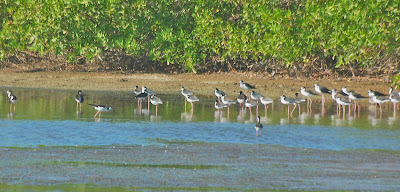
The number of Black-necked Stilts was amazing, these elegant birds are always welcomed to our day lists. The ponds proved to be like an oasis in the middle of a desert for many birds, including several heron species, Greater Yellowlegs, several groups of migrants Blue-winged Teals, Wattled Jacanas, and so on...
Others species typical of this habitat were both Yellow-headed and Crested Caracaras, distant White-winged Doves, Plain-breasted and Ruddy Ground-Doves, Groove-billed Anis, Pearl Kite, and a Common Black-Hawk that left me take this series of photographies showing him perched on a telephone pole, taking off and then landing on the wires.


You can see the rufous-colored flight feathers that supposedly separates this form (known as the Mangrove Hawk) of the Pacific coast from the "real" Common Black-Hawk of the Caribbean coast (in Panama I mean). Nice way to end a day full of contrasts and birds!

Las Yayas

After visiting the General de Division Omar Torrijos Herrera National Park (El Cope National Park for some) last monday, february 20th; Rafael Luck, Luis Isaza and your host decided to visit a popular place in the town of Barrigon: Las Yayas falls. It is only 20 minutes above El Cope (where the asphalt road ends) in a quite good gravel road. Here, members of the community, in association with government agencies, have adapted the place for visitors, both natives and foreigners.
The entrance fee is derisory, enough to pay the maintenance of the place. You start to walk down the slope through some steep stairs while hearing the running water in the bottom of the forested canyon and reading the interpretative signs.
At least two different legends explain the name Las Yayas, both include mysterious, beautiful young ladies who were occasionally seen bathing in the crystalline waters by the natives... and "yaya" is a local name for young lady. We soon reached the first group of falls, in the bottom of the canyon. We couldn't resist to have a cool dive and to experience the strength of the falling water over us.
However, the main falls were some steps up away. The families that decided to spent their carnival's monday in that place were bathing under the big falls (please don't let the sculptural model distract you of seeing the falls).
Time to know Panama don't you think?


High above El Cope

The General de Division Omar Torrijos Herrera National Park is located at the central foothills and highlands of Cocle province (central Panama), above the towns of El Cope and Barrigon, that's why it is simply known as El Cope NP sometimes. After having fun in Penonome during the first two carnival days, I went to this park with my friend Rafael Luck, and his guest Luis Isaza, last monday, february 20th (third carnival day). It is roughly one-hour away from Penonome, with good asphalt road all the way to El Cope and then a quite good gravel road to Barrigon. It is in Barrigon, after the elementary school, when the road becomes steep and deteriorates, making to have a high clearance, 4-wheel drive vehicle a need.
The contrast between the dry, hot lowlands and the fresh, greener hills of El Cope is evident, but when you actually enters the national park, it is like entering a different world: exuberant cloud forest covered in mist and a very chilly temperature with the occasional rain shower. From behind the park rangers' cabin, both towns down in the valley look so distant.
There are many trails to walk within the park. We chose La Rana trail, which is a 2 km long, narrow trail which eventually joins the trail to La Rica, making a loop. It is quite steepy in places, but crosses several creeks and is quite good for forest interior birds, but the day was so misty and chilly that we almost saw anything at all. A pair of Slate-colored Grosbeaks, some Spotted Woodcreepers and a Gray-breasted Wood-Wren were the only ones that did showed up (though we heard many others).
It was gratifying to see the exit sign; however, it only marks the middle of the journey... you still have a long way up until you reach again the main road close to the park facilities. At the Visitors Center, we took a rest before entering another loop trail, Los Helechos. It was a good idea, because a mixed flock was working the trees next to the Center. We enjoyed the sight of Hepatic, Silver-throated, Speckled, Emerald and Bay-headed Tanagers along with Shining and Green Honeycreepers, Bananaquits and a Pale-vented Thrush.
Los Helechos trail is much shorter than La Rana, and it also crosses a beautiful creek in its lower part (around 600 meters above sea level). There, we found the bird of the trip: bathing in a tiny pool, a gorgeous male Snowcap showed us why it is so sought after in this place. The little beauty perched close to the bridge and started preening itself... in the darkness of the trail its snowy white cap and tail flashed like reflectors! It was too dark for photos, but somehow Rafael managed to took these pics which show the bird (first without flash... shows a small dark hummer with white cap; the second was with flash, revealing the amazing purple color of its body... both images are copyright Rafael Luck).

We decided to follow the main road in the car,. all the way to El Calvario, the highest point of that road. That part of the road is only for the brave ones, with huge boulders and slippery mud all over, but the view of the distant Caribbean lowlands and the magnificent forest-covered mountains is worth the bumpy ride. The ride back down slope is scarier than the way up, but Rafael managed to brought us healthy and save back to the civilization.
A very nice trip for a carnival day, and a very special site, with the most beautiful forests of Panama!

Tuesday, February 7, 2012

South of town

I just want to share with you some pics from the savanna south of Penonome (Cocle province, central Panama). It is a special habitat, and it is always amusing to crossed it. I started at the airstrip and took a dirt road running all the way along the fence, each post of it was tipped with a Red-breasted Blackbird, an Eastern Meadowlark or a Fork-tailed Flycatcher!
The dry landscape soon became more wet when I reached the shores of a huge artificial lake in the middle of the savanna. I know the lake was part of a huge development that did not progress.
The open areas with short grass had Cattle and Great Egrets, hundreds of Barn Swallows (both flying and perched), Southern Lapwings and at least two Killdeers.
A marshy area was the home of a group of Purple Gallinules, both shiny adults and duller immatures; however, only the immature stayed enough for photos. In the open waters I only saw a Least Grebe... no ducks in the lake, which is weird considering the big group present in a nearby, much smaller lake which I saw some weeks ago (here the entry).
Only a short trip to a wonderful area, but the trip can not be completed without seeing the icon of this habitat: a magnificent Savanna Hawk posing for photos (this time an immature).

Monday, January 30, 2012

Savanna and mangroves

The morning of last saturday, january 28th; Penonome (Cocle province, central Panama) received the visit of an important delegation of birdwatchers from Panama City, prepared to repeat past weekend finding of a Grasshopper Sparrow in Panama after more than 50 years! I joined Rafael Luck, Osvaldo Quintero and Venicio "Beny" Wilson early that morning and departed to the exact site where I saw the bird.
We didn't see it immediately, but certainly our hearts started pumping when we saw a very unusual flycatcher-type bird. Similar in shape and behavior to a Fork-tailed Flycatcher, it seemed to be a partially albino immature because of its relatively short tail. Shortly after this, we were joined by Darien and Camilo Montañez and Marlene (a guest), and started searching. Soon, we had several sightings of a single bird, all brief, but definitives. You can read more about these encounters at Darien's site, Xenornis.
After spending a couple of hours at the site, we went to the Aguadulce Salinas (saltponds), 25 minutes to the west. However, the former saltponds were completely dry, and we decided to go directly to the coast, were some mangrove still persist... and it turned to be a good idea!
In a little pond surrounded by mangroves, we found this flock of sandpipers. As you can see, most of these birds are Lesser Yellowlegs ( straight, relatively short bills, white eye rings, spotted flight feathers) plus some Greater Yellowlegs (similar to the Lesser Yellowlegs, but bigger, with two-toned upturned bills) and Short-billed Dowitchers (chunky shape, long & straight bills) There are at least two Stilt Sandpipers too (slightly downcurved bills). The pond also hosted a single Red Knot and many Black-necked Stilts which refused to stay for the photos. After seeing the obligate Yellow "Mangrove" Warblers, we had lunch at a local restaurant (we ordered an excellent fried fish) and returned to Penonome where we had more encounters with the sparrow before we had to return to our normal lives. It is always nice to scape from the monotony and to engage in the search of a lost bird.

Thursday, January 26, 2012

2012 first field trip

Last saturday's evening was hot and sunny, typical of a summer day in Penonome (Cocle province, central Panama), I took advantage of the beautiful day and did a scouting trip to some side roads west of town little after 3:30 PM... and it was great! Not only saw my first life bird of the year, at least three Ring-necked Ducks in a large pond, but also re-found the now-famous Grasshopper Sparrow after more than 50 years in Panama! But as I said, that was only the scouting trip. Very early the next morning, I went to the same place before dawn hoping to catch the ducks closer to the shore of the lake. The fresh air in the savanna and the immensity of the place is hard to describe... and the sunrise resembling a scene of "The Lion King" movie was simply unbelievable!
I did saw ducks closer to shore... but it was a group of Lesser Scaups, plus three Blue-winged Teals and three Black-bellied Whistling-Ducks. The three Ring-necked Ducks that I saw the day before were far away in the middle of the lake, and only the male was identified with certainty at that distance.
I began the return journey looking for open habitat specialists, finding surprisingly a Northern Harrier as the first raptor for the day. This is only the second time I see harriers around Penonome (first time here),
and it seems that they are not simply passage migrants, but winter visitors as well. Despite the blurry photo, the shape and white rump is unique among the expected raptors there. After a while, I found a tiny, very shallow pond in the middle of the fields... it was alive with birds. Big waders, in the form of several Great Egrets, a Wood Stork and a Great Blue Heron, were sharing the place with Least and Solitary Sandpipers, two Greater Yellowlegs and three Killdeers which became quite evident thanks to their sweet voices.
The nearby grasslands were full of singing Eastern Meadowlarks, plus some Red-breasted Blackbirds, some of them allowing great pictures and close approaching. They were focused in singing out loud to impress any rival or to attract a mate. It is always nice to see these two species (both called "pastoreros" in spanish) side-by-side. However, the most abundant bird in the savanna was the Fork-tailed Flycatcher. A huge flock of these elegant birds were feeding along the fences and in the ground right in the middle of the dirt road. Easily, they exceeded a hundred of birds!


In the end, I failed to relocate the sparrow, neither I found the Grassland Yellow-Finch reported last year by Ken Allaire... but the bird list for only three hours of birding the savanna was impressive and I can't wait to visit the place again next weekend!

Monday, January 23, 2012

Grasshopper Sparrow in Penonome!!!

If there is a resident bird species in Panama that evokes myths and mystery, that certainly is the Grasshopper Sparrow. Formerly a breeder in the Pacific slope, it was thought eradicated due to habitat loss. Not a single resident, nor a vagrant migrant of northern subspecies, have been recorded since the 60's and thus the endemic subspecies of Cocle, beatriceae, was sadly believed extinct by almost all of those who have crossed the country looking for birds in the last decades... until now.
Last saturday's afternoon, I was returning from seeing my first life bird for 2012 (Ring-necked Duck, more on that in another post) and was almost at the entrance of the dirt road (4 miles west of Penonome, central Panama), already seeing the cars at the Panamerican highway, when I decided to stop just to check a pair of Eastern Meadowlarks. As soon as I stopped, I detected a subtle movement in the short grass next to the car. My very first impression was of a gray, tiny mouse, crawling under the grass... but soon realized that it was a bird! The tiny creature eventually stopped no more than 4 meters from my window, raised its head over its shoulders to inspect me and froze... I was shocked! A mythical bird, almost a ghost, the lost Grasshopper Sparrow was standing in front of me, alive... I still shake only of thinking of it. Nervous, I grabbed my camera and started shooting... and the bird did not move. I was able to see it very well, both with my binoculars and through my camera, realizing how beautifully patterned it was. It stayed for complete five minutes, only moving quickly few steps each time just to stand again. It was doing this whenever I was lowering my look to check the photos or to take the binoculars, and sometimes it was difficult to relocate the bird due to its perfect camouflage. It left so unexpectedly as it appeared, flying very quick and low to taller grass taking advantage of the second I took to check the last series of photos... it was very cautious! I started calling my friends to give the good news, but almost immediately I was concerned about the specific identity of the bird I saw: it was a member of one of the resident subspecies or a migrant from the north?
There is little literature regarding the subspecies of Grasshopper Sparrow found in Panama, and none in recent years. There are descriptions in the monumental work of Alexander Wetmore, and in Ridgely & Gwynne's Birds of Panama, both based on previous papers. However, you can get on-line the paper of Storrs Olson aptly named "The subspecies of Grasshopper Sparrow (Ammodramus savannarum) in Panama" (Proc Biol Soc Wash 1980; 93: 757-9), which describes the three subspecies recorded for the country (two resident, one migrant).
The first thing to take into consideration: the migrant subspecies (pratensis) is essentially indistinguishable of the resident subspecies bimaculatus, distributed along the Pacific slope of Panama (specimens from Chiriqui, in western Panama, and Chepo -east of the Canal area-) and extending to Mexico. There are plenty of photos on-line of pratensis, so it is useful in order to compare with my photos (I took many, but they are essentially variations of those I'm posting here). We have to consider pratensis as a VERY rare vagrant to Panama, only recorded so far in the western Caribbean slope twice in the late 60's and with its southernmost -usual- winter range extends only to Belize. In the other hand, beatriceae (named honoring Alexander Wetmore's wife, Annie Beatrice) is described as quite distinctive in being the palest of all the subspecies.
Based on range, beatriceae is the expected subspecies at that locality (and notice that two specimens examined by Olson were collected exactly at 4 miles west of Penonome). The key characteristics are: throat, breast, flanks and undertail coverts pale pinkish buff (not rich ochraceous yellow as in bimaculatus or pratensis); median crown stripe very pale, almost white (no deep buff). As bimaculatus, beatriceae have distinctly reddish streaks in the nape (distinguishing them from southern subspecies). Others -pale- subspecies from North America have never been recorded south of Honduras in the winter, and are not expected in Panama.
I think (or want to think) the bird of Penonome belongs to the endemic subspecies beatriceae by the field marks highlighted above and that can be appreciated in my photos, which I only cropped (no adjustments of color, contrast or sharpness added)... what do you think?

Tuesday, January 3, 2012

Gabrielle Teresa

Just in case you missed the new, my precious baby girl was born last december 27th weighting a little more than 9 pounds(!), now she is a healthy one week old little baby full of energy and life. For just a week, she seems to have changed since her birth (check the photos here)... or it is only my impression?
Welcome Gabrielle Teresa to the world, mom and dad love you very much!
P.D.: where did I see those tiny binoculars?

Sunday, January 1, 2012

Bird of the month: Cinnamon Woodpecker

This edition of "Bird of the month" features a species selected as "Bird of the year 2012" by the Panama Audubon Society... yes, you're right, I'm talking about the Cinnamon Woodpecker (Celeus loricatus). For such a common species, in the right habitat, this is a beautiful bird. It is well
distributed at our Caribbean slope forests all over Panama, but also in the Pacific slope from central Panama eastward. It looks also comical, with its bushy crest and cinnamon color. As you can see, the female lacks almost all the red color that the male shows in the head, like many others woodpecker species. The Celeus woodpeckers inhabits a broad range of habitats, and all have contrasting patterns in their plumages, with some being absolutely gorgeous
patterned in yellow, black, chestnut or cinnamon. The first photo is the same individual of the winning photo, however, is not exactly the same photo due to contest rules. It is always a thrill to find such a photogenic beauty so close! For these, and many others reasons is why the Cinnamon Woodpecker is our bird of the month (and of the year)!

Literature consulted
1. Angher G, Dean R. The birds of Panama. 2010