Wednesday, June 26, 2019

2019 Macaulay Library Sound Recording Workshop

When you appreciate birds in the wild you quickly realize the infinite variety of facets they have. Taking notes or photos simply becomes insufficient and, at least for me, it became evident that I should record their songs and calls. So, shyly, I started recording bird sounds with my smartphone, nothing more. Definitely not the best, and thanks to some online tutorials I improved my technique a bit ... it was when I started uploading many of my audios to eBird.  Well, someone was paying attention to this.  By the end of 2018, I received an email from Matthew Medler, who is the Collection Manager Leader of the Macauly Library at the Cornell Lab of Ornithology, inviting me to this year Sound Recording Workshop... I was surprised!
Matt showing us interesting equipment at the museum of the Macaulay Library
YES!  Ready to go!
The complexity of bird sounds is so wide that it certainly surpasses other aspects of their lives.  With the large variety of songs, sub songs, calls, contact calls, flight calls and non-vocal sounds (used in some displays and other situations), now I think it is absurd to annotate "Heard only" in my eBird checklists (in fact, it make more sense to annotate "Seen only" if you see a silent bird).  The Macaulay Library collect and preserve recordings of each species' behavior and natural history, and make it available for research, educational and commercial purposes... so I guess there is no better institution to teach you about how to record natural sounds.
Thanks God the parabolas are way lighter now!
Cornell University and the Cornell Lab of Ornithology hosted the workshop.  One by one, each of the participants arrived at the Robert Purcell Community Center, at the North Campus.  Matt gave us an introductory lecture and assigned the equipment, while we started to know each other.  What a terrific group!  Locals and foreigners (from ten different countries) with different interests and expertise, but all passionate about birds and wildlife in general, under the guidance of world-top, renowned instructors, specialist in their fields and experts birders.  I was happy to meet with old friends (like Roselvy) and finally meet people who had only contacted by email at some point during their birding trips through my country (like Kathi, who was one of the instructors).  Staying at the dorms of the North Campus, attending the lectures and having meals at the community center with your personalized card made us feel the academic environment of one of the most renowned institution in the US.
This is how a 4:20 am breakfast looks like
The workshop was planned in detail.  Everyday we started early with breakfast at 4:20 am in order to be on route to our recording sites no latter than 5:15 am.  We changed sites (and thus habitats and sound recording conditions) every day.  The fieldwork consisted of dividing us into small teams (usually of two or three), each with an instructor who showed us the best sound recording techniques, helped us with the settings of the equipments, bird ID and kept us on schedule ... really a personalized attention.
With Daniel Souza (from Mexico), all geared up! Morgan Rd. marshes.
Then we would go back to the community center for lunch. In the afternoon we attended the talks and spent time editing our recordings; but we also attend the Cornell Lab of Ornithology where we carry out various activities... these visits were certainly a personal highlight of the workshop.   Of course we had plenty of spare time to birdwatch and socialize... even one afternoon was scheduled to twitch local rarities and special birds around the Finger Lakes area!
These birders know how to have fun! With Orlando, Rafael and Daniela
And the results?  Well, more than 800 recordings uploaded to eBird by the participants of the workshop during the week, with notable improvement of its quality throughout the days!  I uploaded 69 recordings and had 17 lifers!  But most important, I got new friends from all over the world that share my passion and that work hard to make this world a better one for birds and, why not, for us too!
Some of our instructors: Andrew Spencer, Matthew Medler and Jay McGowan
And what about the lifers?  Well, I documented 13 of my 17 lifers with sound or photo.  The warblers and wrens offered the best sound recordings experiences, while waterfowls were nice highlights, specially those northern breeders that stayed a little bit more due to different circumstances, like Redhead, Canvasback and Snow Goose.  An all-white goose may be boring... but hey!, ANY bird with "Snow" on its name is a highlight for this sun-lover Panamanian!
Adult male Redhead
Adult male Canvasback
Snow Geese
The avian lifers were not the only ones!  We saw plenty of wild mammals running freely at the campus, like White-tailed Deer, Eastern Gray Squirrel and Eastern Cottontail, plus several new  species for most of the foreign members of the group, like extremely-cute Eastern Chipmunks, Woodchucks, Striped Skunk, Muskrat, American Beaver and even an adult Black Bear at the Arnot Forest that allowed GREAT views (video recorded by Arthur Gomes, one of the participants from Brazil)!
Woodchucks
American Beaver... somewhat reminiscent of our Capybaras
I want to thank all the personnel of the Macaulay Library and the Cornell Lab of Ornithology for the great experience... we felt at home.  And all my companions and instructors at the workshop for the great moments.  The question now is... do I get a shotgun microphone or a parabola?  Whatever I decide, prepare to see me recording birds in every corner of Panama soon!

Monday, June 10, 2019

Global Big Day 2019! What a day!

And the Global Big Day started!  Last May 4th, thousands of birders around the world joined efforts to record the largest number of birds species in 24 hours.  Of course, new records were set and hundreds of birding histories were told.  You can read the global summary at the eBird page... and my own history here (just keep reading).
Ramiro Duque, Rolando Jordan, Jan Axel Cubilla and Carla Black
Like last year, my intention was to do some pelagic birding... and again, my destination was Bahía Piñas and fabulous Tropic Star Lodge in eastern Darien.   Last year, getting to Bahía Piñas was a complete adventure... this year, well, there were some inconvenients as well.  First of all, I was not able to take the commercial flight to Bahía Piñas... all the seats were booked due to the Presidential Elections that would be held the next day.  However, the NGO ADOPTA Panama Rainforest managed the support of the government (through MiAmbiente) who contributed with transport and logistics for several teams to remote counting areas, including the ADOPTA Team to Puerto Obaldia, in extreme eastern Guna Yala.  Guido Berguido (ADOPTA's executive director and a friend of mine) included a stop in Piñas in the flight plan, so I joined them in the ride.  After some mechanical setbacks, we were finally in the air heading to Piñas.... but due to some logistical problems, the ADOPTA team had to stay in Piñas, so we improvised a little bit.  Rolando came with me on the boat while the rest of the team birded around the town and the airstrip.
Bahia Piñas airstrip and town
After an early breakfast on May 4th, I was ready for the pelagic trip.  Rolando was already waiting for me at the dock, as well as the crew of our fishing boat.  The day was dark and soon it started to rain... a lot!  Anyway, we headed directly to deep waters.  The Continental Shelf break is very close to the coast in this part of Panama, meaning that quite soon we were enjoying pelagic birds around us.  These waters are incredibly rich, the avifauna is abundant and easy to approach, paralleling the other wildlife for what these waters are famous: pelagic fishes, specially billfishes!
We were not there to fish, that was for sure... we were quite busy counting and identifying the birds around, specially the storm-petrels.  Three different species (Least, Wedge-rumped and Black Storm-Petrels) swarmed around the boat in huge numbers!  Check one of the flocks that we crossed containing all three species.
Storm-Petrels off Piñas
We scanned these flocks looking for rarer or unreported species for Panama, and I tried to took as many photos I could... sometimes you detect rarities on land, reviewing the photos, but not this time.  Apart of the storm-petrels, we saw both Galapagos and Wedge-tailed Shearwaters, several terns and boobies species, including obliging Nazca Boobies!  We essentially followed a route along the shelf, stopping at usual fishing hotspots and whenever we find activity, both of birds and other animals like dolphins and tuna.  In fact, a huge school of tuna was followed by more than 100 Short-beaked Common Dolphins!  What a sight!
Pair of Nazca Boobies on floating debris
Short-beaked Common Dolphin
Time flies when you are having fun, and soon it was time to head back to the lodge.  Closer to the coastline we find different species, like Brown Pelicans and Blue-footed Boobies, adding them to the growing list.  It was not an exceptionally long list, but certainly one with quality birds.  In fact, we were sure that we got that day several unique species for the country, since we were the only team birding the seas.
Blue-footed Booby
Back at dock, I said good bye to Rolando, who went back to Piñas town to bird with the rest of the group.  After few minutes of rest, I also started to scan the surroundings.  The lodge is surrounded by lush forest, and some good species wander around.  Unfortunately, I was not able to relocate the Viridian Dacnis I saw the day before, but anyway, I kept birding.  The highlight was a flock of swifts including Spot-fronted Swifts and a lonely Chapman's Swift!  Creepy photos of both them at this eBird checklist https://ebird.org/camerica/view/checklist/S55817569.  At night, I ended my participation recording Gray-cowled Wood-Rail and Mottled Owl... but a Crab-eating Fox just in front of my cabin stole the show!
Crab-eating Fox
I ended up submitting 72 species for the day, a modest number compared to other teams... but for second year in a row I manage the greatest number of unique species to the national total, only matched by Isaac Pizarro (who birded all the down from Pirre range to the lowlands around El Real): both recorded 11 unique species.  These numbers reflect that we need more participation... another team doing pelagic or more teams covering Darien National Park; but also, they indicate how important each participant is.  As they says, every bird counts!  Panama numbers, as in general, were good.  We didn't break our previous year record of 750 birds species since we got 731!  Still an awesome effort that positioned us as first for the Central American region and 8th worldwide!  I wish to thanks all the participants who kindly donated their time and effort in making this possible, and to ADOPTA a Guido Berguido for coordinating the logistics and transportation provided by the government.  Next year I hope more participation and official support to keep making Panama number ONE in Central America in terms of avian diversity!

Friday, April 19, 2019

500th Bird for 2019!

As posted previously, I spent the last weekend in Penonome with my family.  After exploring the mountains of Olá, we ended the day doing some owling at the savannas surrounding the towns of El Coco and El Gago, finding a new year bird in the form of Barn Owl.  So, when we woke up on Sunday, my Year-List of birds for Panama was at 498!  I already had plans for the day with my family, which included a visit to a river to swim and enjoy, but I was pretty sure that, with some detours of the original plan, I would be able to add at least two new birds during the day.
Zarati river
Actually, it was easier said than done... in my quest for The 600 Club, I have already birded extensively Penonome and surroundings this year.  I needed some intel data and, again, my friend Josanel Sugasti gave me some input on how to find some specialties close to the place I was willing to visit.  We headed north of Penonome, following the road to Chiguirí Arriba, which is a little and charming town almost in the Caribbean side of Cocle province, in central Panama.  The road runs along the Zarati river, eventually crossing it at a place where I usually stop to check the gallery forest along it.
Red-headed Firetip (Pyrrhopyge zenodorus)
At this point, the river excavated an impressive canyon, as you can see in the first photo.  The vegetation attracted several common species of birds, plus my life Firetip (Pyrrhopyge sp.) attending a fruiting tree, but no new species for my year list.  So we kept on until the town of Caimito, where we took the road to Sofre.  The site is known by the colony(ies) of Montezuma Oropendola, which are weirdly into the Pacific slope of the province.  However, it seems that they are located in private property and we didn't have time to ask.  Instead, we focused on another -uncommon- species.  Following the directions of Josanel, I located the lowest part of the road, a place where it cross several narrow creeks, and started to check the power lines.  Soon, we detected a flock of swallows swirling over one of the creeks.  The small size and uniform dark plumage clinched the ID: White-thighed Swallows.
White-thighed Swallow
The swallows offered prolonged views, we even were able to see the tiny white thighs this species is known for and heard some vocalizations.  They were my species # 499 for the year and, to be honest, I thought that was going to be all, since it was time to go to the river as planned, and I was not expecting more new species.  We headed back to Caimito and took again the main road to Chiguiri Arriba.  At the town of La Vieja, we took a dirt road (four-wheel drive needed) to Pozo Azul, also known as Las Pailas by the locals.  We payed at the entrance and took a trail that quickly became a long ladder inside the forest going steeply down the river.
Steps to Pozo Azul
At the bottom, the crystal-clear and chilly waters of Pozo Azul were waiting for us.  What a nice place!  Again, the river had eroded the rocks to form some deep water holes ("pailas") where you can dive and swim, accompanied by fresh water fishes as you can see in the photo!
Pozo Azul
The place was crowded (for Panamanian standards), but anyway we had a great time there.  The way back, up the steps, was not that fun, but we made it on time to hit the road again and continue exploring the region.  With plenty of time, we decided to visit Chiguirí Arriba.  This town is on our hearts since both Gloriela and me did part of our internship at the local (and tiny) health center.  Seeing it after all these years, looking exactly like we remembered it, made us feel nostalgic.
Chiguirí Arriba's health center
I remembered that during my internship, it was not rare to see White-thighed Swallows and Montezuma Oropendola in Chiguiri Arriba, so we had a look, but find neither.  Although the place looked essentially the same as when we did our internship, there were some changes... including a new road to the next town: Vaquilla.  It used to be a rough dirt road... now we were able to reach Vaquilla in few minutes.  To my surprise, right behind the grosery store where we stopped to buy some drinks, we noticed a lot of activity of Montezuma Oropendolas!
Montezuma Oropendola
They were constructing their characteristic nests, and soon realized that there is a complete colony... even including Piratic Flycatchers and oportunistics Giant Cowbirds (both species depend on the oropendolas).  The Montezuma Oropendola was my bird 500th for this year so far!  The truth is that I'm impressed with all the birds obtained (and the sites visited) this year... and we are just starting!  Meanwhile, we ended our visit to northern Penonome at the Cerro La Vieja Butterfly Garden, where our guide explained us the importance of this beautiful insects and the important conservation effort they make at this isolated point of the country... we need more initiatives like that!  Happy birding folks!
Gloriela and Gabrielle at Cerro La Vieja Butterfly Garden

Monday, April 15, 2019

Panoramic Olá

Olá is a little town in central Coclé province (central Panamá) mere 15 minutes from the Pan-American highway.  This quiet town is the capital of the homonymous district which is, perhaps, the less known district of the province when talking about tourism or birdwatching.  However, Olá offers some natural wonders that are frequently visited by locals, like "Los Chorros" or "El Picacho".
Cerro El Peñón
To the north of the town, the paved road takes you to the mountains, which are exceptionally attractive due to overwhelming sceneries.  I visited one of the most accesible, "Cerro El Peñón" this last weekend with my family.  The winding road through the grassy and dry slopes sinuously takes you all the way to the higher slopes of the mountain.  After the asphalt is gone, the dirt road keep going for miles and miles.  Some impressive rock formations and even a high-elevation plateau become evident, with scattered patches of gallery forests along the narrow valleys.
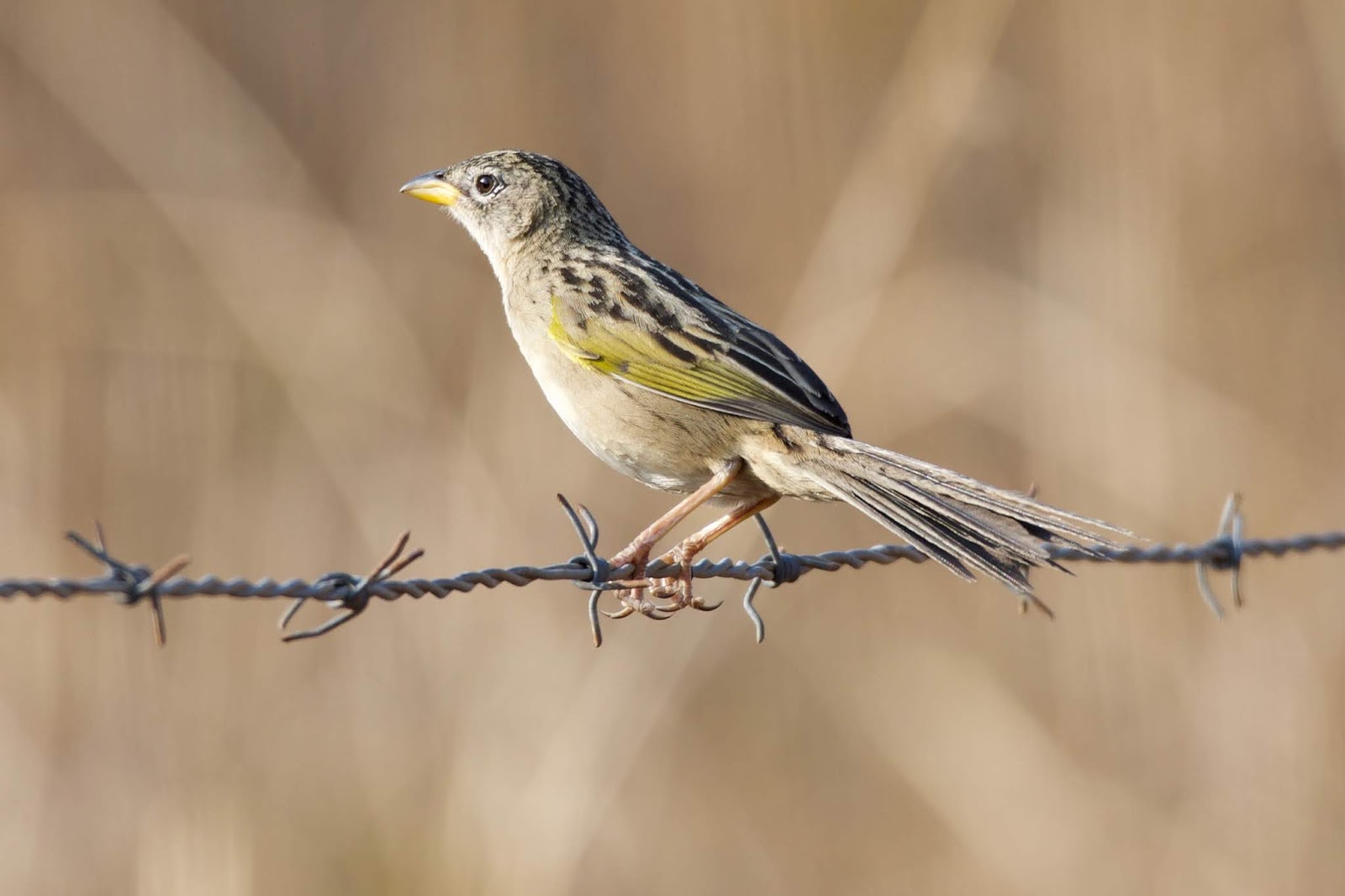
Of course the evidence of human interventions are everywhere in this landscape, but many areas remains wild and untouched... and I'm talking about natural grasslands up there.  This habitat is home to some localized species in Panama, grass-dwelling species that due to the scarcity of habitat are seldom reported, except from usual sites.  One of those species showed up as soon as we left the car to inspect one of these patches of grass.  A pair of Wedge-tailed Grass-Finches inspected us from a barbed wire.  It was nice to see this species again this year, after finding it in Cerro Campana some months ago... after several years without seeing one!
Wedge-tailed Grass-Finch
However, I was interested in another species.  It may sound weird, but I was searching for Rufous-collared Sparrows.  Yes, the ubiquitous "Tío Chicho" of the western highlands have a population in these mountains that was recently re-discovered by my friend Josanel Sugasti last year (check his eBird checklist HERE).  After some tense minutes without noticing any sign of the birds, I eventually saw a pair quietly feeding mere 10 meters away.  I took some photos before they disappeared in the grass... it is the most exciting sight of "Tío Chichos" so far for me!
Rufous-collared Sparrow
According to Ridgely & Gwynne (1989), Rufous-collared Sparrows are unknown in the province, except for an old specimen simply labelled "Cascajal" (¿?), supposedly in Coclé.  Why is this significant?  The easternmost population of this species in Panama is found in Cerro Campana and Cerro Chame and was described by Wetmore in 1951 as the endemic subspecies orestera, which is supposed to be in average darker than the population (costaricensis) present in western Panamá (east to Veraguas).  Some authorities think it is better to treat orestera as synonym of costaricensis... and this population in Coclé may prove this to be right, since its fills the supposed gap in distribution.  To my eye, these birds are identical to those in the western highlands of Panamá.  To be honest, I don't remember how orestera look... I saw my first ever Rufous-collared Sparrow in Cerro Campana back in September, 1996.  There are no recent records of orestera, and the subspecies well may be extinct or critically endangered by unknown reasons, since it seems that its habitat remains.  I wonder what secrets keep these sparrows of Coclé province.... are they costaricensis?, orestera? an undescribed subspecies?  I hope it is not the last time I run into them!

Sunday, April 7, 2019

Time for some LIFERS!!!!

It is not a secret that while you gain experience watching birds in an area, it become more and more difficult to find new ones.  That's why I celebrate every new bird for my Panama list as if it were a lifer... and I knew that if I want more new birds, I had to climb Cerro Pirre, in eastern Darien province.  The first time I went there (check this post), I got almost all the Darien highlands endemics... but my time at the foothills was limited and I missed several species, including some potential lifers.  This time, I contacted a local expert... my friend Isaac Pizarro, who is a certified guide and who knows extremely well the endemics and the local specialties (and more important, he was available for the free days of carnival).  If you don't want to loose time, contact him to find all the birds you need!
Dock with "piraguas" in Yaviza, Darien province
My plan was to spend two nights at "Rancho Plástico", which is a camp site in the middle of the forest around 622 meters on the slopes of Cerro Pirre, in Darien National Park. My journey started very early, driving all the way from Panama City to Yaviza, where I met Isaac, who was waiting for me at the public dock.  From there, we took a "piragua" along the Chucunaque river, arriving to El Real around one hour later, where we met our porter and took a taxi to the community of Piji Basal, where we started to walk.  On the way, we got several eastern Panama specialties, including Double-banded Graytail, Choco Syristes, Yellow-backed Tanager and obliging Black Oropendolas, to name just a few.
Black Oropendola
We reached Pirre Station (better known as Rancho Frío) where part of a group of entomologist was collecting butterflies and other insects.  The other part was already at the Rancho Plástico camp site, so we hurried to go there.  The trail to Rancho Plástico from Rancho Frío is extremely good for birding, specially close to and at Rancho Plástico.  After one hour of hiking, Isaac guided me off the trail to a spot where he regularly sees Black-tipped Cotinga.  To my surprise, an adult male Black-tipped Cotinga was perched and exposed atop a tall and distant tree!  My very first Lifer of the trip!  Terrible photos so I will keep on.  With each step, I was adding more and more species to my Year List (remember that I'm doing a Big Year in Panama for The 600 Club).  Before reaching Rancho Plástico, we checked the lookouts ("Miradores") for mixed flocks (almost always including Scarlet-browed Tanagers) and some other specialties.  Some species easy to hear, but almost impossible to see, where quickly detected and actually seen!  Plumbeous Pigeon, Yellow-browed Shrike-Vireo and my life Choco Tinamou!
Scarlet-browed Tanager, adult male
Plumbeous Pigeon
We set the camp at Rancho Plástico, where the rest of the entomologist group was working on the specimens they collected earlier.  Darien National Park is mega diverse, just imagine how many different insects they found!  But well, I was there for the birds... and the birds did not disappointed us.  Central American Pygmy-Owl, Choco Screech-Owl, Crested and Spectacled Owls were all heard (if not seen) at night, plus bonus Tawny-faced Quail at roost!
Central American Pygmy-Owl 
Tawny-faced Quail, female
The next morning, we started the hike (or I may say climb) to the summit ridge of Cerro Pirre with the entomologists.  The dawn chorus at Rancho Plástico was alive.  We recorded several species by voice first, eventually seeing most of them.  The trail up to the ridge is quite steep and muddy... but there are plenty of avian highlights possibilities to entertain you.  Many of the species are essentially restricted to Darien National Park, while others are way easier to see here than in any other part of Panama (or Central America!).  Most of the lifers I got where in these middle elevations, since the last time I was there, essentially birded only the highest slopes.  Some (HUGE) highlights included Crested Eagle (a dark morph adult), Wing-banded Antbird, Sooty-headed Wren, Gray-and-gold Tanager, Lemon-spectacled Tanager, Yellow-green Grosbeak, Orange-bellied Euphonia and a stunning pair of Yellow-collared Chlorophonia.
Lemon-spectacled Tanager
Yellow-green Grosbeak
Yellow-collared Chlorophonia, immature male
Even before reaching the ridge, as soon as we passed the 900 meters mark, we started to find some of the Darien highlands endemics.  In quick succession we recorded Pirre Hummingbird, Choco Tapaculo, Varied Solitaire and Pirre Chlorospingus.  We dipped on the Green-naped Tanager and on the Pirre Warbler.  The later is nowadays very rare and localized in this part of its limited range and, according to Isaac, it is now necessary to hike around three hours along the ridge to find a good spot for it... time we didn't have.  The group of entomologists set camp at the ridge while Isaac and I spent a couple of hours birding nearby.  We added several Tooth-billed Hummingbirds, King Vulture and Ornate Hawk-Eagle, but nothing else, so we headed back to Rancho Plástico.
Pirre Hummingbird, male
Varied Solitaire
Pirre Chlorospingus
For the last day of the trip, Isaac took me to THE spot for one of the rarest birds in Panama.  I knew all about it... a narrow trail that descends vertiginously from Rancho Plástico to the river, then climb back up a small stream covered with dense vegetation to reach the place where the chances to finding it are the best.  In the way, we found most of the river-dweller birds you might expect: Dull-mantled Antbird, Sapayoa, Buff-rumped Warbler, and many more.  Once at the spot, we waited for the bird to response a taped call... after some tense minutes we heard a response from upstream.  Eventually, a pair of Sharp-tailed Streamcreeper showed up in full display!  What a bird!  I can't show you a decent photo of it but trust me, that is a bird you need to see!
Sapayoa
The Streamcreeper is one of those furnariids that is not closely related to other members of the family; although, the general jizz, accentuated by its long bill, reminded me a leaftosser with bold pale spots in the underparts.   With that great lifer in the bag, the way back up was less miserable than expected.  Once again in Rancho Plástico, it was time to pack up and roll out.  Isaac managed to get me another two lifers (Saffron-headed Parrot and Olive-backed Quail-Dove) before getting to Pirre Station, where we rest a little bit (and I took a well deserved shower!).   As usual, the trail from Pirre Station to the main road was full of nice birds, like Sunbittern, both Rufescent and Fasciated Tiger-Herons, Rufous Piha, White-fronted Nunbird and many more... but my time was limited.
Fasciated Tiger-Heron
White-fronted Nunbird
Our taxi driver from El Real was already waiting for us at the road.  Soon, I got to El Real where I said goodbye to Isaac and thanked him for all the lifers and new year-birds I got.  After all, it was -again- just a three days trip to one of the most remote and preserved forests of Panama.  In summary, I got 77 new year-birds, including seven (7) lifers plus other three (3) Panama lifers!  What a great trip... I can't wait to go back!
Pirre Range (eastern Darien)