Monday, October 3, 2011

Bird of the Month: Spot-crowned Barbet

The Spot-crowned Barbet (Capito maculicoronatus) is distributed from central Panama to northern South America. The barbets are colourful, chunky inhabitants of tropical forest and adjacent areas. Most of them exhibit sexual dimorphism like this species, with males more strikingly patterned. In Panama, the Spot-crowned Barbet is well distributed and common in the right habitat from the Caribbean slope in the central part (around the Canal area) to the east, where it can be found in both slopes. I took all these photos in the province of Darien, Pacific slope of eastern Panama, most of them in a recent trip to that province (all those of the female, with black breast and inspecting nesting sites). You can see in the second photo why this species is called spot-crowned (you may need to enlarge the picture). With some exceptions, almost all the members of this group eat mostly fruits, with some arthropods to add some proteins. There is an interesting taxonomic issue about the barbets. Traditionally, they were recognized as a worldwide family, closely related to others groups, like toucans. Then, some authors considered these two groups as one (barbets and toucans, with the toucans being recognized as simply big-billed barbets). Now, the picture is different: all the three major groups of barbets (neotropical, african and asian) are recognized as separate families, apart of the toucans. Not only that, some authors even split the neotropical barbets in two families: the "typical" barbets and the toucan-barbets (including the Prong-billed Barbet of Costa Rica and Panama and the Toucan-Barbet, endemic to the Choco bioregion of South America). More studies are needed but I'm pretty sure we have not hear the last word about them. For these, and many others reasons is why we choose the Spot-crowned Barbet as our bird of the month!


Literature consulted:

1. Angehr GR, Dean R. The birds of Panama. A field guide. 1st edition. 2010

2.Roberson D. Birds families of the world. 11th edition. Available at http://creagrus.home.montereybay.com/

Tuesday, July 19, 2011

Visiting "La Angostura"

Sometimes we have natural marvels that remain secret despite how attractive they are. That is surely the case of La Angostura canyon in Penonome (Cocle province, central Panama). Close to Gloriela's dad "finca" (see the previous post), the mighty Zarati river runs along a tight rocky canyon after passing its narrowest point (no more than three meters wide), a tiny waterfall known as "La Angostura", which literally means "the narrowness". The Zarati river is quite famous due to all the local legends and narratives inspired on it, and because of the popular aquatic carnivals organized each year attracting thousands of visitors. However, this part of the river is little known, even by the panamanians, surely due to the complete lack of facilities for the visitor and the modest dirt access road passable with a high clearance vehicle, but the place is at walking distance from the main road to La Pintada (the entrance is marked by a chapel, opposite to a Jesus Christ statue, after the neighborhood of Vista Hermosa and before the entrance to Los Uveros town), crossing some pastureland and dry bushes until you reach a rocky formation that descends towards the river (you must use the steps carved in the stone). I visited the place last sunday, under a stifling sun, just for a couple of minutes, enough to appreciate the beauty of the place (also enjoyed by a Green Heron in the other side of the river) and to take these photos. The chocolate-brown tone of the water is due to the recent heavy rains in the area. The most accepted theory about the origins of this canyon states that the Zarati river excavated its way through the material deposited by the volcanic eruptions of the Guacamaya hill, five thousands of years ago. In some parts, the walls of the canyon reach 100 meters og height! So, next time you visit central Panama, specifically the Cocle province, try to visit La Angostura... is worth the effort.

Monday, July 18, 2011

Colourful birds of the dry forest

I went with Gloriela to Penonome (Cocle province, central Panama), to spent the weekend. Of course, we visited Gloriela's dad finca in the outskirts of the town where the originally-planned cabin has become a huge building, looking almost like a fortress with several rooms and gardens, but still surrounded by a nice dry gallery forest and creeks. It is always nice to walk around, feeling the breeze and hearing the birds. One of the most active and colourful is the Rufous-capped Warbler. A group of noisy four of them were working the bushes and the understore close to the house, with one of them begging constantly for food... however, it looked like an adult to me, since it had the complete rufous cap and ear covers characteristic of this species. I easily attracted them by "pishing"... these were very curious birds and I even managed a nice photograph of one of them. Close to them, I heard the unmistakable sound of a Lance-tailed Manakins lek. After a while, I found at least four adult males loosely associated, perched and vocalizing, but I saw no females around. Around the property, I have identified by ear at least four different leks of these beutiful birds, but actually seeing them is more difficult because they like the tangled understore were they perch flying only if a female, or a competitor, approaches. Sometimes, the birds are perched considerably higher in the tree than you expect. I barely got these photos, including a curious male quite high in the canopy, with a "puffy" look, raised red crest and wings dropped down (displaying?). I could spent hours admiring these guys, but I have to admit that sometimes it is frustating because you can hear them very close to you and still remain elusive! I will try to get better pictures next time.

Friday, July 15, 2011

Night outing

Some weeks ago, I went to the famous Pipeline Road and its Rainforest Discovery Center, in central Panama, with Osvaldo Quintero and Rafael Luck, but this time at night during one of the scheduled "night trips" they organize. Of course, our main objective were the owls that live deep inside that forest, specially the Crested Owl that have been reported recently by the Center's staff and which would be new for all three of us. It was a chilly night, and since the instant of our arrival we felt surrounded by the darkness and the silence, only disturbed by the occasional breeze and the buzzing insects. Julia was our (excellent) guide for the night, and we almost immediately heard a Crested Owl behind the facilities, but it was far away. I also heard a distant Spectacled Owl, they sound like a distant machine gun as Ridgely states in "A guide to the birds of Panama". Of course, the photo I'm picturing here is of a different individual that I took many years ago in daylight because we saw no owls that night. These are big birds, actually the biggest of the regular encountered owls in Panama, and one that I have found several times, both at day and night. Julia also heard a distant Tropical Screech-Owl. However, the real show was performed by a little troop of Western Night Monkeys. It is amazing how these creatures move around the tree tops and the branches so acrobatically in complete darkness! My poor photos are due to the distance and the almost complete lack of any source of light. At close range, they don't look like monkeys to me... but like big-eyed squirrels or something like that as you can see in the daylight photo I took in Panama City of a sleeping pair of these some months ago (thanks Beny). There are some taxonomic issues about this species; some think that this form, which occurs in Panama and the colombian Pacific slope, is a good species by its own: the Choco Night Monkey. Eventually, we heard another Crested Owl close to the tower, but despite our efforts, it remained invisible. We heard several others Crested Owl in the entrance road too, plus more Night Monkeys, so I think it was a succesfull night after all!

Tuesday, July 5, 2011

Beach and Motmots

During a familiar weekend at an all-inclusive resort in the coclesian Pacific coast (central Panama), I had the opportunity to have a close look at the resident motmot species: the Blue-crowned Motmot. A single individual (with no tail racquets) was eating the fruits of a palm tree. Of course, the motmot was not the only bird species detected in the gardens of the resort, we also saw many common residents like Boat-billed Flycatchers and the similar-looking Great Kiskadees, Palm and Blue-gray Tanagers and the very vocal Rufous-browed Peppershrike; but by far, the most colourful bird was the motmot. And it was not only beautiful, it is also intriguing. The Cocle province in central Panama is the extreme western end of the range for the conexus subspecies, part of what is described as Momotus subrufescens, or Whooping Motmot by the South America Checklist Committee (SACC), a change not recognized by the AOU nor by the Panama Audubon Society (you can see a distribution map here). The bird did not vocalize, which is the main field mark to separate this form from the lessoni group, the so called Blue-diademed Motmot of western Panama (and Central America). According to Stiles in his original paper, lessoni can be diagnosticable in the field based in 14 plumage characteristics. This bird showed characteristics consistent with conexus, the expected form in this part of Panama (not big contrast between chest and belly, bright green throat, contrasting thighs -as in the last photo-, lots of violet color in the posterior part of the diadem, etc...), except for the black border around the posterior diadem which was broad and conspicuous, as expected for lessoni. Considering that Cocle province could be a potential intergrade zone for the lessoni and conexus forms of this complex, I will try in the months to come to listen for these birds near my home in Penonome in order to address properly this issue about which form occurs in Cocle... so stay tunned!
Bonus, a young Green Iguana at the resort's gardens (abundant!).

This post was submitted to Bird Photography Weekly # 150, check it out!

Friday, July 1, 2011

Bird of the Month: Black-and-white Owl


The Black-and-white Owl (Ciccaba nigrolineata) is a medium-sized, strictly nocturnal bird inhabitant of forest and forest edges and adjacents clearing of Central and South America. In Panama, is a a common owl (by voice) in the adequate habitat, which includes the Panama City itself, where I took all the photos I'm showing here (more specifically, in the Albrook residential area, thanks to my friends Karl and Rosabel Kaufmann). This spectacular bird is beautifully patterned in black and white as its name suggest, with contrasting orange-yellow bare parts, making it unmistakable in its panamanian range, though some similar-looking species exist in South America (including the still undescribed "San Isidro Owl from Ecuador and Peru). Despite its commoness, and characteristic vocalizations (similar to those of the Mottled Owl), it is not well-known by the general population, surely due to its nocturnal habits. It feed mainly on insects (notice the katydid this indivual have in the beak), but also on small mammals, including bats that sometimes flycatch under artificial lights. It is always nice to find these big predators, specially if they allow you to take some pictures despite the light conditions. For these, and many others reasons is why we choose the Black-and-white Owl as our bird of the month!This post was submitted to Bird Photography Weekly #149, check it out!

Literature consulted
1. Ridgely RS, Gwynne J. A guide to the birds of Panama. 1st spanish edition 1993
2. Angehr GR, Dean R. The Birds of Panama. A field guide. 1st edition 2010

Saturday, May 14, 2011

Rainy day in Pipeline road

Some days ago, I received the nice visit of a great friend of mine from Colombia. Rafael Cortes came attending a seminar, but somehow we organized a short walk along the famous Pipeline Road in central Panama, just to remember old times. The day was particularly dark, and a heavy rainstorm quickly change the original plan of walking deep inside the road. Instead, we waited at the Rainforest Discovery Center, enjoying some cokes and snacks, waiting for the rain to stop, and watching wet Yellow-rumped Caciques essentially doing the same (waiting). Eventually, the rain stop, and we were able to walk a little. The activity was low, the day dark, and the percentage of humidity in the environment was so high that we almost felt the water in each breath. Most of the birds recorded were by calls, and Rafael recalled very well many of them despite he is now used to a different set of birds in the Colombian Andes. But we did saw some birds! The first of many of them were a flock a Brown-hooded Parrots, with a pair lovely taking care of each other. They are quite colourful if you got close looks as we did, usually you found these parrots flying swiftly above you. At the bridge over the Frijoles river, I spotted a very distant woodpecker, a pair of them actually. Despite the distance (they were VERY far away), we both recognized the parallel white lines in the back, making them a pair of Lineated Woodpeckers because the other possibility, the Crimson-crested, have white lines in the back forming a "V". My photo shows a female, of course is from my files (notice the clear skies and the proximity of the bird). We walked all the way to the Limbo river, and a little beyond... but it was getting late and it was clear that the road deteriorates after that point, becoming really muddy. In the way back, we crossed an antswarm with all the usual ant followers: Spotted, Bicolored and Ocellated Antbirds, Plain-brown and Northern Barred Woodcreepers, Gray-headed Tanagers, and a group of Song Wrens. At this point, we already recorded two species of trogons, including a male Black-throated Trogon calling from an exposed perch. Later, I heard a White-tailed Trogon... three, of five trogon species found along this road. It was a great day, not only had a good walk through the forest, but also the company of a great friend make it unforgettable. Hope to see you soon Rafael!

Sunday, May 1, 2011

Bird of the month: Black-capped Donacobius

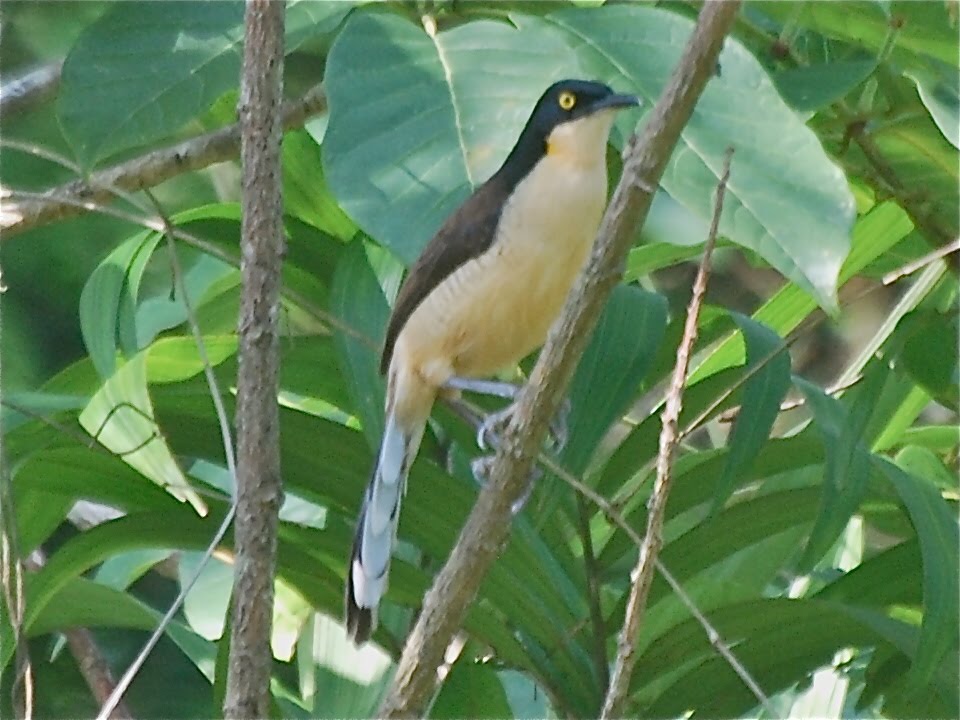
The Black-capped Donacobius (Donacobius atricapilla) is an enigmatic resident of marshy areas and grassy river banks in eastern Panama and most of South America (to northern Argentina). Its real affinities are unclear, being classified as a mockingbird, a wren, incertae sedis (meaning "not classified at all!") and, lately, as the sole member of its own family (Donacobiidae), probably related to an Old World group of warblers! The thing is that this fascinating bird resembles all of them. It is sized and shaped as a mockingbird, but performs loud duets while calling, like some wrens species. Also like some wrens, it is a cooperative breeder, meaning that individuals other than the breeding pair help them to feed the youngs and to protect their territory. Probably we saw one of these "helpers" during our last trip to central Darien province (eastern Panama) where we saw a pair of these splendid birds making the duetted performance accompanied always by a third individual (top photo). Seeing a pair of these birds duetting is an extraordinaire experience, with their loud calls reminiscent of a car alarm (seriously!) and their asynchronic, but rhytmical movements while exposing the patch of orange skin at the sides of their necks. Unlike any wren, they make cup-like nests among the reeds. Panama is the extreme end of its world range, and I have to say that we are very fortunate to have such a beauty as part of our avifauna. For these, and many others reasons is why we choose the Black-capped Donacobius as our bird of the month!


This post was submitted to Bird Photography Weekly # 140. Check it out!

Literature consulted:

1. Angehr GR, Dean R. The Birds of Panama. A field guide. First edition 2010.

2. Remsen JV, et al. A classification of the birds species of South America. Version: 31-march-2011. American Ornithologists Union.

3. Roberson D. Birds Families of the World: Donacobius page. 10th edition.

Saturday, April 30, 2011

Ring-billed Gull in Santa Clara beach

After visiting Penonome (central Panama) during april's last weekend, Gloriela and I decided to stop by the Santa Clara beach before returning to the city. For my surprise, we found a Ring-billed Gull among the dozens or more Laughing Gulls. Probably for most of you, the Ring-billed Gull is an abundant, boring gull found everywhere... but for us, in Panama, it is a very scarce migrant, present mostly on the Pacific coast of central Panama, specially around Panama City (more birdwatchers there?). It has been a while since my last sighting of a Ring-billed Gull in Panama... surely due to my few visits to regular sites like Costa del Este and Panama Viejo. The presence of this gull is expected in this part of the country according to Panama's new field guide (Angehr & Dean 2010), but for me was a nice surprise. It was not a mature adult, as you can see by the brown flight feathers; but I'm not an expert aging sea gulls. It was with a flock of Laughing Gulls, begging for food close to a group of visitors. Compared to the the Laughings, the Ring-billed was bigger, paler, heavier, with a distinctive pale iris and a different flight pattern, which both of us saw several times. I followed the flock for a while, trying to capture some close pictures, and I think I did it well. After a while, the whole group flew away (surely a group a playing kids with their canine pets had something to do with that)... so we left in the place enjoying the breeze, the sand and the cold waters of Santa Clara beach!

How many tones of yellow you see?

Recently, during one of those weekends that Gloriela and I spent in Penonome (central Panama), I noticed that most, if not all, of the birds that I photographed were mostly yellow... Mother Nature have an infinite variety of tones and mixtures of colors, making the word "yellow" not good enough. For example, what can be more yellow than a Yellow Warbler? By this time of the year most of the individuals are gone, and those that you are lucky to see exhibit the bright yellow plumage honoring its name. Nice yellow don't you think? But then a male Yellow-crowned Euphonia appears and you have to re-define your concept of "bright yellow"!


Probably the contrast with the black parts makes its yellow to look brighter... or maybe it is simple BRIGHTER! Well, now compare these two with the modest Yellow-bellied Elaenia's yellow belly. I think it is attractive in spite of its dullness, giving a bit of color to a mostly grayish bird.

In general, the small tyrannids are simply duller than others species. In a short walk near the stream, bordering the property, I found almost side-by-side a Mouse-colored Tyrannulet (thanks to its characteristic call, which to me sounds like a maniac little laugh) and a Pale-eyed Pygmy-Tyrant (also by its pretty loud call, specially considering that it is a really tiny bird). Both are dull yellowish, one with brown tones, the other more greenish. Notice the pale legs and the white iris of the Pygmy-Tyrant. Both species are typical of dry areas, so its ocurrence around Penonome is completely expected because the town is located almost in the heart of Panama's dry arch, the area of coastal lowlands in the Pacific slope of central Panama with a marked dry season. Of course we found others birds typical of this habitat too, like Lesser Goldfinches, Lance-tailed & Golden-collared Manakins (the former with no yellow at all I have to admit, but seriously gorgeous), Tropical Kingbirds, and Rufous-sided Warblers showing also its nice yellow underparts. I found several of these active and curious warblers while walking along the stream, in the most shaded areas. I think they are my favorite birds in Penonome due to their curious behavior and the contrasting patern of the head with the underparts. It was a nice combination of yellow tones and good birds!