Wednesday, January 8, 2020

Bocas' Birds and Friends

Tranquilo Bay pier, Bastimentos Island, Bocas del Toro
Traveling around the country looking for birds also bring friends together... it is always great to reunite with old friends or to meet social media friends personally.  During one of those trips, I went with my family to Bocas del Toro province, in western Caribbean slope, specifically to the Bocas archipelago.  Apart of the birds, the islands are a nice touristic destination, with exuberant vegetation, delicious foods and pristine beaches.. perfect for a family micro-vacations!
The Cubillas at Colon Island, Bocas del Toro
We stayed at Colon island in a beach resort surrounded by secondary vegetation that produced several western Caribbean slope specialties, like Montezuma Oropendola, Olive-crowned Yellowthroat, Grayish Saltator and even a fly-by Gray-headed Dove to my delight (a year-bird for me).  We were close enough to Bocas town to walk the busy streets visiting the stores and to have traditional dinners there, while enjoying the spectaculars sunsets.
Spectacular sunset at Bocas archipelago
My plan included a visit to Tranquilo Bay Eco Adventure Resort, in Bastimentos island.  The calm waters surrounding the pier (as you can see in the first photo) certainly live up to its name (tranquilo = calm), and the forests around the cabins were alive with bird activity.  As usual, my friends Natalia and Ramón showed me the local specialties, including range-restricted (for Panama) Stub-tailed Spadebill, more Gray-headed Doves and Three-wattled Bellbirds that call the islands home during their non-breeding season.  Stacey Hollis, who also is a resident guide at Tranquilo and one of those social media friend that I finally met that day personally, joined us to find more birds!
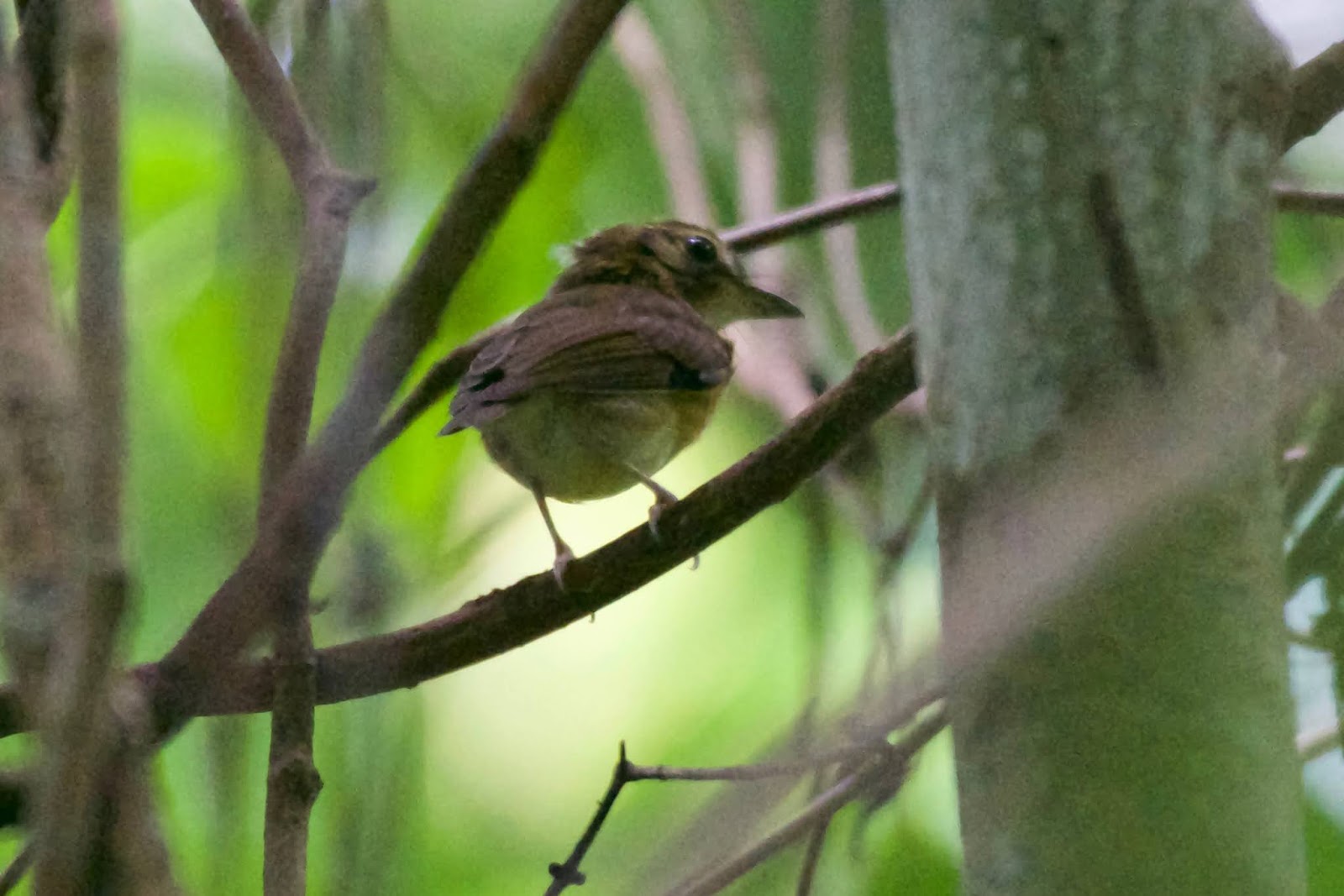
Stub-tailed Spadebill
Three-wattled Bellbird, subadult male
We took a boat to a nearby island: Cayo Venado.  My main target there was the Snowy Cotinga, which use the mangrove forest surrounding the channels.  Soon, eagle-eyed Natalia spotted a female cotinga atop a mangrove tree.  Eventually, we saw several adult males and another female cotinga, allowing some nice photos.  What a bird!  Back at the hotel I was able to say Hi to Renee, Jim and Jay (who own and run the lodge with their families) before heading back to Colon island where my family was enjoying the marine breeze by the swimming pool!
Snowy Cotinga, adult male
Ramón, Natalia, Jan Axel and Stacey
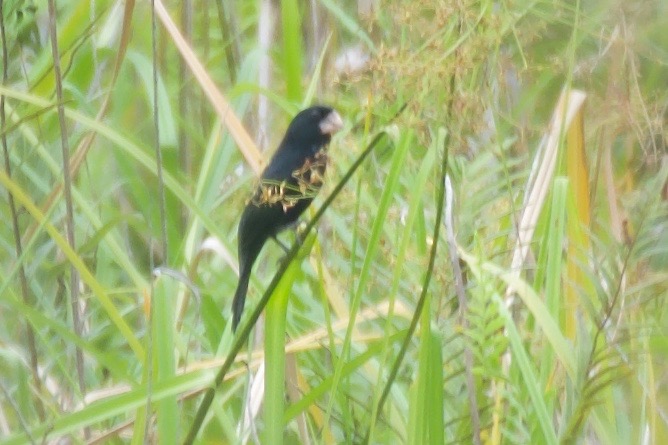
Well, but the mini-vacations were not over yet... I still had some targets in mind.  The next day I met two social-media friends (before that day we knew each other only by emails and WhatsApp messages) at Boca del Drago, at the northern side of Colon island.  Both resident of Colon island, Lukas Bell and Pat Wade (I met his wife Kitty -also a social-media friend- later that day too) joined me to bird along the Snyder channel, an artificial channel that parallels the mainland coast close to Colon island that was used to transport loads of bananas and other merchandises.  We chose that site due to a very localized species: Nicaraguan Seed-Finch.  Our first attempt at the usual sites produced no birds... but the channel and the estuary of the Changuinola river entertained us with many different species.  At the last possible spot, Lukas insistence paid off: an adult male Nicaraguan Seed-Finch was working the grass spikes with its huge, pink bill.  I managed some diagnostic shots, my first pictures of that species!
Nicaraguan Seed-Finch, adult male
Our last target was somewhat easier.  After leaving the channel, our boatman took us to the small Swan Key, home of a colony of seabirds, including dozens of breeding pairs of Red-billed Tropicbirds.   The tropicbirds are almost guaranteed at that location, so with our targets in the bag we made it back to Boca del Drago.  Pat's analogy of my Big Year with the Atlas Stones Competition, where lifting each rock is increasingly tougher... the same as getting new birds while the year advances, was certainly correct.
Jan Axel, Pat and Lukas
Nesting Red-billed Tropicbird
Our twitch ended at Boca del Drago, tasting one of the culinary delights of the Caribbean: the Run down or Rondon.  Simply exquisite!  Lukas took me back at my hotel, but only after checking some prime habitat at Carenero island, adding more species to our growing list.  I spent the rest of the day with my family before departing to Panama City in the last evening flight.  I got many new year-birds... but most important, was able to bird with friends and to spent time with my family at a paradise island as well!

Friday, December 6, 2019

Chiriqui Highlands clean-up!

The advantage of having a small birding community in Panama is that you know most of the avid birders of the country.  That is specially useful when you are doing a Big Year because you need to find local specialties with limited time (specially if you are doing a Big Year AND still have a regular job unrelated to birds or traveling).  After noticing that there was a big gap of Talamanca endemics in my Year List, I called a great friend of mine, Genover "Ito" Santamaria, and planned to spend half-day in his reign, looking for those specialties.  Ito is a nice guy and also a great birder, something you can experience by contacting him through Tamandua Nature & Photo Travel Panama.  Why you should?  Well, keep reading and you will see!
Talamanca endemic Ochraceous Pewee
As mentioned before, I only had half-day to find a list of targets, most of them endemics of the Talamanca mountain range shared by Costa Rica and western Panamá.  So I spend the night at the town of Guadalupe and went to bed after having a hot chocolate with marshmallows (specially good when the temperature outside is 12ºC).  Very early the next morning, Ito joined me with his modified 4WD truck (just after hearing my first target of the list, a Dusky Nightjar, above his house!).  Knowing the we were short of time, he planned to visit some key sites in a quick succession in order to maximize our chances.  The first stop was a road near the town of Las Nubes that crossed several habitats, including some nice patches of forests.  Quickly he started to point out some nice additions to my Year List.  Some forest border specialist, like Ochraceous Pewee and Black-capped Flycatcher were quickly noticed, while some skulkers took a little bit more of time (Buffy Tuftedcheek and Streak-breasted Treehunter).
Streak-breasted Treehunter (also a Talamanca endemic)
We crossed several mixed flocks with flycatchers, tanagers, chlorophonias and redstarts.  The activity was intense... actually, we noticed that it was very intense!  Soon, we realized that a bird we called earlier was vocalizing  and that probably all the clutter was due to its presence.  We started to search every tree, but following the hooting notes to its source was not easy.  However, experienced Ito knew exactly where to look and soon he found it!  A fierce-looking Costa Rican Pygmy-Owl in all its glory showed itself.  We got more-than-excellent views through the spotting scope... only my second sight ever and -by far- the best one!
Costa Rican Pygmy-Owl
Well, with most of my targets in the bag, we moved to another spot nearby where we got more birds, some of them also new year-birds.   Although some of them were not endemics, I was amazed to be able to include in my list some birds that I had not seen in many years in Panama.  Actually, two of them where species that I had seen only once before... in both cases (White-throated Flycatcher and Barred Becard), Ito was also involved in showing them to me for the first time.
White-throated Flycatcher
If you think this is a quick summary, well it is!  We moved from site to site very quickly, always looking for new birds.  We finally visited the last scheduled site, Volcan lakes.  It was almost noon, but the forest surrounding the lakes was alive with singing birds!  We were particularly lucky with flycatchers (with Slaty-capped Flycatcher and Eye-ringed Flatbill being new year-birds) and furnariids.  The mega skulker Ruddy Foliage-Gleaner allowed short -but nice- views... it was a Panama lifer, while both Chiriqui Foliage-Gleaner and Costa Rican Brushfinches offered an unforgettable show, posing for photos and I could even record audio.
Chiriqui Foliage-Gleaner
Costa Rican Brushfinch
What a memorable morning!  But it was time to say good-bye.  Curiously, the target that was still missing was also a widespread and common highland endemic: Long-tailed Silky-Flycatcher.  We were not able to find it at its usual haunts in Guadalupe, but Ito gave me the directions to find it in my way back to David city.  Well, as you guess it, the bird was exactly where Ito told me!
The Long-tailed Flycatcher was my year-bird #700 for Panama!  At the same spot, I got more year-birds, including my life Townsend's Warbler!  So... YES!  It was an amazing quick-trip to the western highlands, full of endemics, specialties and new year-birds but more importantly, it was a birding trip with a good friend!

Friday, October 25, 2019

Visiting Escudo and Rio Cañas

Escudo de Veraguas is an isolated island in the Caribbean coast of the Ngöbe-Bugle comarca in western Panama, re-known by its remoteness, pristine beaches, mangrove canals and rock formations.  My wife and I visited it twice before, more than 10 years ago, before it became the touristic boom it is today.  Apart of the landscapes, the island is a living lab where different species have flourished isolated from mainland relatives and, in some cases, becoming distinct species.
Lizette, Jan Axel, Gabrielle and Gloriela at Chiriqui Grande
We took advantage of one of those organized tours that ran during weekends by Machoemonte, starting at the coastal town of Chiriqui Grande.  Aboard the boat, twelve of us (including Gloriela and Gabrielle) started the adventure to the remote island.  It was not a birding trip per se, but there was another birder in the group, Lizette, who is an ebirder too!  The trip to Escudo from Chiriqui Grande takes almost two hours through both calm (at the Chiriquí Lagoon) and rough waters (after passing the Valiente Peninsula).  We reached the island close to noon since we departed late due to rain and bad weather  conditions... but by the time we reached the island the sky was blue and the heat made us jump right away to the turquoise waters.
Right at the beach we were able to watch some early migrants and common residents of the island.  I was particularly interested in finding resident White-crowned Pigeon and Escudo Hummingbird.  The pigeon is rare everywhere else... only in Escudo de Veraguas (for Panama) is almost a guaranteed sight.  The hummingbird is still considered by many authorities part of Rufous-tailed Hummingbird, but Panama Audubon Society treat it as an endemic species... one with a tiny range (restricted to the island).  Both would be new year-birds for me.  To my surprise, both were right at the first beach we visited!
White-crowned Pigeon (file photo)
Escudo Hummingbird
I know the hummingbird photo is horrible... but you only need to imagine a plumeleteer-sized Rufous-tailed Hummingbird after all!  Of course we saw more species on the island, including endemic forms of Blue-gray Tanager and Bay Wren... but I took few photos since this was more a beach trip.  After having lunch, we visited other sites around the island, including the mangroves channels and a rocky cove with an arch formation that is popular among the visitors.  It was at the mangroves were our boatman pointed out a sleepy Pygmy Sloth (Bradipus pygmaeus), endemic to the island and considered critically endangered.
Pygmy Sloth
It was a great day at Escudo enjoying the sun and the breeze, plus finding endemic birds and mammals as well, but our time there was limited.  We arranged to stay that night at the Ngöbe town of Río Cañas, in mainland comarca facing the island.  It was around 5:00 pm when we started to head that way.  In the middle of the transect, a swift black-and-white shearwater flew by the boat.  It allowed great views and I saw evident dark vent and noticed it small size: Audubon's Shearwater!  A lifer for both Lizette and me (and certainly for most of the passengers too).  There are very few records of this species in Panama, even considering that -supposedly- breeds in some rocky islets in Valiente Peninsula (close to my sighting).  My camera was inside a plastic bag deep in my backpack of course!  When we finally arrived to Río Cañas, a representative of the local women's cooperative welcomed us and guided us to our rooms.  They have a little community project to receive local and foreign tourists.  After a tasty dinner, we enjoyed a demonstration of typical dances (all inspired in local fauna) and handcrafts.  That night, away of the electric lights, we enjoyed a starred sky and profound silence... we sleep like queens and kings with all that peace!
Ngöbe women
Adult male Olive-backed Euphonia
The next morning I keep adding new year-birds to my list: Bronzy Hermit, Olive-throated Parakeet, and Olive-backed Euphonia among others.  We left Río Cañas after breakfast, heading back to Chiriqui Grande.  But first, we planned another stop along the route at Isla Tiburón (Shark Island).  The gentle sound of the braking waves invited us to relax lying on the white and fine sand of the island.  Panama really have spectacular places with potential to compete with major destinations of the world... but at the other hand, I really liked the feeling of being in a little-known corner of paradise with my family!
Cubilla family at Isla Tiburon

Friday, October 11, 2019

My "Lanceolín del Monte" experience... at last!!!

Of all my birding anecdotes, the tale of the Lanceolín del Monte is my favorite one.  And now, thanks to my friend Christian Gernez of Isthmian Adventures, I can told you about it with a happy ending!  You may be wondering what is a Lanceolín del Monte?  Well, it is a VERY rare bird in Panama (and everywhere along its wide distribution), member of the Puffbirds and Nunbirds family: the Lanceolated Monklet.  Is so rare that it used to be known for the country by a single specimen collected back in 1926.  Then, it was "rediscovered" in the 90s at the humid foothills of Bocas del Toro province (now Comarca Ngöbe-Bugle) in western Panamá by an intrepid group of birders including, among others, George Angehr, Loyda Sánchez and the late Wilberto Martínez (who eventually bought the exact place and turned into an eco-lodge, the area is now known as "Willy Mazú").
Foothill of the Ngöbe-Bugle comarca (as seen from the Continental Divide)
For many years, that was the only reliable site for finding that species in Panama and the only site with recent records (except for an isolated and unique report from Cana, in eastern Darien province). Many years after the closure of the eco-lodge, I went with Gloriela looking for the monklet.  The humble keeper of the land and his wife immediately recognized us as birders and invited us to enter the property. Even before I explain them what we were looking for, he told me (in Spanish): "I bet you are looking for the Lanceolín del Monte".  It took me a second to know that he was talking about the Lanceolated Monklet.  I guess that was the closest Spanish name he could elucidate after hearing dozens of birders looking for the enigmatic Lanceolated Monklet! We did not see it that time, but the name was engraved deep in my memory.
Years later, in year 2000, during a Panama Audubon Society's field trip to the foothills above the town of Santa Fe (Veraguas province, central Panama), a Lanceolated Monklet was discovered along the route to the Continental Divide.  It was found by the Mulabá river for the delightedness of all the trip participants (notice the Xenornis report above).  Since then, the road improved a lot, and the Lanceolated Monklet have been reported with certain regularity.  My friend Christian (and others) saw it several times in the very exact place and in new sites but, somehow, that bird eluded me so far.  Some months ago, Christian took me along the road visiting nice birding spots and recording good species, specially mixed flocks including Emerald, Dusky-faced, White-shouldered, Tawny-crested, Black-and-Yellow Tanagers and Yellow-throated Chlorospingus.
Yellow-throated Chlorospingus
Black-and-Yellow Tanager
Tawny-crested Tanager
However, by the time we reached the monklet spot, it was quite late and hot, and I was running out of time so I decided that I would leave it for another occasion.  And that occasion came few months after that.  In my search of new year birds for my Big Year quest, I visited several sites along the central provinces of the country.  Again, I contacted Christian who was willing to show me the exact place were he usually sees the monklet.  This time the monklet was not the only target, since I was also looking for some other goodies at those elevations above Santa Fe.  I got to the site before the first light, the area between the two first bridges over the Mulaba river.  The dawn chorus started with loud Bay Wrens and Buff-rumped Warblers, while the first Tawny-crested Tanagers started to show up along the tangled banks of the river.  As soon as Christian arrived, he took me to the "usual" spot.  He looked confident and relaxed... and just told me to be alert for movement since he was about to play a recorded call just once, in order to not disturb the bird, and wait for it.  After few moments, a little silhouette approached to a nearby tree and stayed still.  Streaked underparts, white-spotted undertail, white front and lores... a LANCEOLÍN DEL MONTE!!!
Lanceolated Monklet a.k.a Lanceolín del Monte
After all these years I finally was in front of one of the most enigmatic birds of the Neotropics!  I can't describe the feeling... but I'm sure that, if you are a birder, you have felt that same sensation... when finally a nemesis bites the dust!  The monklet quietly stayed for a while at the same perch, occasionally doing sally flights to the foliage probably catching some insects.  Reluctantly decided to left it in peace to continue our targets quest... but I was so happy that was sure that the day would not get any better.
Crimson-collared Tanager
Well, as you can see, I was wrong.  My second target for the morning, the awesome Crimson-collared Tanager, took us only 10 more minutes to show up, thanks to Christian experience birding his "area". Considering the great success looking for great bird species in the foothills of Santa Fe, I decided to move to another area (200 km apart) looking for more specialties and then, drive back to Panama City, some 300 km away.  All the way, the image of that Lanceolín del Monte draw me a smile.  What a great lifer and addition to my Big Year.  Thanks Christian for show me it!
Christian and Jan Axel

Thursday, September 12, 2019

Darien Lowlands Clean-up!

Darien, of eastern Panama, is the largest and less-developed province of the country, home of great biodiversity, including tons of endemics and regional specialties found nowhere else in North America.  That is why, if you are doing a Panama (or Central America) Big Year you MUST include several trips to this province.  I covered well the highlands of the province with their hordes of endemics (see field trips posts HERE and HERE), getting some lowlands species as well in the same trips plus other trips with specific targets (like my flash trip to Finca Los Lagos)... but I still needed some lowlands specialties of the province.  So, I contacted Domiciano "Domi" Alveo, of Birding Trips Panama, an experienced bird guide and good friend of mine, to take me to the eastern lowlands in search of those targets.
Because I'm always short of time, we planned a weekend trip leaving Panama City Friday afternoon.  Leaving the city on Friday afternoon is a mess, but somehow we managed it without too much delay.  The 4-hours trip to the town of Metetí was more enjoyable with Domi's company ... we talked about the possibilities that awaited us all the way, and we even had time to spy an Striped Owl on the side of the road.  We got to our hotel at Metetí on time to sleep right away!
Striped Owl
Very early the next day, at first light we were boarding our "piragua" at the town of La Peñita, along the Chucunaque river.  Our destination was the Embera village of Nuevo Vigía, along the Tuquesa river, a tributary of the Chucunaque river.  This community has received visiting birders and naturalists since a while ago and are  well aware of the benefits of the sustainable tourism activities.  It became clearly evident that they know their birds... after all, where can you see a Welcome Sign with Dusky-backed Jacamar on it?
Domi and our boatman on the piragua along the mighty Chucunaque river
"Welcome to the community of Nuevo Vigía"
In fact, the Dusky-backed Jacamar was my main target for the site.  This range-restricted species is only found in eastern Panama and north-western Colombia.  It is quite localized, but usually faith to known locations where it is quite reliable... but you need the local expertise to find them anyway.  A short boat ride took us to a former orchard, now overgrown.  We immediately started to find some eastern Panama specialties, like Capped Heron, Spectacled Parrotlet, Black-tailed Trogon, Double-banded Graytail and Black Oropendola.  Soon Domi located our target: a young male Dusky-backed Jacamar was quietly waiting for its prey to fly-by.  Nice start!  Soon we moved to another locality, this time closer to the village.  The trail took us through secondary forests and degraded areas, to finally reach a swampy area where we looked after Black-collared Hawk without success; however, we got the most amazing views of secretive Bare-crowned Antbirds in the understore.  The pair, but specially the adult male, left us astonished while they confidently stayed in the open, preening and showing off.  Believe me or not, that was my second sight ever of this species and a great addition to my Year List!
Dusky-backed Jacamar
Adult male Bare-crowned Antbird showing its bare crown!
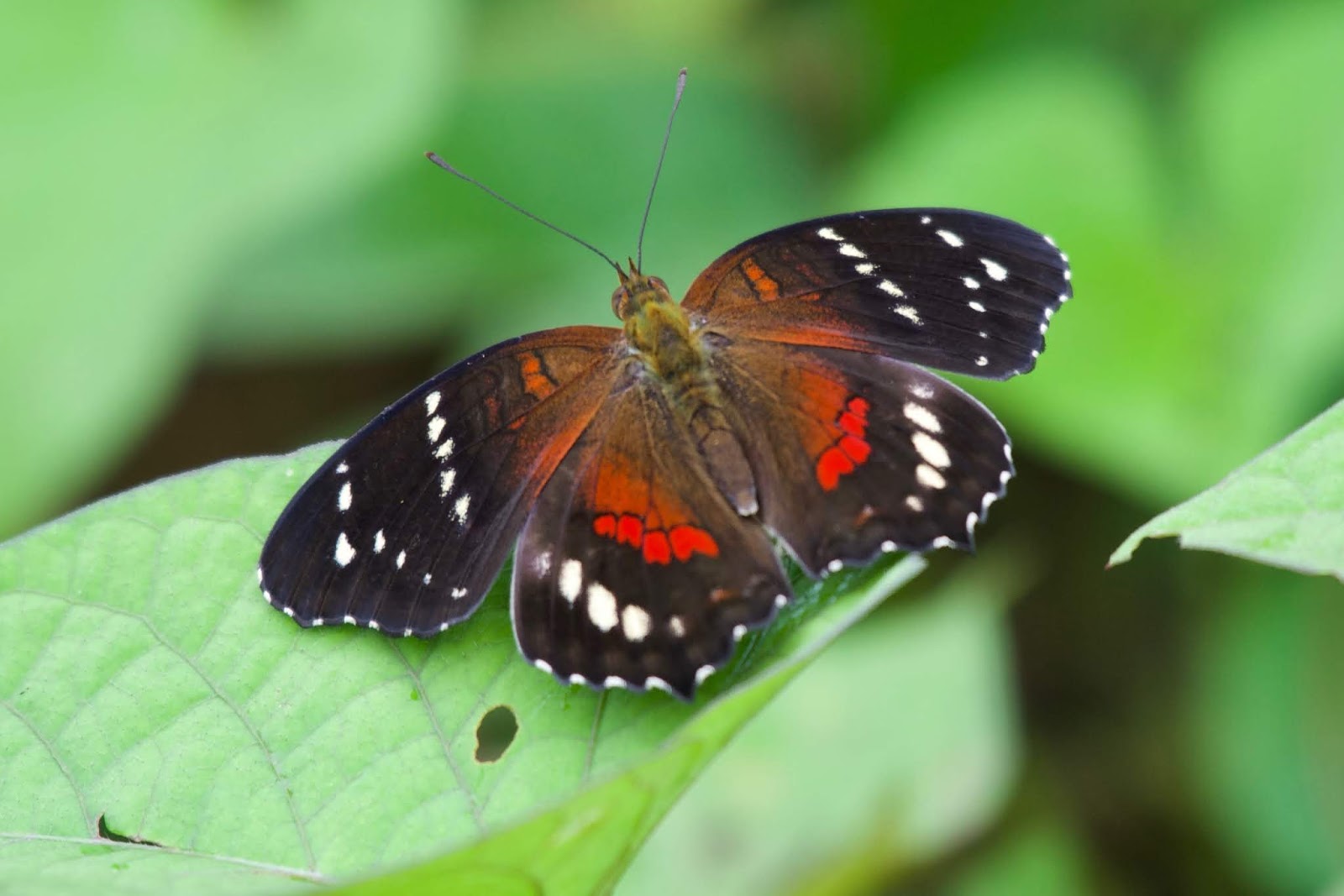
But there were not only avian highlights in Nuevo Vigía.  The open areas and the village itself were exceptionally good for butterflies, including rare and restricted species.  The whites, yellows, sulfurs and patches were exceptionally common, but the diversity was so high that I'm still trying to ID some of them.  My personal highlights were the Glorious Blue-Skipper (Paches loxus), the Zebra Lonwing (Heliconius charithonia) and my long-expected lifer Red Peacock (Anartia amathea) which is an specialty of eastern Panama.
Glorious Blue-Skipper
Zebra Longwing
Red Peacock
Short before midday, we left Nuevo Vigía in order to visit some sites along the Pan-American highway.  The short stops along the road produced more and more eastern Panama specialties, but certainly the highlights were a singing Red-billed Scythebill and a pair of dueting Black-capped Donacobius allowing great views.  Other highlights of these stops along the highway were Yellow-hooded Blackbirds, Large-billed Seed-Finch, Pied Water-Tyrants, Gray-breasted Crake and a mixed flock with rare White-chinned and Spot-fronted Swifts among others (check this eBird checklist).
Red-billed Scythebill
Black-capped Donacobius
Yellow-hooded Blackbird, adult male
Eventually, we reached the town of Yaviza, at the very end of the Pan-American highway.  This town is the gateway to Darien National Park and to hundreds of communities only reachable through piraguas.  We had lunch there and then spend the part of the afternoon looking for some other species.  The usual stakeout for Bicolored Wren (the graveyard) worked well... we saw a family group near its huge nest foraging at all levels and taking dust baths.  They have certainly prospered in the place, the same as the Carib Grackles that were quite common at town.  In fact, we saw more Caribs than Great-tailed Grackles and even saw juveniles and begging immatures all around.
Bicolored Wrens
Carib Grackle, female
It was a successful and long day, but was not over.  A good friend of us, also an expert birding guide resident in Darien, invited us a cup of coffee at his house.  Ismael "Nando" Quiroz (of Tamandua Nature & Photo Travel Panama) is almost a legend in the birding world of Darien and we know each other since long time ago, so paying him and his beautiful family a visit was a must.  Nando was free that weekend and agreed to join us the next day... I still had some targets and he knew some nice spots where we could try for them.  For some reason, I mentioned that I still needed Tropical Screech-Owl for my Year List... Nando knew a nearby spot where it was guaranteed.  Of course, we jumped into the car and started to drive.  Soon, a curious screech-owl was in the spotlight, perched along a live fence bordering pastureland with thousands of fireflies... what a show!
Tropical Screech-Owl
As planned, we met Nando again for breakfast the next day.  We visited several sites, including famous ones like the roads to Lajas Blancas and to El Salto, finding many eastern Panama specialties (and Year birds) like Red-throated Caracara, Barred Puffbird, Orange-crowned Oriole, White-eared Conebill, among others.  But for my main target of the trip, Nando took us to some rice fields by Quebrada Félix.  Of the five species of macaws in Panama, four of them are found in Darien province and, for some reason, one of them have eluded me all these years.  Supposedly common, the Chestnut-fronted Macaw is the smallest of the macaws found in the country.  Probably bad luck or simply short time birding the appropriate habitat explains why I still needed that bird for my Panama list, but I was decided to add it to my lists this year... so was Nando.  Soon, he heard a pair flying across the field and I was finally able to put my binoculars on them.  They were far away... but eventually we got much better views of other individuals (but no better photos).
Chestnut-fronted Macaws
With most of our targets in the bag, and running out of time, we said good-bye to Nando and started our journey back to Panama City.  Birding can not be easier when you have two excellent guides by your side.  Thanks guys for the GREAT weekend.  I recommend both for them if you want to visit Darien province of eastern Panama..., please don't hesitate to contact them!
Great White Longtail (Urbanus chalco) at Nando's backyard!