The mountains of central and eastern Chiriqui province (western Panama) are home to many endemics bird species and sub-species. After the pelagic trip off Punta Mala, I went with Rafael Luck to the town of San Felix (by the Pan-American highway) where Euclides "Kilo" Campos was already waiting for us (the rest of the T.P.  Gang went to the coclesian foothills of El Cope after the Umbrellabird). After a long day in the sea, we were so tired that we fell asleep after a couple of minutes. Still dark, very early the next morning (sunday, september 12th), we started our way to Cerro Santiago, entering the Ngöbe-Buglé reservation and passing first by the town of Hato Chamí. This 30 km-long road is famed because its toughness, only passable with strong 4WD vehicles with really high clearance... not a problem for the FJ Cruiser! After passing Hato Chamí, it was clear enough to see the spectacular landscapes with the subtle morning light... simply impressive. After two hard hours in the road, we reached a muddy part impassable for the cruiser! Can you imagine, we needed to push it to a less-muddy spot and then we began to hike along the very-muddy road (did I already mention that it was muddy?). We
  soon found the first birds along it: Purple-throated Mountain-Gem, Magnificent Hummingbird (a female) and Violet Sabrewings, Golden-crowned Warblers, Spotted Wood-Quail (only heard), Chestnut-capped Brush-Finch, Mountain Thrush and several Silvery-fronted Tapaculos heard in the understore. We were more or less at 1700 meters above sea level and I was feeling the effect of the reduced oxigen plus the steepy and muddy road. Anyway, I managed to follow Rafael and Kilo, finding more interesting species. Soon a female Selasphorus hummingbird showed up. It is supposed that the female Glow-throated
  Hummingbird is indistinguishable from that of the Scintillant Hummingbird, the former a panamanian endemic, the latter not expected there except during migration (photo courtesy of Rafael Luck). Then, Kilo found the other panamanian endemic, a flock of noisy Yellow-green Finches. These birds were shy, and were foraging higher in the trees than its relatives, the Yellow-thighed Finch of Costa Rica and western Panama. They were too far away, usually in dark spots, so I got only a marginal photo (but at least you can see that it is a Pselliphorus finch). We
  reached the antenna, supposedly the best place to find the Glow-throated Hummingbirds, but its favored bush were not flowered, and we only found more females! However, the last female that we saw, both perched and flying while feeding in some tubular flowers, showed conspicuous white tips to the tail (not buffy nor rufous as in the female Scintillant Hummingbird). It is significative? (WARNING: the next two photos are probably the worst photos of any bird ever published in the web; prepare yourself).
 Anyway, the spot was excellent for swifts,
  because they were flying at eye-level. We got two species there: the huge White-collared Swifts, and the less numerous Chestnut-colored Swifts. It was very hard to photograph them, but somehow I managed to get some pics. We also found around there Yellow-winged Vireo, Collared Whitestart, Black-and-yellow Silky-Flycatcher, Black-faced Solitaire, Sooty-capped and Common Bush-Tanagers and a singing Brown-billed Scythebill. In the way down, the sunny day quickly turned into a foggy and rainy one, but despite it we found a male White-tailed
  Emerald, many Western Wood-Pewees and a Mountain Elaenia. Under the rain, and laying on the muddy road, Kilo was able to remove from under the car a part that got stuck into the mud, and we descended the road very carefully because that part protected the axis of the vehicle. Sane and save, we were glad when we reached the lowlands in one piece (trust me, that road is scaring)... but also because we saw many special birds!
 Rafael and Kilo among the fog and the mud.
P.D.: I need some moral support in order to keep (or not?) my decision of not including the Glow-throated Hummingbird in my Life List. Let me know what you think in the comments.
 Gang went to the coclesian foothills of El Cope after the Umbrellabird). After a long day in the sea, we were so tired that we fell asleep after a couple of minutes. Still dark, very early the next morning (sunday, september 12th), we started our way to Cerro Santiago, entering the Ngöbe-Buglé reservation and passing first by the town of Hato Chamí. This 30 km-long road is famed because its toughness, only passable with strong 4WD vehicles with really high clearance... not a problem for the FJ Cruiser! After passing Hato Chamí, it was clear enough to see the spectacular landscapes with the subtle morning light... simply impressive. After two hard hours in the road, we reached a muddy part impassable for the cruiser! Can you imagine, we needed to push it to a less-muddy spot and then we began to hike along the very-muddy road (did I already mention that it was muddy?). We
  soon found the first birds along it: Purple-throated Mountain-Gem, Magnificent Hummingbird (a female) and Violet Sabrewings, Golden-crowned Warblers, Spotted Wood-Quail (only heard), Chestnut-capped Brush-Finch, Mountain Thrush and several Silvery-fronted Tapaculos heard in the understore. We were more or less at 1700 meters above sea level and I was feeling the effect of the reduced oxigen plus the steepy and muddy road. Anyway, I managed to follow Rafael and Kilo, finding more interesting species. Soon a female Selasphorus hummingbird showed up. It is supposed that the female Glow-throated
  Hummingbird is indistinguishable from that of the Scintillant Hummingbird, the former a panamanian endemic, the latter not expected there except during migration (photo courtesy of Rafael Luck). Then, Kilo found the other panamanian endemic, a flock of noisy Yellow-green Finches. These birds were shy, and were foraging higher in the trees than its relatives, the Yellow-thighed Finch of Costa Rica and western Panama. They were too far away, usually in dark spots, so I got only a marginal photo (but at least you can see that it is a Pselliphorus finch). We
  reached the antenna, supposedly the best place to find the Glow-throated Hummingbirds, but its favored bush were not flowered, and we only found more females! However, the last female that we saw, both perched and flying while feeding in some tubular flowers, showed conspicuous white tips to the tail (not buffy nor rufous as in the female Scintillant Hummingbird). It is significative? (WARNING: the next two photos are probably the worst photos of any bird ever published in the web; prepare yourself).Anyway, the spot was excellent for swifts,
  because they were flying at eye-level. We got two species there: the huge White-collared Swifts, and the less numerous Chestnut-colored Swifts. It was very hard to photograph them, but somehow I managed to get some pics. We also found around there Yellow-winged Vireo, Collared Whitestart, Black-and-yellow Silky-Flycatcher, Black-faced Solitaire, Sooty-capped and Common Bush-Tanagers and a singing Brown-billed Scythebill. In the way down, the sunny day quickly turned into a foggy and rainy one, but despite it we found a male White-tailed
  Emerald, many Western Wood-Pewees and a Mountain Elaenia. Under the rain, and laying on the muddy road, Kilo was able to remove from under the car a part that got stuck into the mud, and we descended the road very carefully because that part protected the axis of the vehicle. Sane and save, we were glad when we reached the lowlands in one piece (trust me, that road is scaring)... but also because we saw many special birds!Rafael and Kilo among the fog and the mud.
P.D.: I need some moral support in order to keep (or not?) my decision of not including the Glow-throated Hummingbird in my Life List. Let me know what you think in the comments.


 tip of the Azuero Peninsula in central Panama. Worldbirder Björn Anderson kindly organized the trip and invited me (I'm so grateful by the way) and other four birders: Kenneth Allaire, Gonzalo Horna, Darién Montañéz and Rafael Luck. My journey started friday, when Rafael picked me up after work around 3:00 PM. We were loaded with fish leftovers, tuna cans and popcorn (the ingredients of the chum) and with all the excitement of being part of that trip. We all met at the charming town of Pedasí, where we stayed for the night to meet very early in the morning our captain Jeff and his seaworthy assistant, Armando. We followed them to


 We saw four Oceanites storm-petrels that we are calling Wilsons' (thank you Björn for noticing it). The commonest storm-petrel was the

 At 8:30 AM, Björn found the main target of the trip: a Tahiti Petrel (N 07º 20.002' W 079º 36.910). I hurried enough to see the clear dark-and-white pattern of the underparts and to appreciate its agile and swift flight above the sea


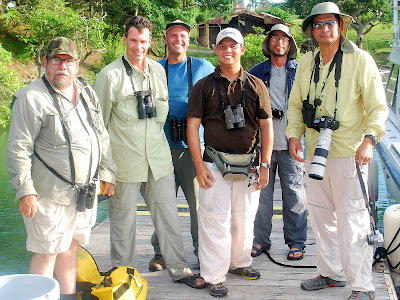 The self-denominated T.P. (Tahiti Petrel) Gang; from left to right: GH, BA, KA, JA, DM and RL.


+female.JPG)


 Posts
Posts