Saturday, August 14, 2010

Odd kingbirds photos

During a visit to the Metropolitan Natural Park (PNM, in Panama City) last tuesday, agust 10th, I found a flock of more or less 20 Tyrannus Kingbirds. I took only four (4) photos, showing three different individuals. All the three birds in the photos show pale heads (specially the throat) with contrasting dark "mask" (including the last photo of a semi-concealed bird), and yellow underparts including the chest, which have little -if any- olive on it. Also, some photos show pale edges in the coverts, notched tails and smallish bills. These marks suggest White-throated Kingbirds, Tyrannus albogularis (never reported out of South America, but migratory in its amazonian distribution), instead of the expected Tropical Kingbirds. Two of these photos were published in XENORNIS and then Ken Allaire kindly posted to ID Frontiers on my behalf with part of the text that I e-mailed him:
"Last tuesday I saw this flock of kingbirds at the highest lookout of the PNM [135 meters above sea level]. In the field I thought it was weird to see all these TK's [Tropical Kingbirds] together (around 20) and all seemed to be quite small, resembling a flock of Eastern Kingbirds. They were eating lots of fruits, but also flycatching. The only reason why I took the photos was precisely that they looked "pretty", you know, with a nice yellow colour of the underparts, including the chest and not like usual TK's (with olive wash to the chest and gray heads). They did not vocalized."
I'm now showing all the original pictures, each one followed by one or two cropped versions. I did not change colours, contrast or sharpness. Feel free to comment about the identity of these birds or follow the discussion at ID Frontiers.


Wednesday, August 11, 2010

Mammals of Metro Park

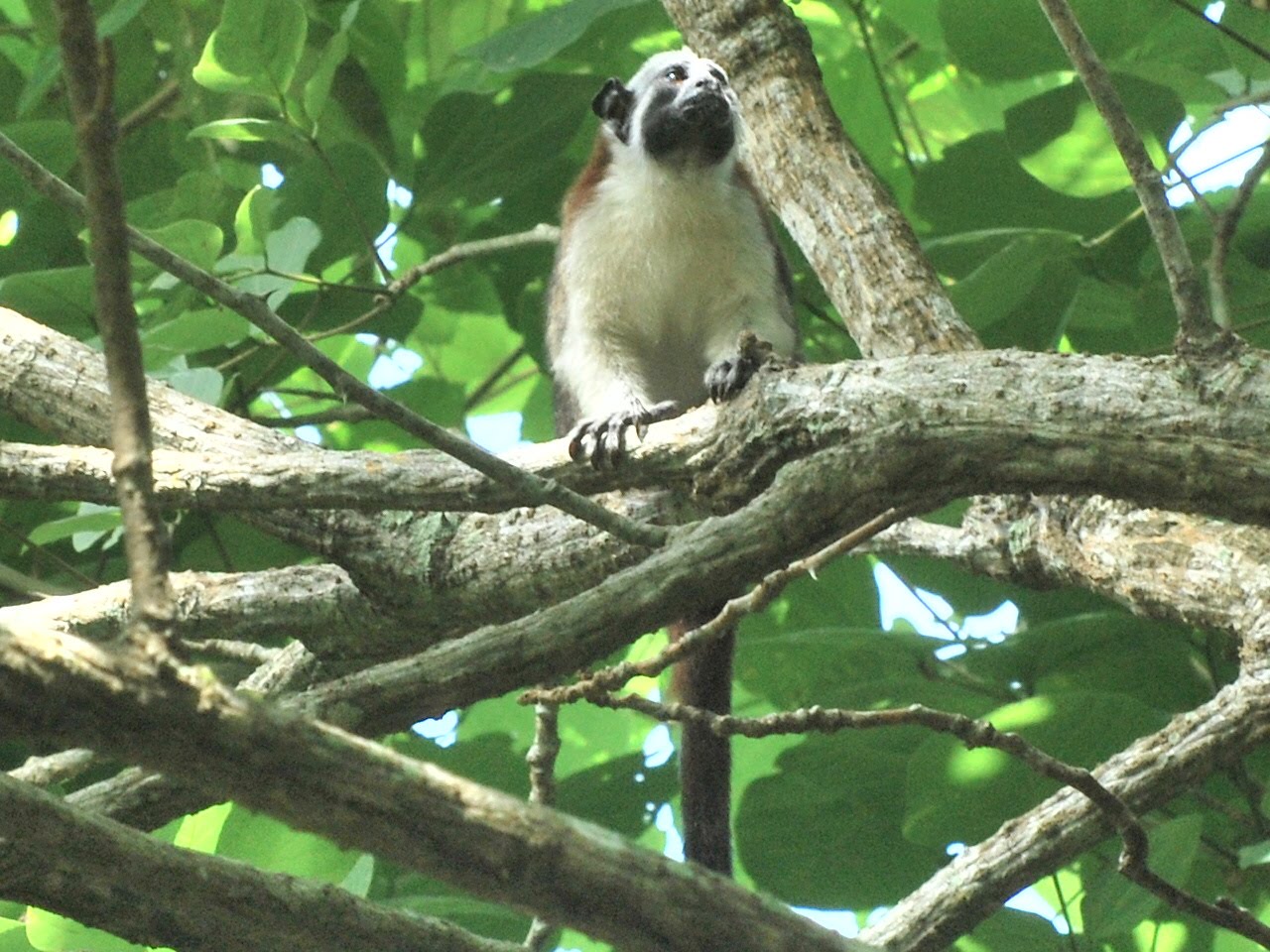
I always have been lucky finding mammals in the Metropolitan Natural Park, and yesterday was not the exception. After all, I think that Panama in general is a good country to find mammals... and it seems that I'm not the only one that think this. I have been reading some comments in the web of how easy it was to some guys to find wildlife in Panama (including mammals) and now I even found offerings of mammals trips to Panama. Well, back to Metro Park, most of the mammals species that I found yesterday were at the lookout (that was full of birds too). Surely, the abundance of fruits had something to do with that. The first species that I saw was a Central American Agouti (Dasyprocta punctata) that quickly ran to cover. They are pretty common in the park, and you can find many individuals along the different trails, sometimes in loose herds. Little after that, I heard a noise close to me. I turned back, finding a Variegated Squirrel (Sciurus variegatoides) that was scolding me while eating a seed. These squirrels are very common in all sort of habitats, including urban areas and open forests. This is the common and familiar squirrel of Panama City and many other cities in the country, exhibiting a great variation in patterns and colours among the subspecies. They share the park with the Red-tailed Squirrels (Sciurus granatensis) that I have found several times there (but not yesterday), usually in wetter and/or darker sites, like along La Cieneguita trail. It is always entertained to see these acrobatic creatures to move effortless through the branches. I also found a family group of White-nosed Coaties (Nasua narica), with an adult (surely a female) and three cubs. The males usually wander alone, the reason of their spanish name "Gato Solo" (lonely cat). These racoons-relatives are as happy in the ground as climbing the trees, as you can see in the photo (one of the cubs, the ear and the tail of the other two cubs also appear in the photo). But the stars of the show were the Geoffrey's Tamarins (Saguinus geoffroyi). A troop of nine tamarins got very close to me while making their bird-like calls. These squirrel-like monkeys are fortunately still pretty common in the right habitat, including this park. I even saw a tamarin with a baby on her back. They did not care about the Double-toothed Kite that was following them. In contrast, they overturned all the attention to another mammal that I had left unnoticed: a Brown-throated Three-toed Sloth (Bradypus variegatus) in a Cecropia tree. What can I say about them? These animals are real survivors, a big success of nature. You can see in the photo the three claws of the forearm, and the masked look that distinguishes this species of the Hoffmann's Two-toed Sloth (Choloepus hoffmanni), also found in the park (but again, not yesterday). It was a great day, both for birds and mammals. In my way out I heard the characteristic howl of a troop of Mantled Howlers Monkeys (Alouata palliata) and found this footprint that I'm trying to figure out to whom it belongs. Any idea? (that's my 67mm lens cap for comparison)

Birds bonanza in Metro Park

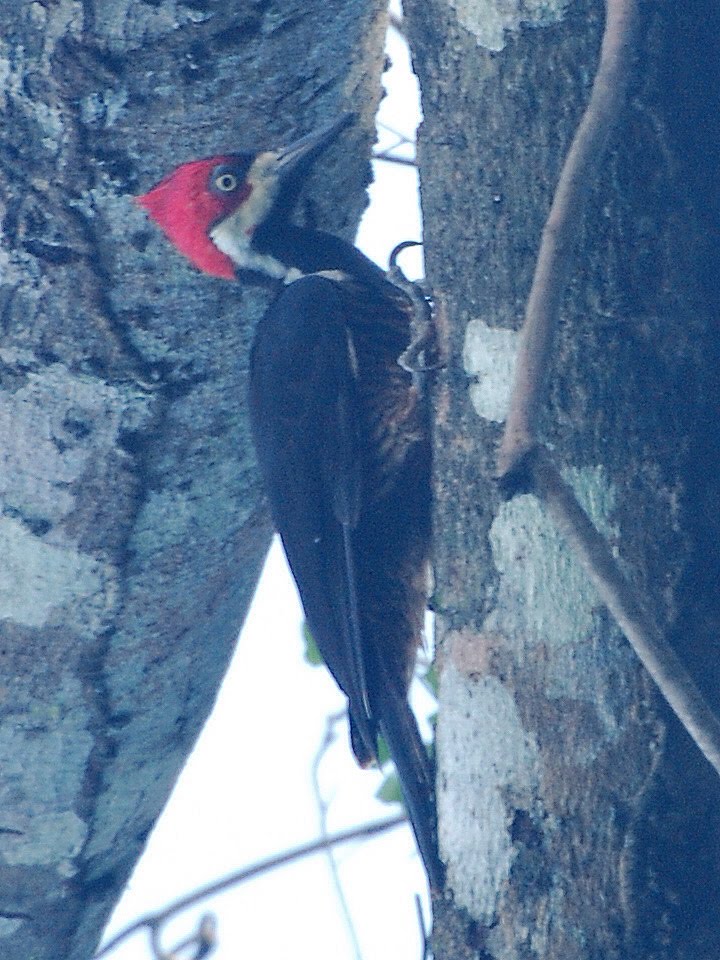
Yesterday, I went to the Metropolitan Natural Park following the directions of Osvaldo Quintero who told me that the trees at the lookout were full with fruits and birds since the last week. I just wanted to see what it was all about up there so my plan was to walk without resting all the way to the lookout, which is at 135 meters above sea level in Cedro hill. I took the Mono Tití trail because is wider and fresher than La Cieneguita trail, which starts behind the rangers' station. Of course, my plan of walk directly to the lookout without stopping on route was quickly interrupted due to bird activity. Close to the first lookout (in the way up), a dead trunk attracted three different couples of birds: one of Crimson-crested Woodpeckers, other of Lineated Woodpeckers and a pair of Orange-chinned Parakeets excavating a nest in a termite nest... all in the same trunk. Both pairs of woodpeckers were working in different branches, ripping apart and throwing huge pieces of bark from the trunk while looking for worms and other insects, without agressions or shouts, everything in harmony. The parakeets stopped what they were doing to have a look at me, they are so curious! The understory that surrounded some fallen branches and roots of the dead trunk was also alive in birds. A pair of Fasciated Antshrikes were inspecting every corner while a Dusky Antbird sang from a cover. It is fascinating how a dead trunk have so many niches to occupy. Back on route, I started to hear the flocks of birds while approaching the lookout. And then I realized why... many of the trees bordering the lookout were full in fruits, just like Osvaldo told me. Many species were taking advantage of this, not only the frugivores, but also many insectivores as well. I also noticed lots of butterflies and other insects in the area, and many mammals too (more about them in my next post). I simply sat down and waited. The birds appeared in waves. First a flock (yes, a flock) of Tropical Kingbirds, more or less 20 birds eating fruits and flycatching, accompanied by one, possible two Dusky-capped Flycatchers. Also, many Yellow-green Vireos were feeding at the trees, probably preparing themselves for their journey to South America. The frugivores were represented by Blue-gray, Palm, White-shouldered and Plain-colored Tanagers and also Blue Dacnises. Even a Squirrel Cuckoo showed up, also eating fruits! Then, I found a single Double-toothed Kite nicely perched just below the canopy. At first, it was far away, but got closer while following a troop of Geoffrey's Tamarins. That was not the first time that I see those kites following monkeys. If you have any doubt about why they are called double-toothed, check the close-up that I made of its head. A mixed flock of swifts and swallows patrolled the air over the lookout, with Short-tailed and Vaux's Swifts, and Gray-breasted Martins. Sometimes, they were so close that I thought they were going to hit me! I spent more or less three hours at the lookout! In the way out, I checked the spot of the Common Potoo reported elsewhere, finding only the downy fledging acting already as an adult potoo... it is not the cuttest thing?

Tuesday, August 10, 2010

What is wrong with this photo?

I took this photo today from the lookout of the Metropolitan Natural Park (135 meters above sea level) more or less at 9:00 AM. It shows the old part of Panama City, plus the Pacific entrance of the Canal. Something is missing, don't you think? Maybe the next photo, taken 20 minutes later, will help you notice what I mean:
Suddenly, the Amador's Coastway and both Naos and Perico Islands appear. That is because the first photo shows a dense SMOG curtaine over the city. Many panamanians think that air pollution is a problem of big cities like Mexico DF or Los Angeles, but the reality is that it is our problem too. Think about this: Panama's government ratified the Kyoto Protocol (1999), the United Nations Framework Convention on Climate Change (1995) and the Vienna Convention, nevertheless we have been unable to reduce our CO2 emissions since then (see the graphic):Most part of our CO2 emissions come from the combustion of liquid fuels (89%), followed by that of the cement manufacturing with 6%. Not only the CO2 is a problem. We produce each year approximately 1.044.000 metric tons of non-CO2 air contaminants (specially carbon monoxide emissions)... and that is a lot! It is time to inform ourselves in how to reduce our CO2 emissions and start to change our way of life for the benefit of our children. After all, we all want a clear sky over our heads, don't we? (the last photo was taken one hour after the second one).Source: Earthrends.wri.org.

Saturday, August 7, 2010

Breeding shorebirds in Aguadulce

OK, it is not that there were breeding shorebirds in the Aguadulce Salinas (saltponds) during my last visit two days ago with Osvaldo Quintero, Euclides "Kilo" Campos and my nephew Michael (except for one species); but we did found many species still wearing part of its alternate (or breeding plumage). Panama is a very important stop for those holartic breeders in its way to the southern hemisphere, and the saltponds in Aguadulce have been historically one of the best sites in Panama to look for them. It is still too early for most of the species, but we found a nice collection of them scattered in the ponds. The first species we saw were the almost present Black-necked Stilts. These elegant birds were noisier than usual, and soon we noticed why: we found at least three different downy fledglings at the ponds, close to screaming adults. They are known to breed in this place since 14 years ago, but this is the first time that I actually see a chick. It was great to watch the little birds trying to look like the sandy soil where they were resting. I suppose that the stilts are still doing fine. Not many shorebirds species breed in Panama. Apart of the stilts, only some plovers breed in Panama... so it is not easy to find nests or chicks in our coast, despite they are full of birds. As you guess, the stilts where not the only shorebirds we found. The most common shorebirds were the Semipalmated and the Western Sandpipers. Several hundred were feeding in scattered flocks, sometimes together. Notice that the Western Sandpiper that I'm picturing here still had part of its rusty crown and scapulars. Apart of these, the spotting along sides and the dropped tip of the bill separate this bird of the similar Semipalmated Sandpiper. We also found a flock of Short-billed Dowitchers, with its distinctive feeding technique. Again, some of them were in alternate plumage. Taking into account the amount of ruddy on its underparts, these dowitchers seemed to be of the hendersoni subspecies, which breeds in central and western Canada. This is the subspecies listed by Ridgely, in the Guide to the Birds of Panama, as the one that earlier arrives to Panama (a group of 25 birds seen by the end of july precisely in Aguadulce, back in 1975). We found smaller numbers of Least Sandpipers, usually close to flocks of the more abundant peeps. They were easily recognized by their smaller size and distinctive darker back. With good light, and close enough we even saw the yellow legs. And talking about yellow legs, the only species we saw was the Lesser Yellowlegs. Despite we didn't have Greater Yellowlegs to compare with (and the fact that the birds didn't call), we were able to id them by noticing its straight and all-black bill. In the photo appears one individual, accompanied by a Western Sandpiper. About the plovers, the only species that we found was precisely one of those that does not breeds in Panama, but anyway is one of the most common, the Semipalmated Plover. We usually see drab brown birds with its winter plumage, so it is always nice to watch a bright individual like the one pictured here. Great collection of shorebirds... I can't wait to visit this place again at the peak of the migration season (in October).

Friday, August 6, 2010

Hot day in the Pacific slope

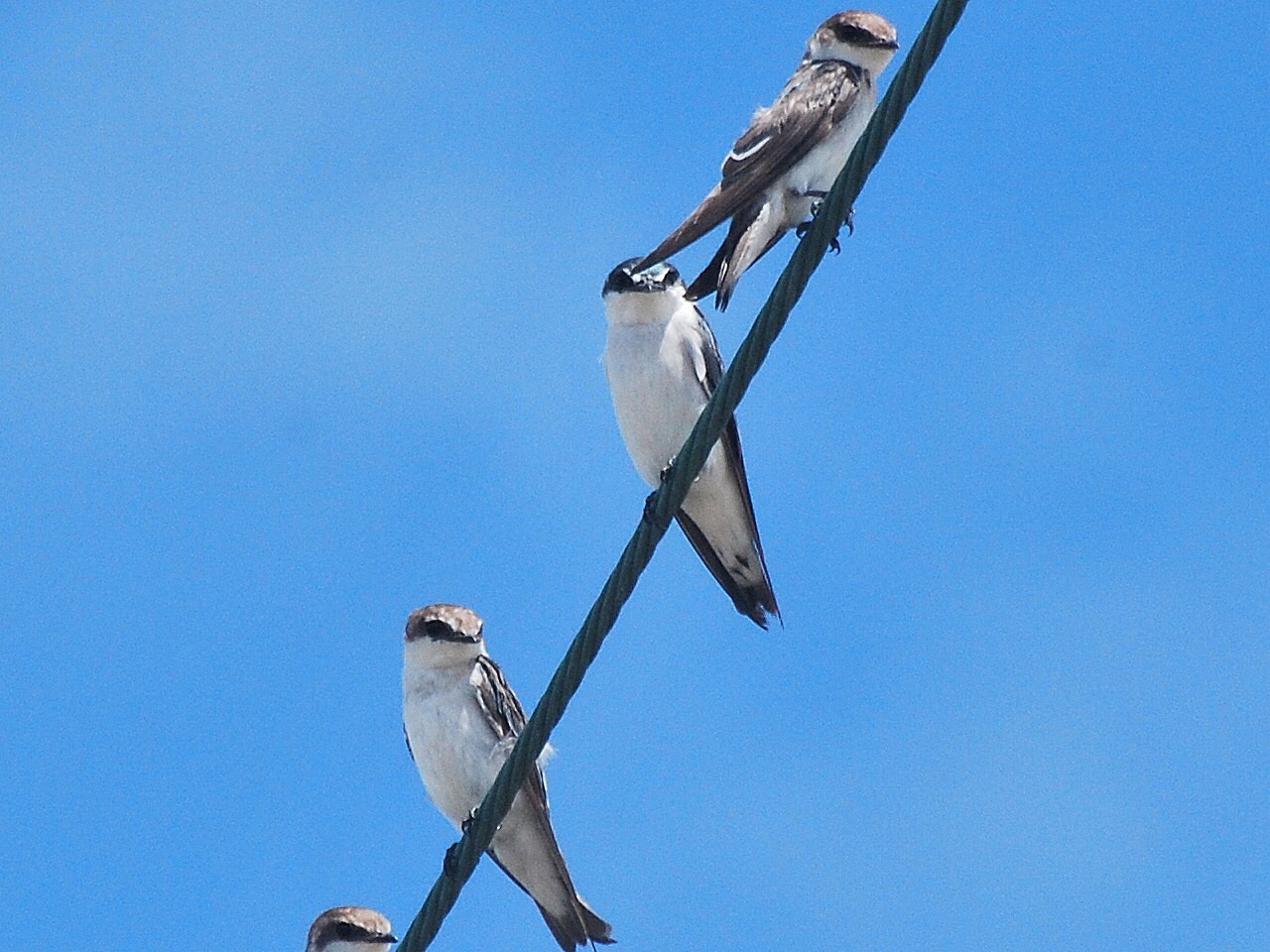
I went yesterday, with Osvaldo Quintero, Euclides "Kilo" Campos and my nephew Michael, to a trip along the Panamerican highway to the Cocle province (central Panama, pacific side) in a quest of some specialties of the area. We did many stops along the route looking for specific targets. Our first stop was at the now-famous El Chiru in order to find the very local Grassland Yellow-Finch. The day was pretty hot, but the activity in the fields soon proved to be quite good. In a huge pasture, Kilo found our first target right in the middle of it. A group of at least five Grassland Yellow-Finches were feeding in the tall grass, showing themselves only for few seconds each time. The patch of grass where they were feeding was close enough to have great looks at the birds with our binoculars, but frustrating far for our cameras! Despite all our efforts, we were not able to get any closer, and our photos only show a pack of yellow pixels in the middle of the grass (a yellow-finch facing to the other side)... but is all what we got, by now. We were cautious recognizing each single bird because we also found Lesser Goldfinches in the same pasture, and the females can look similar to the yellow-finches, specially at the distance. Other species in the same field were Variable, Ruddy-breasted and Yellow-bellied Seedeaters, Blue-black Grassquits, Red-breasted Blackbird and Eastern Meadowlarks. Time for the next target, we headed to the Aguadulce Salinas (saltponds). Our plan was to search at the mangroves for the White-winged Dove, a bird that somehow have eluded Osvaldo so far. Of course we took our time to inspect the saltponds in the way to the mangroves, finding many species of shorebirds, some of them still with part of its alternate plumage (but more on them in my next post), a huge group of Black Skimmers resting, a flock of Mangrove Swallows in different ages, and three terns species: Gull-billed, Sandwich and Least. The Least Tern was alone, gently picking food of the surface of one of the ponds. Again, we were extremely cautious in separating it of the similar Yellow-billed Tern, which have been reported from that place. The black tip of the yellow bill and the little amount of black in the primaries confirmed our id. Back in the road, we reached the mangroves along the road to El Salado where we stopped in several places. In one of them, Kilo obtained an answer to his playback and soon a pair of White-winged Doves showed themselves. What a delicate creature, a very attractive dove that in Panama only lives close to the coast in the Gulf of Parita. It reappears in northern Costa Rica to extend all the way northward into the United States (the same distribution of the Common Ground-Dove). In the way out, we found a Common Black-Hawk in a wire, preening and taking a sunbath. The race of the Pacific coast used to be a different species, the Mangrove Black-Hawk. We then followed the Panamerican highway looking for an Aplomado Falcon. We drove many miles, but we simply were not lucky with that one. Anyway, we saw tons of raptors, as usual in that habitat, including Osprey, White-tailed and Pearl Kites, Short-tailed, Roadside, Gray, Savanna and Common Black Hawks, Crested and Yellow-headed Caracaras and American Kestrels. After a tasty meal in Divisa, we drove back to Penonome, where we took the road to El Gago. We failed to locate the Yellowish Pipits that reside in those fields, but found many Crested Bobwhites, some Mourning Doves, got close views of three vultures species, including the Lesser Yellow-headed Vulture pictured above and a pair of Plain-breasted Ground-Dove (male and immature) that stayed enough for a photo. It was a great day for birding, and long too... we spend 13 hours in the field looking for birds!

Wednesday, August 4, 2010

My balcony list

Not always you can get out to a pristine habitat to chase rare birds. That is why quite often I go to my balcony just to see what can I find to deal with my birding abstinence syndrome (I live in a fourth floor in the center of Panama City). Usually I get the same common species, but sometimes I get surprises. I keep a balcony list where I include all the birds heard or watched while I am standing at my balcony. It is different to a backyard list because it is not restricted to a backyard (in anycase I don't have one)... I count all the birds that I can identify in my field of view, which includes part of the Metropolitan Natural and Camino de Cruces National Parks and the Ancon Hill as well (all are distant forested areas). I also have some photos showing the birds on or over man-made structures like telephone posts, wires, antennas, communication towers, etc... (that is the idea, to show them in an urban environment). So here is, my balcony list:

Magnificent Frigatebird
Great Egret
Wood Stork
Black-bellied Whistling-Duck
Black Vulture
Turkey Vulture
Osprey
White-tailed Kite
Broad-winged Hawk
Short-tailed Hawk
Swainson's Hawk
Zone-tailed Hawk

Yellow-headed Caracara
Anhinga
Southern Lapwing
Laughing Gull
Rock Pigeon
Pale-vented Pigeon

Ruddy Ground-Dove
Orange-chinned Parakeet
Blue-headed Parrot
Red-lored AmazonYellow-crowned Amazon
Common Nighthawk
Chimney Swift
Short-tailed Swift
Rufous-tailed HummingbirdRinged Kingfisher
Red-crowned Woodpecker
Eastern Wood-Pewee
Acadian Flycatcher
Great Kiskadee
Social Flycatcher
Streaked Flycatcher
Tropical Kingbird
Gray Kingbird
Fork-tailed FlycatcherGray-breasted Martin
Southern Rough-winged Swallow
Bank Swallow
Cliff Swallow
Barn Swallow
House Wren
Clay-colored Thrush
Tropical Mockingbird
Yellow Warbler
Blackburnian Warbler
Yellow-crowned Euphonia
Blue-gray Tanager
Palm Tanager
Crimson-backed Tanager
Great-tailed Grackle
House Sparrow

Fifty-three species in total by now, but expect additions to this list in the years to come. In the other hand, if I do not find birds from the balcony, it is always nice to enjoy the sunset every afternoon.

Tuesday, August 3, 2010

Grackles, changos or talingos? Myths and truths

If you visit Panama, probably one of the very first birds you will see will be a Great-tailed Grackle (certainly only second after a Black Vulture). Like many other grackles species, the Great-tailed is an aggressive and very adaptable bird that triumphs in man-made habitats... like our cities. Many of the citizens that does not ignore them, despice them arguing that they are evil and will readily kill any other bird if necessary or only for fun. The truth is that these social birds are real survivors, a complete success of nature that simply knew how to take advantage of us and our food sources. Here in Panama many myths exist about these birds, some with true basis, many others without it.

M. Those birds are talingos. Despite there is not such a thing like a consensus of common names in spanish, the truth is that our grandpas readily recognize the differences among anis (the true talingo) and grackles, which they call changos. Probably the confusion arose by the similarity in color (despite the anis are dull-black, not glossy-black like the males grackles) and the careless observations of the first citizens that named the grackles.
M. They were introduced to Panama during the construction of the canal to control the insects. Panama is part of the natural range of these birds, which extends from southern United States to northwest Peru. In any case, these birds are omnivorous and most of their diet (60%) consist of vegetal matter, not insects. Definitively, they became abundant in and around Panama City (and other cities) in the same way the city became bigger, offering more food sources to the grackles and are naturally expanding their range northward into the United States since the 1960s.
M. They are crows, or at least related to them. The grackles have nothing to do with crows or its relatives the jays. They belong to the Icteridae family, which also includes the more colourful meadowlarks, oropendolas and orioles, but also many other species of blackbirds. Again, the completely black plumage of the adult male brought confusion.
M. The black birds are changos (or talingos), and the brown ones accompanying them are cascas. Casca is the common name of other common bird in the city: the Clay-colored Thrush. Since many citizens recognize the changos as complete black birds, then the obvious conclusion is that the brown ones must be other thing. The truth is that grackles exhibit sexual dimorphism... males and females are not alike. The female is essentially smaller, with dark-brown back and buffy-brown eyebrow and underparts. The juveniles are like the females.
M. The changos (grackles) finished with the talingos (anis). This is a common myth among our grandpas. Both, grackles and anis, are pretty common in their respective habitats. The problem is that most citizens do not often visit the correct habitat for anis, because is not longer found close to the city. Many others simply don't know how to tell apart an ani from a grackle.
M. The changos call the rain. This is due to people trying to explain the bill-up courting display of the males, which usually occurs during the rainy season in Panama and elsewhere, so it is not infrequent to see rain just after seeing this display... or any other!
M. Grackles are cold-blood murderers. The truth is that the grackles do kill smaller birds or other animals, but only to get a meal or to eliminate competition (as in feeders, for example). Is a natural behavior and part of the reason why they are so successful. They are not "mean birds" or "murderers". If you are having problems with grackles at your feeders try to use a tube feeder with short perches or sue feeders requiring birds to cling upside-down. This will discourage the grackles to feed in them. Do not offer food in wide and open platforms or on the ground.
M. They are fearless birds that will not hesitate to attack you without warning. They do are fearless... when protecting their youngs. If you are attacked by grackles, then probably you ignored the signs that were indicating that you was approaching a nest with young birds, like alarm calls and screamings.
So, next time you see one of these birds, try to appreciate how well-adapted and smart are them, its shiny plumage and its social skills. If you know any other myth about these birds let me know in the comments.
This post has been submitted to Bird Photography Weekly # 101.